Antigravity Remote Control


Is this your AI tool? Claim it today.
Verify ownership, manage your profile, and unlock growth features.
Antigravity Anywhere with Remote Control by Google Antigravity offers groundbreaking remote manipulation of antigravity devices, enabling users to control futuristic hardware from a distance with precision and ease. Ideal for researchers, engineers, and innovators in advanced technology sectors, this tool transforms how we interact with levitating mechanisms in real time.
Description
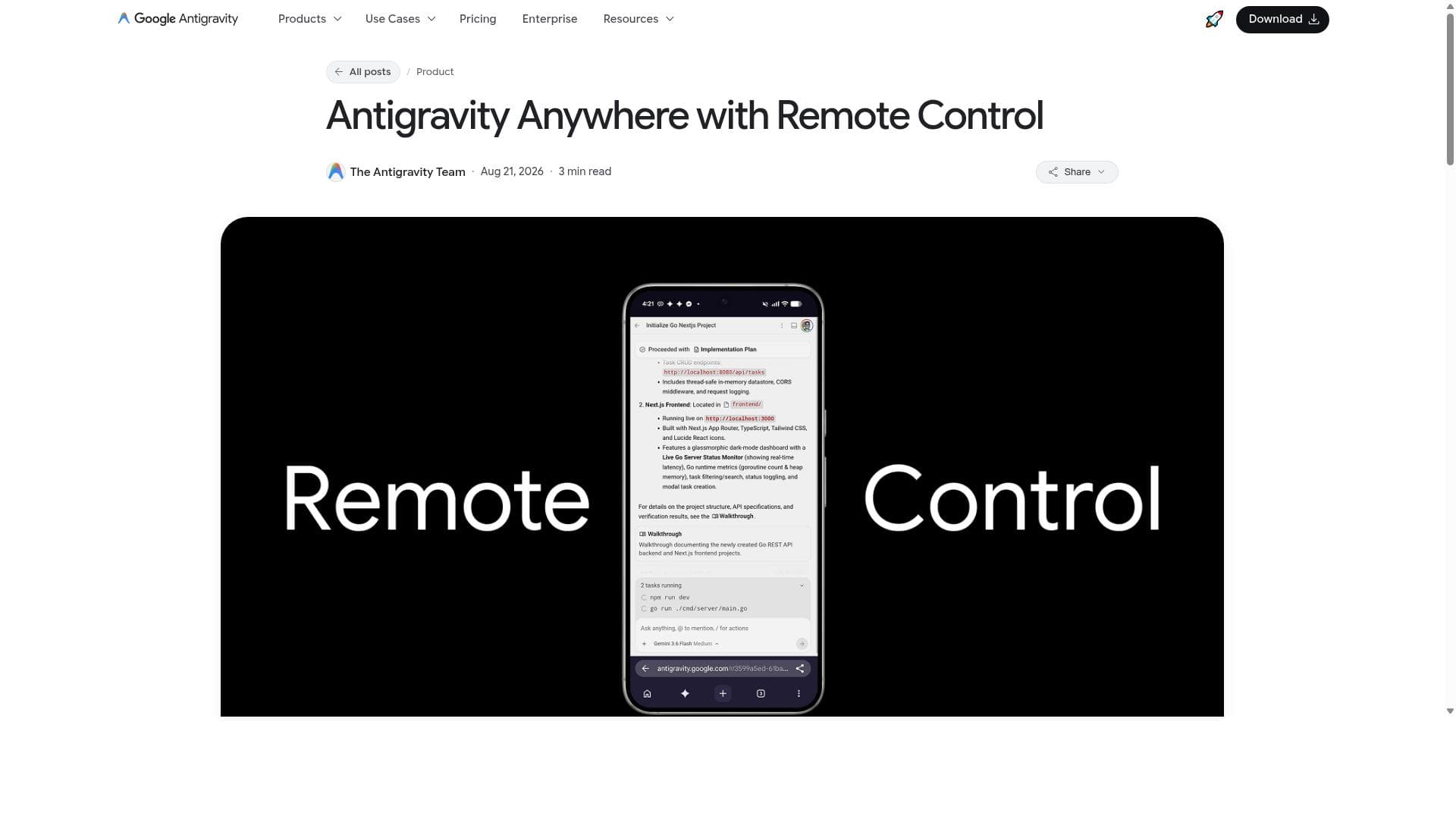
Antigravity Remote Control lets you monitor and drive Antigravity coding sessions from any web browser. Keep full local context, credentials, and build tools on your primary workstation while reviewing plans, approving commands, and receiving push alerts on the go.
Detailed Description
Antigravity Anywhere with Remote Control is an innovative technology developed and showcased by Google Antigravity that revolutionizes the way users interact with antigravity devices. At its core, this technology enables remote control and manipulation of antigravity mechanisms from a distance, opening new frontiers in user interaction and control over futuristic hardware. By leveraging advanced remote communication protocols and precise control algorithms, Antigravity Anywhere with Remote Control allows users to operate antigravity-enabled devices without the need for physical proximity, thereby enhancing convenience, flexibility, and the overall user experience. The key features of this technology include seamless remote control capability, which empowers users to manipulate antigravity devices from virtually anywhere. This is achieved through a sophisticated interface that communicates with the antigravity hardware, allowing for real-time adjustments and commands to be sent remotely. The system enhances user interaction by providing intuitive controls that can manage various aspects of the antigravity mechanisms, such as lift, orientation, and movement. This level of control is critical for applications where direct physical interaction is impractical or impossible, such as in hazardous environments, remote exploration, or advanced robotics. Antigravity Anywhere with Remote Control is particularly suited for industries and users that require precise and flexible control over antigravity technology. This includes research institutions exploring novel physics applications, aerospace companies developing next-generation propulsion systems, and entertainment or virtual reality sectors aiming to create immersive experiences with levitating objects. Additionally, it benefits developers and engineers working on prototyping and testing antigravity devices, as the remote control feature allows for safer and more efficient experimentation. While specific pricing and plans for Antigravity Anywhere with Remote Control have not been publicly disclosed by Google Antigravity, it is expected that access to this technology will be integrated into broader Google Antigravity offerings or available through partnerships and licensing agreements. Interested users and organizations should monitor official Google Antigravity channels for announcements regarding availability, pricing tiers, and potential subscription models. When compared to alternative solutions, Antigravity Anywhere with Remote Control stands out due to its integration with Google's advanced technology ecosystem and its focus on remote manipulation of antigravity devices, a niche yet rapidly evolving field. Unlike traditional control systems that require physical presence or wired connections, this technology offers wireless, flexible, and precise control, which is a significant advantage in futuristic applications. However, since antigravity technology itself is still in developmental stages, alternatives may be limited or less sophisticated, making Google's solution a leading contender in this space. Notable limitations and considerations include the current experimental nature of antigravity technology, which means that the remote control system may require specialized hardware and may not yet be widely accessible to the general public. Additionally, the effectiveness of remote control can be influenced by factors such as signal range, environmental interference, and device compatibility. Users should also consider the learning curve associated with mastering the control interface and the potential need for integration with existing systems. As the technology matures, these limitations are expected to diminish, paving the way for broader adoption and more robust applications.
Tool Features
- Remote control capability for antigravity devices
- Enables manipulation of antigravity mechanisms from a distance
- Enhances user interaction with futuristic technology
Description
Antigravity Anywhere with Remote Control by Google Antigravity offers groundbreaking remote manipulation of antigravity devices, enabling users to control futuristic hardware from a distance with precision and ease. Ideal for researchers, engineers, and innovators in advanced technology sectors, this tool transforms how we interact with levitating mechanisms in real time.
Antigravity Remote Control lets you monitor and drive Antigravity coding sessions from any web browser. Keep full local context, credentials, and build tools on your primary workstation while reviewing plans, approving commands, and receiving push alerts on the go.
Detailed Description
Antigravity Anywhere with Remote Control is an innovative technology developed and showcased by Google Antigravity that revolutionizes the way users interact with antigravity devices. At its core, this technology enables remote control and manipulation of antigravity mechanisms from a distance, opening new frontiers in user interaction and control over futuristic hardware. By leveraging advanced remote communication protocols and precise control algorithms, Antigravity Anywhere with Remote Control allows users to operate antigravity-enabled devices without the need for physical proximity, thereby enhancing convenience, flexibility, and the overall user experience. The key features of this technology include seamless remote control capability, which empowers users to manipulate antigravity devices from virtually anywhere. This is achieved through a sophisticated interface that communicates with the antigravity hardware, allowing for real-time adjustments and commands to be sent remotely. The system enhances user interaction by providing intuitive controls that can manage various aspects of the antigravity mechanisms, such as lift, orientation, and movement. This level of control is critical for applications where direct physical interaction is impractical or impossible, such as in hazardous environments, remote exploration, or advanced robotics. Antigravity Anywhere with Remote Control is particularly suited for industries and users that require precise and flexible control over antigravity technology. This includes research institutions exploring novel physics applications, aerospace companies developing next-generation propulsion systems, and entertainment or virtual reality sectors aiming to create immersive experiences with levitating objects. Additionally, it benefits developers and engineers working on prototyping and testing antigravity devices, as the remote control feature allows for safer and more efficient experimentation. While specific pricing and plans for Antigravity Anywhere with Remote Control have not been publicly disclosed by Google Antigravity, it is expected that access to this technology will be integrated into broader Google Antigravity offerings or available through partnerships and licensing agreements. Interested users and organizations should monitor official Google Antigravity channels for announcements regarding availability, pricing tiers, and potential subscription models. When compared to alternative solutions, Antigravity Anywhere with Remote Control stands out due to its integration with Google's advanced technology ecosystem and its focus on remote manipulation of antigravity devices, a niche yet rapidly evolving field. Unlike traditional control systems that require physical presence or wired connections, this technology offers wireless, flexible, and precise control, which is a significant advantage in futuristic applications. However, since antigravity technology itself is still in developmental stages, alternatives may be limited or less sophisticated, making Google's solution a leading contender in this space. Notable limitations and considerations include the current experimental nature of antigravity technology, which means that the remote control system may require specialized hardware and may not yet be widely accessible to the general public. Additionally, the effectiveness of remote control can be influenced by factors such as signal range, environmental interference, and device compatibility. Users should also consider the learning curve associated with mastering the control interface and the potential need for integration with existing systems. As the technology matures, these limitations are expected to diminish, paving the way for broader adoption and more robust applications.
Frequently Asked Questions
What is Antigravity Anywhere with Remote Control?
Antigravity Anywhere with Remote Control is a technology developed by Google Antigravity that allows users to remotely control and manipulate antigravity devices from a distance, enhancing interaction with futuristic antigravity mechanisms.
How much does Antigravity Anywhere with Remote Control cost?
Google Antigravity has not publicly disclosed specific pricing or plans for Antigravity Anywhere with Remote Control. Pricing details are expected to be announced through official channels or as part of broader Google Antigravity offerings.
Who is Antigravity Anywhere with Remote Control best for?
This technology is best suited for researchers, engineers, aerospace developers, and innovators working with antigravity or levitation technologies, as well as industries requiring remote manipulation of advanced hardware in fields like virtual reality, robotics, and scientific exploration.
What are the main features of Antigravity Anywhere with Remote Control?
Key features include remote control capability for antigravity devices, real-time manipulation of antigravity mechanisms from a distance, and enhanced user interaction through an intuitive control interface designed for futuristic technology.
Does Antigravity Anywhere with Remote Control offer a free trial?
There is currently no information available regarding a free trial for Antigravity Anywhere with Remote Control. Interested users should check Google Antigravity's official website or announcements for any trial offerings.
What integrations does Antigravity Anywhere with Remote Control support?
Specific integrations have not been detailed publicly. However, given Google's ecosystem, it is likely designed to integrate with compatible antigravity hardware and potentially other Google technologies or APIs to facilitate remote control and interaction.
How does Antigravity Anywhere with Remote Control work?
The technology operates by using advanced remote communication protocols to send commands from a user interface to antigravity devices, enabling real-time control over their movement, orientation, and other functions without the need for physical proximity.
Socials
Use ToolReviews
No reviews yet. Be the first to share your experience.