
Is this your AI tool? Claim it today.
Verify ownership, manage your profile, and unlock growth features.
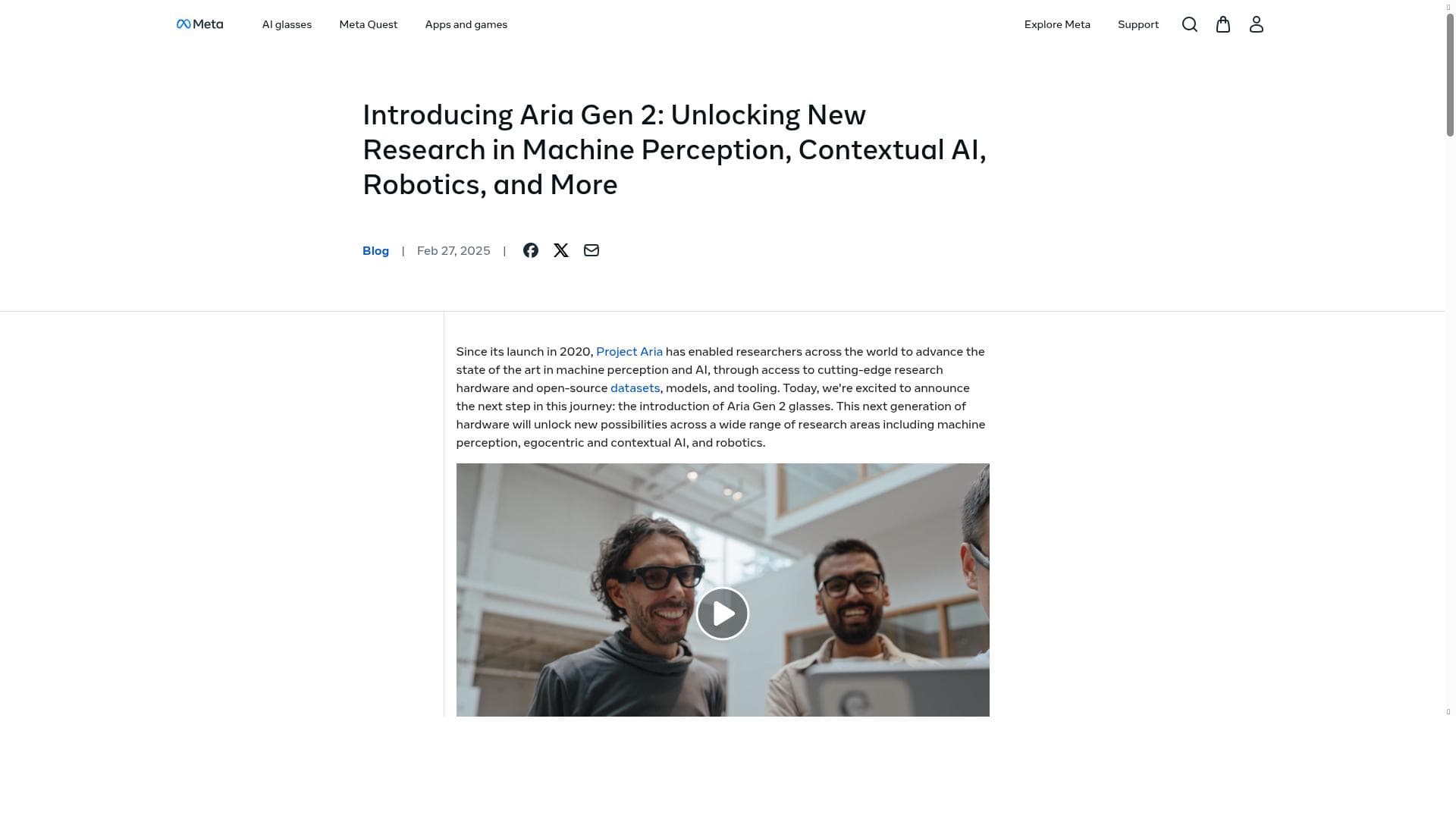
Aria Gen 2 by Meta is a next-generation research glasses platform featuring advanced sensors and on-device AI processing, designed to revolutionize egocentric data collection for AI and robotics research. Ideal for researchers and developers, it enables deep insights into human behavior and environment interaction through rich multimodal sensing.

Description
Project Aria Gen 2, from Meta, is the newest research glasses with advanced sensors (RGB, SLAM, eye tracking, PPG, contact mic) and on-device AI processing. For research now.
Detailed Description
Project Aria Gen 2, developed by Meta, represents a significant advancement in egocentric research glasses designed to push the boundaries of machine perception, contextual AI, and robotics research. These glasses are equipped with a sophisticated array of sensors including RGB cameras, SLAM (Simultaneous Localization and Mapping) technology, eye tracking, photoplethysmography (PPG), and a contact microphone. This combination enables researchers to capture rich, multimodal data streams from a first-person perspective, facilitating a deeper understanding of human-environment interactions and enabling the development of more context-aware AI systems. The on-device AI processing capabilities allow real-time data analysis and reduce reliance on external computing resources, making the glasses highly efficient for field research and experimentation. The core purpose of Aria Gen 2 is to serve as a cutting-edge tool for researchers and developers working at the intersection of AI, robotics, and human-computer interaction. By providing next-generation hardware tailored for egocentric data collection, it empowers scientists to explore new frontiers in machine perception, such as improving spatial awareness, gesture recognition, and contextual understanding in dynamic environments. The advanced sensor suite supports detailed eye tracking to study attention and gaze patterns, while PPG sensors enable physiological monitoring, opening avenues for research into cognitive and emotional states. The integration of SLAM technology allows precise mapping and localization, critical for robotics applications and augmented reality scenarios. Aria Gen 2 is best suited for academic researchers, AI developers, and robotics engineers who require high-fidelity, real-time data from wearable devices to develop and validate novel algorithms and systems. Use cases include studying human behavior in natural settings, advancing assistive technologies, enhancing robotic navigation and interaction capabilities, and creating contextually aware AI assistants. Its robust hardware and software ecosystem make it ideal for longitudinal studies and complex experiments that demand seamless integration of multiple sensor modalities. Regarding pricing, Aria Gen 2 is a paid research tool, reflecting its specialized hardware and advanced capabilities. Specific pricing details are typically provided upon inquiry or through direct engagement with Meta’s Reality Labs division, as the device is targeted primarily at institutional and enterprise-level research teams rather than general consumers. This pricing model aligns with its positioning as a professional research instrument rather than a commercial consumer product. When compared to alternatives, Aria Gen 2 stands out due to its comprehensive sensor array and on-device AI processing, which many competing devices lack. While other research glasses may offer some combination of cameras or eye tracking, few integrate SLAM, PPG, and contact microphones in a single wearable platform. Additionally, Meta’s backing ensures ongoing software support and integration with broader AI and robotics ecosystems. However, unlike consumer AR glasses, Aria Gen 2 is not designed for everyday use or entertainment but is optimized for rigorous research applications. Potential limitations include its specialized nature and cost, which may restrict accessibility to well-funded research institutions. The device’s complexity also requires users to have technical expertise in sensor data interpretation and AI development. Furthermore, as a research prototype, it may have limited availability and require adherence to strict usage guidelines to protect privacy and data security. Prospective users should consider these factors when evaluating Aria Gen 2 for their projects. In summary, Project Aria Gen 2 is a powerful and versatile research platform that equips AI and robotics researchers with unparalleled egocentric sensing capabilities. Its advanced hardware and on-device AI processing enable innovative explorations in machine perception and contextual AI, making it a valuable asset for cutting-edge scientific inquiry and technology development.
Tool Features
- Next-generation egocentric research glasses
- Enables research in machine perception
- Supports contextual AI development
- Facilitates robotics research
- Advanced hardware for AI and robotics experimentation
Description
Aria Gen 2 by Meta is a next-generation research glasses platform featuring advanced sensors and on-device AI processing, designed to revolutionize egocentric data collection for AI and robotics research. Ideal for researchers and developers, it enables deep insights into human behavior and environment interaction through rich multimodal sensing.
Project Aria Gen 2, from Meta, is the newest research glasses with advanced sensors (RGB, SLAM, eye tracking, PPG, contact mic) and on-device AI processing. For research now.
Detailed Description
Project Aria Gen 2, developed by Meta, represents a significant advancement in egocentric research glasses designed to push the boundaries of machine perception, contextual AI, and robotics research. These glasses are equipped with a sophisticated array of sensors including RGB cameras, SLAM (Simultaneous Localization and Mapping) technology, eye tracking, photoplethysmography (PPG), and a contact microphone. This combination enables researchers to capture rich, multimodal data streams from a first-person perspective, facilitating a deeper understanding of human-environment interactions and enabling the development of more context-aware AI systems. The on-device AI processing capabilities allow real-time data analysis and reduce reliance on external computing resources, making the glasses highly efficient for field research and experimentation. The core purpose of Aria Gen 2 is to serve as a cutting-edge tool for researchers and developers working at the intersection of AI, robotics, and human-computer interaction. By providing next-generation hardware tailored for egocentric data collection, it empowers scientists to explore new frontiers in machine perception, such as improving spatial awareness, gesture recognition, and contextual understanding in dynamic environments. The advanced sensor suite supports detailed eye tracking to study attention and gaze patterns, while PPG sensors enable physiological monitoring, opening avenues for research into cognitive and emotional states. The integration of SLAM technology allows precise mapping and localization, critical for robotics applications and augmented reality scenarios. Aria Gen 2 is best suited for academic researchers, AI developers, and robotics engineers who require high-fidelity, real-time data from wearable devices to develop and validate novel algorithms and systems. Use cases include studying human behavior in natural settings, advancing assistive technologies, enhancing robotic navigation and interaction capabilities, and creating contextually aware AI assistants. Its robust hardware and software ecosystem make it ideal for longitudinal studies and complex experiments that demand seamless integration of multiple sensor modalities. Regarding pricing, Aria Gen 2 is a paid research tool, reflecting its specialized hardware and advanced capabilities. Specific pricing details are typically provided upon inquiry or through direct engagement with Meta’s Reality Labs division, as the device is targeted primarily at institutional and enterprise-level research teams rather than general consumers. This pricing model aligns with its positioning as a professional research instrument rather than a commercial consumer product. When compared to alternatives, Aria Gen 2 stands out due to its comprehensive sensor array and on-device AI processing, which many competing devices lack. While other research glasses may offer some combination of cameras or eye tracking, few integrate SLAM, PPG, and contact microphones in a single wearable platform. Additionally, Meta’s backing ensures ongoing software support and integration with broader AI and robotics ecosystems. However, unlike consumer AR glasses, Aria Gen 2 is not designed for everyday use or entertainment but is optimized for rigorous research applications. Potential limitations include its specialized nature and cost, which may restrict accessibility to well-funded research institutions. The device’s complexity also requires users to have technical expertise in sensor data interpretation and AI development. Furthermore, as a research prototype, it may have limited availability and require adherence to strict usage guidelines to protect privacy and data security. Prospective users should consider these factors when evaluating Aria Gen 2 for their projects. In summary, Project Aria Gen 2 is a powerful and versatile research platform that equips AI and robotics researchers with unparalleled egocentric sensing capabilities. Its advanced hardware and on-device AI processing enable innovative explorations in machine perception and contextual AI, making it a valuable asset for cutting-edge scientific inquiry and technology development.
Frequently Asked Questions
What is Aria Gen 2?
Aria Gen 2 is Meta’s latest research glasses equipped with advanced sensors such as RGB cameras, SLAM, eye tracking, PPG, and a contact microphone, combined with on-device AI processing to facilitate cutting-edge research in machine perception, contextual AI, and robotics.
How much does Aria Gen 2 cost?
Aria Gen 2 is a paid research tool, and specific pricing details are typically provided upon direct inquiry with Meta’s Reality Labs. It is primarily targeted at institutional and enterprise research teams rather than general consumers.
Who is Aria Gen 2 best for?
Aria Gen 2 is best suited for academic researchers, AI developers, and robotics engineers who need high-fidelity, real-time egocentric data to develop and validate advanced AI and robotics systems.
What are the main features of Aria Gen 2?
Key features include next-generation egocentric research glasses with RGB cameras, SLAM for spatial mapping, eye tracking, PPG sensors for physiological monitoring, a contact microphone, and on-device AI processing for real-time data analysis.
Does Aria Gen 2 offer a free trial?
There is no publicly available information indicating that Aria Gen 2 offers a free trial. Access is generally provided through research partnerships or direct engagement with Meta.
What integrations does Aria Gen 2 support?
Aria Gen 2 supports integration with AI and robotics research workflows, leveraging Meta’s Reality Labs software ecosystem. Specific third-party integrations depend on the research environment and custom development.
How does Aria Gen 2 work?
Aria Gen 2 captures multimodal data through its advanced sensor suite from a first-person perspective, processes data on-device using AI algorithms, and enables researchers to analyze human-environment interactions and develop context-aware AI and robotic systems.
Socials
Use ToolReviews
No reviews yet. Be the first to share your experience.