
Is this your AI tool? Claim it today.
Verify ownership, manage your profile, and unlock growth features.
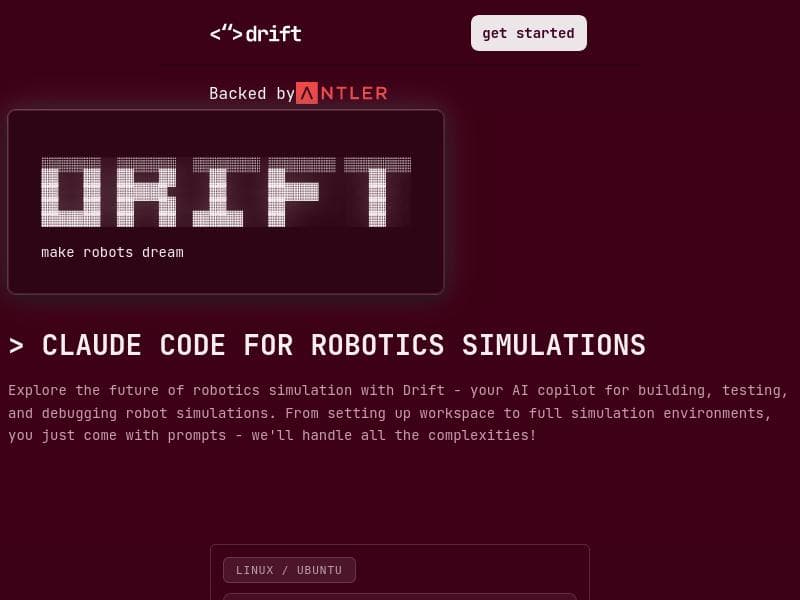
Drift is a cutting-edge AI-powered tool that enables users to build and manage robotics simulations effortlessly from the terminal using simple prompts. Ideal for robotics developers and researchers, it integrates ROS, simulators, and plugins with intelligent AI assistance to streamline development and troubleshooting in one unified platform.

Description
Build robotics simulation in minutes, straight from your terminal with just prompts. Everything you need for ROS, Simulator, Plugins, and OS orchestration. Build any robot and world, launch it in simulation, and wire up your control loop - all from a single prompt. Fix issues swiftly with drift as it actively tracks all ROS states, workspace and the simulator.
Detailed Description
Drift is an innovative AI-powered tool designed to revolutionize the way robotics simulations are created and managed. Its core purpose is to enable developers, engineers, and robotics enthusiasts to build comprehensive robotics simulations quickly and efficiently, directly from their terminal using simple prompts. Drift consolidates all essential components required for robotics simulation, including ROS (Robot Operating System), simulators, plugins, and operating system orchestration, into a single streamlined workflow. This integration allows users to design any robot and environment, launch simulations, and connect control loops seamlessly, all initiated through a single command prompt. By actively tracking all ROS states, workspace configurations, and simulator statuses, Drift provides real-time issue detection and resolution, significantly reducing debugging time and improving development productivity. One of Drift's standout features is its AI copilot, which acts as an intelligent assistant throughout the robotics simulation process. This AI-driven support enhances the simulation experience by offering suggestions, automating routine tasks, and monitoring system states to preemptively identify potential problems. The copilot's ability to understand and manage complex ROS environments and simulation parameters helps streamline the robotics development lifecycle, from initial design to testing and deployment. Additionally, Drift's comprehensive orchestration capabilities allow users to integrate various plugins and tools effortlessly, ensuring compatibility and smooth operation within diverse robotics projects. Drift is particularly well-suited for robotics developers, researchers, and companies involved in designing and testing robotic systems. Its ease of use and prompt-based interface make it accessible for both beginners and experienced professionals, enabling rapid prototyping and iterative development. Use cases include academic research where simulation accuracy and flexibility are critical, industrial robotics development requiring robust testing environments, and startups aiming to accelerate their product development cycles without investing heavily in complex simulation infrastructure. The tool's ability to track and manage ROS states in real-time is especially valuable for projects that demand high reliability and quick troubleshooting. Regarding pricing, Drift offers a freemium model, allowing users to access essential features at no cost, which is ideal for individuals and small teams experimenting with robotics simulation. Advanced features, enhanced AI copilot capabilities, and extended support options are likely available through paid plans, catering to professional users and enterprises requiring more comprehensive solutions. This pricing approach makes Drift accessible to a wide range of users while providing scalability for growing needs. Compared to alternative robotics simulation tools, Drift stands out due to its unique integration of AI assistance directly within the terminal environment, simplifying the traditionally complex setup and management of robotics simulations. While many simulators require extensive manual configuration and separate tools for ROS management, Drift consolidates these tasks, reducing overhead and accelerating development timelines. However, users should consider that as a relatively new and specialized tool, Drift's ecosystem and community support may not yet be as extensive as more established simulation platforms. Additionally, while the AI copilot enhances productivity, reliance on AI-driven automation may require users to maintain a solid understanding of underlying robotics concepts to effectively interpret and validate the AI's suggestions. In summary, Drift offers a powerful, AI-enhanced platform for robotics simulation that dramatically simplifies the creation, management, and troubleshooting of complex robotic systems. Its prompt-driven interface, comprehensive ROS and simulator integration, and intelligent support features make it an invaluable tool for robotics developers seeking to streamline their workflows and accelerate innovation. While it may have some limitations in ecosystem maturity, its freemium pricing and cutting-edge capabilities position it as a compelling choice in the robotics simulation landscape.
Tool Features
- AI copilot for robotics simulations
- Enhances simulation process
- Streamlines robotics development
- Provides intelligent support
Description
Drift is a cutting-edge AI-powered tool that enables users to build and manage robotics simulations effortlessly from the terminal using simple prompts. Ideal for robotics developers and researchers, it integrates ROS, simulators, and plugins with intelligent AI assistance to streamline development and troubleshooting in one unified platform.
Build robotics simulation in minutes, straight from your terminal with just prompts. Everything you need for ROS, Simulator, Plugins, and OS orchestration. Build any robot and world, launch it in simulation, and wire up your control loop - all from a single prompt. Fix issues swiftly with drift as it actively tracks all ROS states, workspace and the simulator.
Detailed Description
Drift is an innovative AI-powered tool designed to revolutionize the way robotics simulations are created and managed. Its core purpose is to enable developers, engineers, and robotics enthusiasts to build comprehensive robotics simulations quickly and efficiently, directly from their terminal using simple prompts. Drift consolidates all essential components required for robotics simulation, including ROS (Robot Operating System), simulators, plugins, and operating system orchestration, into a single streamlined workflow. This integration allows users to design any robot and environment, launch simulations, and connect control loops seamlessly, all initiated through a single command prompt. By actively tracking all ROS states, workspace configurations, and simulator statuses, Drift provides real-time issue detection and resolution, significantly reducing debugging time and improving development productivity. One of Drift's standout features is its AI copilot, which acts as an intelligent assistant throughout the robotics simulation process. This AI-driven support enhances the simulation experience by offering suggestions, automating routine tasks, and monitoring system states to preemptively identify potential problems. The copilot's ability to understand and manage complex ROS environments and simulation parameters helps streamline the robotics development lifecycle, from initial design to testing and deployment. Additionally, Drift's comprehensive orchestration capabilities allow users to integrate various plugins and tools effortlessly, ensuring compatibility and smooth operation within diverse robotics projects. Drift is particularly well-suited for robotics developers, researchers, and companies involved in designing and testing robotic systems. Its ease of use and prompt-based interface make it accessible for both beginners and experienced professionals, enabling rapid prototyping and iterative development. Use cases include academic research where simulation accuracy and flexibility are critical, industrial robotics development requiring robust testing environments, and startups aiming to accelerate their product development cycles without investing heavily in complex simulation infrastructure. The tool's ability to track and manage ROS states in real-time is especially valuable for projects that demand high reliability and quick troubleshooting. Regarding pricing, Drift offers a freemium model, allowing users to access essential features at no cost, which is ideal for individuals and small teams experimenting with robotics simulation. Advanced features, enhanced AI copilot capabilities, and extended support options are likely available through paid plans, catering to professional users and enterprises requiring more comprehensive solutions. This pricing approach makes Drift accessible to a wide range of users while providing scalability for growing needs. Compared to alternative robotics simulation tools, Drift stands out due to its unique integration of AI assistance directly within the terminal environment, simplifying the traditionally complex setup and management of robotics simulations. While many simulators require extensive manual configuration and separate tools for ROS management, Drift consolidates these tasks, reducing overhead and accelerating development timelines. However, users should consider that as a relatively new and specialized tool, Drift's ecosystem and community support may not yet be as extensive as more established simulation platforms. Additionally, while the AI copilot enhances productivity, reliance on AI-driven automation may require users to maintain a solid understanding of underlying robotics concepts to effectively interpret and validate the AI's suggestions. In summary, Drift offers a powerful, AI-enhanced platform for robotics simulation that dramatically simplifies the creation, management, and troubleshooting of complex robotic systems. Its prompt-driven interface, comprehensive ROS and simulator integration, and intelligent support features make it an invaluable tool for robotics developers seeking to streamline their workflows and accelerate innovation. While it may have some limitations in ecosystem maturity, its freemium pricing and cutting-edge capabilities position it as a compelling choice in the robotics simulation landscape.
Frequently Asked Questions
What is Drift?
Drift is an AI-driven robotics simulation tool that allows users to build, launch, and manage complex robotics simulations directly from the terminal using simple prompts. It integrates ROS, simulation environments, plugins, and OS orchestration to streamline the entire robotics development process.
How much does Drift cost?
Drift operates on a freemium pricing model, offering essential features for free with options to upgrade to paid plans for advanced capabilities and enhanced support tailored to professional and enterprise users.
Who is Drift best for?
Drift is best suited for robotics developers, researchers, engineers, and startups who need a fast, efficient way to prototype, simulate, and troubleshoot robotic systems. It caters to both beginners and experienced professionals working with ROS and simulation environments.
What are the main features of Drift?
Key features include an AI copilot for intelligent assistance during simulation, seamless integration of ROS, simulators, and plugins, prompt-driven simulation creation and control, real-time tracking of ROS states and workspace, and streamlined orchestration of the entire robotics development workflow.
Does Drift offer a free trial?
Yes, Drift offers a freemium plan that allows users to access core features at no cost, effectively serving as a free trial to explore the platform before considering paid upgrades.
What integrations does Drift support?
Drift supports integration with ROS (Robot Operating System), various robotics simulators, plugins, and operating system orchestration tools, enabling a comprehensive and cohesive robotics simulation environment.
How does Drift work?
Drift works by allowing users to input simple prompts in their terminal to build and launch robotics simulations. It actively monitors all ROS states, workspace configurations, and simulator statuses, providing intelligent AI-driven assistance to automate tasks, detect issues, and streamline the development process.
Socials
Use ToolReviews
No reviews yet. Be the first to share your experience.