



博客The Growing Role of AI in Everyday Work: How Smart Tools Are Transforming Content Creation and Business Automation
The Growing Role of AI in Everyday Work: How Smart Tools Are Transforming Content Creation and Business Automation
 Shashank Jain
2026年11月16日
6 分钟阅读
Artificial intelligence is no longer a technology reserved for researchers or large technology companies. It has gradually become part of everyday professional life, helping people write content, analyze information, communicate with customers, and manage business operations. From small startups to established enterprises, organizations are exploring how AI can make everyday work more efficient and productive.
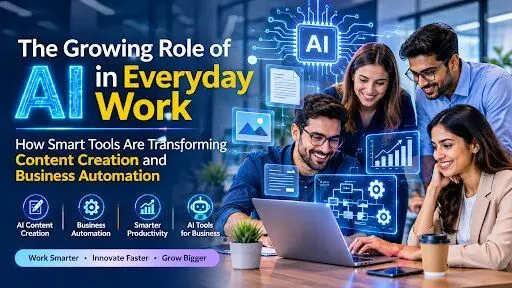
The Growing Role of AI in Everyday Work: How Smart Tools Are Transforming Content Creation and Business Automation
Artificial intelligence is no longer a technology reserved for researchers or large technology companies. It has gradually become part of everyday professional life, helping people write content, analyze information, communicate with customers, and manage business operations. From small startups to established enterprises, organizations are exploring how AI can make everyday work more efficient and productive.
The growing availability of AI tools for business has made it easier for professionals to access capabilities that previously required specialized knowledge, expensive software, or significant manual effort. Tasks such as preparing reports, developing marketing campaigns, organizing customer information, and creating digital content can now be supported by intelligent applications.
However, the real value of AI is not simply its ability to complete tasks faster. It is the opportunity to help people focus on creativity, strategic thinking, and meaningful business decisions. Two areas where this transformation is particularly visible are content creation and business automation.
1. AI Is Changing How People Approach Everyday Work
Traditional workplace processes often involve repetitive activities that consume valuable time. Employees may spend hours organizing documents, researching information, responding to routine inquiries, or preparing reports.
Modern AI tools for everyday work can simplify many of these responsibilities. AI assistants can summarize lengthy documents, generate meeting notes, organize research, and help professionals prepare written communication.
For example, a business owner preparing a presentation can use AI to organize research and create an initial outline. Similarly, a marketing professional can analyze campaign information and develop ideas for future content.
These applications do not eliminate the need for professional judgment. Instead, they provide a starting point that employees can review, improve, and adapt to their specific requirements.
2. Transforming Content Creation With Artificial Intelligence
Content plays an important role in how businesses communicate with customers. Companies regularly need blog articles, website copy, product descriptions, newsletters, social media posts, and advertising materials. Maintaining consistent content production can be challenging, particularly for smaller teams.
AI content creation tools are helping simplify this process.
AI writing assistants can suggest topics, develop outlines, improve headlines, and generate initial drafts. Image-generation applications can help creative teams explore visual concepts, while editing tools can identify grammatical errors and improve readability.
For example, a small marketing team planning a product launch can use AI to brainstorm campaign ideas, prepare social media drafts, and develop different versions of promotional messages.
However, publishing AI-generated material without reviewing it can create problems. Content still needs factual verification, originality, appropriate context, and a consistent brand voice. Human writers and editors remain essential for producing useful, credible, and engaging information.
The most effective approach combines AI-assisted production with human creativity and editorial expertise.
3. Business Automation Is Becoming More Accessible
Business automation is no longer limited to organizations with large technology budgets. The development of AI-powered business automation has made intelligent workflows more accessible to startups, entrepreneurs, and growing companies.
Businesses can use automation to organize customer inquiries, manage repetitive administrative tasks, process information, and support internal workflows.
Consider an online business that receives hundreds of customer messages every week. An AI-powered support assistant can help answer common questions, provide relevant information, and direct complicated requests to human representatives.
Similarly, sales teams can use AI applications to summarize customer conversations, organize potential leads, and prepare follow-up messages.
These capabilities can reduce repetitive work and allow employees to concentrate on activities that require personal attention and decision-making.
The objective should not be to automate every process. Businesses should identify tasks where automation genuinely improves efficiency without affecting service quality.
4. AI Productivity Tools Are Helping Teams Work Smarter
Productivity is not just about completing more tasks. It also involves managing time effectively, prioritizing responsibilities, and making better use of available resources.
AI productivity tools are helping professionals improve their daily workflows through intelligent assistance.
Some practical applications include:
- Writing assistance: Preparing email drafts, reports, summaries, and business documents.
- Meeting management: Summarizing discussions and identifying important action points.
- Research support: Organizing information and extracting useful insights.
- Project management: Helping teams prioritize activities and track progress.
- Data analysis: Identifying patterns and summarizing information for better decisions.
For example, a business manager can use AI to organize meeting notes, prepare project summaries, and identify pending responsibilities. This can reduce administrative effort and create more time for planning and team coordination.
Businesses should evaluate these applications based on their actual needs rather than adopting tools simply because they are popular.
5. Finding the Right AI Tools for Business Needs
As the number of AI applications continues to grow, discovering the right solution has become an important challenge. Different platforms offer different features, pricing structures, integrations, and capabilities.
A tool that works well for a marketing agency may not be suitable for a financial services company or an independent entrepreneur.
Businesses should consider several factors before choosing an application:
Understand the requirement: Identify whether the primary objective is content creation, marketing, customer support, research, or workflow automation.
Compare features and pricing: Evaluate subscription costs, usage limits, available features, and overall value.
Check ease of use: Choose applications that employees can understand and incorporate into existing workflows.
Evaluate security: Review data privacy policies and understand how sensitive business information is collected and processed.
Test before committing: Free trials and demonstrations can help businesses determine whether a solution meets their expectations.
Platforms such as PoweredByAI, an AI tools discovery platform, help users explore AI applications across different categories. By bringing together different AI solutions, PoweredByAI makes it easier for individuals, professionals, and businesses to discover tools that may support their specific requirements.
Having access to a variety of solutions can make the discovery process more organized, particularly for businesses that are still exploring how AI fits into their operations.
6. The Growing Impact of AI on Marketing and Customer Communication
Marketing and customer communication are among the areas experiencing significant changes through AI adoption.
Marketing teams can use AI to research topics, identify keyword opportunities, generate campaign ideas, and analyze audience engagement. These capabilities can help businesses plan more organized marketing activities.
Customer support is also evolving. AI-powered chatbots can respond to frequently asked questions, provide basic assistance, and direct customers to the appropriate support channels.
Social media teams can benefit from tools that help organize content, manage interactions, and streamline repetitive communication activities.
Nevertheless, successful customer relationships depend on trust, empathy, and understanding. Automated systems should always have appropriate human oversight, particularly when dealing with complex customer concerns.
7. Challenges Businesses Should Not Ignore
Despite its advantages, AI adoption also comes with important responsibilities.
Accuracy is one major concern. AI applications can sometimes produce incorrect information or generate responses that appear convincing but lack factual support. Businesses should review important outputs before using or publishing them.
Data privacy is equally important. Organizations must understand how their chosen applications handle customer information, business documents, and confidential data.
There is also a risk of becoming overly dependent on automation. Human creativity, professional experience, and critical thinking remain important in almost every industry.
Clear internal guidelines, employee training, and regular evaluation can help businesses use AI responsibly while maintaining quality and accountability.
Conclusion
Artificial intelligence is steadily changing how people work, communicate, and manage business operations. From AI content creation tools to AI-powered business automation, modern applications are helping organizations simplify repetitive activities and improve everyday productivity.
However, successful AI adoption is not about replacing human expertise or using every available application. It is about identifying genuine business needs, choosing appropriate solutions, and combining technological capabilities with human judgment.
As AI continues to evolve, discovering the right tools will become increasingly important. Platforms such as PoweredByAI can help businesses explore available AI solutions and identify applications that align with their goals.
Ultimately, the future of work will belong to organizations that use technology thoughtfully, encourage innovation, and understand that the greatest value of AI comes from helping people work smarter.
在高流量博客与文章中展示您的 AI 工具
在 PoweredByAI 获得展示,触达正在发现与您类似工具的用户。建立强大的 SEO 外链,提升 Google 排名并带来持续自然流量。
定向触达的赞助博客展示
带 do-follow 外链的客座文章
提升 SEO 的上下文链接投放
深受 25,000+ 款 AI 工具及成长型初创公司信赖
Enjoyed this? Talk AI tools with other founders and builders.
Join our Slack community





 , 产品来自