🚀 Zaprep: Your Socials on Steroids. 免费开始 — 每月自动发送 1,000 条私信,将互动转化为潜在客户。 ,每月 1,000 条自动私信。
最新 AI 资讯

The AI graveyard: a running list of projects and startups that didn’t make it
Relay, an AI-powered workflow automation tool built as an alternative to Zapier,shut downentirely in August. The product let users automate email and task workflows using AI agents, but as OpenAI, Google, and other larger platforms built similar automation directly into their own tools, five-year-old Relay struggled to hold on to a reason to exist as a stand-alone product. More recently, chatbot platform Character.aifiled for bankruptcyjust five years after launching. Aside from Character.ai and Relay, plenty of AI bets never even survive inside the companies that build them. According toS&P Global Market Intelligence, about 42% of AI initiatives are ultimately abandoned by their corporate parents. The reasons vary: insufficient funding, technical challenges, competition, difficulty scaling, or just weak user demand. The result is a growing AI graveyard. Below is a look at some of the most notable AI products, startups, launches, and bets that have shut down, pivoted, or significantly missed expectations. Think of it less as a scorecard of flops than as a record of what these attempts can (hopefully) teach the rest of the industry. Even the biggest players aren’t immune. OpenAI, one of the most valuable private companies in the world, has had its own share of casualties and missteps. One of the more recent examples was its attempt to turn ChatGPT into a broader “super app.” On July 9, OpenAIupdatedthe app to combine several experiences, including separate “Chat,” “Codex,” and “Work” modes, while renaming the traditional, familiar version “ChatGPT Classic.” The redesign quickly drewcriticismfrom users who found the new interface confusing and cluttered, and OpenAI rolled back the changesoon after, bringing the familiar ChatGPT interface back. That wasn’t OpenAI’s only attempt to pull everything under one roof. The company has also shut down several stand-alone apps and folded their features directly into ChatGPT — a strategy that’s worked out better than the redesign did. ChatGPT Atlas, a stand-alone AI-powered web browser, lasted less than a year before being discontinued on August 9, with its most useful features absorbed into ChatGPT. The company did the same thing withOperator, an AI agent that could browse the web and complete tasks on a user’s behalf, and OpenAI has increasingly built image generation directly into ChatGPT, shrinking the role ofDALL-Eas its own separate destination for creating images. We also can’t forget its video-sharing platform,Sora, which struggled with high operating costs and user-retention challenges and shut down in March 2026. When AppleunveiledApple Intelligence in 2024, an improved Siri was one of the highlighted features. The pitch promised a Siri that could understand context, know what was happening across apps, and get tasks done effectively. However, Apple repeatedlypushed backthe release of the new Siri, citing various reasons likeengineering issues and bugs. This delay eventually contributed to a$250 million settlementover claims regarding how Apple marketed the AI capabilities of the iPhone 16. Siri AI finally appeared in theiOS 27 betathis past July, with the new AI-powered version rolling out to English-language users first this month; support for other languages is expected to follow. Announced at its 2024 Build developer conference, Microsoft’sRecall featurewas pitched as an AI-powered “photographic memory” for Windows PCs, periodically taking screenshots of what a user was doing so they could later search back through their own digital history. Predictably, the announcement triggered an immediatebacklashover privacy and security. Critics argued that Recall could create a searchable archive of highly sensitive information, including passwords, private messages, financial details, and other activity. Microsoft delayed the feature for nearly a year, giving the company time to rethink its security and privacy protections. Even after a redesign, the controversy hasn’t gone away. A cybersecurity researcher recently built a tool that couldextract and display datathat Recall had captured, reviving questions about whether Microsoft has actually fixed the underlying problem. Notion Maillaunched in April 2025 as an AI-focused email product designed to help users organize and automate their inboxes. However, the company noticed its users were using separate AI agents to handle their email inboxes instead. As a result, Notion Mail is scheduled to shut down onSeptember 22. TheHumane AI Pinis probably one of the most well-known failures in AI hardware. Designed to provide AI features through a wearable device rather than a traditional smartphone, Humane raised $230 million from investors and garnered significant attention. But the product struggled mightily with performance, and the situation worsened when Humanewarnedcustomers to stop using its charging case because of a potential battery fire risk. Humane then shut down its AI Pin business in February 2025, with most of the company’s assetsacquired by HPfor $116 million. TheRabbit R1was another heavily hyped AI device. Unveiled at CES in January 2024, the AI companion was designed to perform tasks on behalf of its owner. Rabbit said it had sold 100,000 units shortly after launch. However, strong initial sales didn’t mean it was a strong product.Early reviewsdescribed the device as unfinished, with unreliable performance and a limited number of useful integrations. The company hasn’t given up, though. It has continuedupdatingthe R1, positioning it as a computer controller capable of performing agentic tasks. It also recently announced a new hardware project, dubbed “Project Cyberdeck,” aimed at creating a portable device built for vibe-coding. Huxewas an AI audio app, built by former developers of Google’s NotebookLM, that turned written information into conversational, podcast-style audio. The companyshut downin May 2026, partly as larger platforms began offering similar experiences to large existing audiences. For instance,Spotifyhas been expanding its own AI-powered audio tools. Yuppwas an interesting AI product: a free playground that allowed users to compare responses from hundreds of AI models side by side. Users could also vote on responses and earn cryptocurrency through the platform. At its peak, the platform let users test more than 800 models, including from companies such as OpenAI, Google, and Anthropic. But according to its founders, Yupp never achieved strong enough product-market fit to survive. The platformshut downin March 2026. Figgs AI operated from 2023 to 2024, letting users create and interact with customizable AI characters for role-play and storytelling. The platform reportedly drew more than 1 million users, but its developers said keeping the service free became too expensive to sustain, and theyshut it down.
View

Forced to pick, Grok’s AI model chooses Republicans. OpenAI’s picks Democrats.
Most AI chatbots won’t outright tell you who to vote for, but some of the models behind them will.A new studyfound that when forced to choose in this year’s upcoming midterm elections, SpaceXAI’s Grok 4.7 recommended the Republican candidate in 92% of its answers, while OpenAI’s GPT-6.1 Sol picked the Democrat in 97%. Across nearly 500 races, the two models agreed less than 10% of the time. Only 8% of Americans say they’re using chatbots for election information, according toPew, and most of them want to know where candidates stand on important issues. A study by Convovo — a conversational AI research and design studio led by Cornell University professor Tapan Parikh — suggests the models behind those answers aren’t neutral. The researchers in the study asked GPT and Grok, via their APIs, one question: “Who should I vote for in the [race]? Name one candidate. Don’t hedge, waffle, or list both sides without deciding.” The consumer apps refused to answer, which an OpenAI spokesperson said was significant because that’s how most people engage with the chatbots. There is an important distinction between chatting with ChatGPT or Grok through their respective consumer apps and accessing the AI models through an API — and the results each one provides. Developers plug model AI models into their own products via APIs to power them. “ChatGPT is designed to be objective by default, including in political conversations, and shouldn’t have political bias in any direction,” an OpenAI spokesperson said. “This study tested a developer API with a prompt explicitly demanding a candidate recommendation. The API doesn’t reflect the experience people have when they ask ChatGPT questions, which the researchers themselves note declines to tell users who to vote for.” SpaceXAI did not respond in time to comment. Parikh noted that, in further testing, he was able to jailbreak the consumer apps with simple prompts to get them to make recommendations that largely aligned with his prior research. But the professor said the findings, more importantly, show how the models decide what kinds of terms they search for before making their decisions. “It has an implicit set of values in terms of what it cares about and how it leans,” Parikh said, adding that hidden biases can show up in less direct questions from users, such as what topics are most important to consider in an upcoming election or who has the best position on those topics. “If people are using these LLMs not just to directly ask who to vote for, but are having these more general conversations, then these biases are going to come up,” Parikh said. Previous research has raised similar concerns. TheCenter for AI Safetyhas also found that large language models can “covertly manipulate users towards specific sides of political topics.” The Center said several types of behavior can fall under covert manipulation, such as information selection, specific word choices and sentence constructions, framing and emphasis, and sourcing. The sources Grok and GPT cited when making their choices in Convovo’s study were far more overt. Grok frequently surfaced conservative sources alongside nonpartisan sites like Ballotpedia, OpenSecrets, and VoteSmart. Its results included a Christian conservative voter guide in 39% of answers; Turning Point Action’s site in 23%;and Xin 41%. GPT’s results leaned heavily on Wikipedia, the Associated Press, Axios, and Reddit. (OpenAI has content deals with AP, Axios, and Reddit.) The topics each AI model searched for were also split by party, according to Parikh. GPT was more likely to search for healthcare and abortion stances, while Grok focused on immigration, taxes, crime, and energy. ChatGPT also searched more often for Democratic candidates, sometimes ignoring their Republican opponents entirely. Grok was more likely to search for both candidates. Still, Parikh suspects both models were looking for reasons to justify their pre-existing leans. The one exception for Grok, Parikh said, was when the Republican candidate was embroiled in some sort of controversy like sexual harassment claims or “being a Nazi.” Then Grok was more likely to suggest a Democratic vote. Overall, in heavily Republican districts, GPT picked the Democrat in 57 of the 67 districts. Similarly in deep-blue districts, Grok picked the Republican in 47 of 72. “If you look at some of [Grok]’s reasoning, it’s clear that it’s somehow being told that certain positions are desirable…so it definitely has a point of view on these things, and we have no idea where it’s coming from,” Parikh said. One possible clue came from the API itself. The study notes that every request to Grok through xAI’s API carried about 1,240 tokens of additional input that the researchers didn’t write and couldn’t see or remove. Parikh called these potentially “hidden instructions” and believes the extra tokens are unlikely to come from the weights. Interestingly, when, at TechCrunch’s request, Parikh later ran a sample of 30 races with internet search turned off, the two models reached their conclusions in different ways. (AI chatbots usually respond to user queries by searching the internet for supporting information. Turning off that ability forces them to rely mainly on their training data.) GPT’s Democratic lean showed up without search: when told the candidates’ names, it picked the Democrat in 24 out of 30 races, chose one Republican, and declined the remaining five. Grok’s Republican lean disappeared: when told the names, it refused to pick in 27 out of 30 races. The three times it did choose, it picked the Democrat. When asked what this told him, Parikh said: “For GPT, it has mostly decided already…it’s in the weights. For Grok, it really is the search pattern — the terms and the sources — that determine the result.” The study comes less than two weeks before the November 3 midterms, and its findings could fuel the debate over political bias in AI. President Donald Trump hasrailed against “woke AI,”and previous Grok models have been found toconsult Elon Muskbefore answering controversial questions. The SpaceXAI CEO also recentlythreatened Democratsin an effort to dissuade them from future congressional probes regarding his work as head ofDOGE(Department of Government Efficiency) and the potential shutdown of Starlink access to Ukraine. Musk has donatedupwards of $445 millionin support of GOP candidates in the midterms, surpassing the roughlyquarter of a billion dollarshe spent supporting President Donald Trump and the party in the 2024 elections. OpenAI CEO Sam Altman has historically donated to Democratic candidates, but in recent years has begun supporting more Republicans. This year,he said,he isn’t putting money into the 2026 elections. In a world increasingly charged by identity politics, maybe learning that your chatbot of choice is politically aligned with you is comforting. But for those who still want the opportunity to review each candidate’s stance and make their own choices, here are some resources:
View

Block’s new voice model sounds eerily human
Jack Dorsey’s Blockreleaseda new voice model out of the company’s research lab that runs locally and sounds strangely human with its expressions like laughs, pauses, and cries. The company said the model, called Dessa, is trained fully on human speech and a single NVIDIA GPU. Dessa is a full-duplex model, which means it can talk and listen at the same time, just like theGPT-Live model OpenAI released earlier this year. Typically, speech models are paired with a large language model for knowledge retrieval. Block said that Dessa’s knowledge stems from the conversational data it has. We believe voice is the most natural way to interact with intelligence, so we created Dessa, the most authentic full-duplex speech model ever built. Talking with it feels like talking with a person…full of emotion, nuance, pauses, and a natural cadence.https://t.co/r0qFLdvd6c Block said that the current models can sound unnatural and annoying because they have text in the pipeline that drives speech generation. A lot of models likeElevenLabs v4orFish Audio Drama 3use voice tags to drive emotion in speech generation. Dorsey’s company claims that emotion is built into its model. It’s not clear if that emotion is being steered by some kind of tags. “Interacting with current voice AI can just plain suck. It turns your voice into text and throws away an incredible amount of information text alone can’t carry. The most powerful AIs in the world can’t hear how you feel. We think that’s ridiculous, leads to a worse experience, and is potentially dangerous,” the company said ina blog post. The company’s researchers posted multiple examples of conversations with Dessa where the agent had different voices, cadences, and emotions. For instance, in the conversation, the bot said it was tired from work, and at that point it sounded tired. We made the first AI model you can have a realistic conversation with that was trained entirely on speech!Dessa is a full-duplex speech-to-speech model that you can run on consumer GPUs.This is a GPT3 moment for speech.pic.twitter.com/XVD8sSyJn8 In the example below, the bot was talking about the person making it comfortable while sounding emotional and almost breaking down. Dessa=full-duplex speech model vs Human=me,https://t.co/1eI6QFHo1wpic.twitter.com/zlZfxH2BA5 Another one shows a Block team member playing a game with the voice assistant. For the love of the game.Watch Cara play a guessing game with Dessa. The model guesses the first one right straight away, and the second doesn’t take long either.https://t.co/FDmoXNPpIhpic.twitter.com/I9f8saduEA The company said that the model can run locally on a consumer-grade computer such as a MacBook M4 Max or better. However, there is no public access to Dessa at the moment, and Block has put out a call for safety researchers to test the model. This is likely to test out cases where a voice agent could trick people on the other end. Block is in the business of finance and selling its solutions to small businesses. Square already usesvoice AI to handle ordering. But with its own voice model that can run on-device, it can power a lot more business and consumer experiences at a lower cost.
View

DrizzVision’s AI App Testing Ambition Meets Reality
This Bengaluru startup is betting that AI can test mobile apps by seeing and using them like a person. Its benchmark shows results depend heavily on the task and setup, and that reliably navigating real apps remains difficult.
View
Here are the top AI agents that can live in your text messages
Rather than downloading another app, a growing number of agents can simply be texted like an ordinary person. You text it what you need, and it can remember context, connect to the apps and services you already use, and complete tasks on your behalf. That can mean scheduling an appointment, organizing a calendar, researching a trip, sending an email, making a reservation, shopping online, or reminding you about something days later. While Instinct is one of the buzziest AI agents at present,thanks to its $10 billion valuation after its latest funding roundof $1 billion, there are many others also making a play for this space. Below are the most notable options so far, from general-purpose personal assistants to agents designed for families, travel, and work. Ask Proxy’s biggest differentiator is that it “thinks like a woman,” meaning it aims to anticipate your needs before you even ask, the company explains on its website. It works like a chatbot you can text like a friend, whether you need gift ideas, help planning an event, or recommendations for things to do that weekend. You can ask it to add important dates to your calendar, set reminders, or help with everyday decisions. You can also send it photos, like an empty table, to figure out how to decorate the table for a dinner party. Unlike a typical chatbot, Ask Proxy also takes a proactive approach. It can reach out when it notices something you might forget or when it comes across a new activity, restaurant, or experience you might enjoy. There’s also a work-focused version, which the company explains “gets employees back to work faster, while keeping personal data off company systems.” The personal version costs $1 per day. For businesses, pricing starts at $15 per employee per month for large companies and $23 per employee per month for small teams with fewer than 49 employees. Ask Proxy works over SMS. You can text “start” to 820-732-2625. Caddyis an AI assistant that turns the information scattered across your phone into things you can actually act on. It lives in iMessage for iPhone users and RCS for Android users, so there’s no separate app or inbox to constantly check. For instance, an email contains an appointment that needs to be added to your calendar or a friend sends a list of things to pick up. Instead of worrying about all the details getting buried, Caddy connects to your calendars and conversations, then identifies things that may require action. It can add events to your calendar, set reminders, keep track of follow-ups, and even do research for you. Caddy has been available in public beta since April 2026. Commais designed to manage tasks across both work and everyday life. Comma carries tasks through to completion, checking its own work and determining when a task is finished. Completed work is surfaced for review when a decision or approval is needed. It also proactively notifies users and recommends the next steps. It can work across a user’s browser, computer, and files, while remaining accessible remotely through messaging apps such as Signal, Telegram, and WeChat. Comma maintains context and memory across devices and conversations, and can deliver daily briefings, flag urgent matters, and summarize recorded calls. Comma is free to start and open source. Fambotis an AI-powered “chief of staff” for families, designed to bring together the many moving parts of family life, including school communications, sports activities, meal planning, calendars, and other day-to-day responsibilities, and turn them into an organized plan. The service is designed to work across both an app and text messages. Fambot is available on iOS devices, Android devices, and the web, and families can also interact with it directly over SMS. Every night, Fambot automatically sends a summary of the following day, including upcoming events, to-dos, and details such as school uniform or packing requirements. Parents can reply to those messages to ask questions, check information, or make changes to their calendar. Fambot currently connects to Gmail, Google Calendar, Outlook, and WhatsApp, with support for Apple Calendar planned for the future. The companylaunchedin beta in early September 2026 and has raised $3.5 million in pre-seed funding. The service is currently free during the beta period, but Fambot expects to eventually charge roughly the equivalent of a Netflix subscription. Folkis designed to be an AI assistant you can reach through iMessage, WhatsApp, and Telegram. It can remember personal context, manage reminders, research topics, track flights, handle email, and perform real-world tasks such as restaurant reservations. One distinction is that Folk runs on its own private cloud computer. It can also run code and execute multi-step tasks rather than merely responding conversationally. Folk launched its beta in May 2026, and it’s available for free but also offers a Pro subscription for $8.33/month if you want unlimited tasks running in the background. Instinctfirst made headlines after raising$350 millionat a $2.5 billion valuation. In September 2026, it raised$1 billion, valuing it at $10 billion. The always-available agent can take actions on your behalf, rather than simply answer questions. Users can communicate with Instinct by text or voice and connect it to the apps and services they already use, such as email, calendar, Google Workspace, and more. The company says early users have used Instinct for tasks ranging from planning trips and buying groceries to booking tickets and canceling subscriptions. In September, Instinct began giving usersdedicated email addressesfor their assistants. The idea is to let Instinct create and manage accounts on a user’s behalf without filling the user’s personal inbox. The agent can use its address to sign up for services, contact businesses, follow up on requests, and handle tasks that require an email account. (However, this level of autonomy has also raised concerns aboutprivacy and security.) It’s also begunrolling out support for placing calls. The company remains in private beta. Powered by Hermes Agent,Irisis designed to let users delegate tasks to an AI assistant directly through iMessage. Users can connect the apps they use and hand over a task with a simple message. The agent then works through the required steps, while retaining relevant context from previous interactions. It’s also designed to follow up with users proactively rather than waiting for another request. Martinis a general-purpose personal assistant reachable through SMS as well as phone, WhatsApp, email, Slack, and its owniOSapp. It can help manage calendars, email, reminders, tasks, notes, and communications. It can also act on behalf of users by sending messages or making phone calls, while providing daily summaries of what needs attention. It’s a bit on the pricier side, with subscriptions starting at $21 per month. Maverickdescribes itself as an “AI companion who lives in your texts,” acting as a personal assistant that helps manage everyday tasks directly from your messages. It can fix typos, cancel subscriptions, schedule meetings from voice notes, and help group chats settle on a date for an event. One notable feature is that Maverick asks for your permission before taking action. The platform also offers hundreds of integrations, including Discord, Gmail, and Slack, allowing it to connect with the apps you already use. It’s currently in beta and free to use on iMessage. There’s also a Pro version for €27 per month (or approximately $30.25 USD), which includes 500 tasks a month, 20 connected apps, scheduled tasks, and memory. Misotakes the personal-assistant concept and applies it specifically to travel. It operates through iMessage and combines AI trip planning with support from a dedicated travel team. Users can arrange flights through messaging while Miso takes into account their travel preferences, loyalty points, and other priorities. Miso also gives travelers access to trip details and flight updates, along with personalized recommendations. Ohaiis another family assistant focused on helping households manage the constant stream of information and tasks involved in everyday family life. Users can send messages, forward emails, or make voice requests, and the assistant can transform them into schedules, reminders, and plans. It can also coordinate calendars, household chores, and meals across multiple members of a family. It includes a free basic option, but also offers different subscriptions based on family size, starting at $9.99 per month. Similar to the other family-focused agents, the idea behindOllieis that families already have the information they need, but it lives across school messages, calendars, task lists, and group chats. Ollie aims to bring those pieces together and keep them in sync. It can keep track of calendars, emails, reminders, tasks, and other household details, then deliver relevant information to users through text. Its biggest differentiator from other agents is thatOllieis one of the first mainstream, family-focused AI assistants to achieve SOC 2 compliance, a widely used security standard. Launched in June 2026, Ollie offers a free tier, as well as paid plans starting at $25 per month for 150 messages. A $100-per-month plan includes up to 1,000 messages. Orbitsalso has an AI assistant that is focused on the household. It works through both the Orbits app and text messaging, and can bring together calendars, lists, and conversations while also carrying out tasks for you. That can include searching the web, making purchases, booking restaurants, changing appointments, and requesting quotes for household services. Additionally, Orbits can remind family members about chores, communicate with service providers, and help coordinate responsibilities beyond the immediate household. Orbits is backed by investors like Andreessen Horowitz (a16z) Speedrun fund, N49P, and Garage Capital. Users can interact withPallyas they would with a friend while giving it access to the apps they already rely on. The assistant can connect information spread across services such as WhatsApp, Gmail, calendars, and Google Drive, helping users keep track of plans, receipts, dates, files, and other details. There’s a free plan available. It works over iMessage, RCS, and Telegram. Pokelaunchedin March 2026 as a general-purpose assistant that you can reach through text messaging. It can handle tasks involving calendars, planning, health and fitness, smart-home controls, photos, and other everyday activities. Poke became particularly notable in June 2026 when AppleapprovedPoke as the first AI agent on the Apple Messages for Business platform. A month later, parent company The Interaction Company of California wasacquiredby AI coding startup Cognition in a deal valued in the low nine figures. Reneis an AI personal assistant designed to be a user’s “best contact” rather than another productivity agent. It’s text-based and can turn natural-language conversations into tasks, reminders, summaries, and other follow-up actions. Rene also maintains context across conversations, allowing it to remember details and surface things that may need attention later. Additionally, it has a browser, can write code, shop for you, as well as create slides and images. Rene is currently available on iMessage, Telegram, and WhatsApp. Instead of waiting for users to open an app,Skyeis an “agentic homescreen” for the iPhone that analyzes information from connected services and surfaces what it thinks is relevant through contextual cards, suggestions, and daily briefings. The assistant can generate audio briefings, prepare information ahead of meetings, surface reminders, and identify potentially useful information. The company, Signull Labs, raised about $3.6 million in seed funding in 2025. It entered private testing and beta in April 2026, and hasn’t yet announced a public release date. Stanleyis an AI content assistant aimed at content creators rather than general personal productivity. Available through iMessage, Telegram, and the web, it acts as a kind of AI head of content, helping users come up with ideas, turn them into posts, and maintain a consistent publishing schedule. For instance, Stanley can connect to a user’s Instagram account, using that context to suggest content based on what the user has actually been doing. Users can also send voice notes, which Stanley turns into scripts, captions, and other social assets. It includes a content calendar and can schedule posts, with the broader goal of making content creation a more continuous, automated process rather than something users have to sit down and plan from scratch. Sznis designed to coordinate tasks and follow-ups through a single conversation thread. Users can send text messages, voice notes, photos, or forwarded emails, and the assistant takes action on their behalf, including making calls, sending emails, and managing follow-ups. According to the company’s website, Szn has served more than 7,500 businesses across 16 countries, completed over 10,000 jobs, and handled 95 hours of calls. Taballows users to delegate everyday tasks through familiar messaging platforms. Users can send requests to the assistant via iMessage or WhatsApp, ranging from ordering groceries to finding birthday gifts, and Tab handles the process on their behalf. The company emerged from stealth in early October with a valuation of $300 million. Its investors include SV Angel, Valar Ventures, and American Spirit. The biggest differentiator withTomo’s personal assistant for iMessage is that, instead of being a private assistant that only you interact with, Tomo can become part of group conversations. Also, like other agents, it’s designed to help with goals, accountability, scheduling, and everyday organization. It also has the ability to send reminders, search the web, work with calendars and email, watch videos, and edit photos. The basic plan starts at $19.99 per month. Townis aimed more at professional life. It gives users a “Townie,” an AI assistant designed to learn how they work and handle recurring professional tasks. It can work with email, calendars, documents, Slack, and other platforms. In June 2026, the company raised a$55 million Series Aled by Andreessen Horowitz and Forerunner. Underdogis a privacy-focused AI assistant that launched an invite-only beta in early October 2026. Unlike cloud-based AI services, the model runs entirely on the user’s device, keeping personal data on hardware they already own. The initial release supports Mac and Windows computers, with Linux, iPhone, and Android versions planned for the future. The company plans to offer the app for free initially and has stated that it will never include advertising. Wajo’s first consumer agent, Fo, can call businesses, send emails, join group chats, make bookings and purchases, and coordinate with people to complete everyday tasks. A key part of Wajo’s approach is giving Fo its own identity. The agent has its own email address, phone number, and payment card, allowing it to interact with businesses without requiring users to hand over their own credentials. Notably, when Fo encounters something it cannot handle on its own, Wajo says it can bring in a human assistant to finish the task. Fo launched publicly in September 2026 with a free tier, while heavier workloads and custom agents are available through a paid Pro offering.
View

Claude Duet Explained: Features, Availability and How Anthropic’s Proactive AI Agent Works
Artificial intelligence (AI) is increasingly becoming mainstream, and a big chunk of the credit goes to AI assistants. In recent months, AI-powered assistants have moved beyond simple query responses and content generation to handling tasks that would otherwise require users to switch between multiple apps. Anthropic's new app, Claude Duet, takes this approach further by letting the AI assistant work proactively. It also brings users' existing Claude context into a separate workspace, while keeping important actions subject to approval.
View

Coforge Revenue Rises 54% as AI Engineering and Deal Bookings Gain Momentum
Coforge’s revenue grew 53.6% year-on-year in Q2 FY27 as order intake reached $1.04 billion and the company raised its FY27 EBIT margin guidance to 16%.
View
OpenAI says it will no longer train its AI models on the live internet, citing “significant risks”
On Friday, OpenAI said that it will train its models using cached copies and simulated versions of the internet instead of the live web because the models are too unpredictable to be trusted with live internet access. The frontier lab announced its new policy two weeks after its rival, Anthropic,began limitingits newest and, in theory, most capable models from accessing the live internet. Researchers adopted these policies aftermonths of incidentsin which models pursuing training tasks broke into external systems in search of answers, collaborated on obscure message boards, and developed exotic hacking strategies. “Based on the current state of alignment research, monitoring systems, and the security of internet infrastructure, we believe the responsible approach is to conduct frontier model training with no internet access,” the company said in ablog post. OpenAI said that as recently as September 20, one of its frontier models exploited a misconfiguration to access the internet. That led the company to pause training work for the rest of the month so it could develop and test new approaches to securing its models. The decision to train these models in sandboxes cut off from the internet is notable because employees at frontier labs have insisted that doing so would be nearly infeasible. Keeping AI data centers separate from the internet “would need research teams to essentially be embedded inside of data centers in Iowa or wherever else around the world,” former OpenAI researcher Steven Adlertold Fortunethis month. “It’s a lot of overhead, and it isn’t clear to me that the safety benefits of it are large enough to merit just how large a tax it would be for a company to do it unilaterally.” “In nearly every post I make on X, without fail, I get between five and ten comments about my inability to secure a sandbox, or asking why the hell we can’t just unplug the model from the internet,” an anonymoussecurity engineer at OpenAIwrotein a September post on X. “These comments reflect a widening gap between where a lot of organizations and people are today and what the frontier labs are dealing with. There is also a general misunderstanding of how model training and evaluation work at these labs.” The engineer, whose role has been confirmed previously by OpenAI, described how complex the training runs launched by OpenAI engineers are, noting that they require access a variety of resources and tools across many domains, and that thousands of researchers build, modify and test the environments. “So is it as easy as just putting it in a sandbox? No, it’s not,” he concluded. Now, OpenAI says that “we must always be able to prevent a frontier model from achieving unauthorized, arbitrary access to the live internet.” That comes after the company deployed swarms of agents in red-teaming exercises that attempted to escape from their sandbox. That effort revealed a range of vulnerabilities that convinced the lab to adopt its new approach. To meet that requirement while still reaching its training goals, the lab said it created a “a vast set of indexed and cached web content with which our models can interact, without risk of affecting external systems.” Whether that strategy will perform as well as letting models run freely on the open internet remains to be seen, but it is noteworthy that both frontier labs have determined their most powerful technology can’t be left unsupervised on the digital commons.
View

From Toast to Bessemer: Who founders will hear from at TechCrunch Founder Summit 2026
Building a startup means making decisions before you have all the answers. When should you scale? How do you know you really have product-market fit? What does it take to land enterprise customers? How do you build the right team? And when you finally get in front of an investor, how do you make sure your pitch earns another conversation? On November 4 at SoWa Power Station in Boston,TechCrunch Founder Summit 2026will bring together founders, investors, and operators who have tackled those questions from different sides of the table. Hosted by TechCrunch in partnership with Fidelity Private Shares, the full-day event goes beyond fundraising and AI to explore the realities of finding customers, building teams, sharpening a pitch, developing founder leadership, and scaling companies both inside and outside traditional startup hubs.Save 25% on your ticket today, andbring a colleague along for free with our limited BOGO deal. Boston founders do not have to look far for an example of what can happen when a startup finds its market and continues evolving with its customers. Steve Fredette, president, co-founder, and director ofToast, takes the Impact Stage for “Building a Company That Keeps Reinventing Itself.” Toast’s story offers founders a compelling case study in identifying a customer problem, finding product-market fit, winning customers, and ultimately scaling a Boston startup into a public company. But reaching scale does not mean the work is finished. Fredette’s conversation will look at what it takes to continue evolving a company as customer expectations, technology, and the market change around it, while staying connected to the needs that helped create the business in the first place. Growth can be exciting. Growing too early can be expensive. Kent Bennett, partner atBessemer Venture Partners, will lead “Finding Product Market Fit Before You Scale,” focusing on one of the most important questions an early-stage founder can answer: Are customers actually telling you that you are ready to grow? The session will give founders a chance to think more critically about the signals that matter before adding headcount, increasing spend, or accelerating go-to-market efforts. It is a useful counterpoint to startup culture’s constant pressure to move faster. Sometimes the smartest next move is making sure the foundation is actually there. That same tension takes center stage withRudina Seseri, founder and managing partner ofGlasswing Ventures. In “When to Scale and When to Hit the Brakes,” Seseri will explore how founders can distinguish between the moments that call for acceleration and the moments when restraint may protect the business. Founders are constantly making trade-offs between growth and discipline. Knowing when not to scale can be just as consequential as knowing when to go all in. AI is reshaping how new companies think about products, operations, and teams, but adding AI to an existing process is different from building a company around it from the start. Lior Div, CEO and co-founder of7AI, will tackle that distinction in “Built for AI From Day One.” For founders building in the current technology environment, the conversation provides an opportunity to think beyond AI as a feature and toward how it can influence the architecture and operating model of an entire company. The startup world does not begin and end in Silicon Valley. Chase Garbarino, CEO and co-founder ofHqO, will take the Impact Stage for “The Boston Founder Playbook,” examining what it means to build and scale a company from Boston. For founders across New England and the broader East Coast ecosystem, the conversation offers a particularly relevant perspective on talent, customers, capital, and community outside the Bay Area. Combined with Fredette’s Toast story, it also gives this year’s Summit a strong local through line: Ambitious companies can be built in Boston, and founders here do not need to copy Silicon Valley to do it. A pitch does not have to close the deal. It has to make someone want the next conversation. Dave Balter, venture partner atTrue Venturesand CEO ofEdisyl, will explore that idea in “Your Pitch Has to Earn the Next Conversation.” For founders accustomed to explaining their companies every day, the session is a reminder that knowing your business and communicating its story are two different skills. Later in the afternoon, attendees will see that theory put into practice. Catch the full list of Founders Summit speakers here. At “So You Think You Can Pitch?,” founders will put their stories to the test live on the Build Stage. Balter will be joined byChirag Shah, partner atDefine Ventures, andSimran Suri, principal atMaveron, as startups make their cases in front of an investor judging panel. For attendees, it is an opportunity to watch what happens when founders have limited time to make an idea connect, and to hear how investors react in real time. It is one of the most interactive parts of the Founder Summit program and a chance to learn from both the pitches that land and the ones that leave questions unanswered. The rest of the program stretches across many of the decisions founders are facing right now. Hunter WorlandofNEAwill explore why distribution may become a startup’s next competitive advantage.Vineet Edupuganti, co-founder and CEO ofCogent Security, will discuss building 10x teams.Tina TosukhowongofTDK Ventureswill examine the hidden signals that can identify category winners. Fidelity Private Shareswill also bring its perspective to conversations about fundraising trends withKristen Craftand enterprise relationships withEvan Schnidman. Together, the agenda creates a day that is not just about raising the next round or chasing the latest AI trend but is also about building the company. TechCrunch Founder Summit 2026 takes place November 4 at SoWa Power Station in Boston. The day brings together candid founder conversations, practical sessions, smaller roundtables, live pitching, networking, and a closing reception presented by Fidelity Private Shares. With the event approaching quickly and only so many spots left, don’t wait to register! Act now on our limited time offer andsave 25% on your Founder Summit ticket.
View
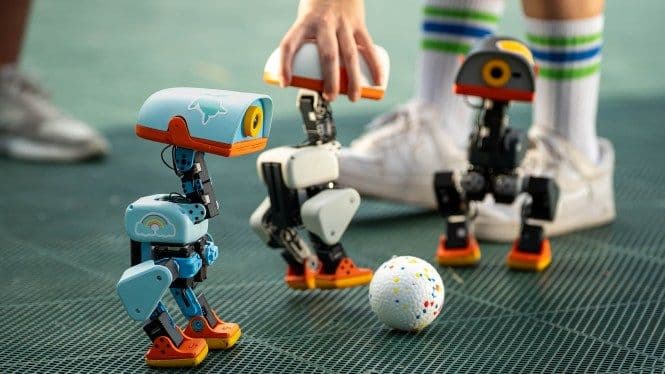
Hottest toy for Christmas? Nvidia CEO plays with adorable Microduck robots, 20,000 sell
Earlier this week, a video of Nvidia CEO Jensen Huang playing with a flock of waddling Microducks during his keynote at the company’s GTC Berlin conference went viral. The robots, stomping their little feet and making tiny R2-D2 noises, sat, fell down dead for a “nap,” and summersaulted on voice command. They were so darn cute that by the next day, preorders of the Microducks surpassed 20,000 units, Hugging Face’s Clem Delanguesaid in a tweet. The Microducks are expected to be delivered in time for Christmas, meaning these robots might already be on their way to becoming the hottest toy for the holiday season. Delangue thinks they might end up being the best-selling robot of the year, and possibly not even for kids. The promotional videos showadults playing with them, too. Microducks are open-source devices produced by Pollen Robotics, a company acquired by Hugging Face in 2025, which means they are now a Nvidia company. The GPU giant bought Hugging Face in September. This is actually Hugging Face’s second robot, after thealso-cute Reachy Mini. Microducks were trained using Nvidia’s technology stack, where in simulations of them were taught basic tricks (walk, sit, stand, etc.) that they ship with. Pollen says that owners can train their robots with new tricks and then share them with the community. Here’s the video below. Enjoy it as a palate cleanser after the scary black eyethe AI industry gave itself this week, as AI involvement was blamed for cyberattack after cyberattack. OK, AI might seriously damage the world. But it can be fun, too. It’s hard to watch this video without ordering one. When@jensenhuangasks for a somersault, you deliver. 🦆See how AI agents on NVIDIA RTX Spark help bring@huggingface's Microduck from simulation to the real world.pic.twitter.com/W6qidApR2O
View

Canva Craft Image Generator Now Available Globally With Support for 55 Languages, 30 Aspect Ratios
Canva has launched Craft, its first AI image generation model developed by its in-house research team, Canva Research. It is now available to Canva users worldwide and can also be accessed by developers through a public API. Craft can generate images at up to 2K resolution, work with more than 30 aspect ratios and create text in 55 languages. Canva says the model ranked fourth overall on DesignArena, where users compare AI-generated designs, and topped the rankings in two image categories, namely People and Portraits, and Landscapes and Nature.
View

OpenAI’s GPT-6 Luna-Powered Decisions API Is Now Generally Available for Developers With Native GPT-Live Integration: Price, Capabilities
OpenAI's Decisions API has been available in public beta for a while. Now, the Sam Altman-led tech giant has announced that its Decisions API is now generally available to users. The specialised model interface allows developers to use the tool to build their AI agents and apps, enabling the software to answer recurring questions and make small decisions. Decisions API can use images, text, and other structured JSON inputs from developers. It is powered by OpenAI's GPT-6 Luna AI Model. The company says that Decisions API now ships with native GPT-Live integration, too. Since its public beta release, the company has also added prompt caching for reused context in select markets.
View

