🚀 Zaprep: Your Socials on Steroids. 免费开始 — 每月自动发送 1,000 条私信,将互动转化为潜在客户。 ,每月 1,000 条自动私信。
最新 AI 资讯

SpaceX’s AI business is beating expectations
SpaceX’s data centers and Grok agents were more profitable than investors expected in third quarter of the year, as the company leaves its roots as a space company behind to focus on artificial intelligence, which now makes up 52% of its income. CEO Elon Musk’s deep tech conglomerate reported $14.6 billion in third-quarter revenue on Tuesday, according to itsregulatory filing. That number was driven by growth in all segments, but especially its renamed “Super Intelligence” business line, which generated $7.5 billion in revenue from the recently acquired Cursor coding tool, Grok bot, and most importantly, the company’s burgeoning neocloud business, which now boasts 1.7 GW of compute. The AI business generated $431 million in profit, which would have been higher without $1.2 billion in one-time stock-based compensation expenses related to the Cursor acquisition. The top-line revenue number was also boosted by about $1 billion in income related to the recovery of Bitcoin prices and unspecified related-party income that might be attributed to a SpaceX investment in another company. The growing revenue is balanced against total capital expenditures of $19.6 billion, as SpaceX continues to build out a second data center project, Colossus II, and increase investment in Starship, the heavy-lift rocket it sees as vital to deploying a new generation of Starlink satellites and developing orbital data centers. CFO Bret Johnsen said the company would spend $35 billion to $40 billion on new capital investments in the fourth quarter. During a live-streamed discussion of the results with investors, Musk said he was spending four days a week in Memphis, Tennessee, the site of Colossus II, working to bring the data center online. “People are starting to realize [that] the constraint on deployment of of super intelligence is more in power and cooling and infrastructure than it is in chips,” Musk argued, saying that he had tasked a team of SpaceX engineers to solve that problem. “This is a bit like the New York Yankees playing in Little League. It’s not fair, but the net result is being able to deploy power cooling infrastructure at a rate that is vastly faster than any anyone else.” In one example, Musk noted that manufacturers of turbines to power data centers are facing 12 to 18 month delays in obtaining the metals blades and vanes required for those machines. Now, SpaceX is using the metal casting capabilities developed for SpaceX to make those components and obtain turbines more quickly. Musk also said that the next test flight of the Starship rocket, expected in November, would see SpaceX attempt to recover both the first-stage booster and the second stage. Recovering both segments of the vehicle would be a “massive technology milestone,” Musk said, but the true milestone will be reflying both stages. SpaceX also saw growth in subscribers to its Starlink space internet network, reaching 13.6 million consumers, with Musk predicting that the growth of AI agents would lead to more demand for connectivity. Despite of those capital expenditures, the company’s revenue boost was substantial enough to push it back into profitability. SpaceX reported net income of $4.4 billion, a turnaround from the $1 billion loss in the same quarter last year. It will still have some catching up to do if it wants to remain profitable for the year, however. In the first nine months of the year, SpaceX still had a net income loss of $413 million. Musk took a particularly bullish stance on the company’s Super Intelligence business segment, predicting that SpaceX’s annual recurring revenue by the end of 2027 will be “somewhere between $500 billion and $1 trillion.” More concretely, Johnsen forecast total revenue for the first quarter of 2027 in the range of $33 billion to $37 billion. This is a developing story. TechCrunch will update.
View

Anthropic’s cloud partnerships are getting messy
Anthropic is having trouble securing enough cloud capacity from AWS, Google, and Microsoft, which increasingly see the Claude-maker as a competitor rather than a customer, according to an S-1 filing leaked toThe Wall Street Journal. The leaked filing provides more color to the numbersReutersand theFinancial Timesreported in late September, including that Anthropic believes it could spend more $750 billion on cloud contracts, some of which includes deals still in negotiation. And still, that is not enough. Anthropic is leasing its own data centers and working with third-party data center operators. But the firm worries those operators have a “limited operating history,” which could make them less reliable than the hyperscalers. Anthropic’s enormous spend comes on the back of an $80.7 billion net loss in the first half of the year. The company reported $16.3 billion in revenue during that same time period, with only two customers accounting for about a fifth of sales, according to the WSJ report. Building on previously reported catastrophic risk disclosures, the filing also warns that Anthropic could be held liable for damages caused by harmful AI behavior to a tune that would exceed available insurance coverage. Last week, the company told prospective investors that third-quarterrevenue alone has now reached $16.8 billion, up 45% from the previous quarter. Anthropic isreportedlytargeting a November IPO. Anthropic did not immediately respond to TechCrunch’s request for comment.
View
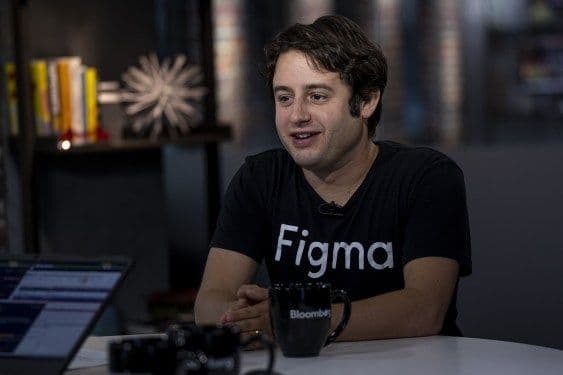
Figma co-founder Dylan Field thinks MCP is not a perfect protocol
Despite Figma co-founder Dylan Field’s concerns about MCP (model context protocol), which standardizes how AI agents connect to external data sources and tools, the company is expanding its support for the open source standard. At the design company’s first Config conference held in India, the company announced 20 new MCP partners, including Amp, ClickUp, Dia, Junie by JetBrains, Linear, Meta Muse, Mistral, Notion, OpenCode, and Sarvam Agents. Field has expressed his misgivings about MCP before. Days before this announcement, one of MCP’s co-creators complained about Figma not supporting the open source tool Pi. As part of his response, Field made a comment about Anthropic not making its various resources available via MCP. “I find it interesting that Anthropic (creators of MCP standard) do not expose artifacts/other cloud resources created via MCP,” he wrote on X. “The debate is framed as open vs closed. Everyone always prefers open … obviously. And meanwhile issues of asymmetric context sharing are ignored.” (Field later added thatFigma plans support Pi.) Can you help me understand why you don't make various Anthropic resources available via MCP? Maybe I'm missing something. At a media briefing, I asked Field about this debate. The co-founder explained that while Figma wants to be open, he doesn’t think MCP is a perfect protocol. “I’m really excited about what we’re doing in terms of opening up our ecosystem. I also think that MCP is not a perfect protocol. And I think that it is something that has tons of room for improvement,” the co-founder responded. “It is advantaged more to frontier labs. Also, I understand everyone online who just wants a protocol that they can use when they want to use their Figma data, and I want them to use it, too.” Figma’s CEO said that the reason the company doesn’t want to be fully open is that the more data the company exposes through MCP, the higher the chance of abuse. He also clarified that while most users don’t intend to use MCP or Figma data in a malicious way, the company still has to think about those potential risks.
View
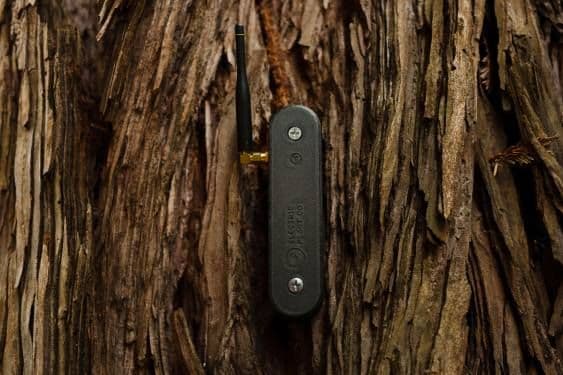
Plants can speak using electricity, so this startup built an AI model to decipher their language
Justin Mast’s life was changed by a cyborg plant. A few years ago, Mast was reading through some scientific literature when he stumbled upon research about ahouseplant wired to a motorized stand. When the plant wanted more light, electrical signals flowed through the living tissues. A control board sensed the current and wheeled the plant closer to the light source. “I’m like, what the heck?” Mast told TechCrunch. “That was the entry to the rabbit hole for me.” Mast wound up partnering with Lee von Kraus, a neuroscientist who has worked with DARPA, to foundElectric Plant, which has been spending the past three years collecting data to build a large language model, Bombadil, capable of interpreting the subtle electrical signals coursing through a plant’s stem and relaying details about the plant’s needs to growers. The founders believe their model could one day lead to a tool that would let people “speak” to plants. “We’re listening more than we’re speaking, but listening’s the first step,” said Mast, co-founder and CEO of Electric Plant. To bring its sensors and Bombadil to market, Electric Plant recently raised an $11.2 million seed round led by Onto Ventures and Climactic, with participation from Ponderosa, Endeavor Catalyst, Ludlow, Michigan Rise, The Fund, Schox VC, and Dug Song. Even in the most controlled greenhouses, farmers and growers don’t have full visibility of what their plants require, Mast said. Traditionally, farmers, growers, and foresters have relied on coarse tools that react to plants’ demands for water, nutrients, or light. And tools like soil probes, handheld spectroscopes, and satellite imagery work well enough, but they leave much to be desired, Mast said. “That technology is sophisticated, but its ability to get at the inside of the plant isn’t very sophisticated. Most of that stuff still lags quite a bit behind the real-time needs of the plant,” he said. Electric Plant had to start somewhere, though, so it used those devices to train its Bombadil model, which is capable of interpreting electrical signals in about 125 different species. “We know the model will surpass a lot of that equipment,” Mast said. The startup’s sensors are also significantly cheaper than existing tools, which generally cost thousands of dollars. “This is tens of dollars,” he said. The sensors, about the size of a regular iPhone folded lengthwise, are attached to a plant using stainless steel screws. The screws must penetrate the cambium — the layer of living tissue just under the bark — to connect to the microvolt changes occurring within the plant. Data collected from these sensors is sent to a base station via a low-power wireless network. Electric Plant only needs a couple sensors per acre for accurate results, Mast said. The data gets interpreted by Bombadil in the cloud, and the results are sent back to the customer, who can use it to, for example, adjust their watering or fertilizer schedules. Mast claims such a system can boost yields while reducing water use by 20% or more. Mast wouldn’t disclose who Electric Plant’s initial customers are, but it’s easy to imagine applications in agriculture and forestry. Bombadil’s first hundred-plus species runs the gamut of plant forms, from ferns, redwoods, and tomatoes to dahlias, Mast said. “This is the most diverse model ever created on biological electrical signals,” he said. “No one’s ever done anything equivalent to this in the animal world.”
View

Meta’s Muse hits 10M U.S. downloads in 40 days, a milestone reached by only 11 other apps
Meta’s AI companion,Muse, is now one of only a dozen mobile apps to have reached 10 million U.S. downloads in its first 40 days on the market. According to new data from market intelligence providerSensor Tower,Muse has seen 10.9 million downloads since its September debut, 10.2 million of which were in the United States. Only 11 other apps to date have reached this type of post-launch milestone, said Sensor Tower’s Senior Insights Analyst Kara Lee. The most recent of these was Meta’s Threads, back in July 2023. Other apps that saw this kind of scale were largely mobile games, Lee noted, like Fortnite, PUBG Mobile, Pokémon GO, and others. Besides Threads, Disney+ was the only other non-game app to make it into the exclusive club. Meta’s success is tied to the company’sability to scale its new appsby marketing them across its other services, which it has done with bothThreadsand Muse. Threads was built on top of Instagram’s social graph, and its content has beenintegratedinto both Facebook and Instagram. However, Muse isn’t only benefiting from Meta’s ability to market the AI agent across its family of apps, which today includes 3.6 billion daily active users; the company is also heavily investing in advertising to drive new users to Muse. Per Sensor Tower’s data, Meta has allocated 39% of its total advertising spend to market Muse in October, up from 23% last month. In addition, Muse now ranks as the 21st largest brand in the U.S. by advertising impressions this month, up from 73rd in September. Still, marketing an app and retaining users after the initial shine wears off are two different things. In this case, Muse is seeing better retention rates than its AI competitors like ChatGPT, Claude, and Grok. In the U.S., the app had a 30% retention rate after 7 days and a 23% retention rate after 14 days. By comparison, its rivals saw an average of a 19% 7-day retention rate and a 16% 14-day retention rate, according to the firm’s data. Muse also hit another milestone that demonstrates active engagement with the AI app. Its daily active users reached 2.5 million for the first time on October 16, a 15% week-over-week increase. Meta’s latest AI app, which can handle various tasks on users’ behalf, has seenbreakout successsince its debut. It shot up to No. 1 on the App Store, and, at one point, evenoutpaced some of the metricsChatGPT saw following its launch. Its latest milestone sees it topping its rivals again, as ChatGPT saw 3.7 million U.S. downloads in its first 40 days on the market. Grok and Claude saw only 500,000 and 200,000 U.S. downloads, respectively, in their first 40 days. Globally, ChatGPT beat out Muse, having scaled to around 15 million global downloads in its first 40 days. But this isn’t a fair comparison, as ChatGPT benefited from a wider reach. Muse is only available in the U.S. and Canada for now, while ChatGPT’s app attracted attention from markets like Japan, Brazil, and Germany, too. (Japan, for instance, accounted for 25% of its global installs during its first 40 days.) Since launching, Muse has retained its No. 1 rank on the U.S. App Store for all days except October 19, when streaming app Kick briefly beat it out. It has since reclaimed the top spot as of Tuesday. Muse has also been No. 1 on Google Play over the past 30 days.
View

Eric Schmidt reportedly owns about half as much of Anthropic as CEO Dario Amodei
Eric Schmidt’s fortune is about to get even bigger. The former Google CEO is reported to ownabout 1% of Anthropicafter investing tens of millions of dollars in the leading AI lab’s Series A round in 2021, according to Bloomberg. The startup was valued at $461 million at the time, according to PitchBook data. If Bloomberg’s estimate is accurate, Schmidt’s stake is remarkably large compared with the2% of the companythat co-founder and CEO Dario Amodei holds. Anthropic is widely expected to go public before the end of the year, with top-end market estimates valuing the company at as much as $2 trillion. At that valuation, Schmidt would add as much as $20 billion to his net worth, which Bloomberg currently puts at $57.5 billion. Schmidt has been an active tech investor since stepping down as Google CEO in 2011. He deploys capital through multiple entities, including Tomorrow Ventures, Innovation Endeavors Management, and his family office, Hillspire. His other AI bets include Mistral, General Intuition, and Reflection AI. Schmidt and Anthropic didn’t immediately respond to our request for comment.
View
Otter.ai raises $320 million from General Catalyst’s growth fund for its meeting tool
Meeting note-taking toolOtter.aiannounced on Tuesday that it has raised $320 million from General Catalyst’s Customer Value Fund (CVF), which provides capital to startups without diluting equity and gets returns on the results of marketing spend. Otter.ai said that it will use these funds for enterprise growth, go-to-market strategy, international expansion, and product innovation. The startup, which has been around for nearly a decade, has raised $50 million in total funding with its last round in 2021, according to PitchBook data. Last year, Otter hit a revenue milestone after crossing$100 million in annual recurring revenue (ARR). The company said it’s now approaching new milestones, but didn’t provide updated figures. The company said that 40 million users have used its product to date, up from 25 million last year. However, given the crowded space among meeting note-taking products, a pertinent challenge for Otter would be to have its customers stick around. Unfortunately, the startup didn’t provide any numbers around its monthly active users or churn. “Voice is one of the biggest untapped opportunities in enterprise AI, and Otter is at the forefront of it – a conviction that’s only deepened watching Otter’s growth,” said Pranav Singhvi, Partner and Co-founder of CVF, General Catalyst. “When Otter enables enterprises to capture critical voice data and turns it into actionable business insights, teams move faster, decisions get sharper, and productivity compounds across the organization, and that’s why it’s a strong partner for CVF.” There is a lot of competition in the market with well-funded meeting notetakers like Fireflies.ai,Granola, andRead AI; new entrants likeCalendly,Wispr, andSuperhuman, which acquired Fathom; and other notetakers like Circleback, Talat, and Quill. Most of these notetakers want to connect to enterprise systems and, based on data captured in meetings, automate workflows. Otter is also heading in that direction. In the last few years, it introduceda meeting assistant,a search function that works across apps, andintegration with other AI tools. Otter’s newly appointed CMO, Alex Gay, who comes from Superhuman, told TechCrunch at a sit-down at the HumanX conference last month that the company sees a big opportunity in turning transcripts into an actionable roadmap for people who are in back-to-back meetings. “When we start thinking about what is actually the bigger problem that people are facing right now, we saw this large pain point in meeting-heavy roles, where people are back-to-back in conversations. These meetings are the work for them. That’s either customer conversations or, from a sales standpoint. That’s where strategies are discussed. But meetings are terribly inefficient because when you come into a meeting, you spend the first twenty minutes recapping what was said before to catch everybody up,” he said. The company is now experimenting with providing insights before, after, and during meetings. It has been testing a feature to send a pre-brief to users with details and background information, with context from previous conversations across surfaces. Plus, it is also trying out a Live Assist feature to let users ask questions to the AI assistant during the meeting to get knowledge.
View

Yelp can now call on your behalf to check wait times at a restaurant
Over the last few weeks, personal assistants like Instinct, Fo, and Muse have enabled users to call businesses for customer support and appointment booking. Following this trend, Yelp is adding the ability for its app users to get a voice agent to call a restaurant to check wait times. The new feature, Check for Me, will show up on restaurant pages in the app, where users can enter their party size and phone number. The AI agent then calls on behalf of the user to check wait times and texts them the results to decide if they want to go to that particular restaurant. Last year, Yelp debuted itsvoice solution for restaurants and service providers. With this new feature, the discovery platform is fulfilling the consumer side of the equation, though there is a possibility that a user’s agent will talk to the restaurant’s agent, and agent-to-agent communication might break down the conversation. The company is also updating its Yelp AI assistant that helps users discover restaurants and services. With the new OpenTable integration, users can easily book a restaurant without leaving the app. Yelp is adding better personalization to its assistant by having it remember preferences that you might have mentioned in previous chats. Plus, you can access your chat history from the past 30 days in the app, with full history available soon. Users can ask the chatbot to set custom reminders, such as sending suggestions for weekend activities every Friday. The company is also letting users build their own lists, starting with two “Been Here” and “Want toGo” lists. You can filter your lists by location, category, and cuisine, reorder, add notes to items, and share them with others. Next month, the company will start showing weekly personalized recommendations based on your saved items and rankings. Yelp is also working on converting collections to lists and giving the lists tab a new look, rolling out later in the year, along with a maps view. To cap off all these changes, Yelp has been thinking about enhancingcustomer supportandbusiness processesthrough AI. In the new update, the company is releasing a new paid product called Smart Lead Reply, which can reply to customers and engage with them to qualify a lead. Business owners, who will be charged $30 per month for these services, can specify how an agent should handle a conversation with a customer. Other companies like Meta have also been courting small businesses withAI offerings to handle inbound customer inquiries.
View
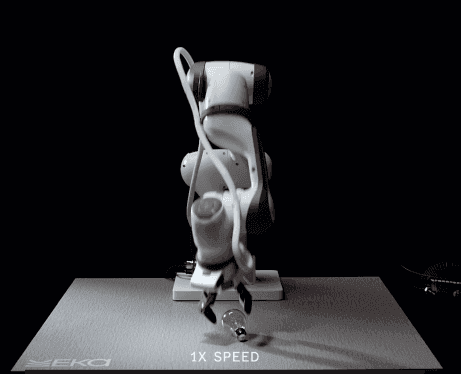
Eka is worth $1.45B thanks to a physical AI model that has experts raving
Robots still aren’t that good at picking things up, despite billions of dollars of investment and endless videos fed into deep learning models. That may be about to change, thanks to a manipulation architecture built by Eka Robotics, which encompasses a force-sensitive gripper and a new kind of deep-learning model. Founded by MIT professor Pulkit Agrawal and former Google DeepMind researcher Tuomas Haarnoja, the startup just closed an $150 million Series A round that values it at $1.45 billion post-money, led by venture funds a16z and F-Prime. “They are already exceeding superhuman performance for certain tasks, and so we think over the next few months there will be superhuman performance in many dexterous manipulation tasks,” Raghu Raguram, the a16z general partner who co-led the fundraising round, told TechCrunch. In an era of never-ending robotic demonstrations, Eka’s capabilities are shocking veteran robot builders. Kris Hauser, a professor at the University of Illinois Urbana-Champaign, said it had a “wow factor” compared to other robot demos he saw recently. The Eka robot “was able to adapt to a large number of different objects without retraining,” Hauser said, adding that it also had an aspect of “humanness, creepy humanness that it would try over and over again if it failed the first time.” Another roboticist, who asked for anonymity because of their work at a frontier lab, told TechCrunch that seeing Eka’s robot in action was an emotional experience, comparable to when robots first achieved reliable legged locomotion five to ten years ago. Take a look for yourself: Loading the player… What’s notable here? How smoothly and rapidly the robot moves. It can pick up about 1,500 objects that weigh up to 1 kg in an hour, compared to about 600 for a human; Eka says it reliably picks up objects more than 95% of the time. And the robot arm is strong enough to hurt itself as it moves that quickly. That indicates, per the frontier lab observer, that “they have a lot of trust in their algorithm not breaking the robot. I wonder how many robots they broke along the way?” When the frontier lab roboticist met Eka’s robot, they handed it a raspberry, the lab’s apparent favorite test item. “The experience of a big, heavy robot rushing towards my arm and then slowing down just in time and very gently touching me is a feeling that I am, as we speak, carrying this feeling in my body,” they told TechCrunch. These capabilities are a consequence of how the foundational model was built. Rather than a vision-language-action model — which is trained to understand the relationship between language, visual inputs, and actions — the schema here is a vision-force-action model, which focuses on the relationship between language, force inputs, and actions. Critics of the current direction of generative AI robotics models,like Rodney Brooks, say that they will fail without an attempt to represent force and touch; Eka’s results suggest such critics have a point. “Vision is not the primary way in which you close this last millimeter problem,” Eka co-founder Agrawal told TechCrunch. “Vision tells you roughly where the object is, what the pose is, but the actual grabbing, the actual searching is happening through forces.” Eka had to design a unique robotic hand that was more flexible than traditional grippers, and included more force sensors; it reacts to contact, which is why it doesn’t crush the raspberry. The founders are cagey about how they achieved that for obvious competitive reasons, but it comes down to using a physics simulator to model the multiple forces the robot will encounter as it attempts to grasp something, and using that to create a reinforcement learning environment that can be run at scale. They say they can generate thousands of hours of robot experience in minutes. “Rather than being limited to the data that you’re collecting from, say, human demonstrations, Eka is pushing through reinforcement learning this approach where the robot can surpass any kind of demonstrations that are given to it,” Hauser said. “What’s really exciting is that they’re able to not be limited to the data that is presented to them for training.” Agrawal and Haarnoja, who first met in graduate school at the University of California, Berkeley, are leading researchers in the field of reinforcement learning for robotics control. Eka’s key bet was that this technique could be done at scale through simulation, rather than relying on videos collected by gigworkers or robot operators performing tasks over many hours. Simulation was key to achieving their robot’s reliable manipulation, a feat that in the past that has proven more difficult for tasks that require interacting with objects, rather than avoiding them. “What EKA is bridging is the generality-performance gap, which plagues a lot of modern robotics,” Agrawal argues. Right now, the most generalizable physical AI models—the ones that can attempt lots of different tasks—aren’tparticularly goodat them. But AI models trained to be highly capable at a single task may not close the business case for a company: The promise of generative AI is that robots can quickly learn multiple tasks, even novel ones. The current approaches are good at producing robots that are more generally intelligent than before — Astra, ChatGPT’s latest LLM, canoperate a robotin an unfamiliar setting and perform tasks with it, but slowly and at a high cost. The promise of a model like Eka’s is that it handles the physicality while a more general model makes decisions about how to solve a problem. Astra, for example, might know that plates get stacked in a cupboard when they come out of the dishwasher, but Eka’s model is capable of picking up a dish without breaking it. “Most of the field has been focusing on the planning,” Eka co-founder Haarnoja says, “so they approach from the top: high-level intelligence, pushing that down towards the physical. Whereas we think about it from the bottom up.” Eka still needs to prove itself in the field, though. The company is working in secretive pilots with a number of industrial customers doing pick-and-place and wire manipulation, but the leap from lab to line is almost as big as the gap between sim and real. “What’s going to be a big challenge is when they work with integrators on real assembly lines, and it needs to run without breaking for an entire year,” Hauser said. The other open question is “‘how generalizable these techniques can be to different tasks?’ What I’ve seen is pick and place, but many industry tasks that are value added involve more than just pick-and-place.” Agrawal is also focused on deployability; right now, he says Eka’s gripper hardware — which costs less than $1,000 — is rated for 5 million duty cycles, but the ultimate goal is to hit the 20 million cycle bar set by standard industrial arms. “What we are building is that engineering of how to design entire workflows, but we are starting off being very pragmatic, and saying here are two verticals in pick, arrange, place, and wire handling, let’s make them be home runs,” Agrawal said. “Once we have made home runs on them, the sky is the limit in how much we can do with the approach we are developing.”
View
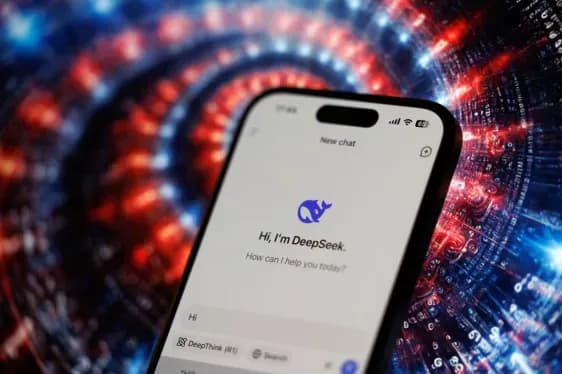
US orders federal agencies to remove China’s DeepSeek AI from their systems
The U.S. has ordered federal civilian agencies to stop purchasing services and products developed by Chinese AI startupDeepSeekand remove them from government IT systems over national security concerns tied to the Chinese AI startup’s operations in China, according tothe Department of Homeland Security.The order goes beyond banning DeepSeek’s own product, butalso coversthird-party products and services built using DeepSeek technology, though agencies can request exceptions. The DHS raised concerns about DeepSeek’s handling of user data, warning that sensitive information from US government users could potentially be accessible to Chinese authorities under Chinese law,the order said. The move comes amid intensifying tech competition in AI between the US and China. The Chinese AI model challenges its U.S. rivals, including OpenAI and Meta, with low-cost open-weight models. China pushed back against the U.S.’s move. Foreign Ministry spokesperson Mao Ning said Tuesday that Beijing opposes “overstretching the concept of national security and politicizing technology and trade issues,” according toan official briefing.“We will resolutely safeguard the legitimate rights and interests of Chinese enterprises,” the spokesperson added. The U.S. has already taken steps to limit DeepSeek’s use in government. A law passed in December 2025 targeted its use in intelligence’s national security systems. The latest order extends the restrictions to federal civilian agencies, covering both new purchases and existing IT systems. Meanwhile, China is reportedly considering export restrictions on 23 AI-related technologies, including chip designs and certain advanced AI models, to address security and misuse risks,Bloomberg reported last week. The Chinese AI lab has faced scrutiny from governments and regulators across theglobesince its R1 reasoning modelshook the AI industry inJanuary 2025, triggering a sharp sell-off inNvidia shares. The U.S. accused DeepSeek and five other Chinese AI companies, including Alibaba and Moonshot AI, of using large-scale model distillation to extract information from American AI systems, according toa September report. In addition, OpenAI and Anthropic have separately raised concerns about DeepSeek’s alleged use of model distillation, a technique that uses outputs from one AI model to train another. Earlier this year,OpenAItold U.S. lawmakers it had observed suspected attempts by DeepSeek to distill its models, whileAnthropicsaid it had identified unauthorized attempts by DeepSeek and other Chinese AI labs to collect outputs from Claude.
View

Why Enterprise AI Prototypes Break in Production
At Cypher 2026, Tiger Analytics executives explained why moving generative AI from a working prototype to production requires more than getting the model to produce the right answer.
View

Anyone Can Make a Robot Move, Few Can Make It Stop
Robotic companies are building safeguards for AI-powered robots, but unpredictable environments still challenge industrial deployment.
View

