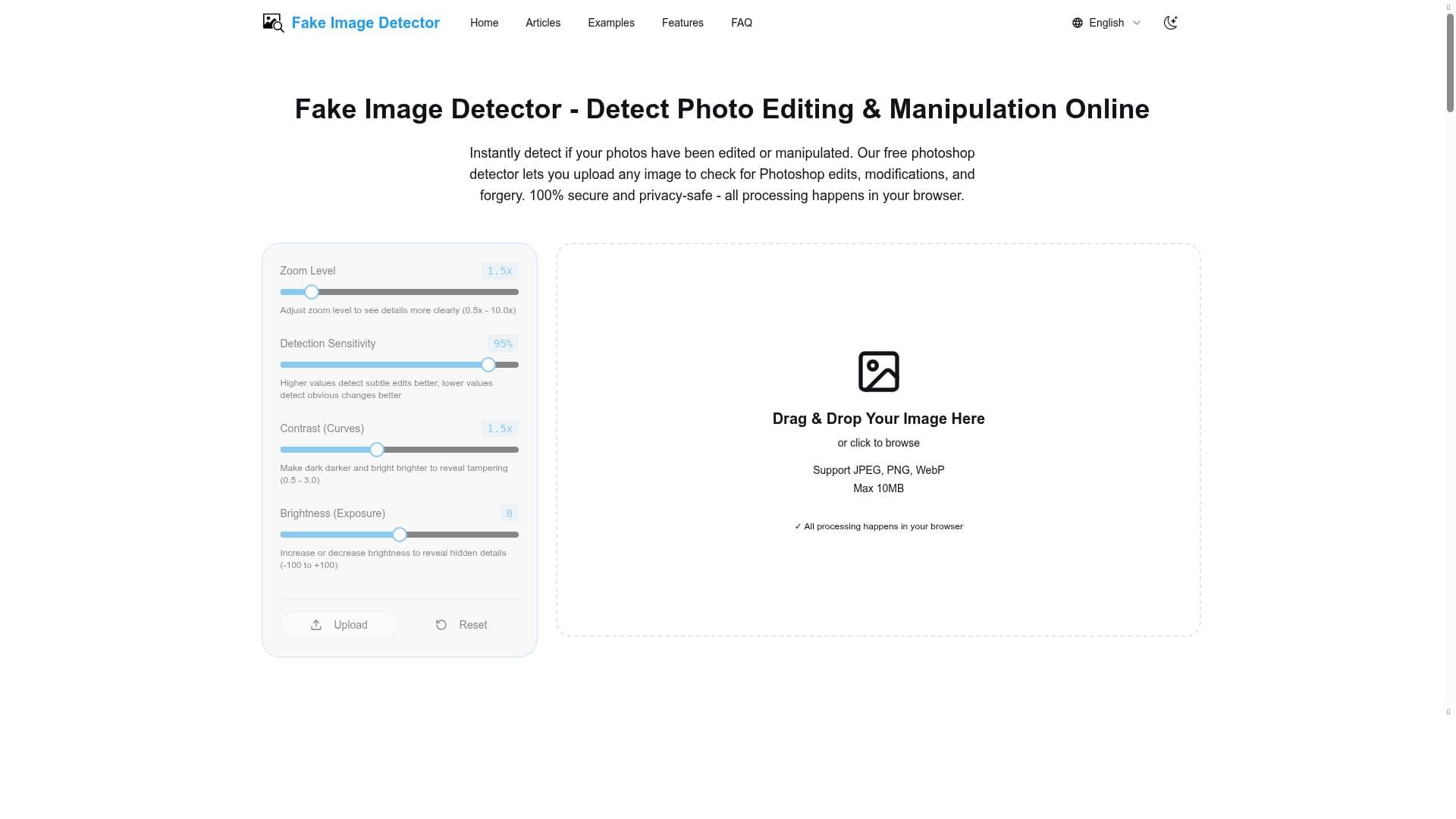


Fake Image Detector leverages advanced algorithms to identify manipulated or fake images, making it an essential tool for journalists, social media users, and digital content verifiers. Its user-friendly interface and detailed analysis reports empower users to quickly assess image authenticity across various platforms.

Description
Fake Image Detector is a tool designed to identify and analyze images to determine their authenticity. It helps users detect manipulated or fake images by leveraging advanced algorithms and image processing techniques. This tool is essential for verifying the credibility of images in various contexts, including social media, news, and digital content verification.
Detailed Description
Fake Image Detector is a specialized AI-powered tool designed to identify and analyze images to determine their authenticity. In an era where digital content is proliferating rapidly and manipulated images are increasingly common, this tool serves as a critical resource for verifying the credibility of visual media. Its core purpose is to help users detect fake or altered images by leveraging advanced image processing algorithms and sophisticated detection techniques. Whether you are a journalist verifying news photos, a social media user wary of misinformation, or a digital content creator ensuring originality, Fake Image Detector provides a reliable solution to assess image integrity. The tool boasts several key features that enhance its effectiveness and user experience. At its core, Fake Image Detector uses cutting-edge image processing algorithms to analyze various aspects of an image, such as inconsistencies in lighting, shadows, textures, and metadata anomalies that often indicate manipulation. It supports verification of images sourced from social media platforms and news outlets, where image authenticity is frequently questioned. Users receive detailed analysis reports that break down the findings, highlighting suspicious elements and providing a confidence score regarding the image’s authenticity. The interface is designed to be user-friendly, making it accessible to both technical and non-technical users. This ease of use ensures that anyone can upload an image and quickly receive a comprehensive authenticity assessment without needing specialized knowledge. Fake Image Detector is ideal for a wide range of users and use cases. Journalists and fact-checkers can utilize it to verify the authenticity of images before publishing, thereby maintaining the integrity of their reporting. Social media users and influencers concerned about misinformation can use the tool to scrutinize images before sharing them. Legal professionals and investigators might also find it useful for examining evidence images. Additionally, educators and researchers interested in digital literacy and media verification can incorporate it into their workflows. Its versatility makes it a valuable asset in any context where image authenticity is paramount. Regarding pricing, Fake Image Detector operates on a freemium model. This means that users can access basic features for free, which is suitable for casual or occasional use. For more advanced capabilities, such as detailed analysis reports or bulk image verification, premium plans are available. These paid tiers cater to professionals and organizations requiring higher volumes or more in-depth analysis. The freemium approach allows users to evaluate the tool’s effectiveness before committing financially. When compared to alternatives, Fake Image Detector stands out due to its combination of advanced algorithmic analysis and user-friendly design. While some competing tools may focus solely on metadata or rely on manual inspection, Fake Image Detector integrates multiple detection methods to provide a more comprehensive assessment. Its support for images from diverse sources like social media and news platforms further enhances its applicability. However, like all AI-based detection tools, it is not infallible and should be used as part of a broader verification process. Notable limitations include potential challenges with highly sophisticated image manipulations that evade current detection algorithms. Additionally, the accuracy of the tool can be influenced by the quality and resolution of the uploaded images. Users should be aware that while Fake Image Detector significantly aids in identifying fake images, it is not a substitute for human judgment and corroborative verification methods. Overall, Fake Image Detector is a powerful, accessible, and essential tool for anyone needing to verify image authenticity in today’s digital landscape.
Tool Features
- Detects fake or manipulated images
- Uses advanced image processing algorithms
- Supports verification of images from social media and news
- Provides detailed analysis reports
- User-friendly interface
Description
Fake Image Detector leverages advanced algorithms to identify manipulated or fake images, making it an essential tool for journalists, social media users, and digital content verifiers. Its user-friendly interface and detailed analysis reports empower users to quickly assess image authenticity across various platforms.
Fake Image Detector is a tool designed to identify and analyze images to determine their authenticity. It helps users detect manipulated or fake images by leveraging advanced algorithms and image processing techniques. This tool is essential for verifying the credibility of images in various contexts, including social media, news, and digital content verification.
Detailed Description
Fake Image Detector is a specialized AI-powered tool designed to identify and analyze images to determine their authenticity. In an era where digital content is proliferating rapidly and manipulated images are increasingly common, this tool serves as a critical resource for verifying the credibility of visual media. Its core purpose is to help users detect fake or altered images by leveraging advanced image processing algorithms and sophisticated detection techniques. Whether you are a journalist verifying news photos, a social media user wary of misinformation, or a digital content creator ensuring originality, Fake Image Detector provides a reliable solution to assess image integrity. The tool boasts several key features that enhance its effectiveness and user experience. At its core, Fake Image Detector uses cutting-edge image processing algorithms to analyze various aspects of an image, such as inconsistencies in lighting, shadows, textures, and metadata anomalies that often indicate manipulation. It supports verification of images sourced from social media platforms and news outlets, where image authenticity is frequently questioned. Users receive detailed analysis reports that break down the findings, highlighting suspicious elements and providing a confidence score regarding the image’s authenticity. The interface is designed to be user-friendly, making it accessible to both technical and non-technical users. This ease of use ensures that anyone can upload an image and quickly receive a comprehensive authenticity assessment without needing specialized knowledge. Fake Image Detector is ideal for a wide range of users and use cases. Journalists and fact-checkers can utilize it to verify the authenticity of images before publishing, thereby maintaining the integrity of their reporting. Social media users and influencers concerned about misinformation can use the tool to scrutinize images before sharing them. Legal professionals and investigators might also find it useful for examining evidence images. Additionally, educators and researchers interested in digital literacy and media verification can incorporate it into their workflows. Its versatility makes it a valuable asset in any context where image authenticity is paramount. Regarding pricing, Fake Image Detector operates on a freemium model. This means that users can access basic features for free, which is suitable for casual or occasional use. For more advanced capabilities, such as detailed analysis reports or bulk image verification, premium plans are available. These paid tiers cater to professionals and organizations requiring higher volumes or more in-depth analysis. The freemium approach allows users to evaluate the tool’s effectiveness before committing financially. When compared to alternatives, Fake Image Detector stands out due to its combination of advanced algorithmic analysis and user-friendly design. While some competing tools may focus solely on metadata or rely on manual inspection, Fake Image Detector integrates multiple detection methods to provide a more comprehensive assessment. Its support for images from diverse sources like social media and news platforms further enhances its applicability. However, like all AI-based detection tools, it is not infallible and should be used as part of a broader verification process. Notable limitations include potential challenges with highly sophisticated image manipulations that evade current detection algorithms. Additionally, the accuracy of the tool can be influenced by the quality and resolution of the uploaded images. Users should be aware that while Fake Image Detector significantly aids in identifying fake images, it is not a substitute for human judgment and corroborative verification methods. Overall, Fake Image Detector is a powerful, accessible, and essential tool for anyone needing to verify image authenticity in today’s digital landscape.
Frequently Asked Questions
What is Fake Image Detector?
Fake Image Detector is an AI-powered tool designed to analyze and verify the authenticity of images by detecting signs of manipulation or fakery using advanced image processing algorithms.
How much does Fake Image Detector cost?
Fake Image Detector offers a freemium pricing model, providing basic features for free and premium plans with advanced capabilities and bulk verification options available for paid subscribers.
Who is Fake Image Detector best for?
It is best suited for journalists, fact-checkers, social media users, digital content creators, legal professionals, and anyone needing to verify the authenticity of images in various contexts.
What are the main features of Fake Image Detector?
Key features include detection of fake or manipulated images, use of advanced image processing algorithms, support for images from social media and news sources, detailed analysis reports, and a user-friendly interface.
Does Fake Image Detector offer a free trial?
Yes, the tool operates on a freemium model, allowing users to access basic features for free without a time-limited trial period.
What integrations does Fake Image Detector support?
While primarily a standalone web-based tool, Fake Image Detector supports image verification from various online sources including social media and news platforms, though specific third-party integrations are not detailed.
How does Fake Image Detector work?
It analyzes images using advanced algorithms that examine inconsistencies in lighting, shadows, textures, and metadata to detect signs of manipulation, then provides a detailed report indicating the likelihood of the image being fake.
Reviews
No reviews yet. Be the first to share your experience.