

Is this your AI tool? Claim it today.
Verify ownership, manage your profile, and unlock growth features.
Cron AI transforms natural language scheduling into precise cron expressions, making cron job creation effortless for developers, sysadmins, and non-technical users alike. Its intuitive interface and support for diverse time intervals streamline automation setup without requiring cron syntax expertise.

Description
Generate cron jobs by just describing how often you want them to run.
Detailed Description
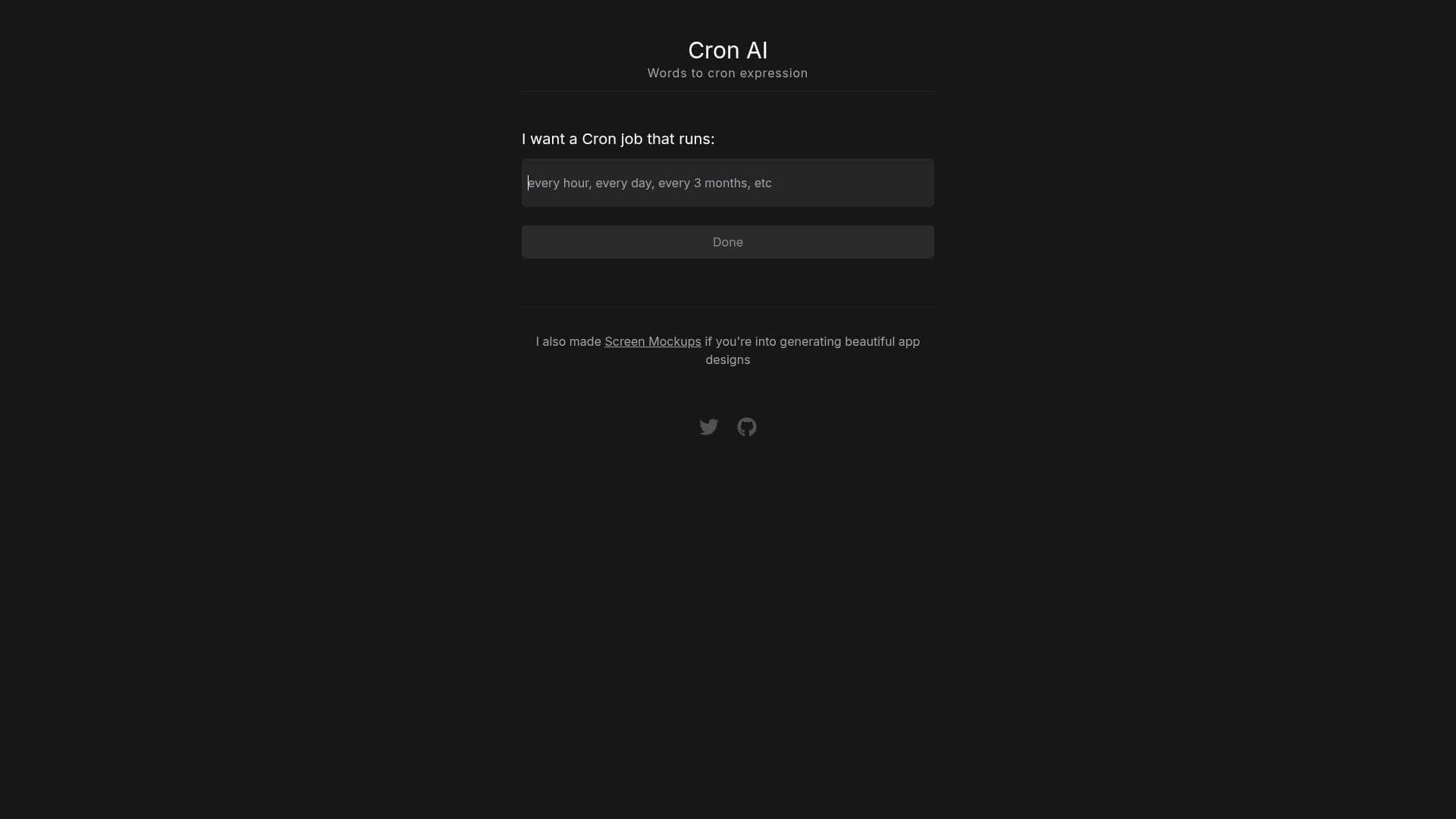
Cron AI is an innovative web-based tool designed to simplify the creation of cron jobs by allowing users to generate cron expressions through natural language descriptions. Traditionally, writing cron jobs requires familiarity with the cron syntax, which can be complex and error-prone for many users. Cron AI eliminates this barrier by enabling users to describe how often they want their tasks to run in plain English, and then automatically converting those descriptions into accurate cron expressions. This core functionality makes scheduling automated tasks accessible to developers, system administrators, and even non-technical users who need to set up recurring jobs without delving into the intricacies of cron syntax. One of the standout features of Cron AI is its ability to interpret a wide range of time intervals, including hourly, daily, weekly, and monthly schedules. Users can input descriptions like "every hour," "daily at 3 PM," or "on the first Monday of every month," and the tool will generate the corresponding cron expression instantly. The interface is designed to be user-friendly, featuring input placeholders that guide users on how to phrase their scheduling needs effectively. This reduces the learning curve and speeds up the process of cron job creation. Additionally, Cron AI helps automate the entire cron job setup by removing the need for manual syntax knowledge, which is especially beneficial for those new to cron or those who want to avoid syntax errors that can cause job failures. Cron AI is ideal for a diverse audience. Developers and DevOps professionals who frequently schedule automated scripts or maintenance tasks will find it a valuable time-saver. System administrators can leverage it to streamline server management tasks without worrying about cron syntax mistakes. Even project managers or product owners who want to understand or create simple cron schedules can use Cron AI without needing technical expertise. Specific use cases include scheduling database backups, automating report generation, running periodic data processing jobs, or triggering notifications at set intervals. By simplifying cron expression generation, Cron AI enhances productivity and reduces the risk of misconfigured cron jobs. In terms of pricing, Cron AI is currently offered as a free tool, making it accessible to anyone who needs to create cron jobs without incurring costs. This free access lowers the barrier to entry and encourages widespread adoption among individuals and teams looking for a straightforward cron job generator. When compared to alternatives, Cron AI stands out due to its natural language processing capabilities and intuitive user interface. While many cron expression generators require users to manually select time fields or understand cron syntax, Cron AI’s approach of using plain English descriptions is more approachable and efficient. This makes it particularly useful for users who are not cron experts. However, unlike some advanced cron management platforms, Cron AI focuses primarily on expression generation rather than full cron job management or integration with cloud services. Notable limitations of Cron AI include its current scope, which is centered on generating cron expressions rather than managing or deploying cron jobs directly. Users will still need to take the generated expressions and configure them within their server or cloud environment. Additionally, while the tool supports a broad range of scheduling intervals, extremely complex cron schedules or environment-specific cron nuances might require manual adjustments. Users should also verify the generated expressions to ensure they meet their precise scheduling requirements. Despite these considerations, Cron AI remains a powerful and accessible tool for anyone needing to create cron expressions quickly and accurately.
Tool Features
- Converts natural language scheduling descriptions into cron expressions
- Supports various time intervals such as hourly, daily, and monthly
- User-friendly input interface with placeholder guidance
- Helps automate cron job creation without manual syntax knowledge
Description
Cron AI transforms natural language scheduling into precise cron expressions, making cron job creation effortless for developers, sysadmins, and non-technical users alike. Its intuitive interface and support for diverse time intervals streamline automation setup without requiring cron syntax expertise.
Generate cron jobs by just describing how often you want them to run.
Detailed Description
Cron AI is an innovative web-based tool designed to simplify the creation of cron jobs by allowing users to generate cron expressions through natural language descriptions. Traditionally, writing cron jobs requires familiarity with the cron syntax, which can be complex and error-prone for many users. Cron AI eliminates this barrier by enabling users to describe how often they want their tasks to run in plain English, and then automatically converting those descriptions into accurate cron expressions. This core functionality makes scheduling automated tasks accessible to developers, system administrators, and even non-technical users who need to set up recurring jobs without delving into the intricacies of cron syntax. One of the standout features of Cron AI is its ability to interpret a wide range of time intervals, including hourly, daily, weekly, and monthly schedules. Users can input descriptions like "every hour," "daily at 3 PM," or "on the first Monday of every month," and the tool will generate the corresponding cron expression instantly. The interface is designed to be user-friendly, featuring input placeholders that guide users on how to phrase their scheduling needs effectively. This reduces the learning curve and speeds up the process of cron job creation. Additionally, Cron AI helps automate the entire cron job setup by removing the need for manual syntax knowledge, which is especially beneficial for those new to cron or those who want to avoid syntax errors that can cause job failures. Cron AI is ideal for a diverse audience. Developers and DevOps professionals who frequently schedule automated scripts or maintenance tasks will find it a valuable time-saver. System administrators can leverage it to streamline server management tasks without worrying about cron syntax mistakes. Even project managers or product owners who want to understand or create simple cron schedules can use Cron AI without needing technical expertise. Specific use cases include scheduling database backups, automating report generation, running periodic data processing jobs, or triggering notifications at set intervals. By simplifying cron expression generation, Cron AI enhances productivity and reduces the risk of misconfigured cron jobs. In terms of pricing, Cron AI is currently offered as a free tool, making it accessible to anyone who needs to create cron jobs without incurring costs. This free access lowers the barrier to entry and encourages widespread adoption among individuals and teams looking for a straightforward cron job generator. When compared to alternatives, Cron AI stands out due to its natural language processing capabilities and intuitive user interface. While many cron expression generators require users to manually select time fields or understand cron syntax, Cron AI’s approach of using plain English descriptions is more approachable and efficient. This makes it particularly useful for users who are not cron experts. However, unlike some advanced cron management platforms, Cron AI focuses primarily on expression generation rather than full cron job management or integration with cloud services. Notable limitations of Cron AI include its current scope, which is centered on generating cron expressions rather than managing or deploying cron jobs directly. Users will still need to take the generated expressions and configure them within their server or cloud environment. Additionally, while the tool supports a broad range of scheduling intervals, extremely complex cron schedules or environment-specific cron nuances might require manual adjustments. Users should also verify the generated expressions to ensure they meet their precise scheduling requirements. Despite these considerations, Cron AI remains a powerful and accessible tool for anyone needing to create cron expressions quickly and accurately.
Frequently Asked Questions
What is Cron AI?
Cron AI is a web-based tool that generates cron job expressions from natural language descriptions, allowing users to schedule automated tasks without needing to understand cron syntax.
How much does Cron AI cost?
Cron AI is completely free to use, providing full access to its cron expression generation features at no cost.
Who is Cron AI best for?
Cron AI is ideal for developers, system administrators, DevOps professionals, and even non-technical users who need to create cron jobs quickly and accurately without learning cron syntax.
What are the main features of Cron AI?
Key features include converting natural language scheduling descriptions into cron expressions, supporting various intervals like hourly, daily, and monthly, offering a user-friendly input interface with guidance, and automating cron job creation without manual syntax knowledge.
Does Cron AI offer a free trial?
Cron AI is free to use and does not require a trial period or subscription.
What integrations does Cron AI support?
Cron AI focuses on generating cron expressions and does not currently offer direct integrations with other platforms or services; users export the generated expressions for use in their own environments.
How does Cron AI work?
Users describe their desired schedule in natural language, such as 'every day at midnight,' and Cron AI processes this input to generate the corresponding cron expression, simplifying the creation of cron jobs.
Reviews
No reviews yet. Be the first to share your experience.