🚀 Zaprep: Your Socials on Steroids. Start free — automate 1,000 DMs/month & turn engagement into leads. with 1,000 automated DMs/month.
BlogTop 5 Agentic AI Development Companies for Custom Business Workflows
Top 5 Agentic AI Development Companies for Custom Business Workflows
 Shashank Jain
28 Oct 2026
9 min read
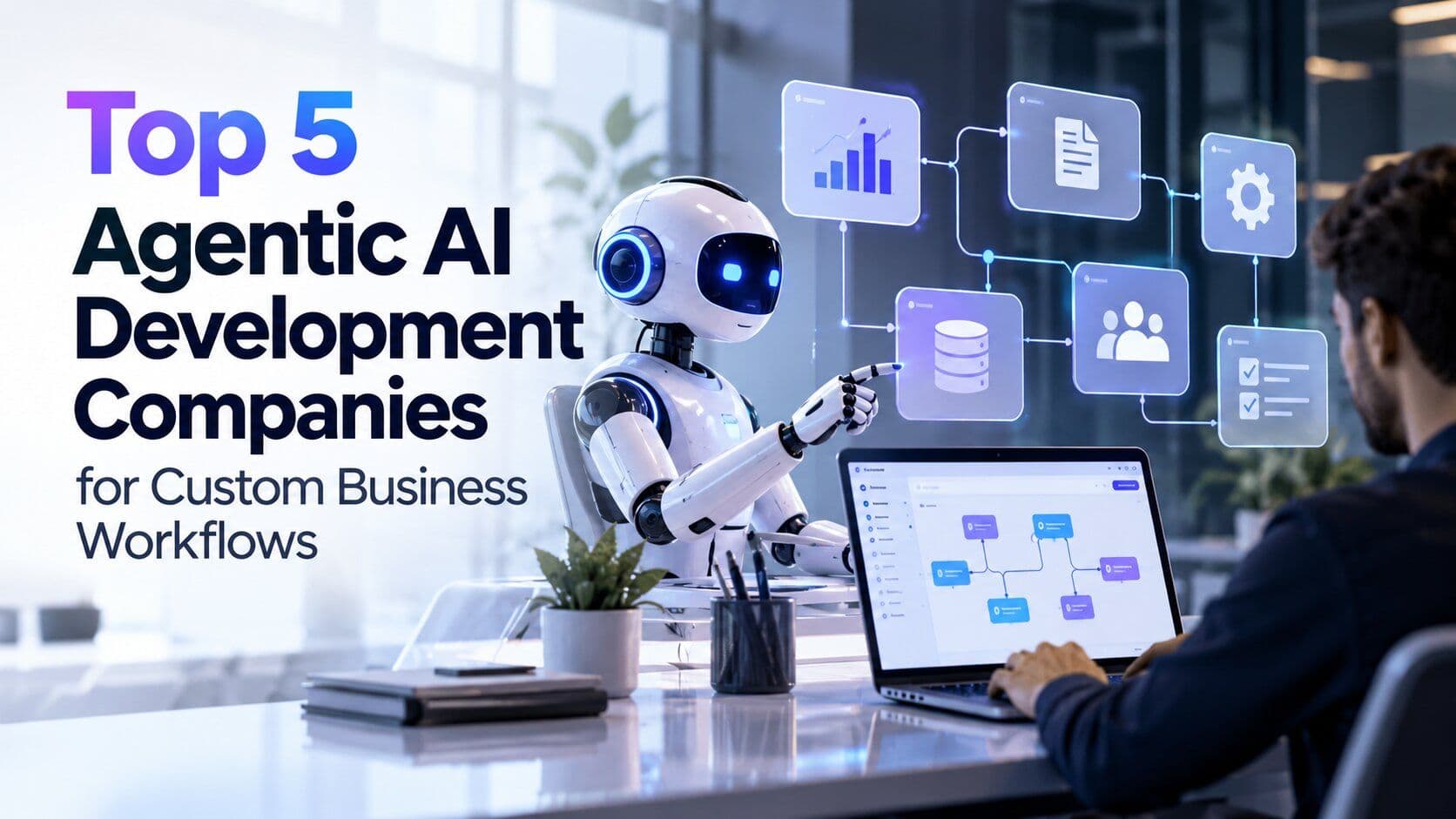
AI agents are becoming a practical way for businesses to automate workflows that need more than a simple chatbot or rule-based script. Instead of only responding to prompts, agentic systems can plan steps, call tools, use business data, trigger actions, and hand work back to humans when review is needed.
Top 5 Agentic AI Development Companies for Custom Business Workflows
AI agents are becoming a practical way for businesses to automate workflows that need more than a simple chatbot or rule-based script. Instead of only responding to prompts, agentic systems can plan steps, call tools, use business data, trigger actions, and hand work back to humans when review is needed.
For companies, the opportunity is clear: faster operations, fewer manual handoffs, better use of internal data, and more scalable processes across departments like customer support, finance, sales, operations, HR, and compliance.
But building these systems is not just about connecting an LLM to a few tools. A reliable agentic AI workflow needs the right architecture, data access, integrations, guardrails, monitoring, and human-in-the-loop controls. This article explains what agentic AI development companies do, how to choose the right partner, and what to expect when building custom business workflows.
What Is an Agentic AI Development Company?
An agentic AI development company builds autonomous AI agents. These are software systems that plan, reason, call tools, and complete multi-step workflows without constant human direction. The distinction from a chatbot is practical: a chatbot answers one message at a time, while an agent sequences actions, hits APIs, keeps memory across steps, and finishes a job end to end. Think of processing an insurance claim from intake to payout, not just answering a question about claim status.
Most firms in this category work across four layers of the stack:
- Foundation model layer: OpenAI, Anthropic Claude, Gemini, Llama, Mistral
- Orchestration layer: LangGraph, LangChain, CrewAI, Microsoft AutoGen
- Memory layer: Pinecone, PostgreSQL with pgvector, and other vector stores
- Enterprise integration layer: Salesforce, Microsoft 365, Slack, SAP, HubSpot
The demand signal is strong. Gartner projects that 40% of enterprise applications will feature task-specific AI agents by the end of 2026, up from under 5% in 2025. That jump explains why so many development shops have repositioned around agents in the last 18 months.
How to Choose the Right Agentic AI Development Company
The vendor market is crowded, and plenty of firms sell wrapper work as engineering. Five criteria separate production-ready partners from the rest.
- Production experience, not prototypes. Only about 2% of large enterprises have deployed agents at scale, even though 83% have adopted them in some form. Ask for case studies with live deployment metrics, not demo videos.
- Proprietary tooling. Firms that built their own orchestration or integration layers, like Azumo's Valkyrie or STX Next's DeepNext, have already solved the hard parts on their own time.
- Compliance posture. SOC 2, HIPAA, GDPR, the EU AI Act, and the NIST AI Risk Management Framework all matter the moment an agent touches regulated data.
- Foundation-model neutrality. Model pricing and capability shift fast. A vendor locked into one provider passes that risk to you.
- Guardrails as a first-class concern. Look for explicit approval thresholds, audit trails, access controls, and human-in-the-loop design in the proposal, not as an afterthought.
1. SoluLab: Transparent-Pricing Agentic AI Builder for Startups and SMBs
SoluLab is one of the few agentic AI development companies that publishes build pricing on its site, which is unusual in a market where most vendors insist on a quote call. Two technophiles with Goldman Sachs and Citrix backgrounds founded the firm in 2014, and it now operates across the USA, India, Canada, and Australia.
Taher Pittalwala leads the AI practice and focuses publicly on a question most vendors dodge: where autonomous authority ends and human review begins. That thinking shows up in SoluLab's "human-in-the-loop by design" methodology, which sets guardrails and approval thresholds before deployment rather than after an incident.
The engineering stack is broad. Orchestration runs on LangGraph, LangChain, CrewAI, and AutoGen. Models include GPT-5, Claude, Gemini, Llama, and Mistral. Memory sits on Pinecone and PostgreSQL with pgvector, and infrastructure runs on Docker, Kubernetes, AWS, and Azure.
Proof points:
- 250+ AI solutions delivered, 500+ AI models deployed, 50+ enterprise clients, 11+ years operating
- Compliance coverage for GDPR, HIPAA, the EU AI Act, and NIST AI RMF
- Published pricing: $15K to $40K for a single-agent build (6 to 8 weeks); $50K to $150K+ for multi-agent systems (10 to 12+ weeks)
- UpdateIA: enterprise automation platform running 14+ specialized agents
- Reported client outcomes of 80% fewer manual workflow steps and 3x faster task execution
- 4.9-star client satisfaction rating
Best fit: startups and SMBs that need a priced, scoped agent build without a six-month procurement cycle.
2. Azumo: Nearshore Agentic AI Development with Proprietary Tooling
Azumo built its own agent-integration layer, Valkyrie, a unified REST API that sits across OpenAI, Anthropic Claude, LLaMA, Mistral, Qwen, DeepSeek, and fine-tuned models. The point is to keep client systems from hard-coding against a provider that may reprice or deprecate next quarter.
Chike Agbai founded Azumo in San Francisco in 2016. As an agentic AI development company, Azumo delivers through dedicated nearshore engineering teams across 20+ Latin American countries, with many engineers in Argentina, one hour ahead of EST, so standups and code reviews happen in real time with U.S. teams.
The agent portfolio covers autonomous workflow agents for claims processing, order fulfillment, and compliance monitoring; AI-powered virtual assistants with human escalation paths; predictive analytics agents that watch data streams and forecast; and multi-agent orchestration for coordinated workflows.
Every deployment ships with configurable autonomy levels, meaning guardrails, access controls, approval thresholds, audit trails, and fallback paths. Frameworks include LangGraph, CrewAI, Microsoft AutoGen, LangChain, and LlamaIndex.
Proof points:
- 300+ successful AI deployments since 2016
- 4.9/5 on Clutch and DesignRush, 93% NPS, 150% net retention
- SOC 2 certified with HIPAA, GDPR, PCI-DSS, and SOX controls
- AI Receptionist: 1.7-second median response time on a live phone line
- Meta case study: Named Entity Recognition across 3.5M+ supplier records with a 40%+ precision improvement
- Roughly 30% to 50% lower cost than equivalent U.S.-based teams
- Clients include Meta, Omnicom, Twitter, Discovery, and NCsoft
Best fit: mid-market and growth-stage product companies that need time-zone-aligned senior engineers.
3. EPAM Systems: Enterprise-Scale Agentic AI with OpenAI and Anthropic Partnerships
EPAM Systems is the only publicly traded agentic AI development company on this list. Arkadiy Dobkin and Leo Lozner founded it in 1993. The firm is headquartered in Newtown, Pennsylvania, has traded on the NYSE since 2012, and joined the S&P 500 in December 2021.
Scale is the differentiator. EPAM reported $4.73 billion in revenue in 2024, and Q1 2026 revenue reached $1.400 billion, up 7.6% year over year, with roughly 56,500 delivery professionals. Agentic AI is now the center of its growth story, spanning enterprise agent platforms for customer service, marketing, sales, and operations, plus software-development agents including vulnerability scanners.
The foundation-model partnerships are unusually deep. EPAM joined the OpenAI Advanced Partner tier in July 2026 and committed to certify 5,000+ consultants in year one, roughly one in eleven delivery staff. Its multi-year partnership with Anthropic covers 10,000 Claude-certified architects, including 250 forward-deployed specialists. EPAM also lists enterprise AI agents on Google Cloud Marketplace for governed procurement.
Proof points:
- 1&1 (German telecom): agentic customer-service platform with 20+ AI agents handling a significant share of weekly call volume, in production in under three months
- Fortune 100 and global enterprise client base
- Added to the S&P 500 in December 2021
Best fit: Fortune 500 organizations that need agents rolled out across business units with governance attached.
4. STX Next: Python-First Agentic AI Development from Poland
STX Next has spent 20 years on Python, the language that dominates AI and ML work. The firm started in 2005 as a branch of a Dutch company and became an independent Polish business in 2008, with Innova Capital investing in 2020.
Headquarters sit in Poznań, Poland, with delivery centers in Poznań and Mérida, Mexico, plus offices in London, Eschborn, and Houston. The team numbers 500+ professionals.
The flagship differentiator is DeepNext, STX Next's own agentic platform. Agents in DeepNext act as autonomous developers, project managers, or QA engineers, writing code from scratch, running tests, handling API integrations, and managing deployment. Head of AI Bartek Roszak says DeepNext can "improve a company's development speed by up to ten times" when deployed properly.
Beyond agents, the firm covers enterprise RAG, AI/ML engineering, MLOps, data engineering on Snowflake, Databricks, and Apache Iceberg, and cloud strategy across AWS, Azure, and Sovereign Cloud.
Proof points:
- 1,000+ projects delivered over 20 years
- 20+ years of Python-first engineering practice
- AWS Advanced Tier Partner, plus partnerships with Snowflake, Databricks, Microsoft Azure, n8n, and Apache Iceberg
- Industries served include financial services, insurance, fintech, manufacturing, e-commerce, adtech, edtech, transport, and oil and gas
Best fit: Python-heavy data and ML organizations that want agents built on the same stack their models already run on.
5. Itransition: Multi-Platform Agentic AI for Enterprise ERP and CRM
If the agent needs to live inside Microsoft Dynamics 365, Salesforce, or Odoo rather than a greenfield stack, Itransition has 25 years of delivery experience inside exactly those systems. The company started in 1998 and now runs offices in Decatur, Georgia, and London, supported by Eastern European delivery centers and 3,000+ engineers globally.
The AI offering covers both copilots and fully autonomous agents for repetitive tasks such as data handling and customer service, along with chatbots and virtual assistants for round-the-clock customer and employee support. Agent development extends into Microsoft Dynamics 365, Salesforce, Odoo, Atlassian, Power BI, and Tableau.
Platform certifications are the real moat here. Itransition has been a Microsoft Partner since 2008, employs Salesforce-certified consultants and developers, holds Odoo Silver partner status, and works as an AWS Partner. That mix matters when an agent has to read from an ERP, write to a CRM, and respect existing role permissions in both.
Proof points:
- 800+ organizations served, with 50 clients in relationships lasting 5+ years
- 5 R&D labs
- Named clients include TradeStops (investment portfolio management), The Economist, a major pharmaceutical multinational, and a global fashion retailer
- 25+ years of enterprise software delivery, longer than most agentic AI firms that launched after 2020
Best fit: enterprises with established ERP and CRM environments where integration depth beats greenfield speed.
What Does an Agentic AI Project Cost and How Long Does It Take?
Published pricing in this market is still rare, but a few concrete data points give an honest picture.
SoluLab publishes $15K to $40K for a single-agent build over 6 to 8 weeks, and $50K to $150K+ for a multi-agent system over 10 to 12+ weeks. Azumo reports proof-of-concept agents in days and production-ready agents in 2 to 6 months, depending on how many systems the agent has to touch. At the enterprise end, EPAM put 20+ agents into initial production at 1&1 in under three months.
Keep the Gartner warning in view while you scope. Over 40% of agentic AI projects will be canceled by the end of 2027 on cost overruns, thin ROI, or weak risk controls. Vendor selection and tight scope control are the two levers that keep a project on the right side of that number.
Final Thoughts
Agentic AI can help businesses move from basic automation to workflows that plan, act, adapt, and coordinate across multiple systems. The real value comes when agents are connected to the right data, tools, permissions, approval paths, and monitoring processes.
Still, successful implementation depends on more than the technology itself. Businesses need a clear use case, reliable integrations, strong guardrails, human review where needed, and measurable outcomes before scaling agentic AI across departments.
The best development partner is the one that can turn a workflow problem into a safe, practical, and production-ready AI system. Before choosing a vendor, companies should review their production experience, compliance readiness, model flexibility, integration depth, and ability to support long-term optimization.
Related Tags
AI ToolsRelated Categories
AI ToolsGet your AI tool featured in articles like this
Reach users actively discovering AI tools on PoweredbyAI and build SEO backlinks that improve your visibility on Google.
Trusted by 25,000+ AI tools and growing startups
Get Your AI Tool Featured in High-Traffic Blogs & Articles
Get featured on PoweredByAI and reach users actively discovering tools like yours. Build powerful SEO backlinks that help you rank on Google and drive consistent organic traffic.
Sponsored blog features with targeted reach
Guest articles with do-follow backlinks
Contextual link placements for SEO boost
Trusted by 25,000+ AI tools and growing startups
Enjoyed this? Talk AI tools with other founders and builders.
Join our Slack communityRecent Blogs
Submit your Tool


PoweredByAI.app is an AI Tools Directory helping individuals, businesses, and creators discover the best AI tools for writing, coding, design, productivity, and more.
© 2026 , Product of011BQ. All rights reserved.