🚀 Zaprep: Your Socials on Steroids. Start free — automate 1,000 DMs/month & turn engagement into leads. with 1,000 automated DMs/month.
BlogHow Enterprise Cloud Security Solutions Protect AI-Driven Businesses
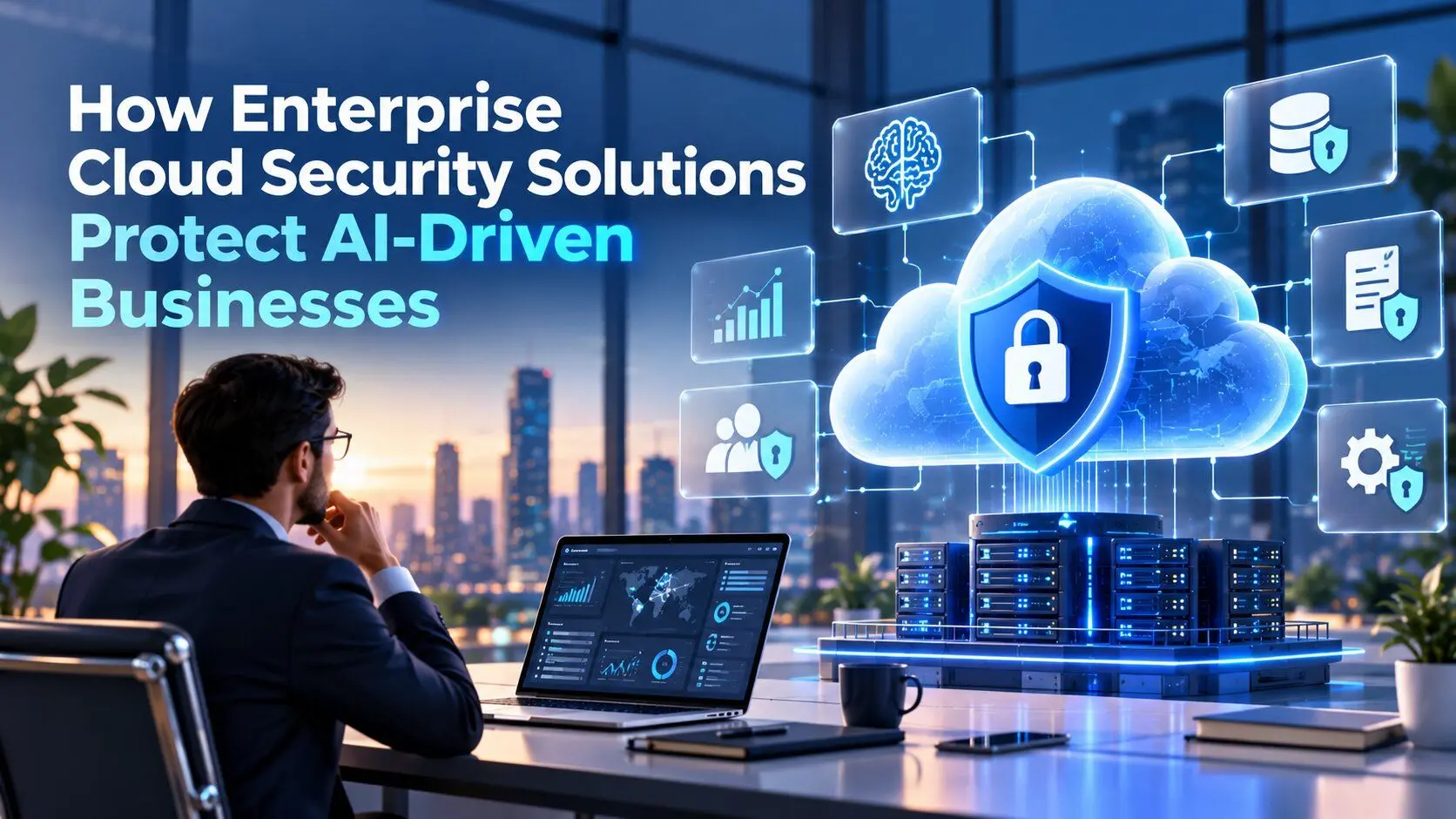
How Enterprise Cloud Security Solutions Protect AI-Driven Businesses
 Shashank Jain
30 Oct 2026
6 min read
Enterprise cloud security solutions protect AI-driven businesses by controlling access to models, data, workloads, APIs, and cloud infrastructure through a consistent set of policies. They also give security teams the visibility needed to detect unusual activity across hybrid and multi-cloud environments before a small policy error becomes a costly incident.
How Enterprise Cloud Security Solutions Protect AI-Driven Businesses
Enterprise cloud security solutions protect AI-driven businesses by controlling access to models, data, workloads, APIs, and cloud infrastructure through a consistent set of policies. They also give security teams the visibility needed to detect unusual activity across hybrid and multi-cloud environments before a small policy error becomes a costly incident.
Now, this need becomes obvious during an incident review. Imagine a financial services firm running customer analytics in one cloud, a generative AI assistant in another, and sensitive training data inside its private environment. Each workload may be adequately protected on its own, but an overlooked service account, exposed API, or loosely governed data pipeline can create a path between them.
That’s why cloud security for AI can’t be treated as another isolated tool purchase. It must connect identity, workload protection, data controls, network policy, and incident response to how AI systems actually operate.
Why AI Changes the Cloud Security Equation
AI workloads stretch across more components than a typical business application. A single service may involve:
- Training datasets
- Model repositories
- Vector databases
- Inference endpoints
- Open-source packages
- Third-party APIs
- Short-lived compute resources
It means every connection introduces another decision about trust.
Therefore, security teams should begin by mapping these dependencies rather than focusing only on the model. Here, an enterprise cloud security solutions guide can provide useful context for aligning protection across cloud applications, infrastructure, and distributed users, especially when the business operates across several environments.
The harder issue here is that AI systems don’t merely store information. They consume it, transform it, generate new material, and sometimes trigger actions in connected systems. Traditional perimeter thinking breaks down quickly here.
AI Expands the Identity Problem
Many AI services depend on non-human identities, including application credentials, service accounts, APIs, containers, and automated agents. Teams may grant these identities broad permissions during development to move quickly.
However, those temporary permissions often become permanent, which is why identity controls should account for both people and machines. That means short-lived credentials, workload identity federation where appropriate, tightly scoped roles, and routine checks for dormant or excessive permissions.
Additionally, privileged activity should also be visible to the SOC in near real time, not buried in a cloud console that nobody reviews until Friday afternoon.
Data Integrity Matters as Much as Data Theft
For AI-driven businesses, attackers don’t always need to steal a dataset. Altering it may be enough.
Poisoned training data can affect model behavior, while manipulated prompts or retrieval sources may influence the answers produced by an otherwise trusted system. The US National Security Agency’s guidance on deploying AI systems securely calls for protecting AI systems, models, and data throughout deployment and operation.
Useful controls for enterprise security solutions include:
- Encryption for data in transit and at rest
- Provenance records for training and reference data
- Integrity checks before models or datasets enter production
- Segmentation between development, training, and inference environments
- Logging of changes to models, configurations, and data pipelines
These controls won’t make a model trustworthy on their own, but they will make tampering harder to hide.
How can cloud security solutions reduce unexpected AI infrastructure costs?
Cloud security can flag crypto mining, stolen API keys, runaway inference requests, and unauthorized GPU usage. Combining usage thresholds with behavioral alerts helps teams distinguish legitimate demand spikes from compromised accounts or poorly configured AI services.
What Enterprise Cloud Security Solutions Need to Cover
Buying several cloud security products doesn’t automatically produce effective coverage. That’s why what matters is whether policies follow workloads, users, and data across environments without creating blind spots between tools.
Consistent Policy Across Hybrid and Multi-Cloud Systems
A typical enterprise may have different security policies for its data center, public cloud accounts, SaaS applications, and remote users. But AI projects often cross those boundaries within a single workflow, and the policy inconsistency creates gaps that prove critical later.
For instance, one environment may block public storage access while another permits it by default. Similarly, a development team might apply strict controls to production workloads but leave model-testing endpoints reachable from the internet.
That’s why the security architecture should establish a common policy baseline while still allowing exceptions for genuine technical needs. Also, exceptions must have owners, expiry dates, and a recorded business reason because “The development team asked for it” isn’t enough.
What is the shared responsibility model for cloud-based AI?
The cloud provider generally protects the underlying platform, while the customer remains responsible for data, access permissions, configurations, applications, and model usage. Exact boundaries vary, so security teams should document ownership before an AI service goes live.
Protection for Cloud Workloads and AI APIs
Cloud workloads change too quickly for occasional vulnerability scans. Containers appear and disappear, code is deployed several times a day, and infrastructure templates can replicate one error across dozens of accounts.
Therefore, controls should inspect workloads during development and runtime. They should also identify exposed services, vulnerable packages, suspicious process behavior, and unexpected outbound connections.
API protection deserves equal attention here as AI APIs can expose data, consume expensive computational capabilities, or trigger downstream actions. Rate limits, authentication, schema validation, and behavioral monitoring can reduce the risk of abuse without blocking legitimate experimentation.
One Investigation Trail
What happens when an AI assistant accesses an unusual dataset and then sends a large volume of traffic to an external service?
If identity events, network logs, cloud activity, and workload alerts sit in separate systems, the SOC must rebuild the chain manually. But that costs time, particularly when account names and timestamps don’t line up neatly.
Security telemetry here should let analysts trace activity from the user or machine identity to the workload, dataset, model, API call, and network destination.
Can cloud security help meet AI compliance requirements?
Yes. Centralized policy enforcement, audit-ready logs, data-location controls, retention settings, and access records can support regulatory evidence. However, security tools don’t create compliance automatically; legal, privacy, risk, and technical teams still need coordinated governance.
A Practical Review Framework for Security Leaders
Before approving an AI workload for production, CISOs and architecture teams need to ask the following five questions:
- What data does the system consume or create? Classify it, identify its owner, and document where it travels.
- Which human and non-human identities can reach? Review permissions, credentials, and administrative paths.
- What can the AI system do after producing an output? Reading a document is quite different from approving a payment or changing a customer record.
- Can the SOC reconstruct an incident? Test whether logs show the full sequence rather than isolated alerts.
- What happens when the model, cloud service, or security control fails? Define fallback behavior, escalation routes, and recovery steps.
There’s a real argument for slowing certain AI deployments until these answers are clear. This move will frustrate business teams, but it is a necessary step, as it usually proves cheaper than discovering something during an investigation when no one knows which dataset trained the production model.
The European Union Agency for Cybersecurity also treats AI security as part of the wider ICT environment, not a standalone discipline. Its AI and cybersecurity guidance addresses risks spanning infrastructure, privacy, manipulation, and AI system operations.
How should enterprises assess third-party AI providers?
Enterprises should review data retention terms, model-training practices, breach-notification commitments, subcontractor access, deployment locations, and deletion procedures. Contracts should also define audit rights and clarify whether the provider may reuse submitted business data.
Security That Keeps Pace with AI Adoption
AI adoption will continue to outrun some internal approval processes. Employees can connect cloud-hosted models to corporate data in minutes, while formal risk reviews may take weeks. Security leaders won’t close that gap by banning every unsanctioned experiment.
They can narrow it by offering approved deployment patterns, clear data rules, reusable identity controls, and logging that works from the start. Guardrails need to be easier than workarounds. Otherwise, teams will find the shortest route to production, and security will hear about it later.
Well-designed enterprise cloud security solutions give businesses room to use AI without losing control of the infrastructure beneath it. The business value isn’t another dashboard. It’s the ability to answer, quickly and credibly, who accessed the system, what changed, where the data went, and whether the incident has actually been contained.

Related Tags
AI ToolsRelated Categories
AI ToolsGet your AI tool featured in articles like this
Reach users actively discovering AI tools on PoweredbyAI and build SEO backlinks that improve your visibility on Google.
Trusted by 25,000+ AI tools and growing startups
Get Your AI Tool Featured in High-Traffic Blogs & Articles
Get featured on PoweredByAI and reach users actively discovering tools like yours. Build powerful SEO backlinks that help you rank on Google and drive consistent organic traffic.
Sponsored blog features with targeted reach
Guest articles with do-follow backlinks
Contextual link placements for SEO boost
Trusted by 25,000+ AI tools and growing startups
Enjoyed this? Talk AI tools with other founders and builders.
Join our Slack communityRecent Blogs


Submit your Tool


PoweredByAI.app is an AI Tools Directory helping individuals, businesses, and creators discover the best AI tools for writing, coding, design, productivity, and more.
© 2026 , Product of011BQ. All rights reserved.