🚀 Zaprep: Your Socials on Steroids. Start free — automate 1,000 DMs/month & turn engagement into leads. with 1,000 automated DMs/month.
BlogBest AI Companion for Groups: 7 Platforms That Keep Track of Who's Speaking
Best AI Companion for Groups: 7 Platforms That Keep Track of Who's Speaking
 Shashank Jain
15 Sept 2026
8 min read
Browse the chatbot and companion categories on any AI tools directory and you’ll find plenty of apps promising group chats. Try one with three characters, though, and the cracks show quickly. Everyone starts to sound the same, the quiet character never gets a line, and somebody answers a question that was meant for someone else.
Best AI Companion for Groups: 7 Platforms That Keep Track of Who's Speaking
Browse the chatbot and companion categories on any AI tools directory and you’ll find plenty of apps promising group chats. Try one with three characters, though, and the cracks show quickly. Everyone starts to sound the same, the quiet character never gets a line, and somebody answers a question that was meant for someone else.
If you’re shopping for an AI companion that can actually host a group scene, the feature list only tells you so much. For this guide, a real group scene means one human, several clearly labeled AI characters, and ideally a narrator who keeps track of what happened. Here’s how seven platforms handle keeping track of who’s speaking, and where each one falls short.
How We Judged Each Platform
We created a 100-point rubric before the first prompt, so every service faced the same test.
30% Speaker attribution. Does each line carry the correct nameplate? Speaker-aware training lifts multi-party dialogue quality in large language models, according to a 2025 arXiv study on contrastive speaker-aware learning.
20% Group architecture. Native multi-character scenes, plus an optional narrator that does not consume a character slot, score highest.
20% Memory and context. We favor layered memory systems over sheer token windows.
30% Control and practicality. Turn selection, setup friction, reliability, price, and privacy clarity share the final bucket.
Every platform was scored against the same scenario: one human, three characters, and a narrator, so the results stay comparable.
1. DreamGen: Best for Native Narrator-Led Group Scenes

Group Mechanics and Speaker Handling
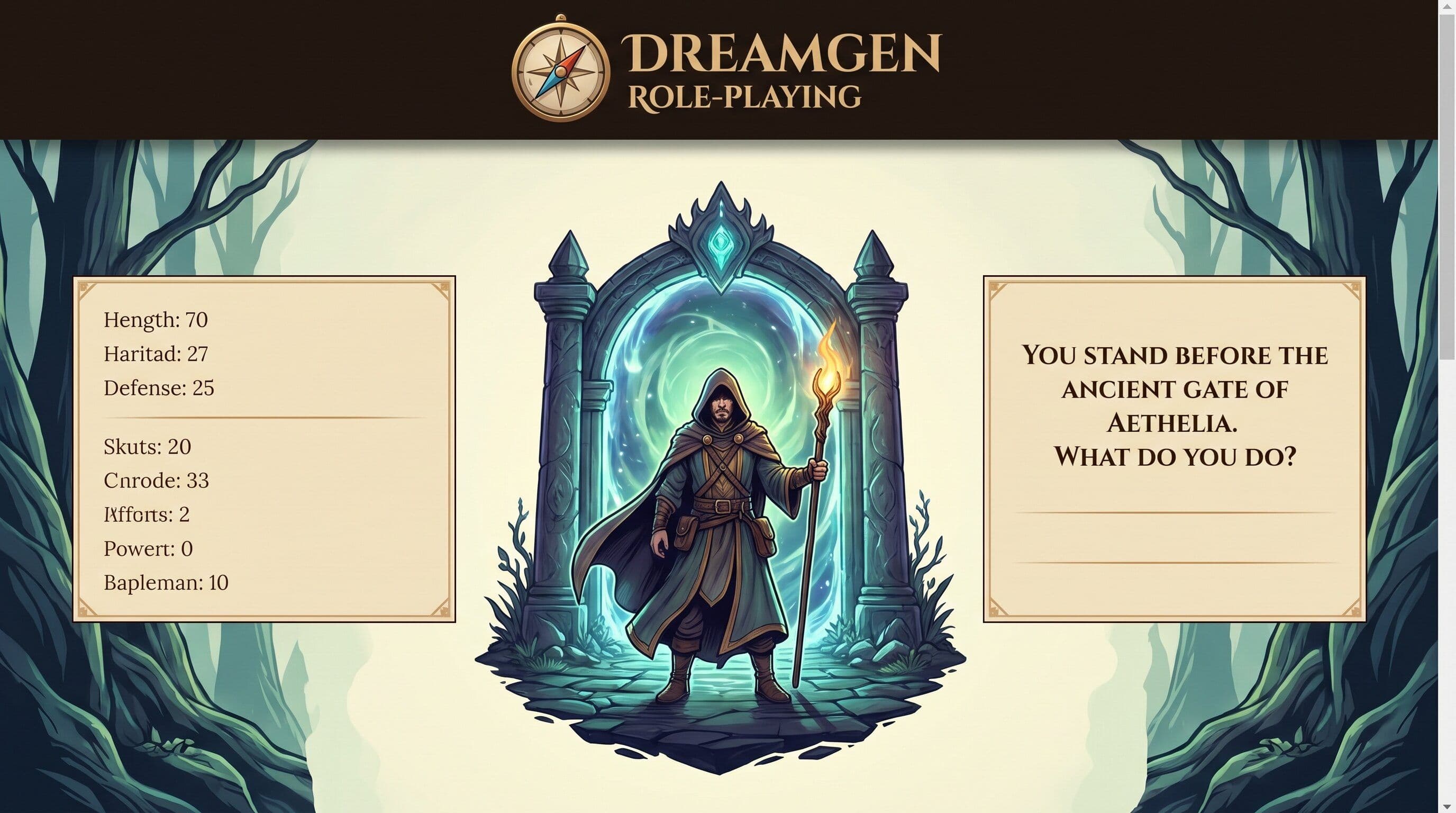
Built for immersive multi-character scenes, the DreamGen platform runs group stories in Role-Play Mode and provides a Scenario Wizard so you can spin up an entire world before the first line of dialogue. You set up your own character, add supporting personas, and a narrator keeps the scene moving. The Scenario Codex holds backstories and world facts, and lines land with clear nameplates, turning rapid exchanges into a clean script instead of a jumble of voices.
Memory, Models, and Creative Control
Even on the Starter tier, DreamGen keeps about 5,000 tokens of recent context. The Advanced tier raises that to 15,000 tokens and Pro to 30,000, while the Role-Play Assistant helps you keep a long scene on track. You can edit Codex entries as the story grows and choose between DreamGen’s own models and optional third-party models.
Pricing, Platforms, and Limits
Group chat runs in any modern browser. A Free plan lets you try the platform, and Pro adds the 30,000-token context plus up to a 60 percent discount on select third-party models; check the pricing page for current rates. DreamGen has no mobile app. The public scenario library is SFW only and smaller than Character.AI’s, which means less time spent sifting through low-quality fan scripts.
If you want tight speaker control, a built-in narrator, and space for novel-length backstory, DreamGen remains the front-runner.
2. Nomi: Best for Persistent Multi-Companion Memory
Group Mechanics and Speaker Handling
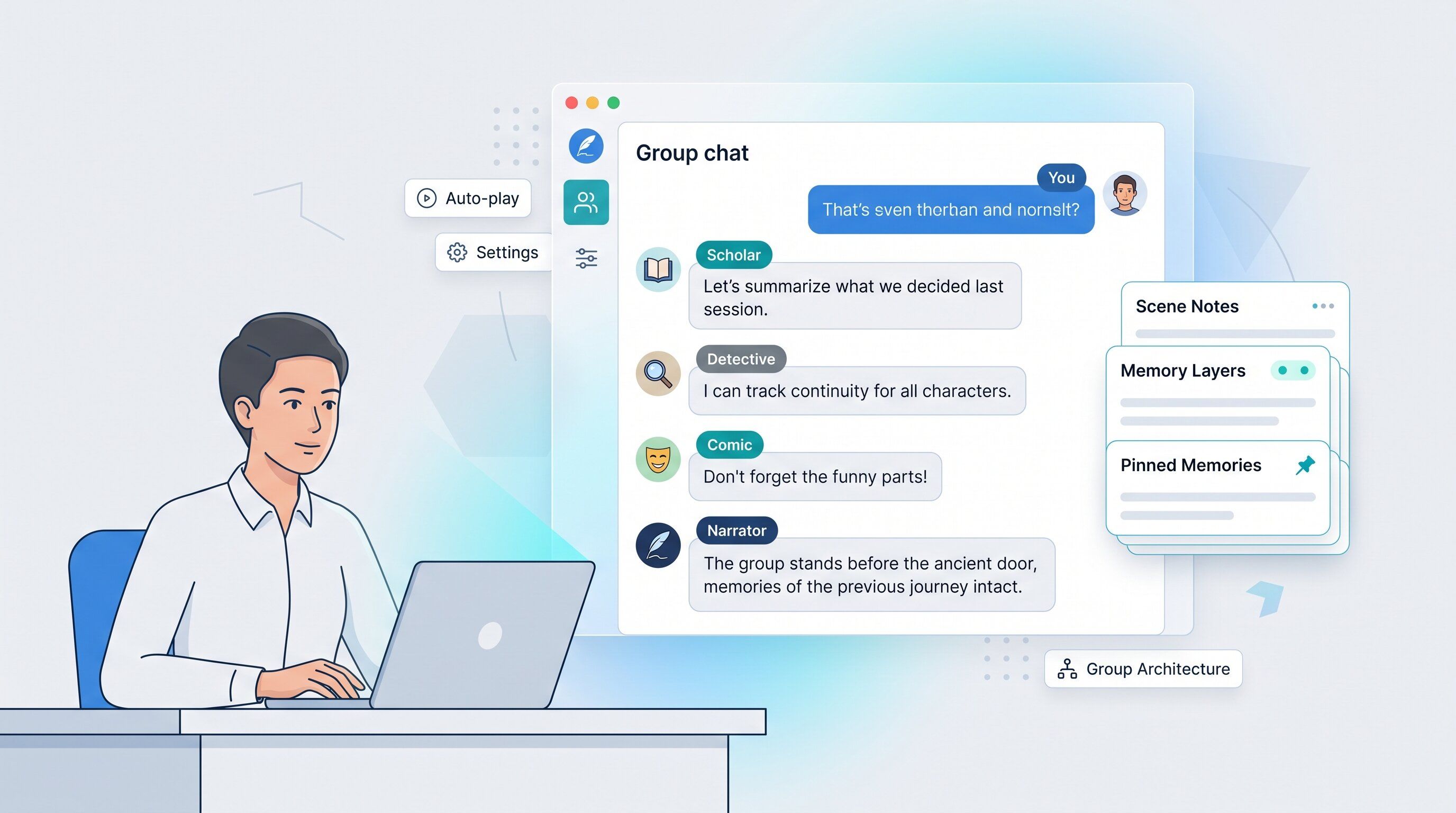
With a subscription you can place up to 10 Nomis in one room and toggle Auto-play so they decide who speaks next, so no manual prodding is required. Every line shows the speaker’s avatar and nameplate, and you can add a narrator by creating another Nomi and giving it the director’s chair.
Memory and Creative Control
Nomi stacks memory in three layers, short, medium, and long-term, which helps each companion stay consistent over time. In practice a character can bring back an old in-joke without derailing today’s scene.
Pricing, Platforms, and Limits
One-to-one chats are free; group mode unlocks on the paid plan—$15.99 per month, $39.99 quarterly, or $99.99 yearly on web as of September 14, 2026. Pick up the conversation on web, iOS, or Android; all participants share one account. Nomi anonymises chats and states it never sells them, though conversation data is still collected to improve the service. If that privacy model and single-account rule suit your workflow, Nomi provides some of the stickiest long-term memory in the companion market.
3. Kindroid: Best for Structured Group Memory
Group Mechanics and Speaker Handling
Kindroid supports up to 10 Kindroids in one group chat. A shared Group Context delivers scene notes to everyone, while each Kindroid keeps its own backstory, so secrets stay put even when tempers rise.
Memory and Creative Control
Memory comes in three layers: short-term context, Cascaded Memory for mid-term summaries, and long-term consolidation for permanent lore. Ultra and MAX add-ons multiply those layers, so a months-old running gag still lands on cue. Because each Kindroid’s memory vault is isolated, you can erase a single misstep without wiping the timeline. Model presets and a quick editing panel keep you steering the story instead of chasing stray personalities.
Pricing, Platforms, and Limits
Group chat is a paid feature, and subscription prices differ between the website and the mobile apps, so check current rates on the platform you use. Ultra and MAX memory add-ons stack on top, pushing costs toward premium-software territory for marathon sessions. You can chat on web, iOS, or Android. High-capacity bundles can raise the bill quickly if you run nightly sagas.
4. SillyTavern: Best for Self-Hosted Turn Control
Group Mechanics and Speaker Handling
Every character loads as its own card, and you choose the reply strategy—Manual, Natural, List, or Pooled. Click a name to force a reply, mute a chatterbox, or switch on Auto-reply so the cast debates without you. Because SillyTavern runs on your own machine, latency stays low and speaker tags stay put throughout the scene.
Memory and Creative Control
SillyTavern itself keeps only the chat log; memory lives in whichever model, extension, or lorebook you connect. Run a local 70B model for full privacy, route messages to OpenAI for a larger context window, or trigger a lorebook on specific keywords. System prompts, author notes, and per-character presets are all editable, letting you adjust personality bleed as needed.
Pricing, Platforms, and Limits
The frontend is free and open source, so your costs come from hardware and any external API calls. Install on Windows, macOS, Linux, Android (via Termux or Pydroid), or Docker. All data—chats and API keys—sits in plain-text files on your server, so secure access if others share the box. There is no official app-store release, built-in voice, or support desk. What you gain instead is near-total control over turn order, model choice, and context length, making SillyTavern ideal for tinkerers and less suited to plug-and-play users.
5. Character.AI: Best for Discovery and Lighter Controls
Group Mechanics and Speaker Handling
Character.AI allows up to 10 Characters in a room and offers limited auto-turn control. Adding a narrator Character can help keep the scene on track, though manual prompting is often required.
Memory and Creative Control
Each chat lets you pin up to five messages as memories. The platform captures additional context automatically but does not expose fine-grained memory tools.
Pricing, Platforms, and Limits
The core service is free; the c.ai+ subscription costs $9.99 per month or $94.99 per year. Character.AI is a cloud-hosted service, and chats can be used for model training, with an opt-out offered only to users in the EEA and UK.
6. Backyard AI: Best for High-Context Hosted Chats
Group Mechanics and Speaker Handling
Backyard AI limits rooms to four AI characters, but each line can draw on up to 100,000 tokens of context on the Pro tier. Turn order is automatic; you can @-mention a name to pull someone in or mute a voice that drifts off-topic. Most users reserve one slot for a narrator and keep three for leads.
Memory and Creative Control
Free and Standard plans offer a 16,384-token window, while Pro stretches to 100,000. Lorebooks inject background facts only when a trigger word appears, keeping prompts lean. A model menu lets you switch between 12-billion-parameter role-play engines and larger “context giants,” with sliders for temperature, Top-P, and repetition penalty.
Pricing, Platforms, and Limits
- Free: 300 messages per week, 16,384-token context
- Standard: unlimited messages, $12 per month
- Pro: unlimited messages, 100,000-token context, $35 per month
Backyard runs on web and iOS. All chats live on Backyard’s servers, and detailed encryption controls are not published, so treat it like any other cloud service. If you can live with the four-seat cap, the Pro tier’s novel-length context is tough to match.
7. RisuAI: Best for Open-Source Model Choice
Group Mechanics and Speaker Handling
RisuAI lets you load as many character cards as your chosen backend can handle; the client itself enforces no hard cap. Speaker tags appear in a sidebar, and you can force, mute, or reshuffle characters mid-scene. Add a narrator by creating another card and flagging it as omniscient. Because everything runs client-side, every control is just a click away with no server delays.
Memory and Creative Control
The client connects to OpenAI-compatible endpoints, Claude, Gemini, local models, and more. Long chats stay manageable through HypaMemory and SupaMemory, two built-in compression schemes that summarise older turns and re-summarise when needed. You can reorder system, author, and user messages, attach trigger-based lorebooks, or script images and sound cues, turning the app into a modular prompt studio.
Pricing, Platforms, and Limits
RisuAI is free and open source on Windows, macOS, Linux, web, and Android (APK or Docker). Costs appear only after you connect a backend: run a local 13B model for zero dollars beyond hardware, or stream GPT-4 on demand. Self-hosting keeps chats on your SSD; routing through an external API follows that provider’s logging policy. Practical group size depends on the context window your chosen model supports, so token limits—not RisuAI itself—set the ceiling. RisuAI suits tinkerers; skip it if you prefer plug-and-play ease.
AI Companion Group-Chat Comparison
Decision point | DreamGen | Nomi | Kindroid | SillyTavern | Character.AI | Backyard AI | RisuAI |
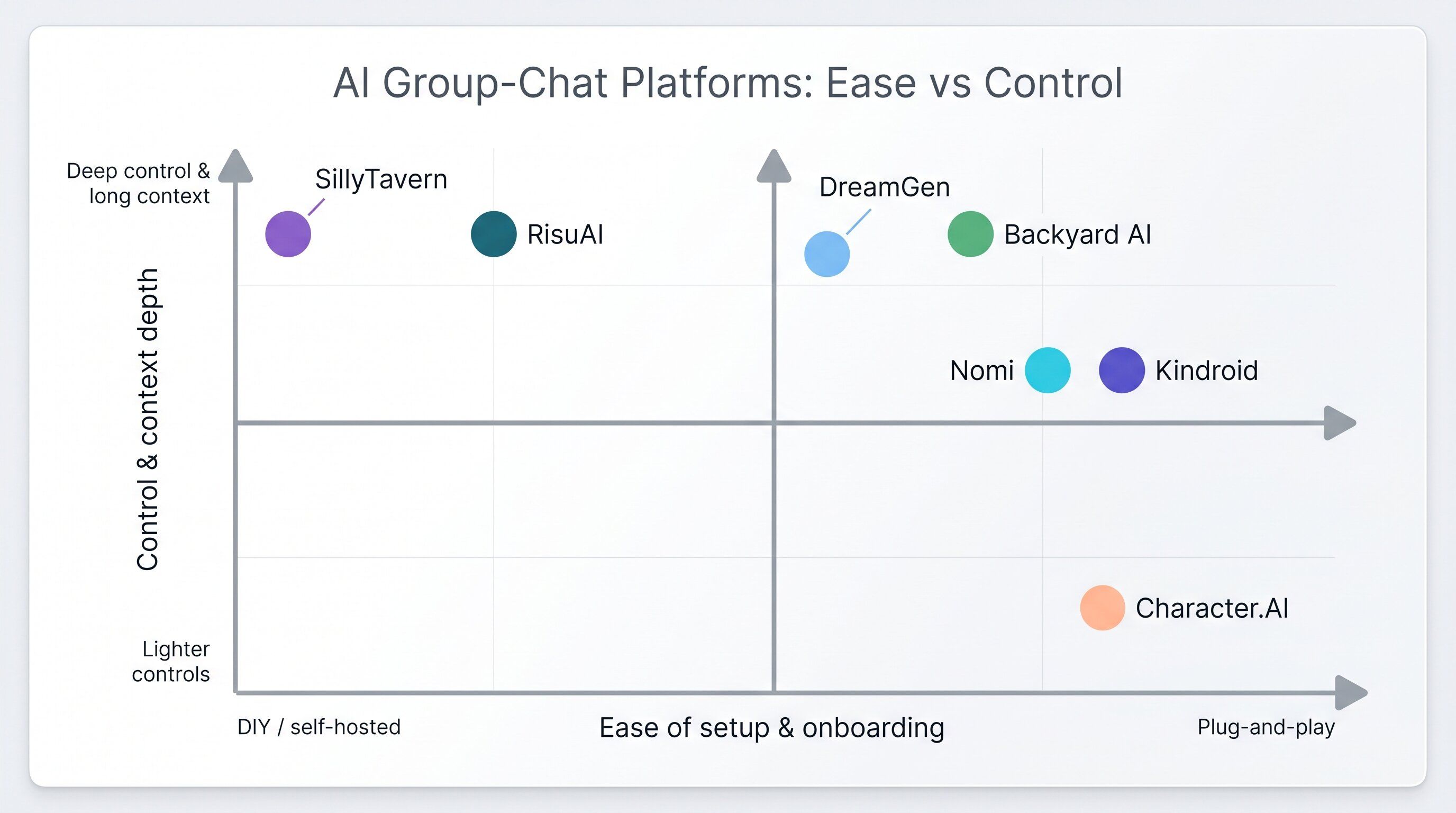
Max group size / architecture | Native narrator and flexible cast | 10 Nomis (one account) | 10 Kindroids (shared context) | Card-based, user-defined cap | 10 Characters, auto turns | 4 Characters, hosted | Model-limited, no hard cap |
Narrator & turn control | Built-in narrator, editable turns | Create narrator Nomi; auto or manual | Shared Group Context | Manual, Natural, List, Pooled; force or mute | Add Character narrator; limited control | Basic mute and @-mention | Add narrator card; force and mute |
Context & memory system | 5,000–30,000 tokens + Scenario Codex | Layered short, medium, long memory | Cascaded + long-term consolidation | Backend-dependent; lorebooks | 5 pinned memories + auto-memory | 16,384–100,000 tokens + lorebooks | Hypa/SupaMemory; model-based |
Starting price | Free plan; paid tiers | Free 1-to-1, groups $15.99 per month | Groups on paid plan | Free client | Free; c.ai+ $9.99 per month | Free; Standard $12, Pro $35 | Free client |
Deployment & privacy | Hosted web | Hosted web and apps | Hosted web and apps | Self-hosted | Hosted; chats may train models | Hosted web and iOS | Self or cloud-hosted |
Best fit / key limit | Writers; no mobile app | Long-term bonds; single-account rule | Structured lore; rising cost | Tinkerers; setup burden | Discovery; lighter controls | Huge context; 4-seat limit | Power users; DIY footprint |
Conclusion
Each of these seven services excels in a different area, from context length to privacy controls, so choose the one that fits your priorities around memory, control, and cost. If you want a built-in narrator and clean speaker handling with no setup, start with DreamGen.
If long-term bonds with the same companions matter most, look at Nomi or Kindroid. If you enjoy tinkering and want full control over models and data, SillyTavern or RisuAI will reward the extra setup time. Before you commit, compare current pricing against other conversational AI chatbots side by side, and start on a free tier wherever one exists.
Related Tags
Related Categories
Get your AI tool featured in articles like this
Reach users actively discovering AI tools on PoweredbyAI and build SEO backlinks that improve your visibility on Google.
Trusted by 10,000+ AI tools and growing startups
Get Your AI Tool Featured in High-Traffic Blogs & Articles
Get featured on PoweredByAI and reach users actively discovering tools like yours. Build powerful SEO backlinks that help you rank on Google and drive consistent organic traffic.
Sponsored blog features with targeted reach
Guest articles with do-follow backlinks
Contextual link placements for SEO boost
Trusted by 10,000+ AI tools and growing startups
Recent Blogs

Submit your Tool


PoweredByAI.app is an AI Tools Directory helping individuals, businesses, and creators discover the best AI tools for writing, coding, design, productivity, and more.
© 2026 , Product of011BQ. All rights reserved.