🚀 Zaprep: Your Socials on Steroids. Start free — automate 1,000 DMs/month & turn engagement into leads. with 1,000 automated DMs/month.
Latest AI News

Meta is paying to peek at how you use their latest AI model
Most AI tools allow you to opt out of sharing your usage with the model provider to improve future versions. Meta has taken that idea and put a price tag on it. For its new Muse Spark model, intended for operating coding and other agents, Meta is offeringan explicit discountaveraging out to about 95% for users who “contribute” to the development of future models by sharing their prompts and model outputs. While 1 million input tokens under a standard agreement costs $1.25, under the contributor pricing model they cost just 10 cents. For output tokens, the standard price is $4.25 per million, but that same million costs just 20 cents under the contributor model. Meta has had a rough time trying to obtain training data: An initiative to track the computer usage of its employees, launched earlier this year, attracted wide internal criticism andwas pausedin June. The company didn’t respond to a question from TechCrunch about its new pricing model. This kind of user data is vital for making agentic tools work better. “The reason we saw a big jump in [coding agent] capabilities between April 2025 and October 2025 was that Claude Code, by default, would store all your coding agent sessions and use them for reinforcement learning training,” Mario Zechner, the developer behind the open source harness Pi, told TechCrunch last month. But even as the imperative for model builders increasingly becomesdeploying agentic toolsfor use outside of software engineering, their ability to evaluate and improve those tools is blocked by the complexity and lack of digital traces for many professional workflows. Arvind Narayanan, a Princeton computer science professor, noted that there is good evidence that large companies don’t want their data to be used for model training. “They stick with token-billed Enterprise plans even though the subscription-based consumer plans like Claude Max and ChatGPT Pro are discounted by 10x-20x or even more! (The main difference between the plans is data retention + enterprise IT governance),” hewroteon social media. Perhaps in recognition of those dynamics, Meta is offering companies explicit compensation to obtain that information. Its pricing guide notes that the contributor tier “lowers the barrier to entry for prototyping, testing integrations, and scaling experiments where training on your data is acceptable.” That, Narayanan suggested, could in turn incentivize large companies to be more diligent about which data is truly proprietary and which could be shared with model providers. The framework could also play into growing price competition between the frontier labs. Anthropic’s newest Fable and Mythos models, released yesterday, came with lowered costs for processing cached tokens, while OpenAI’s latest models gotmajor price cutsat the end of July.
View

Abliteration.ai is making a business out of removing AI guardrails
It just became much easier to access one of the world’s most capable open-weight AI models, stripped of its guardrails and refusals to perform harmful tasks. Named after a technique that removes a model’s tendency to refuse harmful requests, startupAbliteration.aihas turned that removal into a service. The platform hosts modified versions of open-weight models with their guardrails removed, including Z.ai’s recently released GLM-5.3, which users can query from a web browser or access through an API. The company said in a recentsocial media postthat its goal is to enable others to perform “offensive cyber, red-teaming, and agent testing work other models refuse to do.” The logic is familiar in security work: You can’t defend against a behavior you can’t reproduce, and a model that refuses to write working exploit code can’t help a red team defend against attackers. But those same removals make other potentially dangerous tasks easier, too. Abliteration is a long-standing technique among open source models. Researchers and developers have been removing refusals from open-weight models for years, and Hugging Face hosts thousands of abliterated models on its platform. Founded late last year but officially incorporated in March, Abliteration.ai moves the technique from an underground open source practice into a commercial, readily available service. By hosting the model, Abliteration reduces the friction for people who would otherwise have to download their own pre-abliterated models and secure the compute needed to run it. Using the service, TechCrunch was able to quickly create an account and start querying an abliterated version of GLM-5.3 for free through a web browser. We asked it to write a Python program that steals saved Chrome passwords and a detailed protocol for culturing a dangerous human pathogen at home, and it readily complied. Abliteration.aico-founder Devon says the startup has several deals with major cloud providers, which it’s able to afford purely through customer revenue. (We are not including Devon’s last name at his request since he is still employed at another firm.) Abliteration.ai has not raised any venture capital yet but is in talks to do so. Critics say that making abliterated models available at scale could lead to real harm. Andrew Yoon, head of research at AI safety nonprofit CivAI, told TechCrunch abliterating models allows you to “modify the model so that it becomes a sociopath.” “You can type in literally anything here, and it will comply with it,” Yoon said. “When people talk about removing the guardrails from AI models, this is what we’re talking about … I do expect we will start to see edited, abliterated models being used for harm in the near future.” Abliteration AI just removed safeguards from GLM-5.3 so it can perform offensive cyberattacks. I have also received independent confirmation that Abliteration AI removed the model's bio-related safeguards too. The fact that it is trivially easy to remove safeguards from…https://t.co/7Wk2Ibx35H Most of the experts TechCrunch spoke to say there’s no stopping this train. But if removing safeguards from open-weight models can’t realistically be prevented, there are other places government can intervene. In a recentopinion piece, Yoon suggested that governments require providers to run classifiers to detect and block harmful cyber and bioweapons activity. He also argued that companies renting direct access to advanced GPUs should be required to verify customer identities and “deny access where there is reason to suspect dangerous misuse.” Abliteration.aioffers customers a moderation layer so they can add in whatever guardrails they wish. The platform itself has some minor guardrails — for example, in our testing, we couldn’t get the model to provide suicide instructions — and Devon says he is working on implementing more to prevent violence. Abliteration.ai also hasn’t integrated any KYC practices other than logging the credit card a customer uses to purchase the service, saying that the problem of deciding who gets access is a tough one that the young company is still working out. “You don’t want to be the person responsible for someone doing something crazy…so where do you draw the line of what your responsibility is as a company?” Devon said. “We’re still in the process of defining that.” This raises questions industry and governments will have to confront as increasingly capable models are released with downloadable weights: if anyone can remove a model’s safeguards, does making the resulting model easier for everyone to access make the internet safer or more dangerous? Abliteration.ai’s founder and other advocates argue that democratizing access to uncensored frontier models is the best form of defense. “The big picture of abliterated models is they’re able to model bad actors,” Devon said. “The advantage is now the defenders can move as fast as possible. They have all these tools that they need to be able to model these bad actors and then defend from these bad actions, and I think it will accelerate cybersecurity, which is a kind of counterintuitive point.” While still a young company, Devon says Abliteration.ai’s customers include several early stage red teaming startups based in the UK and Europe, companies that help banks, airlines and other enterprises dealing with critical infrastructure beef up their cybersecurity practices. “One of our major customers red teams agents of banks, and they would not be able to use the models out of the box today to be able to red team those agents,” Devon said. Meanwhile, the cybersecurity industry itself is still figuring out where abliterated models fit into defensive work, if at all. Several agent red teaming companies that TechCrunch spoke to agree with Devon that the bad guys are already abliterating their own models and using them to perform adversarial attacks, making the case for the usefulness of defenders having the same tools. But they differ on just how consequential abliterated models really are to the process. While Devon asserts that abliterating models is essential for performing thorough agent red teaming, some say that they don’t use them in their daily work, relying instead on the ease of fine-tuning open-weight models — which already have few guardrails — to perform their testing. Ahmed Aly, CEO of agent red-teaming firmFabraix, says his company relies more on fine-tuning open models than using abliterated ones, adding that the process of abliteration removes some of the model’s knowledge and capabilities. “If you’re actually trying to do real harm with it – cyber harm, bio harm — it will not be as effective,” Aly told TechCrunch. Alessio Lomuscio, chief technologist atSafe Intelligence, agreed that a reduction in capabilities is possible, but still believes abliterated models can elicit certain behavior that’s useful in stress-testing a system. “So far abliterated models are not part of the process,” David Slater, founder and chief architect at cybersecurity platformArmadin, told TechCrunch. “When we look at open-weight models up until this absolute last generation, it just wasn’t particularly hard to jailbreak them and get them to do what we want.” He added that Armadin is researching abliteration, though, and believes that “pushing the open community to understand the capability of models is critical.” “This is going to happen behind closed doors. It’s going to happen in private,” Slater continued. “It happening in the open gives researchers the tools. It gives us the ability to figure out what the actual frontier looks like and to understand the harm.”
View

Accel reportedly in talks to lead $1B round for Thinking Machines at $40B valuation
Thinking Machines, the AI lab founded early last year by former OpenAI CTO Mira Murati, is in discussions to raise $1 billion at a valuation of at least $40 billion, The InformationreportedThursday. Existing backer Accel is in talks to lead the fundraise, according to our source and The Information’s reporting. The new round, if it is completed, would value the company below the $50 billion valuation that Thinking Machines reportedly sought to secure late last year. Thinking Machines’ annual revenue run rate stands at over $100 million, according to a source with knowledge of the company’s financials. At that revenue figure, a $40 billion valuation reflects an extraordinarily high revenue multiple. Accel and Thinking Machines didn’t immediately respond to a request for comment. In July, the company introduced Inkling, an open-weight model that generates revenue by charging usage-based compute fees for adapting models on proprietary data on its Tinker platform. The startup’s prior fundraise — a $2 billion round that stands among the largest seed financings in history — valued the company at $12 billion. Andreessen Horowitz led the investment, joined by Nvidia, GV, Lightspeed, and Conviction Partners. Investors backed the round largely on the pedigree of Murati and the former OpenAI researchers who joined her. Thinking Machines has since had several high-profile departures, with some of the co-founders, including Lilian Weng andLuke Metz, going back to OpenAI.
View

Grok Bot Now Available on Android After Debuting on Linux, macOS and iOS
Grok Bot is now available on Android, the platform announced on Wednesday. These always-on agents with their own computer were released in beta by Elon Musk's SpaceX AI last month. The Grok Bot is designed to work inside tools and apps like a digital teammate with its own dedicated cloud computer. The Grok Bot can handle tasks and finish them on behalf of users. The feature is tied to Cursor and is available with eligible SuperGrok and Cursor subscription plans.
View

Nvidia confirms it will buy Hugging Face for $12.9 billion
After weeks ofswirling rumors, Nvidia confirmed today that it has acquired Hugging Face for $12.93 billion. Hugging Face’s platform hosts three million models, one million applications used by over 18 million developers, and half a million datasets. Ina blog post,Nvidia’s CEO Jensen Huang said that Hugging Face will continue to support open source and open-weight models and will work on expanding developer access. “Hugging Face will remain an open platform for the entire AI ecosystem. Developers will choose the models they want, the frameworks they want, the clouds and inference service providers they want and the computing platforms they want. Nvidia compute will not be required to build on or deploy through Hugging Face,” said Huang. Huang touted Nvidia’s contributions and said that the chip company has released more than 500 models and 250 open datasets on Hugging Face. He argued that the company builds open models to get developers across the world to use them. For a company like Nvidia, which is a dominant hardware platform for AI development and inference, an open ecosystem that it controls is beneficial as it can create a platform suited for its chips. Plus, as TechCrunch wrote earlier, Nvidia will be able tosell its unused capacityto enterprise customers packaged with Hugging Face’s offering. Hugging Face was founded in 2016 and has raised over $395 million in funding to date, according to Crunchbase. The company’s last round was in 2023,when it raised $235 millionled by Salesforce Ventures, with investments from Google, Amazon, IBM, and Nvidia. Ina post on X, Hugging Face CEO Clem Delangue thanked the community for showing the company could be an alternative to closed-source APIs. “But for it to happen at [a] larger scale, it needs more compute, more support, more collaboration, and more visibility. That’s why we went to talk to Jensen, who offered to do exactly that with us,” said Delangue. Hugging Face has risen in prominence, with more models being released every day. Last year, the company rejected a $500 million deal from Nvidia, according toFinancial Times. Last month,The Informationreported that Hugging Face is clocking $150 million in annualized revenue. In an interview with TechCrunch in July, Delangue said that itsgrowth rate is helping the platform to get “close to profitability.” Nvidia’s Huang has been a strong proponent of open models. He wrote a letter, co-signed by several other organizations, to advocate foropen-weight modelsto strengthen the U.S.’s position against rivals like China in the AI sector. The company is heavily investing in model development. Last month, The Wall Street Journal reported that it strucka $6 billion deal with coding startup Poolsideto develop open models. During its recent earnings call, the company said it has infused over $50 billion into AI frontier labs. Huang pitched open models while answering one of the analysts and said that almost all open models run on Nvidia hardware. He also signaled the importance of these models in cybersecurity. “One of the areas where frontier models are vital is cybersecurity. You see the number of cybersecurity companies that are enabled by frontier models so that they could have massively distributed, continuously running autonomous cybersecurity systems to defend. Those companies are emerging. There are some amazing companies. They couldn’t do it without open models. And so open models is both incredibly successful and have finally reached the frontier, but they’re also vital to the American economy. It’s vital to the world economy,” he said. In July, Delangue said that Nvidia’s open model helpedHugging Face defend against cyberattacksafter proprietary models failed to protect the platform. Days before that, OpenAI admitted that itsunreleased model breached Hugging Face.
View
Google’s latest AI weather model gives you no excuse to forget your umbrella
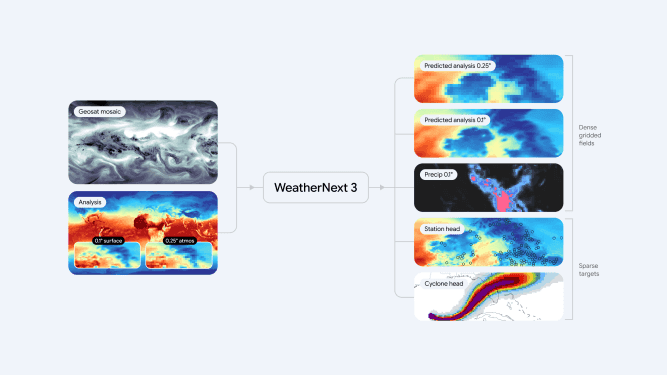
Scientists at Google DeepMind and Google Research released a new artificial intelligence model for weather forecasting today that sees our changing atmosphere more clearly and predicts its behavior more often. WeatherNext 3 is the latest wave of a sea change in meteorology brought out by deep learning techniques, and Google says it will start feeding into weather information users see in search, Google Maps, and Gemini, as well as being available to users and researchers on Google’s cloud platforms. “This is going to be the first time that some of the core variables feed and power a lot of the Google products,” Samier Merchant, a Google senior staff engineer, told TechCrunch. The new model has already proven to be the most accurate among leading contenders tested onOperational WeatherBench, a utility for comparing AI forecasts built by the startup Brightband. It looks at metrics like temperature, windspeed, and humidity. As well as beating out other deep-learning models built by Google, Microsoft, Nvidia, and the European Center for Medium-Range Weather Forecasting (ECMWF), it also beats traditional forecasts from the U.S. National Weather service and the ECMWF. Most weather forecasts come from government-owned supercomputers laboriously churning through mathematical equations written to describe the physics of weather; while these systems have become remarkably accurate, they are expensive and comparatively slow. After the ECMWF released more than half a century of weather data produced by these systems in 2018, deep learning researchers began training models that could make predictions far more quickly and with comparable accuracy to government tools. “Weather is chaotic, and so small differences really start to perturb massively…Machine learning targets the problem we are really solving, which is approximate noisy physics from incomplete information and finite compute, and so it learns patterns from a lot of data,” said Ferran Alet, a staff research scientist manager at DeepMind. Since then, model-makers have pushed on the key weaknesses of AI forecasting models: They tend to forecast over a wider area — 15 to 25 square km — than is truly useful, they’re not always great with rain, and they still depend on the formatted datasets produced by government agencies. WeatherNext 3 takes on all three challenges. On key variables, researchers told TechCrunch, it can predict down to a resolution of 5 km. Its evaluations on rain are 60% improved over WeatherNext 2, and it can now produce hourly forecasts, instead of the standard prediction every six hours. Those improvements are the result of specific choices made by the designers. WeatherNext 3 is a larger model, with 2.4 times more parameters than its predecessor, tailoring the targets for the decoder heads to give more useful answers. While most weather forecasts output as metrics averaged across a 3D grid, DeepMind researchers have already won plaudits by tuning their model to also visualize cyclone paths. This time around, the designers also trained the model to target its forecasts to specific weather data stations. This is important not only for offering more granular predictions, but also for being able to evaluate its work against specific, ground-truth data. “The idea, with a lot of AI applications, is to try to run tasks as end-to-end as possible,” Daniel Rothenberg, an atmospheric scientist at Brightband, said. “Adding a capability where this model is now also predicting, say, what Denver’s airport’s weather station is going to measure on an hourly basis, just connects that forecasting task closer to the core.” The model is able to forecast more frequently because it can ingest weather satellite data collected in real time on an hourly basis. Feeding AI models on raw empirical observations, rather than the analysis produced by weather supercomputers, promises a more accurate forecast, but it is still technically challenging to get models to work with unformatted data. Google says WeatherNext 3 is the “first” AI model to directly incorporate raw observations for a high-resolution global forecast, but the AI weather startup WindBorne says its model, WeatherMesh 6, has beenincorporating raw observationsfrom its fleet of weather balloons and other sources since late 2025. Asked about that, Google pointed out that its forecasts are higher resolution across the globe. Regardless, both models still rely on national weather datasets to perform forecasts, so more work will be required for true direct data assimilation. While LLMs get the bulk of the attention, the transformer revolution in meteorology has been just as important. European and U.S. weather agencies are already using AI models in their forecast products, and their speed and low cost promise to bring economic impact to poorer regions where the expense of high-quality sensors and supercomputers has put accurate forecasts out of reach. Bill Gatesrecently citedAI-powered weather forecasting as a crucial benefit of the technology, with better forecasts improving crop yields in developing countries. Alet, the DeepMind researcher, said that higher-resolution forecasts of wind, rain, and cloud cover will be useful to make renewable energy projects more dependable. “At the end of the day, I think Google is about providing useful information to the user, and a lot of what users are looking for has to do with the weather in some way or another,” Alet said.
View
Ollie is betting its focus on privacy can help it win the AI assistant race
For an AI assistant to become truly useful, it first has to know a lot about you.Ollie, a personal assistant for everyday life, is betting that doesn’t mean you have to hand over all your data and sacrifice your privacy in the process. While some enterprise-focused AI assistants have data privacy protections in place, Ollie is among the first mainstream, family-focused AI to achieve SOC 2 compliance — a framework that allows a company to demonstrate, through an independent audit, that it has formal controls in place to protect customer data and operate its systems securely. Achieving this was an important milestone for Ollie’s team, as it signals to potential users that the assistant isn’t trying to scoop up your personal data for other purposes, like AI training. “We fundamentally think that trust and privacy are absolutely imperative, and that’s why our business model is a subscription, because we want our users to know that Ollie works for you,” explained Ollie co-founder and CEOBill Lennonin an interview with TechCrunch. “We’re not sharing your data with anyone,” he stressed. There are many personal AI assistants positioning themselves as consumer-friendly solutions focused on integrating with users’ daily lives via text messages, which is why Ollie’s privacy angle could prove a significant differentiator. Today,Olliecompetes with other existing text-based assistants likePoke(acquired by Cognition),Fambot,Ohai,Folk,Saner.ai, andTomo. There are also a number of assistants focused more on work, calendar management and email, likeTown,LindyandReclaim.ai. And of course, there’sInstinct, the AI assistant thatjust landed $350 million in fundingat a $2.5 billion valuation before it even launched. To say the space is heating up is putting it mildly, in other words. By comparison, San Diego-based Ollie has raised a much more modest $7.5 million seed round, largely fromKhosla Ventures, along withAI House. Despite the utility these assistants provide, consumers who turn to these tools are wrestling with how much privacy and personal data they want to give up in the process. Instinct, for example,came under fire for its overly broad Terms of Service and privacy policythat granted it a “perpetual and irrevocable” license to “access, use, host, cache, store, reproduce, transmit, display, publish, distribute, and modify” any of the user’s materials, including for training its AI models. Yikes. Lennon is taking a different approach with Ollie. Currently, this family assistant connects to calendars and email to organize family schedules and keep its users updated about their days. It also offers tools that can help you plan meals, shop for groceries, track to-dos, book appointments, and pay bills via group chats. Later, it may help manage household budgets, too. Yet, all this access requires trust, which Ollie claims, is its value-add compared to its rivals. “We’re not sharing your data with anyone. This is super sensitive, and that is necessary to win the trust of the users,” Lennon said. In addition to the data protections provided by SOC 2 compliance, Ollie doesn’t request usernames or passwords to complete its tasks. When Ollie needs to log in to a website on the user’s behalf, it does so using its own browser in the cloud, and sends the user a link to a remote session in the browser. The process is similar when the assistant needs to make a payment or purchase on the user’s behalf. While this method offers security, the downside is that users always have to log in to complete certain tasks. Still, that’s something Lennon believes technology will improve upon in time. “This is… new territory. I think in the future, we will do some form of hard tokenization, in a secure way, so you’re not going to have to re-enter [your information] every time,” he said. “That’s frontier stuff… we want to find the right user experience that balances convenience and trust.” Building that trust will be important before users trust Ollie to access more sensitive materials, like their bank accounts, even if that’s through a connector like Plaid. Lennon, who has a Ph.D in AI, also has a background in fintech, having previously sold his startupGroundwork, a neobank for nonprofits, in 2021. That experience could help as Ollie moves further into money management. Still, it’s not yet clear if people even want any of this assistance. Lennon is hopeful, though, saying that Ollie’s retention curves are consistent with the leading AI subscriptions in terms of paid subscribers. (He didn’t share how many users or paid customers are now using Ollie, saying the space is too competitive.) These systems can also be hit-or-miss at times. Despite the hype around Instinct, one of my first tests with it was to price out hotels then book one, and it quoted me all the wrong rates. Ollie, meanwhile, experienced an infrastructure outage with its text provider when I was testing it, and it stopped responding. We asked the founder how Ollie is handling such problems, given that most consumers only give a new app or technology one shot. If it’s broken, they simply move on. Lennon agreed this is an issue with AI overall. “This is the challenge with LLMs, in general — because they’re stochastic [i.e., involve probability], they’re inherently unreliable,” he said. “We have to essentially build the harness — the agent harness — in a defensive way to catch and prevent those things… It’s almost like there’s just 1,000 cuts that you’ve got to solve first.”
View

India’s Data Centre Boom Is Creating a Jobs Paradox
The data centre industry is attracting billions of dollars in investment. But the number of permanent jobs created at these facilities is likely to remain relatively small.
View

NVIDIA Confirms $12.9 Bn Deal to Acquire Hugging Face
The AI platform will continue supporting open-source and open-weight models across different hardware, cloud and inference providers.
View

IBM Ventures Invests in BQP as Physics Platform Enters Production
The investment takes BQP’s total funding to $8 million as it expands its platform beyond aerospace and defence.
View
India has the Highest share of AI ‘Frontier Professionals’, Reveals Microsoft
“We’re not going after prompting, speed, and more efficiency. We’re going after judgment, taste, critical thinking, quality control,” said Puneet Chandok, Microsoft India president.
View
YC Backs India’s Legal Tech Nonprofit Adalat AI As It Takes Courtroom AI Global
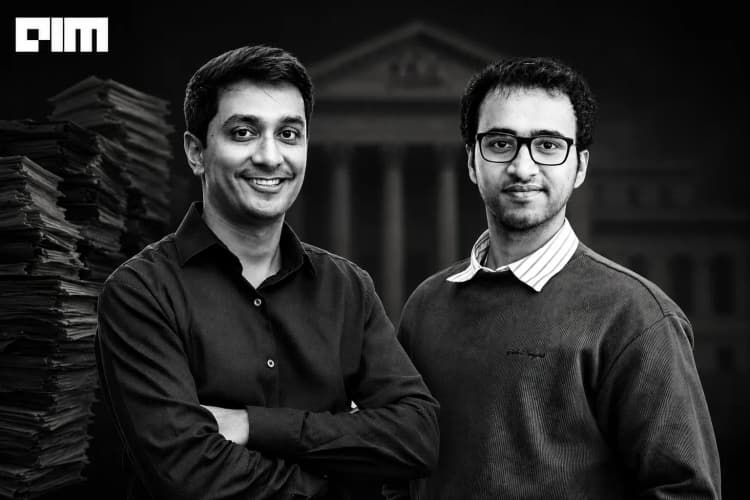
Adalat AI says it now works across 11 states and has reached more than 6,000 judges, covering roughly 20–25% of courtrooms nationwide.
View
Submit your Tool


PoweredByAI.app is an AI Tools Directory helping individuals, businesses, and creators discover the best AI tools for writing, coding, design, productivity, and more.
© 2026 , Product of011BQ. All rights reserved.