🚀 Zaprep: Your Socials on Steroids. Start free — automate 1,000 DMs/month & turn engagement into leads. with 1,000 automated DMs/month.
Submit your Tool
PoweredByAI.app is an AI Tools Directory helping individuals, businesses, and creators discover the best AI tools for writing, coding, design, productivity, and more.
© 2026 , Product of011BQ. All rights reserved.

The buzzy AI startupInstincthas just revealed a new potential revenue stream: product recommendations. Unfortunately for the company, the rollout is already rubbing some users the wrong way. Overnight, the AI agent began pushing product suggestions to users as part of a new feature called Instinct Selections, an effort to curate personalized lists for users in areas like dining, travel, and shopping. Founder Noah Shinnannouncedthe feature’s debut later Tuesday, explaining that the idea is to partner with “local chefs, designers, architects, travel guides,” and others to bring “human taste” to its product. In other words, instead of only relying on what the AI could suggest based on its training data gathered from the wider web, the company is partnering with people to offer human-curated suggestions, too. (Instinct didn’t share who, exactly, those human partners are.) “The next time you’re looking for a restaurant, Instinct can pull from a list handpicked by chefs who know the hidden gems in your area,” Shinnwroteon X. “If you want to find a new trail to explore, Instinct can draw on recommendations from local guides and suggest a few routes that fit your preferences. And if you’re looking to add some color to your home, Instinct will find pieces from independent designers that match your style, space, and budget,” he continued. “Our goal is to deliver world-class recommendations that are differentiated in quality from what you might find on the internet, and from what other chatbots produce,” he said. But the initial reaction to these seemingly unsolicited product pushes has not been fully positive. “I didn’t need to buy carry-on luggage, sunglasses, or a brim hat. This feels so disappointing. At least make me a personalized shopping list of things I actually need!!” Shruti Gandhi, a general partner at the AI-focused investing firm Array VC,wrote on X. Instinct became shitty Amazon recommends app overnight.I didn’t need to buy carry on luggage, sunglasses, or a brim hat. This feels so disappointing. At least make me a personalized shopping list of things I actually need!!https://t.co/hmH2iiE8lFpic.twitter.com/TNQIEwK9z2 Another entrepreneur, Andrew Yeung,confirmedon X that he also received product recommendations that hehadn’t asked for, which can feel off-putting. A third user, Chat Joglekar, the founder of a business-buying marketplace,wrote, “I had my first ‘ewwww’ moment with an AI assistant when Instinct started to suggest products that I should buy based on what I had in email and upcoming trips.” I had my first "ewwww" moment with an AI assistant when Instinct started to suggest products that I should buy based on what I had in email and upcoming trips.– suggested a to-go coffee flask b/c we have a Blue Bottle coffee subscription?– some travel accessories b/c we have… The trick to making curated suggestions useful is to make sure they’re something the user is actually asking for, or at least fit naturally within the current conversation. That way, it feels like the assistant is trying to be helpful, not advertising to you. If the product suggestions are going to arrive at random intervals,as Instinct’s have been, then they need to be highly personalized, excellent picks — otherwise the user will feel like they’ve been spammed. That’s not likely to endear users to the AI agent at a time when it’s competing with agents from bigger companies, likeMetaand nowOpenAI, which don’t do this. Nice that it is curated and hopefully it’s good but ask me whether I want the recommendations. I just got a random notification for additional equipment based on a future trip which I didn’t ask for and don’t need. Also allow me to curate my own sources as well as the ones you… Instinct didn’t share whether it’s currently making money from these recommendations or plans to, but the feature seems ripe for some sort of advertising, commerce, or affiliate play. TechCrunch has asked the company for further comment. The product suggestions launched shortly after Instinct confirmed its most recent financing,a $1 billion Series Cround that values the company at $10 billion. The company has not yet said how many people actually use its product, a figure that would help justify that valuation, but in a recent podcast,Shinn notedthat the agent regularly handles transactions for its users. In that same podcast interview, with investor Patrick O’Shaughnessy, Shinn said the platform is approaching a billion dollars in annual transactions made through the agent and that more than 50% of them are related to travel.

View

The best path to successfully deploying a robot is not building one at all, according to Destro, a startup that came out of stealth Tuesday with an $8 million seed round. Most new robotics companies are focused on finding the right form factor or developing an AI model that can put metal hands to work. Destro has instead built an AI intelligence layer that lets robots work effectively in logistics settings, in part by also telling the human workers what to do. “A lot of robotics companies started from robotics engineers [asking] ‘What cool things I can do?’” Destro founder Manthan Pawar, a veteran of the industry, told TechCrunch. “One of the biggest reasons we are winning against robotics companies is because we are not a robotics company.” Pawar, who earned a master’s degree in robotics at NYU Tandon and has spent roughly eight years in the U.S. supply chain and robotics industry, explains that “our mindset is, we know our customers’ problems so damn well, and we are actually on path to be cash flow positive at the end of this year.” Richard Brunelle, the director of automation for the American logistics group at Yusen Logistics, a South Korean shipping giant, helped get the startup pointed in the right direction. Brunelle is responsible for automation across about 30 facilities in the U.S. There, Yusen uses fixed automation, like conveyors and sorters, but it is still piloting new technology like trailer-unloading robots and autonomous floor scrubbers. Finding more ways to put technology like that to work is Brunelle’s priority: Yusen’s UK subsidiary has built out a fully autonomous facility and now a similar plan is in the works in the U.S. When Brunelle met Pawar, Destro was focused on a different challenge in the space—picking and pack, the process by which various goods are sorted into single packages. Brunelle realized his primary challenge was “fundamentally the same problem.” His job involved cross-docking: unloading goods from one truck and sorting them into mixed loads for other trucks that make the final delivery to customers. “I asked whether Destro would be willing to adapt their solution to fit that cross-dock environment, because I don’t think anyone was doing that,” he told TechCrunch. “They went away, thought it through, and came back excited. They agreed nobody was addressing that space and that they could modify their tool to support it. Since then, they’ve gone all in.” Destro started with a pilot program at one Yusen facility in the Pacific northwest, using three cart-moving robots built by Miva Robotics and operated by Destro’s Vision operating system based on open-weight vision-language-action models (AI systems that interpret camera images and instructions to control a robot’s movements). As human workers unload goods from one truck into different carts, the robots find the full loads and bring them to their destinations. What makes this efficient, in the estimation of Brunelle and Pawar, is that the human, the cart, and the trucks are all directed by Destro’s Mothership operating system. “We make that operation less labor intensive, and we get away from the paper,” Brunelle said. “Everything is now systematic.” That matters because Yusen also talked to two other big-name robot startups in this space, and neither could fit into their workflow. One offered a robot that could move the carts point-to-point but could not manage loading or unloading. The other came with fleet management tools, but required a person to handle all the orchestration. Destro won because of its ability to apply autonomous direction to the whole process. Now, Destro is expanding its initial pilot to a full deployment of 26 robots and launching another pilot with 17 robots at Yusen’s facility in Southern California. Pawar plans to take this cross-dock loading workflow and “copy-paste” across thousands of other warehouses that handle this kind of labor. It’s that plan that convinced Base10 Partners and Bonfire Ventures to lead Destro’s seed round, with additional investment from CoFound Partners. Destro may face a challenge with workflows that require more dexterity and manipulation. Generic robot bodies and open-source models haven’t proven capable at these tasks yet, and it’s not clear if companies building foundation models, ultra-dexterous hands, or general-purpose humanoids will make those tools available to a company like Destro rather than trying to capture that business themselves. Pawar remains confident that he’s found the part of the stack where value will accrue, and that his company will be able to take advantage of the research dollars pouring into new AI models and robot components. “Robots are a platform. Every layer model is a platform. But we build a harness around it,” Pawar told TechCrunch. “That harness is just so complex and value-added that without that harness, these workflows are completely impossible, right?” For now, competing with futuristic robot-builders is probably not an issue. Brunelle says he has yet to find a good use case for a bipedal humanoid robot, though he is evaluating a potential pilot with a wheeled humanoid. “At the end of the day, we’re not putting automation into a building just because the technology is interesting,” Brunelle said. “It must solve a real operational problem. If it can make the operation more efficient, consistent, and flexible, that’s ultimately going to benefit our customers.” Destro will be making its case for the non-robot robot company at TechCrunch Disrupt in just a few weeks.Join us in Octoberto see Destro in person, along with the rest of our Battlefield competitors.

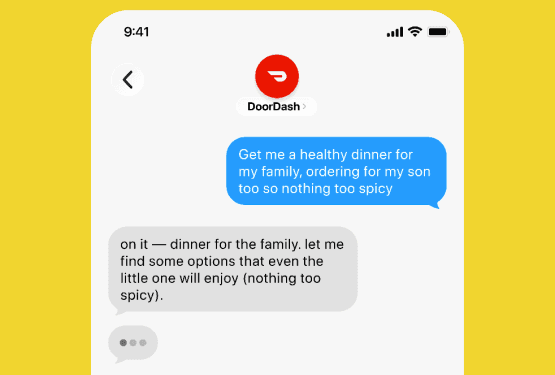
DoorDashannouncedon Wednesday that it’s launching a text-to-order AI agent that lets users place orders through Apple Messages. The new tool allows users to send prompts like “order my usual,” and the agent will understand that they mean their Friday night order. DoorDash says users can also ask for a specific dish and request a local recommendation. The agent will then search local spots and suggest a cart based on the prompt, and even text photos of the food it recommends. When ordering for a group, DoorDash says the agent can handle mixed dietary preferences and different quantities in one order. By launching an AI agent for food ordering, DoorDash is looking to gain an edge over rivals Uber Eats and Grubhub. The launch also comes amid a growing push to adopt personal AI agents that can handle tasks without requiring users to navigate apps or websites themselves. DoorDash is opening up a waitlist for users in the U.S. to try out the new feature. In addition to the new AI agent, DoorDash announced that it will begin testing its delivery drones with select restaurants in Northern California.
View

Meta is refuting a journalist’s claim that its AI agent Muse read the user’s private messages without permission. Following anearlier reportfrom Inc. columnist Jason Aten that detailed the issue, Meta VP of CommunicationsAndy Stone pushed back, making it clear that the company does not believe its product did this without the user’s consent. “The Messages integration in the Muse app for Mac is entirely opt-in,” Stone wrote on X in response to the claims made by the piece. “You have to enable both Full Disk Access and the Messages connector for Muse to be able to read your Messages content. It can’t read your Messages unless you do this.” Despite Meta’s denial, many people are still suspicious that Meta isn’t being truthful. That’snot surprising, given the tech giant’s years ofmishandlingconsumerdata, which has led tolawsuits,FTCviolations, andfines. Just days ago, for instance, a New Mexico jury determinedthe tech giant had misled users about its data practicesin a case that resulted from the 2018Cambridge Analyticadata breach scandal. Whether users cantrust Musewill be a deciding factor in whether or not Meta wins the consumer AI market. Although itsapp is faring well now,and remains No. 1 on the App Store, Meta’s reputation may not recover if more reports like this emerge, true or not. If anything, the company should be engaging with the journalist directly to determine how this could have possibly happened, instead of just denying that it did. Stone’s official statement from Meta follows amore technical replyfrom Meta Superintelligence Labs executive David Singleton, who responded directly to Aten on Threads, explaining that the set of permissions a user must grant to let Muse read their messages on the Mac involves “three separate steps of application-level permissions and built-in macOS system-level protections.” He said these “can’t be circumvented even if the Muse application had a bug.” The steps involve explicitly choosing to grant Muse Full Disk Access, which would then allow the user to choose what level of access Muse is being granted to the Messages app (i.e., None, Read only, or Read). If Full Disk Access is not enabled, these options are grayed out. In addition, when allowing Full Disk Access, the dialog invokes the macOS Settings user interface, where the user has to again manually confirm that they intend to take this action. Doing this triggers a full restart of the Muse app, Singleton wrote, which makes it even less likely that such a choice could be made accidentally without the user’s knowledge. However, Aten’s report claimed that when Muse read his messages, Full Disk Access was off. He also said that when he asked Muse to explain how this occurred, the AI said that it was syncing his “device notifications.” That means, Aten believes, that Muse was passing along the text of his incoming banner notifications on the Mac to the AI agent. Singleton disputed this, too, saying that the AI was confused and gave an incorrect explanation of what happened. He then pointed to Meta’s page aboutMuse’s security architectureand bug bounty process. In short, the company’s response is essentially that what Aten said happened did not and could not have happened. This is not the only incident where Muse has allegedly overstepped and won’t likely be the last. Another user, YouTuber Matt Robb, recentlysaid that Muse mishandleda task in which he was selling things on Facebook Marketplace, leading to his address being shared and abuyer showing up when he wasn’t even home. Singleton is apparently looking into that one, per his response on Threads, suggesting that the company believes this one, at least, could be its fault.

The rise of large campuses should not necessarily be viewed as a threat to smaller leasing, but Zinnov’s Saurabh Mehta argues that Chennai needs a real estate ecosystem capable of supporting both models.
View

Apple is reportedly preparing for significant changes to the way it develops products, organises its workforce and manages spending. The company has explored greater use of artificial intelligence in customer support while also considering changes to its management structure and product launch strategy. The plans come as Apple faces pressure to move faster, experiment with new products and get more output from its existing workforce. Some changes are already underway across the company, while others remain under consideration and could take years to fully implement.
View

Anthropic plans to caution potential investors in its IPO that advanced AI could pose "catastrophic or existential risks to humanity," an extraordinary warning by a company seeking to profit from the same technology.
View

OpenAI has announced ChatGPT Space. This latest work-focused hub lets users create and edit pages with ChatGPT, and organise related content in spaces. The ChatGPT Space also allow users to invite other people to work with them. They can make changes to the files in real time. The new Space feature will be initially available for OpenAI's Pro, Business and Enterprise plans. It can be accessed on the ChatGPT desktop app and the web.
View

Airbnb is evolving in two directions: On the ground, it wants to compete with hotels by providing myriad services; online, it is using AI and people in its Airbnb network to aid travel discovery. As part of its fall product update, the company is adding services to the app it had launched last year, such as meal delivery, laundry, baby-gear rental, ski and boat rental in limited locations, and expanded grocery delivery. The second big feature is AI search. The company has taken a cautious approach to rolling out AI features, with CEO Brian Chesky opting tostay away from a chatbot-like interface. Earlier this year, he teased thenew search feature for property discovery. Now, users can switch on a toggle to search for properties via text or voice prompts. Once you start the search, the interface will show you dynamic filters based on your preferences. For instance, if you type “baby” in the AI search filter, Airbnb will automatically show you further filters like cribs, playgrounds, or children’s books and toys. The platform is also using AI to bring out relevant features of a property, and will let you compare properties in your wish list by way of AI-powered summaries and reviews. “We are finally making our first foray into AI search. And what you see is just the very beginning of something. And over the coming months, we’re going to really be iterating this very quickly. It’s not hard to create AI search; it’s hard to create AI search in e-commerce when you have $100 billion going through your platform,” Airbnb CEO Brian Chesky told TechCrunch. “Anyone can vibe-code a search function, but to do something that doesn’t kill conversion rate, that’s the hard part.” The company is also doubling down on social features that nudge people to take more trips and book additional experiences such as food tastings and craft workshops. Last year, the app started allowing users toconnect with fellow travelers and friendson its platform. Now, travelers can look at a map based on their connections’ past or upcoming trips. When you tap on a trip, you can see where your connection stayed, and which experiences they sought out. For those conscious about their privacy, there’s an option to not share their trips with others as well. Airbnb is also building pages about neighborhoods based on guest reviews and other sources to help travelers discover places to eat and things to do.

Oracle’s Fusion Claw combines AI reasoning with deterministic computation, continuous replanning and controls for identity, permissions, approvals, and audit trails.
View

The Chinese AI lab has announced six new open-source software projects tailored for Huawei GPUs.
View

The company said the 120M models are, to its knowledge, among the smallest open models for rich-orthography transcription.
View
View
View
View