🚀 Zaprep: Your Socials on Steroids. 免费开始 — 每月自动发送 1,000 条私信,将互动转化为潜在客户。 ,每月 1,000 条自动私信。
博客How to Launch a Mobile App on a Tight Budget
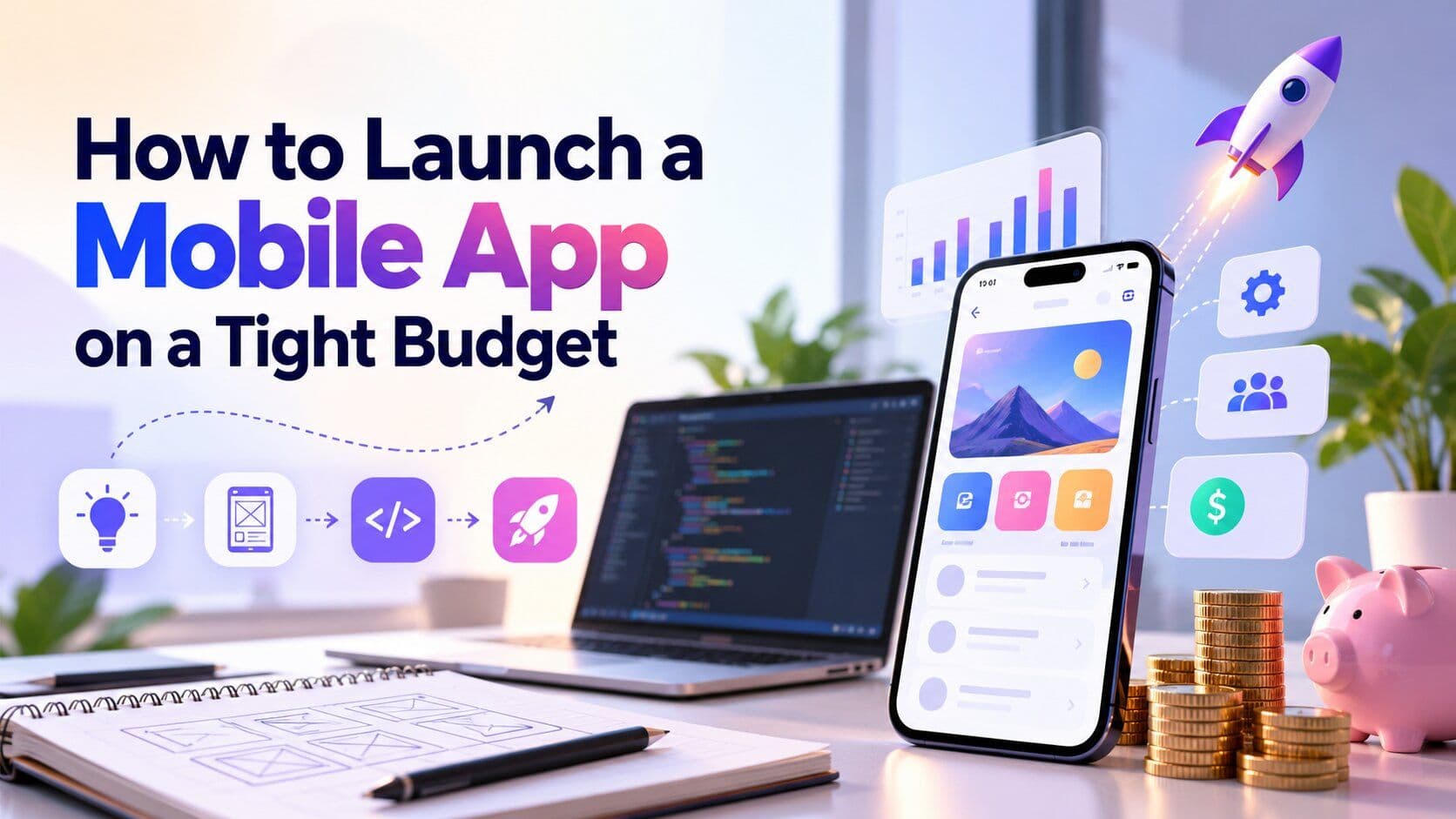
How to Launch a Mobile App on a Tight Budget
 Shashank Jain
2026年10月23日
11 分钟阅读
How to Launch a Mobile App on a Tight Budget
The average cost to acquire a single app user through paid advertising in 2026 sits somewhere between $2 and $5 for consumer apps, and significantly higher for finance, health, and B2B categories — sometimes reaching 20–50 per install. For a founder bootstrapping a launch with a few thousand dollars in the bank, that math doesn't work. A $3,000 marketing budget at $3 per install buys you 1,000 users. It's not nothing, but it's not a launch strategy either — it's a rounding error in most competitive categories.
The founders who launch successfully on tight budgets aren't finding a magic cheap alternative to paid ads. They're running a fundamentally different playbook — one built on time, creativity, and systematic execution rather than ad spend. It's more work. It's also proven, repeatable, and doesn't require outside capital to execute.
Here's the playbook.
The Mental Model: Trade Money for Time and Effort
Every scrappy launch tactic that works follows the same underlying trade: where a well-funded competitor spends money to buy attention, you spend time and effort to earn it. This isn't a consolation prize — done well, earned attention often converts better and costs less per acquired user than paid attention, because it comes with implicit trust that an ad doesn't carry.
The tactics below aren't a random grab bag. They're organized around the specific budget-free or low-budget levers available to a scrappy founder: your existing network, your story, communities that already have your audience, product mechanics that generate their own distribution, and a small amount of strategic spend on the highest-leverage paid tactics when free ones aren't enough.
Before Launch: Build the Foundation That Makes Everything Else Work
Nail Your One-Sentence Pitch
Every tactic that follows depends on being able to explain your app in one sentence that makes someone want to try it. If you can't do this, fix it before doing anything else — it's the highest-leverage five minutes you'll spend.
The formula that works: [specific outcome] for [specific audience] without [specific pain point]. "Track every subscription you're paying for, automatically, without digging through bank statements" is a pitch. "A smarter way to manage your finances" is not — it's too vague to make anyone act.
Build a Pre-Launch Email List
Every scrappy launch tactic performs better when you have even a small list of people who've already opted in to hear from you. Building this before launch — through a landing page, a build-in-public presence, or direct outreach — gives you an owned audience that doesn't depend on any platform's algorithm or any ad spend.
A simple landing page with a clear pitch and an email capture, shared consistently across your existing channels for the weeks before launch, can realistically generate 100–500 pre-launch signups for most first-time founders willing to put in consistent effort. Those signups become your day-one download base and your first reviewers.
Prepare Your Assets in Advance
Nothing kills launch-day momentum like scrambling to create assets while the moment is happening. Before launch day, have ready: a demo video under 60 seconds, 3–5 strong screenshots, a one-paragraph and one-sentence description of the app, a founder story (why you built this, what problem it solves for you personally), and a list of the specific communities and people you'll reach out to on launch day.
Tactic 1: Launch on Product Discovery Platforms
This remains the single highest-leverage free distribution channel for new apps, and it costs nothing but preparation and execution.
Product Hunt can drive hundreds to thousands of visitors in a single day if you execute well — but success depends heavily on preparation, not luck. Launch on a Tuesday, Wednesday, or Thursday (higher traffic than weekends or Mondays). Have your network ready to visit and engage genuinely within the first few hours, since Product Hunt's ranking algorithm weights early engagement heavily. Write a founder comment that tells the real story, not marketing copy — authentic founder comments consistently outperform polished ones in generating genuine discussion.
Hacker News, for developer tools, technical products, or anything with an interesting technical story, can drive significant qualified traffic through a "Show HN" post — but the community is famously allergic to marketing language. A genuine, technical, humble framing performs far better than anything that reads as promotional.
Indie Hackers, BetaList, and category-specific discovery platforms (AlternativeTo for competitor-alternative positioning, relevant subreddits for niche categories) round out a free launch-week distribution push. None of these cost money — they cost the time to prepare a genuinely good submission and engage authentically with the community response.
A Note on Preparing Momentum Before Launch
Discovery platforms disproportionately reward content that shows early traction — a Product Hunt launch with zero upvotes in its first hour rarely recovers, regardless of product quality, because the platform's own algorithm interprets weak early signal as weak content. This is precisely why pre-launch list building and network activation aren't optional steps — they're the mechanism that gives your discovery platform launches a real chance to gain the visibility the platform is capable of providing.
Tactic 2: Build in Public Before and After Launch
Documenting your journey publicly — the real numbers, the real struggles, the real decisions — has become one of the most cost-effective distribution strategies available to founders, because it generates an engaged audience over time that converts to users at launch and continues generating word-of-mouth afterward.
This costs nothing but consistency. Post your actual progress — user counts, retention struggles, feature decisions, revenue if you're comfortable sharing it — on whichever platform your target audience actually uses. Twitter/X and LinkedIn work well for most B2B and productivity apps; TikTok and Instagram work well for consumer apps with visual appeal.
The compounding value here is real: founders who build in public for months before launch typically convert a meaningful percentage of their following into actual users at launch, at zero acquisition cost, because those followers have already invested emotional interest in the outcome.
Tactic 3: Turn Your Product Into Its Own Distribution Channel
The cheapest user acquisition is the user acquisition your product generates on its own. This requires product decisions, not marketing decisions, but it's worth making explicit because it's often overlooked by founders focused purely on external promotion tactics.
Build in a natural sharing moment. If your app produces something shareable — a result, an achievement, a creation, a piece of content — make sharing it frictionless and give people a genuine reason to want to. A fitness app that generates a shareable workout summary, a budgeting app that generates a shareable savings milestone, a creative app whose output is inherently shareable — these product mechanics turn every satisfied user into a potential distribution channel.
Consider a referral mechanism, even a simple one. "Invite a friend, you both get [benefit]" doesn't require sophisticated infrastructure to implement at a basic level, and even modest referral participation compounds meaningfully over time compared to zero built-in virality.
Make the app genuinely good enough to talk about. This sounds obvious, but it's the actual foundation underneath every other tactic on this list. Word-of-mouth — still the highest-converting, zero-cost acquisition channel available to any product — only happens for apps that deliver a genuinely strong experience. No launch tactic compensates for a product people don't want to recommend.
Tactic 4: Community Engagement — The Highest-Effort, Highest-Quality Channel
Direct, genuine engagement in communities where your target users already spend time is free, scalable with effort, and produces some of the highest-quality early users of any channel — because they're self-selected people already interested in the problem you solve.
Identify 5–10 relevant communities — subreddits, Discord servers, Slack communities, Facebook Groups, niche forums — where your target audience genuinely participates. Spend time as a real participant before promoting anything. Answer questions, share genuine expertise, build a track record as a real community member.
Share your app when it's genuinely relevant, not as a cold promotional drop. The most effective framing: someone asks a question your app directly solves, or a community has a designated space for sharing what members are building (many subreddits and Discord communities have weekly "what are you working on" threads specifically for this). Respecting community norms and being transparent about your involvement with the product — "I built this, curious what you think" — performs far better than an anonymous or disguised promotional post, and avoids the reputational damage of being caught being inauthentic.
This tactic doesn't scale the way an ad campaign scales, but the users it produces tend to be highly engaged, provide genuine feedback, and are more likely to become organic advocates than users acquired through any paid channel.
Tactic 5: Strategic Press and Newsletter Outreach
Press coverage and newsletter features cost nothing but outreach effort, and a single well-placed feature can drive more qualified traffic than a modest ad budget would purchase.
Target niche, relevant publications and newsletters over major outlets. A feature in a newsletter with 5,000 highly relevant subscribers often converts better than a mention in a major outlet with a broad, less relevant audience. Research newsletters and blogs that cover your specific category and pitch them directly with a clear, specific angle — not a generic "we launched" press release.
Have a genuine story, not just a product announcement. "We built an app" isn't a story journalists or newsletter writers want to cover. "We built this because [specific personal problem], and along the way discovered [interesting insight about the market/problem]" is a story. Frame your outreach around the story, with the product as supporting evidence.
Follow up, but respect boundaries. A single, well-crafted follow-up a week after your initial outreach — with any updates or new angle since your first email — is reasonable. Repeated follow-ups without new information tend to damage the relationship rather than improve response rates.
Tactic 6: Use Crowdsourcing for the Highest-Leverage Paid Spend
For the specific budget you do have, not every dollar produces equal return. Traditional paid app install ads, at 2–50+ per install, depending on category, are among the least efficient uses of a genuinely tight budget in the earliest launch phase — you're paying premium rates for a channel that performs best once you already have social proof, review volume, and conversion data to optimize against.
Affordable app promotion platforms that connect apps with real users willing to download, try, and review a product for a small payment offer a meaningfully more cost-effective allocation of limited launch budget for a specific purpose: building the review volume, rating baseline, and initial usage signals that make every subsequent channel — organic search, paid ads, press coverage — perform better.
The comparative economics matter here: a modest budget allocated toward genuine crowdsourced reviews and downloads, aimed at crossing early app store visibility thresholds, typically produces more downstream value per dollar than the same budget spent on early paid install campaigns, precisely because app store algorithms and conversion rates both depend heavily on the social proof that crowdsourcing can help establish quickly.
Where this fits in a scrappy launch budget:
Prioritize it early, before other paid spend, because the review and rating foundation it builds improves the performance and reduces the cost of every subsequent growth channel — including any paid advertising you eventually run.
Keep the spend proportionate — this is a foundation-building tactic, not a primary growth channel. A modest, realistic allocation to cross initial visibility thresholds is the efficient use case, not an attempt to manufacture your entire user base through this channel alone.
Combine it with the free tactics above rather than substituting for them. The strongest scrappy launches use every available lever — network activation, discovery platforms, community engagement, and targeted, efficient paid spend — working together rather than relying on any single channel.
What to Skip When the Budget Is Genuinely Tight
Being scrappy also means being disciplined about what not to spend on, even when it's tempting.
Skip broad paid social ads before you have conversion data. Running Facebook or Instagram ads without a tested, converting app store listing wastes budget on traffic that won't convert. Fix your listing conversion rate through organic traffic first; only then does paid traffic become efficient.
Skip expensive PR agencies for an early-stage launch. A skilled founder doing direct outreach, armed with a genuine story, often outperforms an expensive agency relationship for an early-stage product — agencies are more valuable once you have traction and a bigger story to tell.
Skip building elaborate custom growth infrastructure before you need it. Sophisticated referral systems, complex attribution tracking, and custom analytics dashboards are valuable at scale but are often premature investments of scarce time for a founder who should be talking to users and iterating on the product instead.
Skip over-polishing launch assets at the expense of launching. A good-enough demo video and a functional landing page, shipped this week, beats a perfect version shipped next month. Momentum matters more than polish in the earliest phase.
The Realistic Math of a Scrappy Launch
A founder executing this playbook consistently over 4–8 weeks — pre-launch list building, a coordinated discovery platform launch, ongoing community engagement, build-in-public momentum, and a modest, strategic allocation toward review and rating acceleration — can realistically reach the first 500–2,000 downloads without a meaningful ad budget, depending on category and execution quality.
This isn't a shortcut that avoids work. It trades a marketing budget you don't have for a time and effort investment you do have. The founders who succeed with this playbook are the ones who treat it as seriously as they'd treat any other core part of building the company — not a side task squeezed in after "real" work, but a central, planned, tracked part of the launch itself.
Money buys attention. Effort earns it. On a tight budget, effort is the only lever you have — so pull every part of it, deliberately and consistently, and the launch that money alone couldn't buy becomes achievable.
在高流量博客与文章中展示您的 AI 工具
在 PoweredByAI 获得展示,触达正在发现与您类似工具的用户。建立强大的 SEO 外链,提升 Google 排名并带来持续自然流量。
定向触达的赞助博客展示
带 do-follow 外链的客座文章
提升 SEO 的上下文链接投放
深受 25,000+ 款 AI 工具及成长型初创公司信赖
Enjoyed this? Talk AI tools with other founders and builders.
Join our Slack community