🚀 Zaprep: Your Socials on Steroids. 免费开始 — 每月自动发送 1,000 条私信,将互动转化为潜在客户。 ,每月 1,000 条自动私信。
博客AI to Human Text: Why Most Rewrites Fail and How to Fix Them
AI to Human Text: Why Most Rewrites Fail and How to Fix Them
 Shashank Jain
2026年10月14日
7 分钟阅读
You paste a ChatGPT draft into a rewriting tool, click the button, and get something back that is different but somehow worse. The words changed. The sentences moved around. It still reads as if a machine wrote it, and now a couple of lines don't quite make sense.
AI to Human Text: Why Most Rewrites Fail and How to Fix Them
You paste a ChatGPT draft into a rewriting tool, click the button, and get something back that is different but somehow worse. The words changed. The sentences moved around. It still reads as if a machine wrote it, and now a couple of lines don't quite make sense.
That experience is common, and it has a simple cause. Most attempts to turn AI into human text work on the wrong layer. They change the wording and leave the real problem in place. This article explains why that happens, what the research says about it, and how to rewrite AI to human text in a way that holds up with real readers.
What Makes AI Text Sound Like AI in the First Place
When people say a draft "sounds like AI," they usually mean a mix of things. Some of it is vocabulary, the familiar set of words chatbots reach for again and again. But a lot of it sits deeper than word choice.
AI drafts tend to say what anyone could say about a topic. There is no first-hand experience in them, no specific example the writer lived through, no opinion that someone might disagree with. The structure is predictable too: a scene-setting opening, a few evenly sized sections, and a closing paragraph that repeats the introduction. A reader picks up on all of this, even if they could not name it.
Keep that in mind, because it explains almost every failed rewrite. If the problem is missing substance and a predictable shape, then changing the words cannot fix it.
Why Most AI to Human Text Rewrites Fail
1. They swap words instead of ideas
The most basic rewriters replace words with synonyms and shuffle clause order. The results can be strange. In 2021, a group of computer scientists noticed odd wording turning up in published research papers, such as "counterfeit consciousness" where the authors meant artificial intelligence, and "colossal information" in place of big data. Nature reported on these "tortured phrases", and the researchers who found them linked the style to free online rewriting tools.
Those are extreme cases, but milder versions show up in everyday rewrites. "Use" becomes "utilize." "Help" becomes "facilitate." A clear technical term gets replaced with something nobody in the field would ever write. The text is now harder to read and no more human than it was before.
2. They keep the AI's skeleton
Even a good sentence-level rewrite leaves the outline untouched. If the original draft opened with "In today's world," moved through three tidy sections, and ended with a summary, the rewritten version will do the same thing in slightly different words. Readers notice structure faster than they notice vocabulary. A familiar shape tells them what kind of text they are reading before they finish the first paragraph.
3. They add nothing new
A rewrite cannot add information that was never there. If the AI draft was generic, the rewritten draft will be generic too. This matters for search as well as for readers. Google's guide to creating helpful, people-first content asks site owners whether their pages offer original information or analysis, and whether content that draws on other sources adds value instead of simply copying or rewriting them. A reworded AI draft with no new information fails that test, no matter how natural the sentences sound.
4. They change the meaning
This one causes the most damage, and people often miss it. Rewriting tools work by predicting plausible replacements, and plausible is not the same as accurate. In the process, a few things tend to get lost or bent:
- Qualifiers disappear, so "may reduce costs" turns into "reduces costs."
- Numbers get rounded, swapped, or attached to the wrong claim.
- Technical terms get replaced with near-synonyms that mean something different.
- The order of cause and effect flips.
Any of these can turn a correct draft into an incorrect one. The text may read more smoothly, but you are now publishing a claim you never meant to make.
5. They aim at a detector score instead of a reader
Many people judge a rewrite by running it through an AI detector. That is an unreliable target. Detectors disagree with each other, and the same tool can give different scores on similar text. Vendors also report their own results in ways that are hard to compare, which is why no single humanizer test result should be taken at face value. A piece can pass every detector and still bore the person reading it. The reader is the test that counts.
How to Rewrite AI to Human Text That Holds Up
The fix is to change the order of work. Decide what the piece needs to say first, rebuild the structure second, and only then worry about the sentences.
Step 1: List what you know that the AI doesn't
Before you touch the draft, write down the things only you can add. That might be a result from your own project, a mistake you made and fixed, a number from your analytics, a customer question you hear every week, or an opinion you hold about the topic. If the list is empty, the piece needs research before it needs rewriting.
Step 2: Rebuild the outline
Look at the AI's headings and ask whether that is the order a reader needs. Often the most useful point is buried in the middle. Move it up. Cut sections that repeat each other, and merge ones that are too thin to stand alone. Some sections deserve two paragraphs and some deserve six. Let the content decide.
Step 3: Write the opening and the ending yourself
These are the two places where AI drafts are weakest and where readers decide whether you are worth their time. Start with the problem the reader has or the most interesting thing you found. End with the point you most want them to remember, or the next thing they should do. Skip the recap.
Step 4: Apply plain language rules to the sentences
Now work on the wording. The U.S. government's plain language guide on writing for understanding is a useful checklist here. It recommends active voice, the present tense, and shorter words. It also warns against hidden verbs, where an action gets turned into a noun. "Conduct an analysis of the data" becomes "analyze the data." AI drafts are full of these, and fixing them alone makes a draft read more like a person talking.
Step 5: Use a tool for the sentence pass, then check every line
Rewriting tools are good at one narrow job: smoothing rhythm and phrasing across a long draft. Used that way, after you have fixed the substance and structure, they save time. Some kinds of writing benefit more than others, such as emails, product descriptions, and machine-translated text, and it helps to see where an AI-to-human rewriter fits in a workflow before you rely on one. Whatever tool you use, compare the output to your draft line by line. Check every number, every qualifier, and every technical term against what you meant to say.
Step 6: Read it out loud
This takes five minutes and catches what the other steps miss. If you trip over a sentence, rewrite it. If a phrase is something you would never say to a colleague, replace it with what you would say.
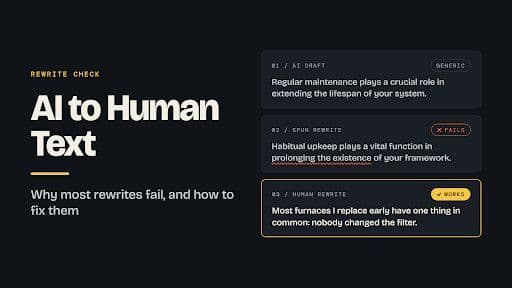
One Paragraph, Three Versions
Here is how the difference looks in practice. Start with a typical AI draft:
"Regular maintenance plays a crucial role in extending the lifespan of your HVAC system. By scheduling routine inspections, homeowners can identify potential issues early and avoid costly repairs."
A synonym-swapping rewriter might return this:
"Habitual upkeep plays a vital function in prolonging the existence of your HVAC framework. By arranging customary examinations, property holders can recognize prospective problems promptly and evade expensive fixes."
Every word changed, and the paragraph got worse. "Prolonging the existence of your HVAC framework" is a tortured phrase in the making. Now compare a version rewritten from what an HVAC technician knows:
"Most of the furnaces I replace early have one thing in common: nobody changed the filter. A clogged filter makes the blower work harder all winter. A $15 filter every three months is the cheapest repair you will ever make."
The third version has a speaker, a specific cause, a real number, and a clear piece of advice. No rewriting tool could have produced it, because the information was not in the original draft. (The figures here are illustrative; use the ones from your own work.)
The Short Version
Most attempts to convert AI to human text fail because they treat a substance problem as a wording problem. Synonym swaps make text stranger, and even good rewrites keep the AI's structure and its lack of new information. To rewrite AI-generated text into human text that works, add what you know, rebuild the outline, write the opening and ending yourself, and only then polish the sentences. A tool can help with that last step. The rest is still your job, and it is the part readers notice.
在高流量博客与文章中展示您的 AI 工具
在 PoweredByAI 获得展示,触达正在发现与您类似工具的用户。建立强大的 SEO 外链,提升 Google 排名并带来持续自然流量。
定向触达的赞助博客展示
带 do-follow 外链的客座文章
提升 SEO 的上下文链接投放
深受 25,000+ 款 AI 工具及成长型初创公司信赖
Enjoyed this? Talk AI tools with other founders and builders.
Join our Slack community