🚀 Zaprep: Your Socials on Steroids. 免费开始 — 每月自动发送 1,000 条私信,将互动转化为潜在客户。 ,每月 1,000 条自动私信。

Voice AI company ElevenLabsrevealednew investors that are part of its $500 million Series D fundraise,which was first announced in February. The additions include institutions such as BlackRock, Wellington, D.E. Shaw, and Schroders; enterprises like NVIDIA, Salesforce, Santander, KPN, and Deutsche Telekom; and individual investors such as Jamie Foxx, Eva Longoria, and Squid Game creator Hwang Dong-hyuk. The startup also noted that it surpassed $500 million in ARR (Annual Recurring Revenue), after endinglast year with nearly $350 million in ARR. The company’s co-founder and CEO, Mati Staniszewski, said last month that ElevenLabs added$100 million in net new ARR in Q1 2026, ending the quarter at roughly $450 million in ARR. The company has also accelerated its valuation rapidly, growing from $6.6 billion last September to $11 billion this February. “Voice is the highest-stakes channel for any customer interaction, and the bar for quality, latency, and security is extremely high. ElevenLabs is not just a category leader – it is becoming a foundational enabler of Deutsche Telekom’s broader Industrial AI vision. From voice-as-a-service to multilingual automation and in-network AI agents, we believe the company is uniquely positioned to reshape how businesses interact with customers across all channels,” Karine Peters, Managing Director at Deutsche Telekom’s venture arm T. Capital said in a statement. In the past quarter, the voice AI company has signed enterprise contracts with the likes of Deutsche Telekom, Revolut, and Klarna. ElevenLabs said that, besides the fundraising, it also closed a $100 million tender, a second in roughly six months after the company issued one last September. Staniszewskisaid in a blog postthat the company will give an opportunity to retail investors to invest in ElevenLabs through Robinhood Ventures, but didn’t provide details about the program. Staniszewski noted that consumers won’t trust systems that sound robotic or “interact strangely” and emphasized the importance of building “human-level AI voice models.” Last month, the company acquired the team from Polish voice AI startup Paplato bolster its research team.
View

Meta will start using AI to scan photos and videos for visual clues to see if a user is under 13 and should be removed from Facebook and Instagram, the companyannouncedon Tuesday. These visual clues include a person’s height or bone structure, it said. “We want to be clear: this is not facial recognition,” Meta explained in its blog post. “Our AI looks at general themes and visual cues, for example height or bone structure, to estimate someone’s general age; it does not identify the specific person in the image. By combining these visual insights with our analysis of text and interactions, we can significantly increase the number of underage accounts we identify and remove. The visual analysis system is now operating in select countries, but Meta says it’s working toward a broader rollout. Meta says this system is part of its efforts to keep kids under 13 off its platforms. These efforts include using AI to analyze entire profiles for contextual clues, such as birthday celebrations or mentions of school grades. The company looks for these signals across different formats, such as posts, comments, bios, captions, and more. Meta plans to expand this technology to more parts of its apps, including Instagram Live and Facebook Groups, in the future. If Meta determines that a person may be underage, it will deactivate their account, and the user will need to prove their age using the company’s age verification process in order to prevent their account from being deleted. The announcement comes weeks after a New Mexico juryordered Meta to pay $375 millionin civil penalties for misleading consumers about the safety of its platforms and putting children at risk. The company was also ordered to implement fundamental changes to its platforms. Meta has since threatened toshut down its social media servicesin the state. It’s worth noting that this case isone of manylawsuits that Meta and other Big Tech companies are facing over child safety. Meta also announced on Tuesday that it’s expanding its technology that automatically places teens into stricter“Teen Accounts”on Instagram to 27 countries in the EU and Brazil. These teen accounts place users into a stricter account experience with additional safeguards, such as receiving DMs only from people they follow or are already connected to, hiding harmful comments, and setting accounts to private by default. Additionally, Meta said it’s expanding the technology to Facebook in the U.S. for the first time, followed by the U.K. and EU in June.
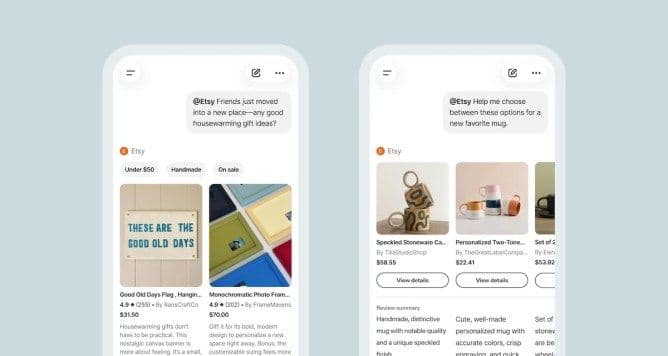
EtsyannouncedTuesday the launch of its native app within ChatGPT, opening up a new way for shoppers to explore its catalog of over 100 million listings. The new experience is designed to move beyond the limitations of traditional keyword queries. Instead of typing something like “wooden coffee table,” then scrolling and adjusting filters, users can now express what they’re looking for in natural language. For instance, “Help me find a Mother’s Day gift under $100 for my mom who loves gardening.” Now live in beta, the feature allows users to tag @Etsy directly within a prompt. From there, the Etsy app in ChatGPT surfaces relevant product listings that users can browse, compare, and click through to Etsy for additional details or purchase. This isn’t Etsy’s first experiment inside ChatGPT. Back in September, Etsy became an early partner in ChatGPT’sInstant Checkoutintegration, which let users buy products directly inside the chat interface. However, the initiativeended in March, suggesting it didn’t perform as OpenAI had hoped. It wasreportedthat Etsy didn’t see a large volume of sales from the integration, leading Etsy to start building a native app within ChatGPT instead. Alongside this launch, Etsy also revealed it’s testing a beta conversational search experience within its platform, specifically geared toward helping users find gifts. The gift assistant acts as a personal shopper, offering a guided, conversational way to discover ideas, narrow down preferences, and surface relevant products. This builds on Etsy’s broader AI push, which includes anAI-powered discovery experiencefeaturing curated collections and a suite ofseller tools, including a tool that helps generate product titles and descriptions, as well as a writing assistant to help draft messages to buyers. In 2024, Etsyintroduceda new “Designed” label to identify AI content, part of an effort to increase transparency as AI-generated artwork becomes more prevalent on the platform. The news of a ChatGPT integration comes a week after Etsyreportedits Q1 2026 earnings, surpassing revenue expectations with $631 million, and marketplace gross merchandise sales were up 6% year over year. Notably, active buyers increased for the first time in two years to 86.6 million. Etsy also touted 5.6 million active sellers on the platform. In February, the companyannouncedit was selling Depop to eBay for $1.2 billion in cash, a move aimed at doubling down on its core marketplace. Etsy joins a growing list of companies buildingnative appswithin ChatGPT, including Angi, SeatGeek,Tubi, and Wix. Developers have been able to build apps within the chatbot since October.
PayPal is looking towards the future, despite its falling stock and looming layoffs. In its first-quarter earnings call, CEO Enrique Lores told investors that PayPal needs to “recommit to the fundamentals,” which included “becoming a technology company again.” There was no need to read between the lines — PayPal was pitching an AI-powered turnaround. Lores explicitly said so, telling analysts on this week’s call that leading companies find ways to differentiate themselves by innovating, and that now is the time for PayPal to take action. This includes modernizing its tech platform, moving faster to become “cloud-native,” and “aggressively adopting AI in our development processes,” Lores said. The latter would increase developer productivity and shorten time to market, he added. It’s a startling admission from PayPal that it has yet to fully embrace AI in-house, when AI-assisted coding is one of the breakout areas where the technology has truly excelled. Other consumer tech companies have rapidly adopted AI in recent months to assist with coding, with Spotify even declaring in February that its top developershaven’t written a line of codesince December. Meanwhile, top dev teams are trying to outcompete one anotherby tokenmaxxing— a proxy for understanding who at the company is experimenting with AI more often, based on the number of AI tokens they use. PayPal is only now catching up, it seems. Lores said the company has formed a new “AI transformation and simplification” team to help with its enterprise AI agenda. Combined with the planned layoffs, which Lores characterized as PayPal removing layers from its organizational structure, the addition of AI-enabled processes is expected to bring the company at least $1.5 billion in cost savings over the next two to three years, he said. The company announced last week it wasreorganizing its business, which streamlines the operation into three segments: checkout solutions and PayPal, consumer financial services (and Venmo) as well as payment services and crypto. In addition,Bloomberg reportedon Tuesday that PayPal plans to cut around 20% of its workforce over the next two to three years as part of its cost-savings plan, equating to north of 4,500 jobs. More cost savings will come from PayPal’s plans for AI adoption, company execs said on the call. That includes bringing AI into areas beyond coding, like customer service, support operations, and risk management, to name a few. “I think the changes that AI will enable us to do are going to drive — are going to be very significant,” said Lores. “This is why we created a group last week, reporting to me, that is going to be in charge of driving — function by function, process by process — this AI transformation. And this is not about adopting AI as a technology, where we have done many pilots in the company, and we have seen what is possible. It’s really about understanding how can we redesign the key processes … this is what we have seen that really will drive significant savings.” Announcing an AI-driven push to cut costs while eliminating thousands of jobs underscores a core criticism of the technology — it comes with a human cost It’s worth noting that, in this case, PayPal was already in need of restructuring. The company may have beat on its first-quarter earnings with revenue of $8.4 billion, up 7% year-over-year, but it forecast weak guidance for the second quarter,sending the stock tumblingafter earnings. That follows a long post-pandemic decline that has sentthe stock down over 80%from its 2021 high and has stunted PayPal’s growth. Asked if separating Venmo into its own business meant the company would be open to selling it, Lores said that, for now, this is what made the most sense in terms of the turnaround plan. Still, he signaled openness to future deals by saying “my number one priority is to maximize shareholder value,” in answer to an analyst’s question about a sale.

Coforge said AI-led delivery helped sustain profitability, though reported earnings were partly boosted by a one-time tax adjustment.
View

Former Indian cricketer Mithali Raj said AI is not just enhancing performance and storytelling, but also redefining the very nature of the sport.
View

Without semantic layers and governance, enterprise AI stays a demo, never a decision engine.
View

The latest growth is driven by enterprises deploying voice-based AI agents across customer support, sales, hiring, and marketing functions.
View

Anthropic and OpenAI might soon compete for a share of the enterprise services market. On Monday, the Claude maker announced the creation of a new enterprise artificial intelligence (AI) services company to serve mid-sized businesses across sectors. The new venture brings together Anthropic, Blackstone, Hellman & Friedman, and Goldman Sachs and is backed by several investors. On the other hand, a report claims that OpenAI is also planning to announce a new venture focused on providing tailored AI services to enterprises.
View

The state signals a shift from data centre hosting to manufacturing, with an investment of ₹1,000 crore and job creation.
View

Hyderabad stands among the fastest-growing GCC hubs in the country, surpassing most major cities and adding over 75 GCCs in the past year alone.
View

The country turns to India’s tech expertise to unlock growth, scale digital infrastructure, and drive recovery.
View
View
View
View

