



Featured in:Best AI Data Science Tools
Get featured →



✦
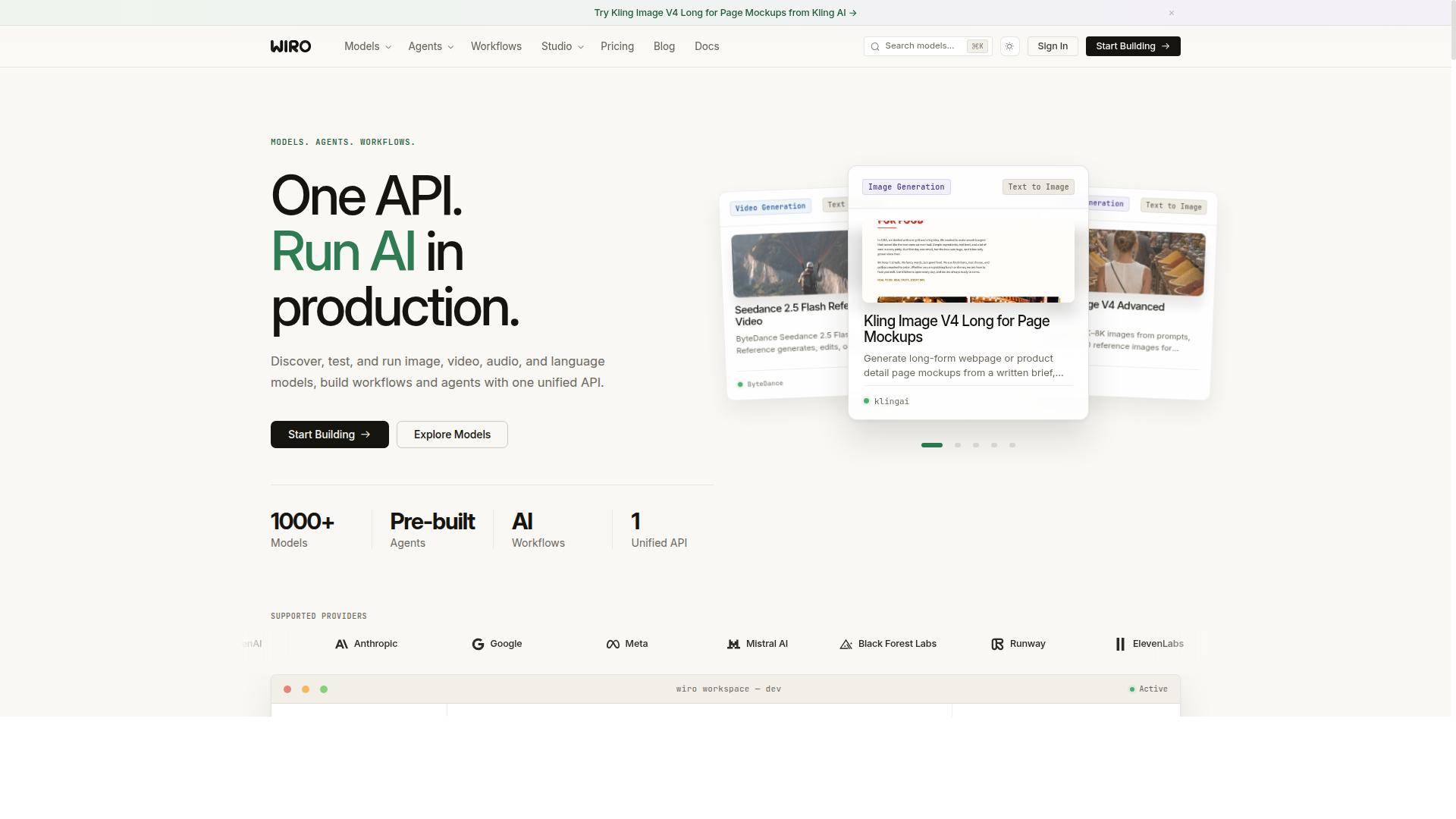
Wiro AI is a unified platform offering over 1,000 generative AI models across images, video, speech, music, 3D, and chat—all accessible through a single API without managing GPUs or multiple vendor accounts. Ideal for developers and teams, it features workflow orchestration, hosted AI agents, and OpenAI-compatible endpoints, making it a powerful, flexible solution for integrating AI into diverse products.
Description
Wiro AI is a platform for developers and teams who want to add generative AI to their product without running GPUs or opening an account with every model vendor. The catalog lists 1,000+ models for image generation and editing, video, speech, music, 3D and chat. It includes Kling, Veo, Seedance, Seedream, FLUX, Nano Banana and ElevenLabs voices, plus open models that Wiro hosts on its own GPUs. Every model takes the same kind of request. You POST the inputs to /Run and get a task ID back, then read the result by polling, over a WebSocket, or through a webhook sent to your callbackUrl. A /sync variant waits and returns the output in one call. LLMs from OpenAI, Anthropic, Google, Qwen, DeepSeek and others are also served on an OpenAI- and Anthropic-compatible endpoint, so existing SDK code only needs a new base URL. Models can be chained into workflows: a graph of steps that runs as one job, can be resumed if a step fails, and can start from the public gallery. Wiro also hosts AI agents. You deploy an agent from a template or from your own skills, connect the accounts it needs, and message it or give it scheduled tasks. Billing is prepaid. Each model has its own price per request, second, token or output, and the full list is public; agents have their own plans. Wiro ships SDKs for Flutter, React Native, Swift and Kotlin, a Node.js client, an MCP server for Claude Code, Cursor and other assistants, an n8n node and a Zapier app. Teams get a shared wallet with spend limits.
Detailed Description
Wiro AI is a comprehensive platform designed to empower developers and teams to seamlessly integrate generative AI capabilities into their products without the complexity of managing GPUs or maintaining multiple vendor accounts. At its core, Wiro AI offers a unified API that provides access to an extensive catalog of over 1,000 models spanning various domains including image generation and editing, video creation, speech synthesis, music production, 3D modeling, and conversational AI. This breadth of models includes proprietary voices such as Kling, Veo, Seedance, Seedream, FLUX, Nano Banana, and ElevenLabs, alongside numerous open-source models hosted on Wiro's own GPU infrastructure, ensuring a wide range of options for diverse AI-driven applications. One of Wiro AI's standout features is its standardized request handling across all models. Users send input data via a POST request to the /Run endpoint and receive a task ID in response. Results can then be retrieved through multiple methods: polling, WebSocket streams, or webhooks directed to a callback URL. For synchronous needs, a /sync endpoint variant allows the client to wait and receive the output in a single call. This consistent interface simplifies integration and reduces development overhead. Furthermore, Wiro AI supports large language models (LLMs) from major providers such as OpenAI, Anthropic, Google, Qwen, and DeepSeek, all accessible through an endpoint compatible with OpenAI and Anthropic SDKs. This compatibility means existing applications that rely on these SDKs can switch to Wiro AI by simply updating the base URL, facilitating effortless migration or multi-vendor fallback strategies. Wiro AI also enables advanced use cases through its workflow capabilities. Developers can chain multiple models into a directed graph of steps executed as a single job. These workflows are resilient, allowing jobs to resume from the point of failure, which is critical for complex pipelines involving multiple AI tasks. Users can also start workflows from a public gallery of pre-built templates, accelerating development. Beyond workflows, Wiro hosts AI agents that users can deploy either from templates or by incorporating custom skills. These agents can connect to external accounts, receive messages, and execute scheduled tasks, offering a powerful framework for building interactive and autonomous AI-driven services. The platform operates on a prepaid billing model with transparent pricing. Each model has its own cost structure based on request count, processing time, token usage, or output volume, and the full pricing list is publicly available. Agents have separate pricing plans tailored to their operational needs. To support diverse development environments, Wiro provides SDKs for popular frameworks and languages including Flutter, React Native, Swift, Kotlin, and Node.js. Additionally, it offers an MCP server compatible with assistants like Claude Code and Cursor, as well as integration nodes for automation platforms such as n8n and Zapier. For teams, Wiro AI supports shared wallets with spend limits, enabling collaborative budget management and cost control. Wiro AI is best suited for software developers, AI researchers, and product teams looking to embed generative AI features into applications without the hassle of infrastructure management or juggling multiple API providers. Use cases range from creative content generation—such as images, videos, and music—to conversational agents and complex multi-step AI workflows. Its broad model catalog and flexible integration options make it ideal for startups, enterprises, and agencies seeking to innovate rapidly with AI. Compared to alternatives, Wiro AI's unique selling point lies in its unified API that aggregates a vast array of models and providers, eliminating the need for multiple vendor accounts and simplifying billing. Its support for workflow orchestration and hosted AI agents further distinguishes it by enabling sophisticated, resilient AI pipelines and autonomous services. However, users should consider that pricing varies per model and usage type, which may require careful cost monitoring. Additionally, while Wiro AI hosts many open models, some specialized or proprietary models might still require direct vendor engagement. In summary, Wiro AI offers a powerful, flexible, and developer-friendly platform for integrating generative AI across multiple modalities. Its extensive model catalog, standardized API, workflow orchestration, and agent hosting capabilities provide a comprehensive toolkit for building next-generation AI applications. With transparent pricing and robust SDK support, it stands out as a versatile solution for teams aiming to leverage AI innovation efficiently and at scale.
Tool Features
- 1,000+ image, video, speech, music, 3D and LLM models behind one API
- Results by polling, WebSocket or webhook, plus a one-call /sync mode
- OpenAI- and Anthropic-compatible LLM endpoint
- Workflows that chain models into one resumable job
- Hosted AI agents with connected accounts and scheduled tasks
Description
✦
Wiro AI is a unified platform offering over 1,000 generative AI models across images, video, speech, music, 3D, and chat—all accessible through a single API without managing GPUs or multiple vendor accounts. Ideal for developers and teams, it features workflow orchestration, hosted AI agents, and OpenAI-compatible endpoints, making it a powerful, flexible solution for integrating AI into diverse products.
Wiro AI is a platform for developers and teams who want to add generative AI to their product without running GPUs or opening an account with every model vendor. The catalog lists 1,000+ models for image generation and editing, video, speech, music, 3D and chat. It includes Kling, Veo, Seedance, Seedream, FLUX, Nano Banana and ElevenLabs voices, plus open models that Wiro hosts on its own GPUs. Every model takes the same kind of request. You POST the inputs to /Run and get a task ID back, then read the result by polling, over a WebSocket, or through a webhook sent to your callbackUrl. A /sync variant waits and returns the output in one call. LLMs from OpenAI, Anthropic, Google, Qwen, DeepSeek and others are also served on an OpenAI- and Anthropic-compatible endpoint, so existing SDK code only needs a new base URL. Models can be chained into workflows: a graph of steps that runs as one job, can be resumed if a step fails, and can start from the public gallery. Wiro also hosts AI agents. You deploy an agent from a template or from your own skills, connect the accounts it needs, and message it or give it scheduled tasks. Billing is prepaid. Each model has its own price per request, second, token or output, and the full list is public; agents have their own plans. Wiro ships SDKs for Flutter, React Native, Swift and Kotlin, a Node.js client, an MCP server for Claude Code, Cursor and other assistants, an n8n node and a Zapier app. Teams get a shared wallet with spend limits.
Detailed Description
Wiro AI is a comprehensive platform designed to empower developers and teams to seamlessly integrate generative AI capabilities into their products without the complexity of managing GPUs or maintaining multiple vendor accounts. At its core, Wiro AI offers a unified API that provides access to an extensive catalog of over 1,000 models spanning various domains including image generation and editing, video creation, speech synthesis, music production, 3D modeling, and conversational AI. This breadth of models includes proprietary voices such as Kling, Veo, Seedance, Seedream, FLUX, Nano Banana, and ElevenLabs, alongside numerous open-source models hosted on Wiro's own GPU infrastructure, ensuring a wide range of options for diverse AI-driven applications. One of Wiro AI's standout features is its standardized request handling across all models. Users send input data via a POST request to the /Run endpoint and receive a task ID in response. Results can then be retrieved through multiple methods: polling, WebSocket streams, or webhooks directed to a callback URL. For synchronous needs, a /sync endpoint variant allows the client to wait and receive the output in a single call. This consistent interface simplifies integration and reduces development overhead. Furthermore, Wiro AI supports large language models (LLMs) from major providers such as OpenAI, Anthropic, Google, Qwen, and DeepSeek, all accessible through an endpoint compatible with OpenAI and Anthropic SDKs. This compatibility means existing applications that rely on these SDKs can switch to Wiro AI by simply updating the base URL, facilitating effortless migration or multi-vendor fallback strategies. Wiro AI also enables advanced use cases through its workflow capabilities. Developers can chain multiple models into a directed graph of steps executed as a single job. These workflows are resilient, allowing jobs to resume from the point of failure, which is critical for complex pipelines involving multiple AI tasks. Users can also start workflows from a public gallery of pre-built templates, accelerating development. Beyond workflows, Wiro hosts AI agents that users can deploy either from templates or by incorporating custom skills. These agents can connect to external accounts, receive messages, and execute scheduled tasks, offering a powerful framework for building interactive and autonomous AI-driven services. The platform operates on a prepaid billing model with transparent pricing. Each model has its own cost structure based on request count, processing time, token usage, or output volume, and the full pricing list is publicly available. Agents have separate pricing plans tailored to their operational needs. To support diverse development environments, Wiro provides SDKs for popular frameworks and languages including Flutter, React Native, Swift, Kotlin, and Node.js. Additionally, it offers an MCP server compatible with assistants like Claude Code and Cursor, as well as integration nodes for automation platforms such as n8n and Zapier. For teams, Wiro AI supports shared wallets with spend limits, enabling collaborative budget management and cost control. Wiro AI is best suited for software developers, AI researchers, and product teams looking to embed generative AI features into applications without the hassle of infrastructure management or juggling multiple API providers. Use cases range from creative content generation—such as images, videos, and music—to conversational agents and complex multi-step AI workflows. Its broad model catalog and flexible integration options make it ideal for startups, enterprises, and agencies seeking to innovate rapidly with AI. Compared to alternatives, Wiro AI's unique selling point lies in its unified API that aggregates a vast array of models and providers, eliminating the need for multiple vendor accounts and simplifying billing. Its support for workflow orchestration and hosted AI agents further distinguishes it by enabling sophisticated, resilient AI pipelines and autonomous services. However, users should consider that pricing varies per model and usage type, which may require careful cost monitoring. Additionally, while Wiro AI hosts many open models, some specialized or proprietary models might still require direct vendor engagement. In summary, Wiro AI offers a powerful, flexible, and developer-friendly platform for integrating generative AI across multiple modalities. Its extensive model catalog, standardized API, workflow orchestration, and agent hosting capabilities provide a comprehensive toolkit for building next-generation AI applications. With transparent pricing and robust SDK support, it stands out as a versatile solution for teams aiming to leverage AI innovation efficiently and at scale.
Frequently Asked Questions
What is Wiro AI?
Wiro AI is a platform that provides developers and teams with access to over 1,000 generative AI models for tasks such as image generation, video, speech synthesis, music, 3D modeling, and conversational AI through a single unified API, eliminating the need to manage GPUs or multiple vendor accounts.
How much does Wiro AI cost?
Wiro AI uses a prepaid billing model where each AI model has its own pricing based on requests, processing time, tokens, or output volume. The full pricing list is publicly available, and AI agents have separate plans. Teams can manage spending with shared wallets and spend limits.
Who is Wiro AI best for?
Wiro AI is best suited for developers, AI researchers, and product teams who want to integrate generative AI capabilities into their applications quickly and efficiently without managing hardware or multiple vendor relationships. It supports a wide range of use cases including creative content generation, conversational agents, and complex AI workflows.
What are the main features of Wiro AI?
Key features include access to 1,000+ models across images, video, speech, music, 3D, and language; a standardized API with multiple result retrieval methods (polling, WebSocket, webhook, synchronous calls); OpenAI- and Anthropic-compatible LLM endpoints; workflow orchestration that chains models into resumable jobs; hosted AI agents with connected accounts and scheduled tasks; and SDKs for multiple programming environments.
Does Wiro AI offer a free trial?
The available information does not specify a free trial. Interested users should visit the Wiro AI website or contact their sales team for the most current details on trial availability or demo options.
What integrations does Wiro AI support?
Wiro AI provides SDKs for Flutter, React Native, Swift, Kotlin, and Node.js, an MCP server compatible with assistants like Claude Code and Cursor, as well as integration nodes for automation platforms such as n8n and Zapier, enabling seamless incorporation into various development and workflow environments.
How does Wiro AI work?
Users send input data to Wiro AI's /Run API endpoint and receive a task ID. Results can be retrieved by polling, WebSocket, or webhook callbacks. For synchronous operations, a /sync endpoint returns results in one call. Models can be chained into workflows for complex multi-step jobs, and AI agents can be deployed with connected accounts and scheduled tasks, all managed via a unified API.
Socials


Reviews
0 reviews
No reviews yet. Be the first to share your experience.
Sponsored Tools

















Recommended Tools
Stay updated on latest Ai tools
Get the latest insights, Join our newsletter
Read and trusted by 50,000+ readers
Join the biggest AI Community
Our community and staff are here to help!
Your feedback will help Alice AI improve in future versions.





 , Product of