

Is this your AI tool? Claim it today.
Verify ownership, manage your profile, and unlock growth features.
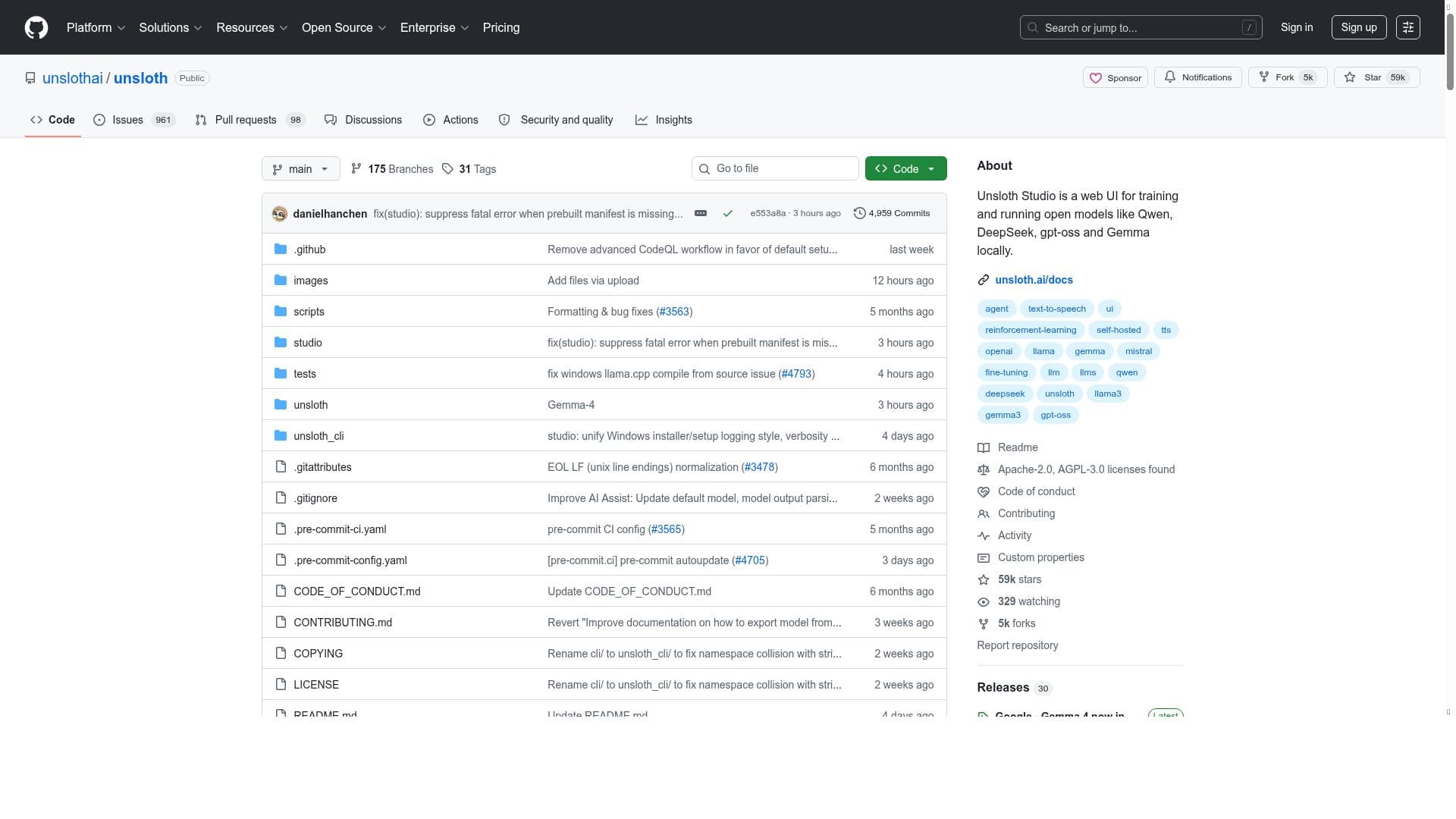
Unsloth is a versatile local user interface that enables running and training of large language and diffusion models on your own hardware, supporting a wide array of advanced AI model formats. Ideal for AI researchers and developers seeking privacy and control without cloud dependency, unsloth offers a powerful open-source solution for local AI experimentation and development.

Description
Unsloth Desktop is an open-source app to run and train AI models locally. Run LLMs, image/video diffusion, and audio. Connect agents like Claude Code or Codex to your local GPU with one command, and fine-tune models with no-code workflows.
Detailed Description
Unsloth is a powerful local user interface designed to facilitate the running and training of large language models (LLMs) and diffusion models directly on users' machines. Its core purpose is to provide an accessible, efficient, and flexible environment for AI practitioners, researchers, and enthusiasts to experiment with advanced AI models without relying on cloud infrastructure. By enabling local deployment and training, unsloth empowers users to maintain full control over their data and computational resources, ensuring privacy and reducing dependency on external services. One of unsloth's standout features is its comprehensive support for a wide range of model formats, including GGUF, MLX, and Qwen3.8. This compatibility extends to advanced models such as DeepSeek-V4, MiniMax-H3, Gemma 4, and FLUX, making it a versatile tool for diverse AI workflows. Users can seamlessly load, run, and fine-tune these models within a unified interface, simplifying the process of managing complex AI systems. Additionally, unsloth supports the training of diffusion models, which are crucial for generative tasks like image synthesis, further broadening its applicability. The local UI design emphasizes ease of use and accessibility, allowing users to experiment with large-scale models without needing extensive cloud-based setups or subscriptions. This makes unsloth particularly valuable for developers and researchers who prefer or require on-premises solutions due to data sensitivity, latency concerns, or cost constraints. The interface provides tools to monitor training progress, adjust parameters, and evaluate model outputs, facilitating iterative development and experimentation. Unsloth is best suited for AI researchers, machine learning engineers, and hobbyists who want to explore state-of-the-art LLMs and diffusion models locally. It is ideal for those who seek to customize models, conduct experiments, or deploy AI solutions in environments where cloud access is limited or undesirable. Use cases include academic research, prototyping AI-driven applications, and personal projects where control over the AI pipeline is paramount. Regarding pricing, unsloth is an open-source project hosted on GitHub, making it freely available to users. This open access encourages community contributions and continuous improvement. Users only need to provide their own hardware resources to run and train models, which can range from consumer-grade GPUs to more powerful workstations depending on the model size and complexity. Compared to cloud-based AI platforms, unsloth offers the distinct advantage of local execution, which eliminates ongoing cloud costs and potential data privacy issues. While cloud services often provide scalability and ease of access, unsloth's local approach ensures users retain full ownership and control. In contrast to other local AI tools, unsloth's broad model format support and training capabilities set it apart, catering to a wider variety of AI workflows. However, there are some considerations to keep in mind. Running and training large models locally demands significant computational resources, including high-performance GPUs and ample memory. Users without suitable hardware may face limitations in model size or training speed. Additionally, as an open-source project, unsloth may require a degree of technical proficiency to install, configure, and optimize effectively. Documentation and community support are available but may not match the comprehensive support services offered by commercial platforms. In summary, unsloth is a robust, flexible, and free local AI interface that enables users to run and train cutting-edge language and diffusion models on their own machines. Its extensive model compatibility, training support, and privacy advantages make it an excellent choice for those seeking a self-contained AI development environment, provided they have the necessary hardware and technical skills.
Tool Features
- Local UI to run large language models
- Support for training diffusion models
- Compatible with multiple model formats such as GGUF, MLX, Qwen3.8
- Supports advanced models like DeepSeek-V4, MiniMax-H3, Gemma 4, FLUX
- Enables local experimentation without cloud dependency
Description
Unsloth is a versatile local user interface that enables running and training of large language and diffusion models on your own hardware, supporting a wide array of advanced AI model formats. Ideal for AI researchers and developers seeking privacy and control without cloud dependency, unsloth offers a powerful open-source solution for local AI experimentation and development.
Unsloth Desktop is an open-source app to run and train AI models locally. Run LLMs, image/video diffusion, and audio. Connect agents like Claude Code or Codex to your local GPU with one command, and fine-tune models with no-code workflows.
Detailed Description
Unsloth is a powerful local user interface designed to facilitate the running and training of large language models (LLMs) and diffusion models directly on users' machines. Its core purpose is to provide an accessible, efficient, and flexible environment for AI practitioners, researchers, and enthusiasts to experiment with advanced AI models without relying on cloud infrastructure. By enabling local deployment and training, unsloth empowers users to maintain full control over their data and computational resources, ensuring privacy and reducing dependency on external services. One of unsloth's standout features is its comprehensive support for a wide range of model formats, including GGUF, MLX, and Qwen3.8. This compatibility extends to advanced models such as DeepSeek-V4, MiniMax-H3, Gemma 4, and FLUX, making it a versatile tool for diverse AI workflows. Users can seamlessly load, run, and fine-tune these models within a unified interface, simplifying the process of managing complex AI systems. Additionally, unsloth supports the training of diffusion models, which are crucial for generative tasks like image synthesis, further broadening its applicability. The local UI design emphasizes ease of use and accessibility, allowing users to experiment with large-scale models without needing extensive cloud-based setups or subscriptions. This makes unsloth particularly valuable for developers and researchers who prefer or require on-premises solutions due to data sensitivity, latency concerns, or cost constraints. The interface provides tools to monitor training progress, adjust parameters, and evaluate model outputs, facilitating iterative development and experimentation. Unsloth is best suited for AI researchers, machine learning engineers, and hobbyists who want to explore state-of-the-art LLMs and diffusion models locally. It is ideal for those who seek to customize models, conduct experiments, or deploy AI solutions in environments where cloud access is limited or undesirable. Use cases include academic research, prototyping AI-driven applications, and personal projects where control over the AI pipeline is paramount. Regarding pricing, unsloth is an open-source project hosted on GitHub, making it freely available to users. This open access encourages community contributions and continuous improvement. Users only need to provide their own hardware resources to run and train models, which can range from consumer-grade GPUs to more powerful workstations depending on the model size and complexity. Compared to cloud-based AI platforms, unsloth offers the distinct advantage of local execution, which eliminates ongoing cloud costs and potential data privacy issues. While cloud services often provide scalability and ease of access, unsloth's local approach ensures users retain full ownership and control. In contrast to other local AI tools, unsloth's broad model format support and training capabilities set it apart, catering to a wider variety of AI workflows. However, there are some considerations to keep in mind. Running and training large models locally demands significant computational resources, including high-performance GPUs and ample memory. Users without suitable hardware may face limitations in model size or training speed. Additionally, as an open-source project, unsloth may require a degree of technical proficiency to install, configure, and optimize effectively. Documentation and community support are available but may not match the comprehensive support services offered by commercial platforms. In summary, unsloth is a robust, flexible, and free local AI interface that enables users to run and train cutting-edge language and diffusion models on their own machines. Its extensive model compatibility, training support, and privacy advantages make it an excellent choice for those seeking a self-contained AI development environment, provided they have the necessary hardware and technical skills.
Frequently Asked Questions
What is unsloth?
Unsloth is a local user interface designed to run and train large language models and diffusion models directly on your machine, supporting multiple advanced AI model formats for flexible experimentation without relying on cloud services.
How much does unsloth cost?
Unsloth is an open-source project available for free on GitHub. Users only need to provide their own hardware resources to run and train models locally.
Who is unsloth best for?
Unsloth is best suited for AI researchers, machine learning engineers, and hobbyists who want to experiment with and train large AI models locally, especially those concerned with data privacy or cloud dependency.
What are the main features of unsloth?
Key features include a local UI for running large language models, support for training diffusion models, compatibility with multiple model formats like GGUF, MLX, and Qwen3.8, and support for advanced models such as DeepSeek-V4, MiniMax-H3, Gemma 4, and FLUX.
Does unsloth offer a free trial?
Since unsloth is open-source and free to use, there is no need for a trial period. Users can download and use it immediately without cost.
What integrations does unsloth support?
Unsloth primarily focuses on local model formats and does not rely on external integrations or cloud platforms, enabling users to work entirely offline with supported AI model formats.
How does unsloth work?
Unsloth provides a graphical user interface that allows users to load, run, and train supported large language and diffusion models locally. It manages model files, training parameters, and execution workflows on the user's hardware without requiring cloud connectivity.
Socials
Use ToolReviews
No reviews yet. Be the first to share your experience.