🚀 Zaprep: Your Socials on Steroids. Start free — automate 1,000 DMs/month & turn engagement into leads. with 1,000 automated DMs/month.


Is this your AI tool? Claim it today.
Verify ownership, manage your profile, and unlock growth features.
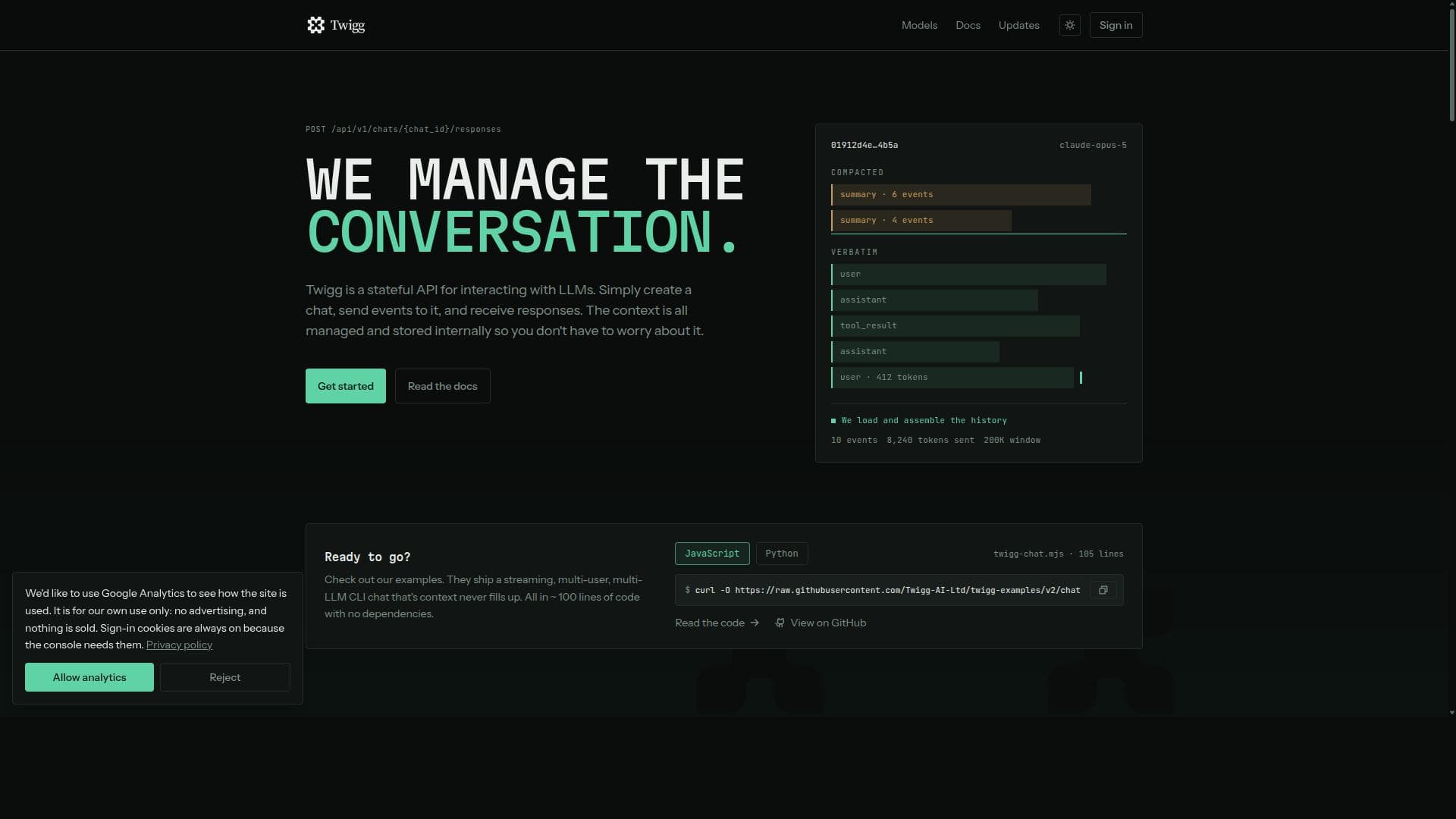
Twigg revolutionizes conversational AI by offering a hosted context store and model router that lets developers create chats once, send only the next event, and switch LLMs mid-conversation seamlessly. Perfect for developers seeking stateful interactions without provider lock-in, Twigg provides unmatched flexibility and control over AI model usage.

Description
Twigg is a stateful API for calling LLMs. Instead of rebuilding and resending your whole conversation on every request, you create a chat once and send only the next event. Twigg holds the state: it fits context to the target model's schema, compacts or truncates when it runs long, and routes the call. Control tool schemas, system prompts and context windows from the dashboard, and track usage and billing. Build anything from personal agents to enterprise apps. You never manage context again.
Detailed Description
Twigg is a sophisticated platform designed to enhance the management of conversations with large language models (LLMs) by providing a hosted context store, an assembler, and a model router. Its core purpose is to enable developers to create chat interactions once and then efficiently manage the conversation state by sending only the next event. This approach significantly reduces the complexity and overhead typically involved in handling stateful conversations with LLMs. Twigg’s architecture allows conversations to live outside the LLM providers, which means that the conversation history and state are maintained independently, offering greater flexibility and eliminating provider lock-in. This unique design empowers developers to switch between different AI models mid-conversation seamlessly, optimizing the use of various LLMs based on the context or requirements without losing continuity or conversation history. Key features of Twigg include a hosted context store that manages the entire conversation state securely and reliably, making it easier to build complex, stateful chatbots and AI assistants. The assembler component allows developers to construct and organize conversation flows and events efficiently. The model router is a standout feature that facilitates dynamic switching between multiple LLMs during a single conversation, enabling developers to leverage the strengths of different models as needed. By creating a chat once and sending only the next event, Twigg reduces data transmission and processing time, improving responsiveness and scalability. Additionally, because conversations are stored outside the LLM providers, users retain full control over their data and can avoid dependency on any single AI provider. Twigg is best suited for developers, AI researchers, and companies building conversational AI applications that require robust state management and flexibility in model usage. It is particularly valuable for those who want to avoid being locked into a single LLM provider and need to optimize costs or performance by routing requests to different models dynamically. Use cases include customer support chatbots, virtual assistants, interactive storytelling, and multi-model AI experiments where switching between models mid-dialogue is beneficial. Twigg’s architecture also supports compliance and data governance requirements by keeping conversations independent of third-party LLM providers. Regarding pricing and plans, Twigg’s website does not publicly detail specific pricing tiers, which suggests that pricing may be customized based on usage, scale, or enterprise needs. Interested users are encouraged to visit the official website or contact the Twigg team directly for detailed pricing information and potential trial options. Compared to alternatives, Twigg stands out by combining conversation state management with model routing and assembler capabilities in a hosted solution. While many platforms offer LLM integration or conversation state management, few provide seamless mid-conversation model switching or store conversations independently of LLM providers. This makes Twigg uniquely positioned for developers seeking flexibility, control, and efficiency in managing multi-model conversational AI applications. However, some competing tools might offer more extensive integrations or user-friendly interfaces, so Twigg’s appeal is strongest for technically proficient users focused on advanced conversation orchestration. Notable limitations or considerations include the potential learning curve associated with integrating Twigg into existing workflows, especially for teams unfamiliar with managing conversation state or model routing. Since pricing details are not openly published, smaller teams or individual developers may need to inquire directly to assess affordability. Additionally, as Twigg focuses on backend conversation management rather than end-user chatbot design, users may need to combine it with other tools for front-end user interface development. Overall, Twigg offers a powerful and flexible solution for managing stateful LLM conversations with no provider lock-in, ideal for developers and organizations aiming to optimize their AI model usage and maintain full control over conversational data.
Tool Features
- Hosted context store for conversation state management
- Assembler and model router for flexible model switching
- Create a chat once and send only the next event
- Switch models mid-conversation seamlessly
- Conversations live outside the LLM providers
Description
Twigg revolutionizes conversational AI by offering a hosted context store and model router that lets developers create chats once, send only the next event, and switch LLMs mid-conversation seamlessly. Perfect for developers seeking stateful interactions without provider lock-in, Twigg provides unmatched flexibility and control over AI model usage.
Twigg is a stateful API for calling LLMs. Instead of rebuilding and resending your whole conversation on every request, you create a chat once and send only the next event. Twigg holds the state: it fits context to the target model's schema, compacts or truncates when it runs long, and routes the call. Control tool schemas, system prompts and context windows from the dashboard, and track usage and billing. Build anything from personal agents to enterprise apps. You never manage context again.
Detailed Description
Twigg is a sophisticated platform designed to enhance the management of conversations with large language models (LLMs) by providing a hosted context store, an assembler, and a model router. Its core purpose is to enable developers to create chat interactions once and then efficiently manage the conversation state by sending only the next event. This approach significantly reduces the complexity and overhead typically involved in handling stateful conversations with LLMs. Twigg’s architecture allows conversations to live outside the LLM providers, which means that the conversation history and state are maintained independently, offering greater flexibility and eliminating provider lock-in. This unique design empowers developers to switch between different AI models mid-conversation seamlessly, optimizing the use of various LLMs based on the context or requirements without losing continuity or conversation history. Key features of Twigg include a hosted context store that manages the entire conversation state securely and reliably, making it easier to build complex, stateful chatbots and AI assistants. The assembler component allows developers to construct and organize conversation flows and events efficiently. The model router is a standout feature that facilitates dynamic switching between multiple LLMs during a single conversation, enabling developers to leverage the strengths of different models as needed. By creating a chat once and sending only the next event, Twigg reduces data transmission and processing time, improving responsiveness and scalability. Additionally, because conversations are stored outside the LLM providers, users retain full control over their data and can avoid dependency on any single AI provider. Twigg is best suited for developers, AI researchers, and companies building conversational AI applications that require robust state management and flexibility in model usage. It is particularly valuable for those who want to avoid being locked into a single LLM provider and need to optimize costs or performance by routing requests to different models dynamically. Use cases include customer support chatbots, virtual assistants, interactive storytelling, and multi-model AI experiments where switching between models mid-dialogue is beneficial. Twigg’s architecture also supports compliance and data governance requirements by keeping conversations independent of third-party LLM providers. Regarding pricing and plans, Twigg’s website does not publicly detail specific pricing tiers, which suggests that pricing may be customized based on usage, scale, or enterprise needs. Interested users are encouraged to visit the official website or contact the Twigg team directly for detailed pricing information and potential trial options. Compared to alternatives, Twigg stands out by combining conversation state management with model routing and assembler capabilities in a hosted solution. While many platforms offer LLM integration or conversation state management, few provide seamless mid-conversation model switching or store conversations independently of LLM providers. This makes Twigg uniquely positioned for developers seeking flexibility, control, and efficiency in managing multi-model conversational AI applications. However, some competing tools might offer more extensive integrations or user-friendly interfaces, so Twigg’s appeal is strongest for technically proficient users focused on advanced conversation orchestration. Notable limitations or considerations include the potential learning curve associated with integrating Twigg into existing workflows, especially for teams unfamiliar with managing conversation state or model routing. Since pricing details are not openly published, smaller teams or individual developers may need to inquire directly to assess affordability. Additionally, as Twigg focuses on backend conversation management rather than end-user chatbot design, users may need to combine it with other tools for front-end user interface development. Overall, Twigg offers a powerful and flexible solution for managing stateful LLM conversations with no provider lock-in, ideal for developers and organizations aiming to optimize their AI model usage and maintain full control over conversational data.
Frequently Asked Questions
What is Twigg?
Twigg is a hosted platform that manages conversation state for large language models, allowing developers to create chats once, send only the next event, and switch between different AI models mid-conversation. It keeps conversations outside LLM providers to avoid lock-in and improve flexibility.
How much does Twigg cost?
Twigg does not publicly list pricing details on its website. Pricing may vary based on usage and scale. Interested users should contact the Twigg team directly through their website for detailed pricing and plan information.
Who is Twigg best for?
Twigg is best suited for developers, AI researchers, and companies building conversational AI applications that require robust state management and the ability to switch between multiple LLMs seamlessly. It is ideal for those who want to avoid provider lock-in and optimize AI model usage.
What are the main features of Twigg?
The main features include a hosted context store for managing conversation state, an assembler for building conversation flows, a model router for seamless switching between LLMs mid-conversation, the ability to create a chat once and send only the next event, and storing conversations independently of LLM providers.
Does Twigg offer a free trial?
There is no explicit mention of a free trial on Twigg’s website. Prospective users should reach out to the Twigg team directly to inquire about trial options or demos.
What integrations does Twigg support?
Twigg primarily integrates with various large language model providers by acting as a router and context store. Specific integrations depend on the LLMs developers choose to connect. For detailed integration capabilities, contacting Twigg or reviewing their documentation is recommended.
How does Twigg work?
Twigg works by hosting the conversation context externally, allowing developers to create chat sessions once and then send only incremental events to update the conversation. It routes requests to different LLMs dynamically mid-conversation, enabling seamless model switching while maintaining full conversation state outside the providers.
Reviews
No reviews yet. Be the first to share your experience.
Sponsored Tools




















Recommended Tools
Stay updated on latest Ai tools
Get the latest insights, Join our newsletter
Read and trusted by 50,000+ readers
Join the biggest AI Community
Our community and staff are here to help!
Your feedback will help Alice AI improve in future versions.







Submit your Tool


PoweredByAI.app is an AI Tools Directory helping individuals, businesses, and creators discover the best AI tools for writing, coding, design, productivity, and more.
© 2026 , Product of011BQ. All rights reserved.