🚀 Zaprep: Your Socials on Steroids. Start free — automate 1,000 DMs/month & turn engagement into leads. with 1,000 automated DMs/month.


Is this your AI tool? Claim it today.
Verify ownership, manage your profile, and unlock growth features.
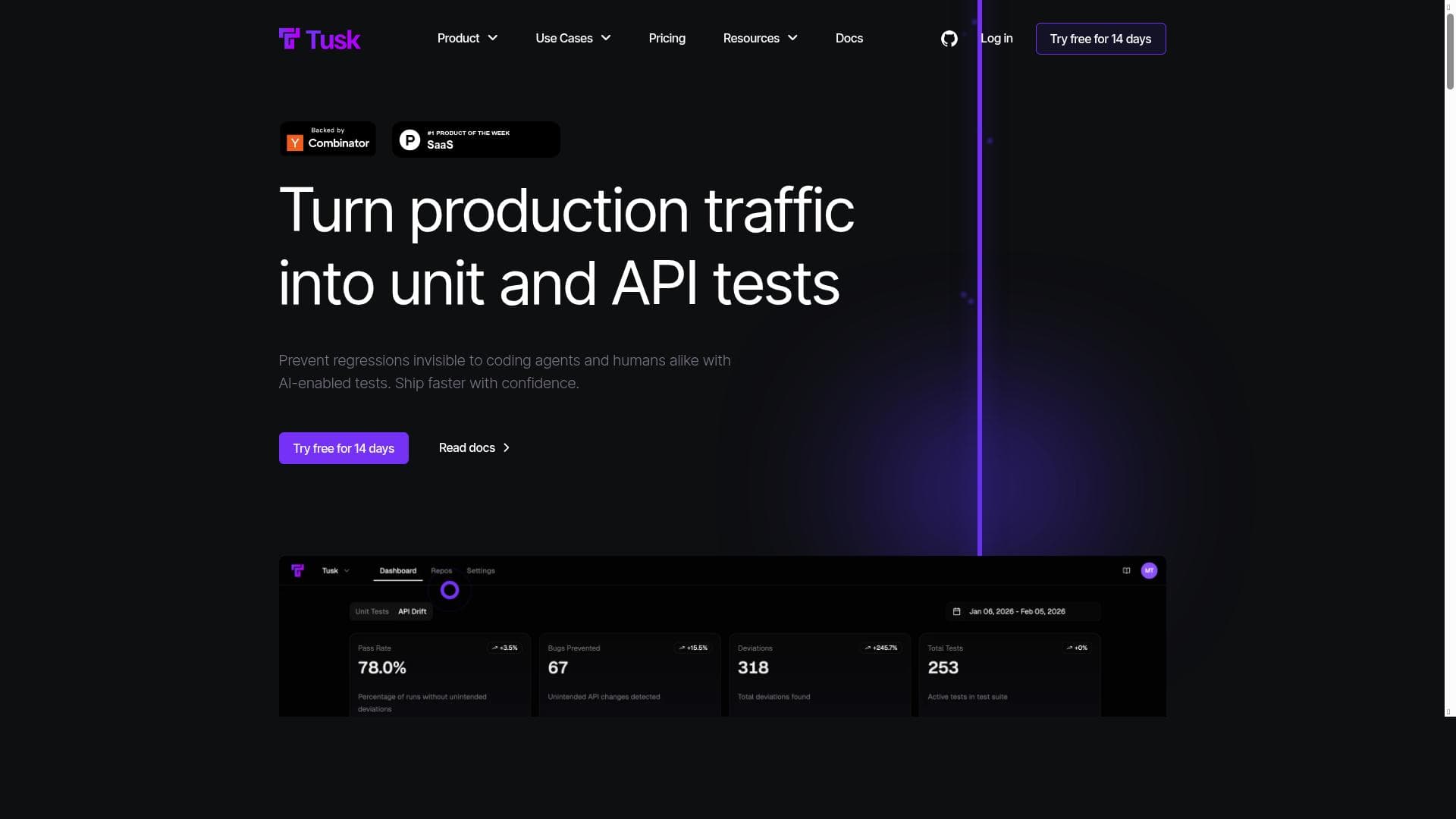
Tusk (YC W24) is a cutting-edge AI agent that automates UI changes from ticket to pull request, freeing product teams from repetitive tasks like minor bug fixes and copy edits. With features like AI-enabled testing, self-healing tests, and PR review automation, it empowers engineering teams to deliver faster, higher-quality updates without extra overhead.

Description
Tusk is an AI agent that helps product teams complete UI changes from ticket to pull request. Automate away grunt work like minor bug fixes and copy changes to increase customer NPS without bothering your software engineers.
Detailed Description
Tusk (YC W24) is an innovative AI-powered agent designed specifically to streamline the workflow of product teams by automating the entire process of implementing UI changes from the initial ticket to the final pull request. Its core purpose is to eliminate the tedious and repetitive tasks that often bog down software engineers, such as minor bug fixes, copy edits, and routine UI adjustments. By automating these grunt work elements, Tusk enables engineering teams to focus on more complex development tasks while simultaneously improving customer satisfaction metrics like Net Promoter Score (NPS) through faster and more reliable UI updates. At the heart of Tusk’s capabilities is a comprehensive suite of testing and automation features that ensure high-quality software delivery. It offers AI-enabled unit testing that intelligently generates and executes tests to verify individual components. Integration testing capabilities allow Tusk to validate interactions between different modules, ensuring seamless functionality across the product. The tool also supports API testing to confirm that backend services respond correctly to various requests. One of Tusk’s standout features is automated test generation, which reduces manual effort by creating relevant test cases based on code changes. Additionally, Tusk incorporates self-healing tests that automatically adapt to minor UI or code changes, minimizing test maintenance overhead. Code coverage analysis provides insights into which parts of the codebase are tested, helping teams identify gaps. Tusk also automates pull request (PR) reviews by analyzing code changes and suggesting improvements or flagging potential issues. Regression detection is another critical feature that identifies when new changes inadvertently break existing functionality, ensuring software stability. Tusk is ideally suited for product teams, software engineers, QA specialists, and engineering managers who want to accelerate their development cycles without sacrificing quality. It is particularly useful for teams that frequently push UI updates, bug fixes, or copy changes and want to reduce the dependency on engineers for routine tasks. Startups and growing companies that need to maintain high customer satisfaction while scaling their engineering efforts will find Tusk especially valuable. Use cases include automating the completion of UI tickets, reducing the time spent on manual testing, improving test reliability with self-healing capabilities, and streamlining PR reviews to speed up code merges. Regarding pricing, Tusk offers a freemium model, allowing teams to get started without upfront costs and explore its core functionalities. While the free tier provides access to essential features, advanced capabilities and higher usage limits are likely available through paid plans, though specific pricing details are not disclosed publicly. This approach makes Tusk accessible to small teams and startups while providing scalability for larger organizations. When compared to alternatives, Tusk stands out due to its end-to-end automation focus that covers everything from UI change implementation to testing and PR review. Many tools specialize in isolated aspects like test automation or code review, but Tusk integrates these processes into a single AI-driven workflow. Its self-healing test feature is particularly notable, reducing the maintenance burden common in automated testing frameworks. However, unlike some dedicated testing platforms, Tusk’s primary emphasis is on UI-related changes and product team workflows rather than deep backend testing or performance monitoring. Potential limitations include the dependency on AI accuracy for generating and maintaining tests, which may require human oversight to ensure correctness in complex scenarios. Teams with highly customized or unconventional UI architectures might face integration challenges. Additionally, as a relatively new YC W24 startup, Tusk’s ecosystem and third-party integrations may be less mature compared to established testing suites. Prospective users should evaluate how well Tusk fits into their existing development pipelines and whether its automation capabilities align with their specific technology stacks. In summary, Tusk (YC W24) is a powerful AI agent designed to automate UI change workflows from ticket creation to pull request completion, significantly reducing manual effort and accelerating product delivery. Its rich feature set, including AI-enabled testing, self-healing tests, and PR automation, makes it an excellent choice for product teams aiming to enhance efficiency and customer satisfaction. While it may require some adaptation for complex environments, its freemium pricing and comprehensive automation capabilities position it as a compelling solution for modern software development teams.
Tool Features
- AI-enabled unit testing
- Integration testing
- API testing
- Automated test generation
- Self-healing tests
- Code coverage analysis
- PR review automation
- Regression detection
Description
Tusk (YC W24) is a cutting-edge AI agent that automates UI changes from ticket to pull request, freeing product teams from repetitive tasks like minor bug fixes and copy edits. With features like AI-enabled testing, self-healing tests, and PR review automation, it empowers engineering teams to deliver faster, higher-quality updates without extra overhead.
Tusk is an AI agent that helps product teams complete UI changes from ticket to pull request. Automate away grunt work like minor bug fixes and copy changes to increase customer NPS without bothering your software engineers.
Detailed Description
Tusk (YC W24) is an innovative AI-powered agent designed specifically to streamline the workflow of product teams by automating the entire process of implementing UI changes from the initial ticket to the final pull request. Its core purpose is to eliminate the tedious and repetitive tasks that often bog down software engineers, such as minor bug fixes, copy edits, and routine UI adjustments. By automating these grunt work elements, Tusk enables engineering teams to focus on more complex development tasks while simultaneously improving customer satisfaction metrics like Net Promoter Score (NPS) through faster and more reliable UI updates. At the heart of Tusk’s capabilities is a comprehensive suite of testing and automation features that ensure high-quality software delivery. It offers AI-enabled unit testing that intelligently generates and executes tests to verify individual components. Integration testing capabilities allow Tusk to validate interactions between different modules, ensuring seamless functionality across the product. The tool also supports API testing to confirm that backend services respond correctly to various requests. One of Tusk’s standout features is automated test generation, which reduces manual effort by creating relevant test cases based on code changes. Additionally, Tusk incorporates self-healing tests that automatically adapt to minor UI or code changes, minimizing test maintenance overhead. Code coverage analysis provides insights into which parts of the codebase are tested, helping teams identify gaps. Tusk also automates pull request (PR) reviews by analyzing code changes and suggesting improvements or flagging potential issues. Regression detection is another critical feature that identifies when new changes inadvertently break existing functionality, ensuring software stability. Tusk is ideally suited for product teams, software engineers, QA specialists, and engineering managers who want to accelerate their development cycles without sacrificing quality. It is particularly useful for teams that frequently push UI updates, bug fixes, or copy changes and want to reduce the dependency on engineers for routine tasks. Startups and growing companies that need to maintain high customer satisfaction while scaling their engineering efforts will find Tusk especially valuable. Use cases include automating the completion of UI tickets, reducing the time spent on manual testing, improving test reliability with self-healing capabilities, and streamlining PR reviews to speed up code merges. Regarding pricing, Tusk offers a freemium model, allowing teams to get started without upfront costs and explore its core functionalities. While the free tier provides access to essential features, advanced capabilities and higher usage limits are likely available through paid plans, though specific pricing details are not disclosed publicly. This approach makes Tusk accessible to small teams and startups while providing scalability for larger organizations. When compared to alternatives, Tusk stands out due to its end-to-end automation focus that covers everything from UI change implementation to testing and PR review. Many tools specialize in isolated aspects like test automation or code review, but Tusk integrates these processes into a single AI-driven workflow. Its self-healing test feature is particularly notable, reducing the maintenance burden common in automated testing frameworks. However, unlike some dedicated testing platforms, Tusk’s primary emphasis is on UI-related changes and product team workflows rather than deep backend testing or performance monitoring. Potential limitations include the dependency on AI accuracy for generating and maintaining tests, which may require human oversight to ensure correctness in complex scenarios. Teams with highly customized or unconventional UI architectures might face integration challenges. Additionally, as a relatively new YC W24 startup, Tusk’s ecosystem and third-party integrations may be less mature compared to established testing suites. Prospective users should evaluate how well Tusk fits into their existing development pipelines and whether its automation capabilities align with their specific technology stacks. In summary, Tusk (YC W24) is a powerful AI agent designed to automate UI change workflows from ticket creation to pull request completion, significantly reducing manual effort and accelerating product delivery. Its rich feature set, including AI-enabled testing, self-healing tests, and PR automation, makes it an excellent choice for product teams aiming to enhance efficiency and customer satisfaction. While it may require some adaptation for complex environments, its freemium pricing and comprehensive automation capabilities position it as a compelling solution for modern software development teams.
Frequently Asked Questions
What is Tusk (YC W24)?
Tusk (YC W24) is an AI-powered agent designed to help product teams automate the process of completing UI changes from the initial ticket through to the pull request stage, reducing manual effort and improving development efficiency.
How much does Tusk (YC W24) cost?
Tusk offers a freemium pricing model, allowing users to access essential features for free, with advanced capabilities and higher usage limits available through paid plans. Specific pricing details are not publicly disclosed.
Who is Tusk (YC W24) best for?
Tusk is best suited for product teams, software engineers, QA specialists, and engineering managers who want to automate routine UI changes, reduce manual testing effort, and accelerate their development cycles.
What are the main features of Tusk (YC W24)?
Key features include AI-enabled unit testing, integration testing, API testing, automated test generation, self-healing tests, code coverage analysis, pull request review automation, and regression detection.
Does Tusk (YC W24) offer a free trial?
Yes, Tusk provides a freemium plan that allows users to try out its core functionalities without any upfront cost.
What integrations does Tusk (YC W24) support?
While specific integrations are not detailed, Tusk is designed to fit into typical product development workflows, likely supporting common version control systems and CI/CD pipelines to automate testing and PR processes.
How does Tusk (YC W24) work?
Tusk uses AI to automate the entire UI change workflow, from interpreting tickets to generating code changes, creating and maintaining tests, analyzing code coverage, and automating pull request reviews, thereby reducing manual effort and speeding up delivery.
Socials
Use ToolReviews
No reviews yet. Be the first to share your experience.
Sponsored Tools




























Recommended Tools
Stay updated on latest Ai tools
Get the latest insights, Join our newsletter
Read and trusted by 50,000+ readers
Join the biggest AI Community
Our community and staff are here to help!
Your feedback will help Alice AI improve in future versions.







Submit your Tool


PoweredByAI.app is an AI Tools Directory helping individuals, businesses, and creators discover the best AI tools for writing, coding, design, productivity, and more.
© 2026 , Product of011BQ. All rights reserved.