

Is this your AI tool? Claim it today.
Verify ownership, manage your profile, and unlock growth features.
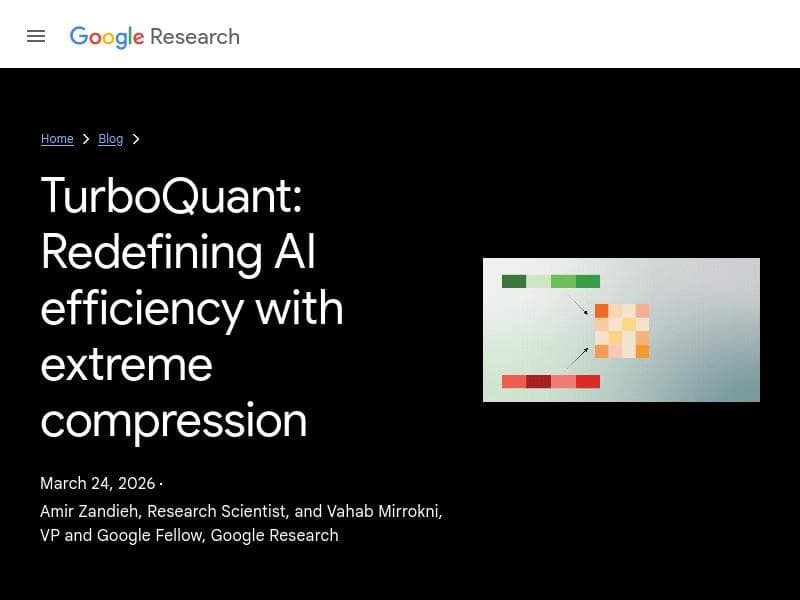
TurboQuant revolutionizes AI efficiency by providing advanced quantization algorithms that massively compress large language models and vector search engines without sacrificing performance. Ideal for developers and enterprises needing faster, resource-friendly AI inference, TurboQuant enables powerful AI deployments even on limited hardware, all at no cost.

Description
A set of advanced theoretically grounded quantization algorithms that enable massive compression for large language models and vector search engines.
Detailed Description
TurboQuant is an innovative suite of advanced quantization algorithms designed to significantly compress large language models (LLMs) and vector search engines without compromising their performance. Developed with a strong theoretical foundation, TurboQuant addresses one of the most pressing challenges in AI deployment today: the need to reduce the size and computational demands of massive AI models while maintaining their accuracy and efficiency. By applying extreme compression techniques, TurboQuant enables organizations to deploy powerful AI models in resource-constrained environments, accelerating inference speeds and reducing operational costs. At its core, TurboQuant focuses on quantization, a process that reduces the precision of the numerical representations within AI models. Unlike traditional quantization methods that often lead to degraded model performance, TurboQuant's algorithms are meticulously designed to preserve the integrity and predictive power of the original models. This is achieved through theoretically grounded approaches that optimize the balance between compression ratio and accuracy retention. As a result, TurboQuant can shrink model sizes dramatically, sometimes by orders of magnitude, while ensuring that the AI's output quality remains virtually unchanged. Key features of TurboQuant include its ability to perform extreme compression on AI models, making it possible to deploy large-scale language models and vector search engines on hardware with limited memory and processing power. This compression translates directly into faster AI inference times, as smaller models require fewer computational resources and bandwidth. Additionally, TurboQuant reduces the overall resource consumption associated with AI deployments, including energy usage and storage requirements, contributing to more sustainable and cost-effective AI operations. TurboQuant is particularly well-suited for AI researchers, developers, and enterprises that rely heavily on large language models or vector search technologies but face constraints related to hardware capacity, latency, or operational costs. Use cases span from deploying conversational AI and recommendation systems on edge devices to scaling search engines that handle vast datasets efficiently. Organizations aiming to democratize access to powerful AI models by making them runnable on less powerful devices will find TurboQuant especially valuable. One of the standout advantages of TurboQuant is that it is offered for free, lowering the barrier to entry for teams and organizations looking to optimize their AI models. This accessibility encourages widespread adoption and experimentation, fostering innovation in AI model compression and deployment strategies. Compared to alternative quantization and compression tools, TurboQuant distinguishes itself through its rigorous theoretical backing and its focus on maintaining model performance despite aggressive size reductions. While other solutions may sacrifice accuracy for compression or require complex retraining processes, TurboQuant streamlines this balance, delivering efficient models ready for immediate deployment. However, users should consider that the effectiveness of TurboQuant may vary depending on the specific architecture and use case of the AI model. Additionally, as with any compression technique, there may be edge cases where some performance degradation occurs, necessitating thorough evaluation before production use. In summary, TurboQuant offers a cutting-edge, free solution for compressing large AI models with minimal impact on their capabilities. Its ability to enhance inference speed and reduce resource consumption makes it an essential tool for AI practitioners seeking to optimize deployments in diverse environments. While it excels in many scenarios, users should carefully assess its fit for their particular models and applications to maximize benefits.
Tool Features
- Extreme compression of AI models
- Maintains AI performance despite size reduction
- Enables faster AI inference
- Reduces resource consumption for AI deployments
Description
TurboQuant revolutionizes AI efficiency by providing advanced quantization algorithms that massively compress large language models and vector search engines without sacrificing performance. Ideal for developers and enterprises needing faster, resource-friendly AI inference, TurboQuant enables powerful AI deployments even on limited hardware, all at no cost.
A set of advanced theoretically grounded quantization algorithms that enable massive compression for large language models and vector search engines.
Detailed Description
TurboQuant is an innovative suite of advanced quantization algorithms designed to significantly compress large language models (LLMs) and vector search engines without compromising their performance. Developed with a strong theoretical foundation, TurboQuant addresses one of the most pressing challenges in AI deployment today: the need to reduce the size and computational demands of massive AI models while maintaining their accuracy and efficiency. By applying extreme compression techniques, TurboQuant enables organizations to deploy powerful AI models in resource-constrained environments, accelerating inference speeds and reducing operational costs. At its core, TurboQuant focuses on quantization, a process that reduces the precision of the numerical representations within AI models. Unlike traditional quantization methods that often lead to degraded model performance, TurboQuant's algorithms are meticulously designed to preserve the integrity and predictive power of the original models. This is achieved through theoretically grounded approaches that optimize the balance between compression ratio and accuracy retention. As a result, TurboQuant can shrink model sizes dramatically, sometimes by orders of magnitude, while ensuring that the AI's output quality remains virtually unchanged. Key features of TurboQuant include its ability to perform extreme compression on AI models, making it possible to deploy large-scale language models and vector search engines on hardware with limited memory and processing power. This compression translates directly into faster AI inference times, as smaller models require fewer computational resources and bandwidth. Additionally, TurboQuant reduces the overall resource consumption associated with AI deployments, including energy usage and storage requirements, contributing to more sustainable and cost-effective AI operations. TurboQuant is particularly well-suited for AI researchers, developers, and enterprises that rely heavily on large language models or vector search technologies but face constraints related to hardware capacity, latency, or operational costs. Use cases span from deploying conversational AI and recommendation systems on edge devices to scaling search engines that handle vast datasets efficiently. Organizations aiming to democratize access to powerful AI models by making them runnable on less powerful devices will find TurboQuant especially valuable. One of the standout advantages of TurboQuant is that it is offered for free, lowering the barrier to entry for teams and organizations looking to optimize their AI models. This accessibility encourages widespread adoption and experimentation, fostering innovation in AI model compression and deployment strategies. Compared to alternative quantization and compression tools, TurboQuant distinguishes itself through its rigorous theoretical backing and its focus on maintaining model performance despite aggressive size reductions. While other solutions may sacrifice accuracy for compression or require complex retraining processes, TurboQuant streamlines this balance, delivering efficient models ready for immediate deployment. However, users should consider that the effectiveness of TurboQuant may vary depending on the specific architecture and use case of the AI model. Additionally, as with any compression technique, there may be edge cases where some performance degradation occurs, necessitating thorough evaluation before production use. In summary, TurboQuant offers a cutting-edge, free solution for compressing large AI models with minimal impact on their capabilities. Its ability to enhance inference speed and reduce resource consumption makes it an essential tool for AI practitioners seeking to optimize deployments in diverse environments. While it excels in many scenarios, users should carefully assess its fit for their particular models and applications to maximize benefits.
Frequently Asked Questions
What is TurboQuant?
TurboQuant is a set of advanced, theoretically grounded quantization algorithms designed to enable extreme compression of large language models and vector search engines while maintaining their performance and accuracy.
How much does TurboQuant cost?
TurboQuant is offered for free, making it accessible to a wide range of users without any licensing fees.
Who is TurboQuant best for?
TurboQuant is best suited for AI researchers, developers, and enterprises that need to deploy large AI models efficiently, especially in environments with limited computational resources or where faster inference and reduced costs are priorities.
What are the main features of TurboQuant?
The main features include extreme compression of AI models, maintenance of AI performance despite size reduction, faster AI inference speeds, and reduced resource consumption for AI deployments.
Does TurboQuant offer a free trial?
TurboQuant is free to use, so there is no need for a trial period; users can access and implement it without cost.
What integrations does TurboQuant support?
While specific integrations are not detailed, TurboQuant is designed to work with large language models and vector search engines, implying compatibility with common AI frameworks and deployment environments.
How does TurboQuant work?
TurboQuant applies advanced quantization algorithms to reduce the numerical precision of AI model parameters, significantly compressing model size while using theoretically grounded techniques to preserve accuracy and performance during inference.
Socials
Use ToolReviews
No reviews yet. Be the first to share your experience.