🚀 Zaprep: Your Socials on Steroids. Start free — automate 1,000 DMs/month & turn engagement into leads. with 1,000 automated DMs/month.


Is this your AI tool? Claim it today.
Verify ownership, manage your profile, and unlock growth features.
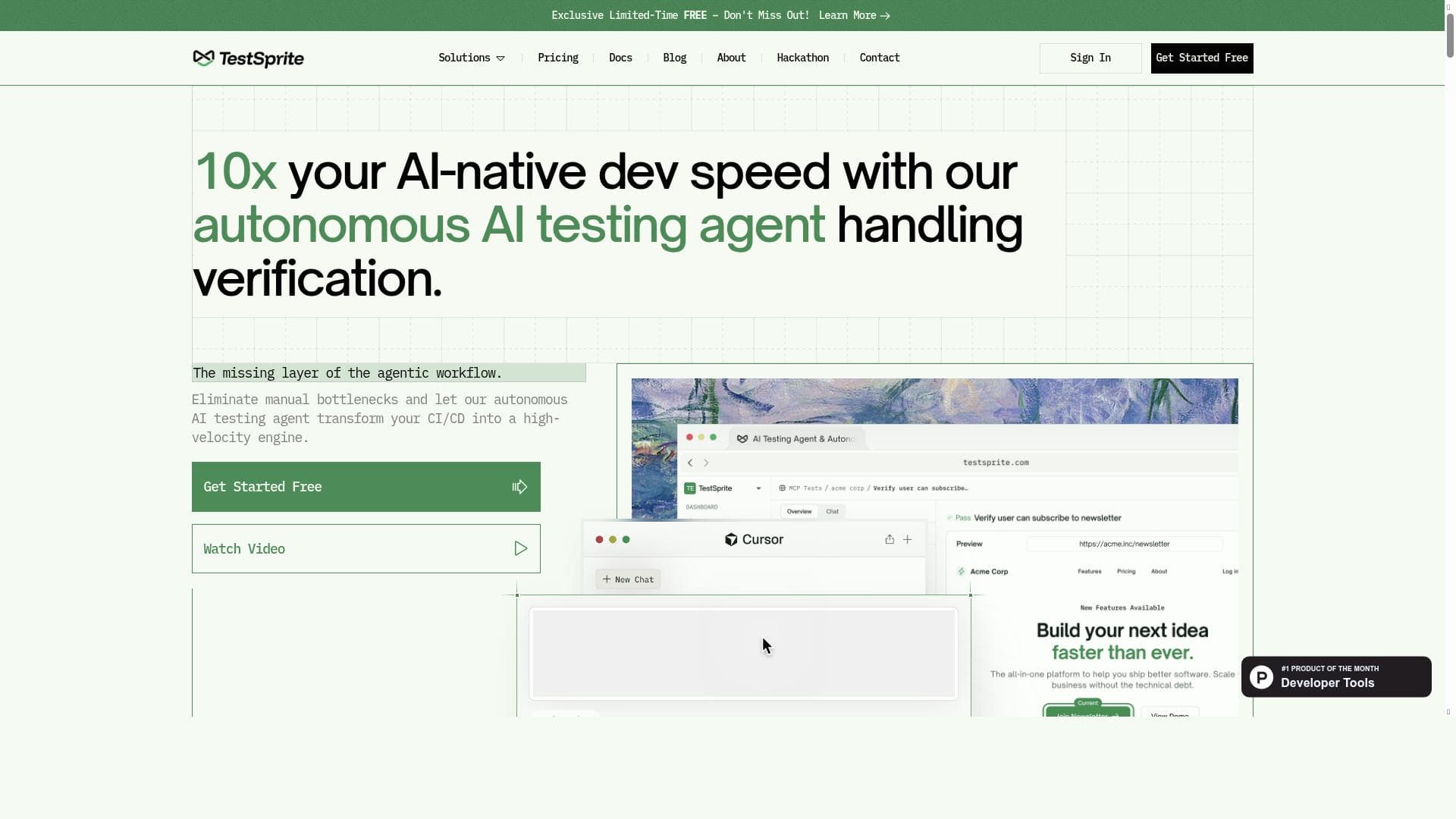
TestSprite 3.0 revolutionizes end-to-end testing by autonomously generating, executing, and debugging tests using AI-powered agents that mimic real user interactions and handle complex backend scenarios. Ideal for development teams seeking to automate testing with minimal input, it uniquely offers auto-heal for UI drift and integrates seamlessly with popular AI coding tools.

Description
TestSprite generates and runs end-to-end tests for your app, autonomously. For backend, we can now generate complex integration tests with dynamic variables, auto-cleanup, and Data Flow debugging. For frontend, we now send a fleet of parallel AI agents to explore your app first — clicking through every feature like real users, then feeding results into testing. We're the first to do this. 3.0 also adds auto-heal for UI drift, auto-auth for regression, and a CLI for Claude Code, Codex users.
Detailed Description
TestSprite 3.0 is an advanced AI-driven testing platform designed to autonomously generate and execute comprehensive end-to-end tests for both frontend and backend applications. Its core purpose is to streamline and automate the entire testing lifecycle, reducing manual effort while increasing test coverage and reliability. By leveraging AI agents and sophisticated algorithms, TestSprite 3.0 can simulate real user interactions on the frontend and create complex integration tests on the backend, making it a powerful tool for modern software development teams aiming to improve quality assurance processes. One of the standout capabilities of TestSprite 3.0 is its ability to build detailed test plans automatically. This means users do not need to spend extensive time designing test cases manually; instead, the platform analyzes the application and generates relevant test scenarios. It then writes the corresponding test code, executes these tests, and provides debugging support for any failures encountered. The tool also generates comprehensive test reports that help developers and QA teams understand the results and identify issues quickly. Minimal input is required from users, making it accessible even for teams with limited testing expertise. For backend testing, TestSprite 3.0 excels at generating complex integration tests that incorporate dynamic variables and automatic cleanup routines to maintain test environment integrity. It also features Data Flow debugging, which helps trace and diagnose issues in the data lifecycle during tests. On the frontend side, the platform employs a fleet of parallel AI agents that explore the application by clicking through every feature as real users would. This exploratory testing approach uncovers edge cases and UI behaviors that traditional scripted tests might miss. Additionally, version 3.0 introduces auto-heal functionality to address UI drift, ensuring tests remain stable despite interface changes, and auto-authentication capabilities to handle regression testing scenarios requiring user login. TestSprite 3.0 is particularly well-suited for software development teams, QA engineers, and product managers who need robust, scalable testing solutions that reduce manual overhead. It benefits startups and enterprises alike, especially those with complex applications requiring frequent releases and continuous integration/continuous deployment (CI/CD) pipelines. Use cases include automated regression testing, integration testing for backend services, UI testing for web and mobile apps, and exploratory testing to discover unexpected bugs. Regarding pricing, TestSprite 3.0 offers a freemium model, allowing users to access core features at no cost while providing premium capabilities through paid plans. This approach makes it easy for teams to try the platform and scale usage as their testing needs grow. Although specific pricing tiers and limits are not detailed here, the freemium option lowers the barrier to entry for smaller teams or individual developers. Compared to alternative testing tools, TestSprite 3.0 stands out due to its autonomous AI-driven test generation and execution, especially the innovative use of parallel AI agents for frontend exploration. Many traditional testing frameworks require significant manual scripting and maintenance, whereas TestSprite minimizes this through automation and self-healing mechanisms. Its support for both backend and frontend testing in a single platform also reduces toolchain complexity. However, some competitors may offer deeper integrations with specific CI/CD tools or specialized testing types like performance or security testing, which TestSprite does not emphasize. Potential limitations include the reliance on AI-generated tests, which might occasionally miss highly specialized edge cases that require domain expertise to script manually. Additionally, while the auto-heal and auto-auth features improve test resilience, complex UI changes or authentication flows might still require manual intervention. Users should also consider the learning curve associated with integrating AI-powered testing into existing workflows and the need to monitor AI agents’ exploratory testing results carefully. Overall, TestSprite 3.0 represents a significant advancement in automated software testing by combining AI innovation with practical testing needs. Its autonomous test generation, execution, debugging, and reporting capabilities make it a valuable asset for teams seeking to enhance software quality while reducing manual testing burdens.
Tool Features
- Builds test plans automatically
- Writes test code
- Executes tests
- Debugs test failures
- Generates test reports
- Minimal input required from users
- Supports multiple testing scenarios
Description
TestSprite 3.0 revolutionizes end-to-end testing by autonomously generating, executing, and debugging tests using AI-powered agents that mimic real user interactions and handle complex backend scenarios. Ideal for development teams seeking to automate testing with minimal input, it uniquely offers auto-heal for UI drift and integrates seamlessly with popular AI coding tools.
TestSprite generates and runs end-to-end tests for your app, autonomously. For backend, we can now generate complex integration tests with dynamic variables, auto-cleanup, and Data Flow debugging. For frontend, we now send a fleet of parallel AI agents to explore your app first — clicking through every feature like real users, then feeding results into testing. We're the first to do this. 3.0 also adds auto-heal for UI drift, auto-auth for regression, and a CLI for Claude Code, Codex users.
Detailed Description
TestSprite 3.0 is an advanced AI-driven testing platform designed to autonomously generate and execute comprehensive end-to-end tests for both frontend and backend applications. Its core purpose is to streamline and automate the entire testing lifecycle, reducing manual effort while increasing test coverage and reliability. By leveraging AI agents and sophisticated algorithms, TestSprite 3.0 can simulate real user interactions on the frontend and create complex integration tests on the backend, making it a powerful tool for modern software development teams aiming to improve quality assurance processes. One of the standout capabilities of TestSprite 3.0 is its ability to build detailed test plans automatically. This means users do not need to spend extensive time designing test cases manually; instead, the platform analyzes the application and generates relevant test scenarios. It then writes the corresponding test code, executes these tests, and provides debugging support for any failures encountered. The tool also generates comprehensive test reports that help developers and QA teams understand the results and identify issues quickly. Minimal input is required from users, making it accessible even for teams with limited testing expertise. For backend testing, TestSprite 3.0 excels at generating complex integration tests that incorporate dynamic variables and automatic cleanup routines to maintain test environment integrity. It also features Data Flow debugging, which helps trace and diagnose issues in the data lifecycle during tests. On the frontend side, the platform employs a fleet of parallel AI agents that explore the application by clicking through every feature as real users would. This exploratory testing approach uncovers edge cases and UI behaviors that traditional scripted tests might miss. Additionally, version 3.0 introduces auto-heal functionality to address UI drift, ensuring tests remain stable despite interface changes, and auto-authentication capabilities to handle regression testing scenarios requiring user login. TestSprite 3.0 is particularly well-suited for software development teams, QA engineers, and product managers who need robust, scalable testing solutions that reduce manual overhead. It benefits startups and enterprises alike, especially those with complex applications requiring frequent releases and continuous integration/continuous deployment (CI/CD) pipelines. Use cases include automated regression testing, integration testing for backend services, UI testing for web and mobile apps, and exploratory testing to discover unexpected bugs. Regarding pricing, TestSprite 3.0 offers a freemium model, allowing users to access core features at no cost while providing premium capabilities through paid plans. This approach makes it easy for teams to try the platform and scale usage as their testing needs grow. Although specific pricing tiers and limits are not detailed here, the freemium option lowers the barrier to entry for smaller teams or individual developers. Compared to alternative testing tools, TestSprite 3.0 stands out due to its autonomous AI-driven test generation and execution, especially the innovative use of parallel AI agents for frontend exploration. Many traditional testing frameworks require significant manual scripting and maintenance, whereas TestSprite minimizes this through automation and self-healing mechanisms. Its support for both backend and frontend testing in a single platform also reduces toolchain complexity. However, some competitors may offer deeper integrations with specific CI/CD tools or specialized testing types like performance or security testing, which TestSprite does not emphasize. Potential limitations include the reliance on AI-generated tests, which might occasionally miss highly specialized edge cases that require domain expertise to script manually. Additionally, while the auto-heal and auto-auth features improve test resilience, complex UI changes or authentication flows might still require manual intervention. Users should also consider the learning curve associated with integrating AI-powered testing into existing workflows and the need to monitor AI agents’ exploratory testing results carefully. Overall, TestSprite 3.0 represents a significant advancement in automated software testing by combining AI innovation with practical testing needs. Its autonomous test generation, execution, debugging, and reporting capabilities make it a valuable asset for teams seeking to enhance software quality while reducing manual testing burdens.
Frequently Asked Questions
What is TestSprite 3.0?
TestSprite 3.0 is an AI-driven testing platform that autonomously generates and runs end-to-end tests for both frontend and backend applications, automating test plan creation, code writing, execution, debugging, and reporting.
How much does TestSprite 3.0 cost?
TestSprite 3.0 offers a freemium pricing model, allowing users to access basic features for free with the option to upgrade to paid plans for advanced capabilities.
Who is TestSprite 3.0 best for?
It is best suited for software developers, QA engineers, and product teams who want to automate testing processes, improve test coverage, and reduce manual effort in both frontend and backend testing.
What are the main features of TestSprite 3.0?
Key features include automatic test plan building, test code generation, test execution, failure debugging, test report generation, minimal user input requirements, support for multiple testing scenarios, AI-driven frontend exploration, backend integration tests with dynamic variables, auto-heal for UI drift, and auto-authentication for regression testing.
Does TestSprite 3.0 offer a free trial?
Yes, the freemium model allows users to try core features at no cost, effectively serving as a free trial with the option to upgrade for additional functionality.
What integrations does TestSprite 3.0 support?
TestSprite 3.0 supports integration with AI coding tools such as Claude Code and Codex via its command-line interface (CLI), and it can be incorporated into various development workflows, although specific CI/CD integrations are not detailed.
How does TestSprite 3.0 work?
It works by using AI agents to autonomously explore frontend applications like real users, generating test scenarios and code. For backend, it creates complex integration tests with dynamic variables and auto-cleanup. It then executes these tests, debugs failures, and produces detailed reports, all with minimal user input.
Socials
Use ToolReviews
No reviews yet. Be the first to share your experience.
Sponsored Tools


































Recommended Tools
Stay updated on latest Ai tools
Get the latest insights, Join our newsletter
Read and trusted by 50,000+ readers
Join the biggest AI Community
Our community and staff are here to help!
Your feedback will help Alice AI improve in future versions.








Submit your Tool


PoweredByAI.app is an AI Tools Directory helping individuals, businesses, and creators discover the best AI tools for writing, coding, design, productivity, and more.
© 2026 , Product of011BQ. All rights reserved.