


Is this your AI tool? Claim it today.
Verify ownership, manage your profile, and unlock growth features.
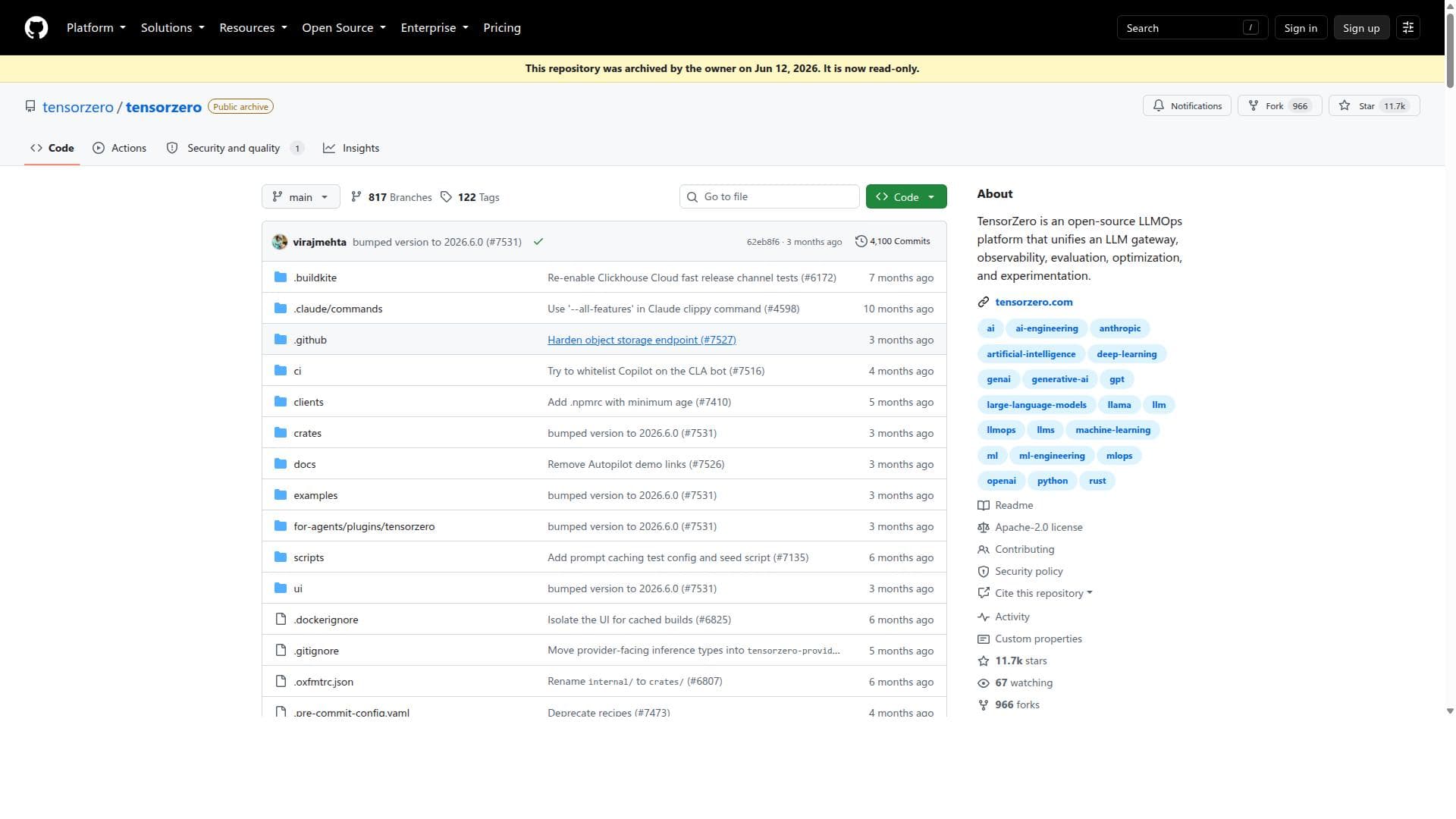
TensorZero is a comprehensive open-source LLMOps platform that unifies deployment, monitoring, evaluation, and experimentation of large language models into one seamless solution. Ideal for AI developers and enterprises managing LLMs at scale, it offers powerful tools to optimize and observe model performance while fostering rapid innovation through experimentation.

Description
Build industrial-grade LLM applications: one API for every LLM, observability, optimization (prompts, models, etc.), evaluations, and A/B testing — all open source. Turn metrics and human feedback into smarter, faster, and cheaper LLMs. Get started in minutes.
Detailed Description
TensorZero is an advanced open-source platform designed to streamline the operations and management of large language models (LLMs). Its core purpose is to provide a unified ecosystem that handles everything from deployment to monitoring, evaluation, optimization, and experimentation of LLMs. By consolidating these essential functions into a single platform, TensorZero simplifies the complex workflows involved in managing LLMs, enabling organizations and developers to focus on building and refining AI-driven applications with greater efficiency and insight. At the heart of TensorZero is its open-source LLMOps platform, which acts as a comprehensive gateway to large language models. This gateway facilitates seamless integration and management of various LLMs, providing a centralized interface for routing requests and managing model interactions. Beyond just access, TensorZero offers robust observability features that allow users to monitor model performance in real-time. This includes tracking usage metrics, latency, accuracy, and other vital statistics that help ensure models operate optimally in production environments. TensorZero also excels in providing powerful evaluation and optimization tools. Users can systematically assess model outputs against benchmarks or custom criteria to identify areas for improvement. Optimization capabilities enable fine-tuning and resource management to enhance model efficiency and response quality. Additionally, the platform supports experimentation workflows, allowing data scientists and engineers to run controlled tests, compare model versions, and iterate rapidly on model configurations and parameters. This platform is particularly well-suited for AI researchers, machine learning engineers, and enterprises that deploy large language models at scale. Use cases include deploying chatbots, virtual assistants, content generation systems, and any application requiring reliable and scalable LLM integration. TensorZero’s open-source nature makes it attractive for organizations seeking customizable and transparent solutions without vendor lock-in. Regarding pricing, TensorZero is freely available as an open-source project on GitHub, allowing users to deploy and customize the platform without licensing fees. However, organizations should consider infrastructure costs for hosting and running LLMs, as well as any additional cloud or hardware expenses associated with deployment. Compared to alternative LLM management tools, TensorZero stands out due to its unified approach and open-source accessibility. While some commercial platforms offer similar features, they often come with proprietary restrictions and higher costs. TensorZero’s comprehensive feature set, combined with community-driven development, provides flexibility and extensibility that proprietary solutions may lack. However, users should be prepared to manage their own infrastructure and potentially contribute to ongoing development efforts. Notable limitations include the requirement for technical expertise to deploy and maintain the platform effectively. Since it is open-source, users may need to handle updates, integrations, and troubleshooting independently or with community support. Additionally, while TensorZero covers many operational aspects, organizations with highly specialized needs might require additional custom development or integration with other tools. In summary, TensorZero is a powerful, open-source LLMOps platform that unifies critical functions for managing large language models. Its rich feature set, including a unified gateway, observability, evaluation, optimization, and experimentation support, makes it an excellent choice for teams looking to efficiently deploy and refine LLMs in production. By leveraging TensorZero, organizations can gain greater control, insight, and flexibility in their AI operations while benefiting from the transparency and collaboration of an open-source ecosystem.
Tool Features
- Open-source LLMOps platform
- Unified LLM gateway
- Observability for large language models
- Evaluation and optimization tools
- Experimentation support
Description
TensorZero is a comprehensive open-source LLMOps platform that unifies deployment, monitoring, evaluation, and experimentation of large language models into one seamless solution. Ideal for AI developers and enterprises managing LLMs at scale, it offers powerful tools to optimize and observe model performance while fostering rapid innovation through experimentation.
Build industrial-grade LLM applications: one API for every LLM, observability, optimization (prompts, models, etc.), evaluations, and A/B testing — all open source. Turn metrics and human feedback into smarter, faster, and cheaper LLMs. Get started in minutes.
Detailed Description
TensorZero is an advanced open-source platform designed to streamline the operations and management of large language models (LLMs). Its core purpose is to provide a unified ecosystem that handles everything from deployment to monitoring, evaluation, optimization, and experimentation of LLMs. By consolidating these essential functions into a single platform, TensorZero simplifies the complex workflows involved in managing LLMs, enabling organizations and developers to focus on building and refining AI-driven applications with greater efficiency and insight. At the heart of TensorZero is its open-source LLMOps platform, which acts as a comprehensive gateway to large language models. This gateway facilitates seamless integration and management of various LLMs, providing a centralized interface for routing requests and managing model interactions. Beyond just access, TensorZero offers robust observability features that allow users to monitor model performance in real-time. This includes tracking usage metrics, latency, accuracy, and other vital statistics that help ensure models operate optimally in production environments. TensorZero also excels in providing powerful evaluation and optimization tools. Users can systematically assess model outputs against benchmarks or custom criteria to identify areas for improvement. Optimization capabilities enable fine-tuning and resource management to enhance model efficiency and response quality. Additionally, the platform supports experimentation workflows, allowing data scientists and engineers to run controlled tests, compare model versions, and iterate rapidly on model configurations and parameters. This platform is particularly well-suited for AI researchers, machine learning engineers, and enterprises that deploy large language models at scale. Use cases include deploying chatbots, virtual assistants, content generation systems, and any application requiring reliable and scalable LLM integration. TensorZero’s open-source nature makes it attractive for organizations seeking customizable and transparent solutions without vendor lock-in. Regarding pricing, TensorZero is freely available as an open-source project on GitHub, allowing users to deploy and customize the platform without licensing fees. However, organizations should consider infrastructure costs for hosting and running LLMs, as well as any additional cloud or hardware expenses associated with deployment. Compared to alternative LLM management tools, TensorZero stands out due to its unified approach and open-source accessibility. While some commercial platforms offer similar features, they often come with proprietary restrictions and higher costs. TensorZero’s comprehensive feature set, combined with community-driven development, provides flexibility and extensibility that proprietary solutions may lack. However, users should be prepared to manage their own infrastructure and potentially contribute to ongoing development efforts. Notable limitations include the requirement for technical expertise to deploy and maintain the platform effectively. Since it is open-source, users may need to handle updates, integrations, and troubleshooting independently or with community support. Additionally, while TensorZero covers many operational aspects, organizations with highly specialized needs might require additional custom development or integration with other tools. In summary, TensorZero is a powerful, open-source LLMOps platform that unifies critical functions for managing large language models. Its rich feature set, including a unified gateway, observability, evaluation, optimization, and experimentation support, makes it an excellent choice for teams looking to efficiently deploy and refine LLMs in production. By leveraging TensorZero, organizations can gain greater control, insight, and flexibility in their AI operations while benefiting from the transparency and collaboration of an open-source ecosystem.
Frequently Asked Questions
What is TensorZero?
TensorZero is an open-source platform designed to manage large language models by providing a unified gateway, observability, evaluation, optimization, and experimentation capabilities, all within a single ecosystem.
How much does TensorZero cost?
TensorZero is free to use as an open-source project available on GitHub. Users only need to cover their own infrastructure and hosting costs.
Who is TensorZero best for?
TensorZero is best suited for AI researchers, machine learning engineers, and enterprises deploying large language models who require a comprehensive, customizable, and transparent platform for LLM operations.
What are the main features of TensorZero?
Key features include an open-source LLMOps platform, a unified LLM gateway for model management, observability tools for monitoring performance, evaluation and optimization utilities, and support for experimentation workflows.
Does TensorZero offer a free trial?
As an open-source platform, TensorZero is freely available to use without a trial period. Users can deploy and test the platform immediately from its GitHub repository.
What integrations does TensorZero support?
TensorZero supports integration with various large language models and can be extended to work with different AI frameworks and deployment environments, thanks to its open-source and modular design.
How does TensorZero work?
TensorZero works by providing a centralized gateway to manage LLM requests, coupled with observability tools to monitor model performance, evaluation modules to assess output quality, optimization features to tune models, and experimentation support to run tests and iterations efficiently.
Socials
Use ToolReviews
No reviews yet. Be the first to share your experience.