🚀 Zaprep: Your Socials on Steroids. Start free — automate 1,000 DMs/month & turn engagement into leads. with 1,000 automated DMs/month.


Is this your AI tool? Claim it today.
Verify ownership, manage your profile, and unlock growth features.
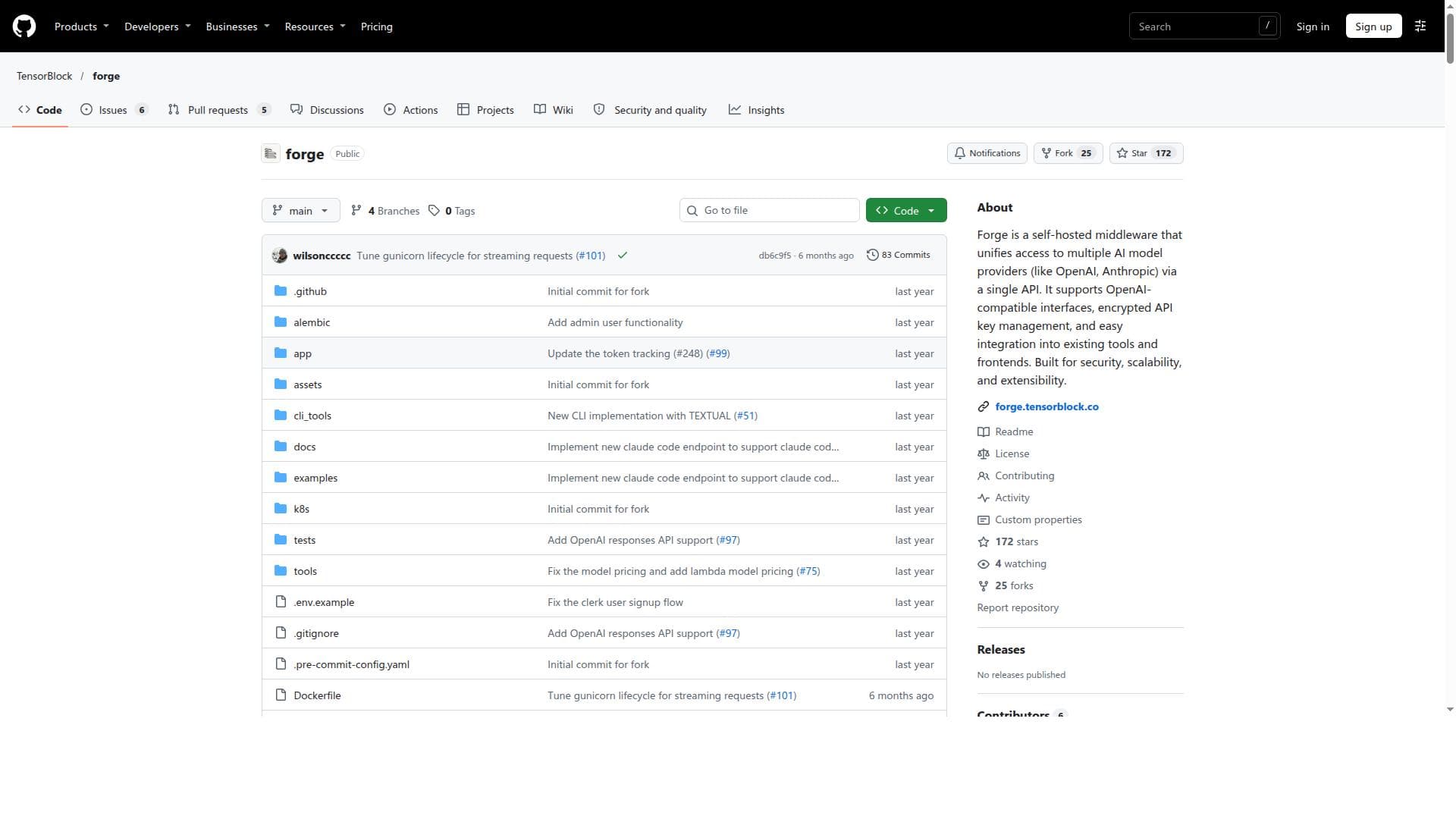
Forge is a self-hosted middleware that unifies access to multiple AI providers like OpenAI and Anthropic through a single, secure API. Ideal for developers and organizations seeking flexibility, security, and scalability, Forge simplifies managing and integrating diverse AI models within existing tools and workflows.

Description
Forge is the fast, secure way to connect and run AI models across providers—no more fragmented tools or infrastructure headaches. Just 3 lines of code to switch. OpenAI-compatible. Privacy-first.
Detailed Description
Forge is a powerful self-hosted middleware platform designed to unify and simplify access to multiple AI model providers through a single, consistent API. Its core purpose is to streamline the management and integration of various AI services, such as OpenAI and Anthropic, enabling developers and organizations to interact with multiple AI models without the complexity of handling each provider's unique API separately. By offering an OpenAI-compatible interface, Forge allows seamless integration with existing tools and frontends that already support OpenAI's API, reducing the learning curve and development effort required to adopt multiple AI providers. One of Forge's standout features is its encrypted API key management system, which ensures that sensitive credentials are securely stored and handled within the platform. This focus on security extends to its overall architecture, which is built for scalability and extensibility, making it suitable for projects ranging from small startups to large enterprises with demanding AI workloads. Forge's middleware approach abstracts the underlying AI providers, allowing users to switch or combine models from different vendors without changing their application code significantly. This flexibility is particularly valuable for teams looking to optimize costs, performance, or capabilities by leveraging the strengths of various AI models. Forge supports OpenAI-compatible interfaces, meaning it can serve as a drop-in replacement or proxy for OpenAI's API. This compatibility simplifies the process of integrating Forge into existing AI-powered applications, chatbots, or analytics tools that already rely on OpenAI's ecosystem. Additionally, Forge's easy integration capabilities allow developers to embed it into diverse environments and frontends, accelerating deployment and reducing operational overhead. The platform also emphasizes extensibility, enabling developers to customize or extend its functionality to meet specific business needs or workflows. Forge is best suited for developers, AI engineers, and organizations that require centralized control over multiple AI service providers. It is ideal for companies that want to avoid vendor lock-in, manage API keys securely, and maintain a consistent development experience across different AI models. Use cases include building multi-model AI applications, experimenting with various AI providers to find the best fit, and scaling AI services while maintaining security and compliance standards. It is also beneficial for teams that need to integrate AI capabilities into existing software infrastructure without extensive refactoring. Regarding pricing, Forge is an open-source project hosted on GitHub, which means it can be self-hosted without licensing fees. However, users will incur costs associated with the AI providers they connect through Forge, such as OpenAI or Anthropic, based on those providers' pricing models. This approach gives organizations full control over their infrastructure and costs but requires them to manage hosting and maintenance. There are no explicit paid plans or tiers for Forge itself, making it a cost-effective solution for those with the technical resources to deploy and manage it. Compared to alternatives, Forge stands out by offering a unified API that supports multiple AI providers with OpenAI compatibility, encrypted key management, and a focus on security and scalability. Many other solutions either lock users into a single provider or lack the flexibility to manage keys securely or scale efficiently. Forge's open-source nature also provides transparency and customization opportunities that proprietary platforms may not offer. However, unlike fully managed AI platforms, Forge requires self-hosting and technical expertise to operate, which may not suit all users. Notable limitations include the need for technical knowledge to deploy and maintain the middleware, as well as the responsibility for infrastructure security and uptime. Since Forge acts as a proxy, performance depends on both the hosting environment and the underlying AI providers. Additionally, while Forge supports major providers like OpenAI and Anthropic, integration with other or emerging AI services may require additional development. Users should also consider compliance and data privacy requirements when self-hosting AI middleware. In summary, Forge is a robust, secure, and scalable middleware solution that simplifies multi-provider AI integration through a single, OpenAI-compatible API. It empowers organizations to manage AI services flexibly and securely, making it a valuable tool for developers and enterprises seeking to leverage diverse AI models within a unified framework.
Tool Features
- Unifies access to multiple AI model providers via a single API
- Supports OpenAI-compatible interfaces
- Encrypted API key management
- Easy integration into existing tools and frontends
- Built for security, scalability, and extensibility
Description
Forge is a self-hosted middleware that unifies access to multiple AI providers like OpenAI and Anthropic through a single, secure API. Ideal for developers and organizations seeking flexibility, security, and scalability, Forge simplifies managing and integrating diverse AI models within existing tools and workflows.
Forge is the fast, secure way to connect and run AI models across providers—no more fragmented tools or infrastructure headaches. Just 3 lines of code to switch. OpenAI-compatible. Privacy-first.
Detailed Description
Forge is a powerful self-hosted middleware platform designed to unify and simplify access to multiple AI model providers through a single, consistent API. Its core purpose is to streamline the management and integration of various AI services, such as OpenAI and Anthropic, enabling developers and organizations to interact with multiple AI models without the complexity of handling each provider's unique API separately. By offering an OpenAI-compatible interface, Forge allows seamless integration with existing tools and frontends that already support OpenAI's API, reducing the learning curve and development effort required to adopt multiple AI providers. One of Forge's standout features is its encrypted API key management system, which ensures that sensitive credentials are securely stored and handled within the platform. This focus on security extends to its overall architecture, which is built for scalability and extensibility, making it suitable for projects ranging from small startups to large enterprises with demanding AI workloads. Forge's middleware approach abstracts the underlying AI providers, allowing users to switch or combine models from different vendors without changing their application code significantly. This flexibility is particularly valuable for teams looking to optimize costs, performance, or capabilities by leveraging the strengths of various AI models. Forge supports OpenAI-compatible interfaces, meaning it can serve as a drop-in replacement or proxy for OpenAI's API. This compatibility simplifies the process of integrating Forge into existing AI-powered applications, chatbots, or analytics tools that already rely on OpenAI's ecosystem. Additionally, Forge's easy integration capabilities allow developers to embed it into diverse environments and frontends, accelerating deployment and reducing operational overhead. The platform also emphasizes extensibility, enabling developers to customize or extend its functionality to meet specific business needs or workflows. Forge is best suited for developers, AI engineers, and organizations that require centralized control over multiple AI service providers. It is ideal for companies that want to avoid vendor lock-in, manage API keys securely, and maintain a consistent development experience across different AI models. Use cases include building multi-model AI applications, experimenting with various AI providers to find the best fit, and scaling AI services while maintaining security and compliance standards. It is also beneficial for teams that need to integrate AI capabilities into existing software infrastructure without extensive refactoring. Regarding pricing, Forge is an open-source project hosted on GitHub, which means it can be self-hosted without licensing fees. However, users will incur costs associated with the AI providers they connect through Forge, such as OpenAI or Anthropic, based on those providers' pricing models. This approach gives organizations full control over their infrastructure and costs but requires them to manage hosting and maintenance. There are no explicit paid plans or tiers for Forge itself, making it a cost-effective solution for those with the technical resources to deploy and manage it. Compared to alternatives, Forge stands out by offering a unified API that supports multiple AI providers with OpenAI compatibility, encrypted key management, and a focus on security and scalability. Many other solutions either lock users into a single provider or lack the flexibility to manage keys securely or scale efficiently. Forge's open-source nature also provides transparency and customization opportunities that proprietary platforms may not offer. However, unlike fully managed AI platforms, Forge requires self-hosting and technical expertise to operate, which may not suit all users. Notable limitations include the need for technical knowledge to deploy and maintain the middleware, as well as the responsibility for infrastructure security and uptime. Since Forge acts as a proxy, performance depends on both the hosting environment and the underlying AI providers. Additionally, while Forge supports major providers like OpenAI and Anthropic, integration with other or emerging AI services may require additional development. Users should also consider compliance and data privacy requirements when self-hosting AI middleware. In summary, Forge is a robust, secure, and scalable middleware solution that simplifies multi-provider AI integration through a single, OpenAI-compatible API. It empowers organizations to manage AI services flexibly and securely, making it a valuable tool for developers and enterprises seeking to leverage diverse AI models within a unified framework.
Frequently Asked Questions
What is Forge?
Forge is a self-hosted middleware platform that unifies access to multiple AI model providers such as OpenAI and Anthropic through a single, OpenAI-compatible API. It simplifies managing multiple AI services by providing encrypted API key management and easy integration into existing tools.
How much does Forge cost?
Forge itself is an open-source tool available for free on GitHub. However, users are responsible for hosting and maintaining the platform, as well as paying for usage fees from the AI providers they connect through Forge, such as OpenAI or Anthropic.
Who is Forge best for?
Forge is best suited for developers, AI engineers, and organizations that want centralized, secure, and scalable access to multiple AI providers. It is ideal for those looking to avoid vendor lock-in, manage API keys securely, and integrate AI models into existing applications with minimal changes.
What are the main features of Forge?
Key features of Forge include unified access to multiple AI providers via a single API, OpenAI-compatible interfaces, encrypted API key management, easy integration into existing tools and frontends, and a design focused on security, scalability, and extensibility.
Does Forge offer a free trial?
Since Forge is an open-source self-hosted middleware, there is no traditional free trial. Users can freely download and deploy Forge from GitHub without cost, but they must manage their own hosting and pay for any AI provider usage separately.
What integrations does Forge support?
Forge supports integration with multiple AI model providers, including OpenAI and Anthropic. It offers OpenAI-compatible API endpoints, enabling easy integration with tools and applications that already support OpenAI's API.
How does Forge work?
Forge acts as a middleware proxy that unifies requests to different AI providers through a single API. It securely manages API keys with encryption and translates calls to the respective provider’s API, allowing developers to interact with multiple AI services seamlessly and securely.
Socials
Use ToolReviews
No reviews yet. Be the first to share your experience.
Sponsored Tools

























Recommended Tools
Stay updated on latest Ai tools
Get the latest insights, Join our newsletter
Read and trusted by 50,000+ readers
Join the biggest AI Community
Our community and staff are here to help!
Your feedback will help Alice AI improve in future versions.








Submit your Tool


PoweredByAI.app is an AI Tools Directory helping individuals, businesses, and creators discover the best AI tools for writing, coding, design, productivity, and more.
© 2026 , Product of011BQ. All rights reserved.