🚀 Zaprep: Your Socials on Steroids. Start free — automate 1,000 DMs/month & turn engagement into leads. with 1,000 automated DMs/month.


Is this your AI tool? Claim it today.
Verify ownership, manage your profile, and unlock growth features.
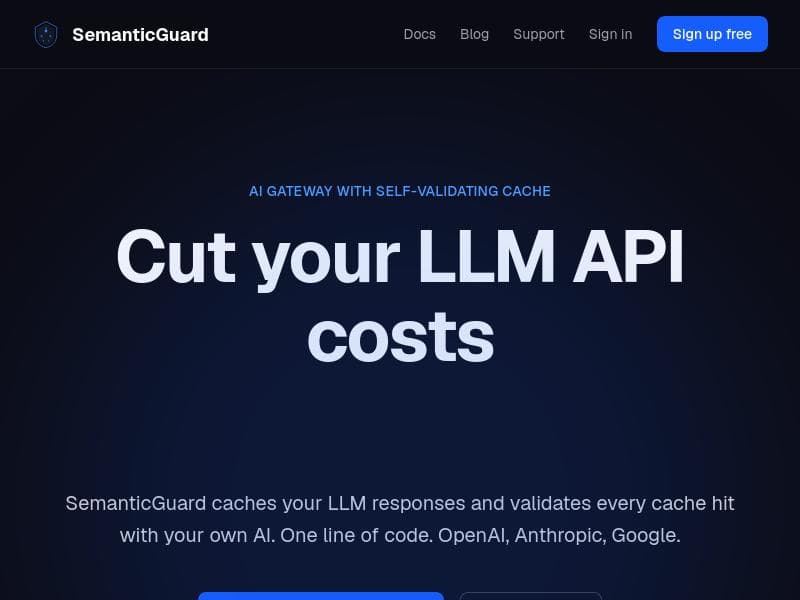
SemanticGuard is a powerful AI gateway that slashes OpenAI, Anthropic, and Google AI costs by up to 70% through intelligent semantic caching and continuous AI-driven validation. Ideal for developers and enterprises using multiple AI providers, it integrates effortlessly with a single line of code and delivers real-time cost analytics and multi-layer caching for unmatched savings and accuracy.

Description
Most LLM calls in production are repeats. Same questions, same prompts, sometimes worded slightly differently. SemanticGuard caches them. Sits between your app and OpenAI/Anthropic/Google, returns cache hits in <50ms, cuts costs 40-70%. One line of code to install. Shadow Mode shows your savings before you flip caching on. Every hit validated by your own AI so you never serve a wrong answer.
Detailed Description
SemanticGuard is an advanced AI gateway designed to significantly reduce the costs associated with using large language model (LLM) APIs such as OpenAI, Anthropic, and Google Vertex AI. Its core purpose is to optimize and minimize API usage expenses by intelligently caching AI responses through semantic understanding rather than simple key-value caching. By integrating with just one line of code, SemanticGuard acts as a middleware layer between your application and multiple AI providers, intercepting requests and serving cached responses whenever possible without compromising accuracy or quality. This approach can reduce your LLM API costs by 40-70%, making it a highly cost-effective solution for businesses and developers relying heavily on AI-powered applications. SemanticGuard’s key features revolve around its sophisticated caching mechanisms and validation processes. It employs a self-validating cache system where your own AI model continuously judges the correctness of every cached response before it is served, ensuring that no outdated or incorrect data is delivered to end users. This self-validation is crucial for maintaining trust and reliability in cached results. The platform also uses continuous learning through LLM-based skeleton extraction, which identifies variable prompt slots such as names, IDs, or dates, allowing it to generalize and reuse cached responses intelligently across similar but not identical prompts. This multi-layer cache includes exact matches, template-based caching, substituted prompts, and semantic caching, covering a wide range of use cases and maximizing cache hit rates. Integration is seamless with a one-line SDK addition via the withSemanticGuard() function, requiring no changes to your existing API request formats or vendor lock-in. SemanticGuard supports multiple providers beyond OpenAI and Anthropic, including Google, Azure, AWS Bedrock, and Mistral, making it a versatile tool for multi-cloud AI strategies. It also offers a shadow mode that provides cost visibility and analytics without serving cached responses, allowing teams to evaluate potential savings before fully enabling caching. The real-time cost analytics and savings dashboard give detailed insights into usage patterns and financial impact, empowering organizations to optimize their AI spend continuously. SemanticGuard is best suited for organizations and developers who rely heavily on LLM APIs for applications such as chatbots, virtual assistants, content generation, and data analysis. Enterprises with large-scale AI deployments will find the platform especially valuable for controlling spiraling API costs while maintaining high-quality AI interactions. Its multi-provider support and compatibility with popular AI agent frameworks like LangChain, CrewAI, and AutoGen make it ideal for teams building complex AI workflows and integrations. Additionally, the built-in MCP server support for Claude, Cursor, and other AI tools enables direct querying of cost and cache analytics, enhancing operational transparency. Pricing plans include a free tier offering 10,000 requests per month with shadow mode and exact cache functionality, ideal for initial trials and small projects. The Pro plan at $49/month includes 50,000 requests and access to the full caching pipeline, suitable for growing teams and mid-sized applications. For large enterprises, a custom Enterprise plan charges 15% of documented savings with a $500/month minimum, aligning costs directly with realized benefits. This tiered pricing ensures accessibility for startups and scalability for large organizations. Compared to built-in caching solutions from providers like OpenAI or Anthropic, which only cache exact prompt prefixes within short time windows, SemanticGuard’s semantic caching captures a much broader range of similar queries, including reworded questions, different user inputs, and recurring intents over longer periods. This results in substantially higher cache hit rates and cost savings. Unlike simple caching proxies, SemanticGuard’s continuous validation and multi-layer cache architecture provide superior accuracy and flexibility. However, users should consider that SemanticGuard requires initial setup and monitoring to fine-tune cache validation thresholds and ensure the AI model used for validation is appropriately configured. The reliance on your own AI for cache validation means that the quality of savings depends on the validation model’s effectiveness. Additionally, while SemanticGuard supports many providers, integration with niche or proprietary LLM APIs may require custom development. Overall, SemanticGuard offers a powerful, cost-saving solution for AI-heavy applications but requires thoughtful implementation to maximize benefits.
Tool Features
- Self-validating cache: your AI judges every cached response for correctness
- Continuous learning: LLM-based skeleton extraction identifies variable prompt slots
- Semantic caching for OpenAI, Anthropic, Google Vertex AI
- One-line SDK integration via withSemanticGuard()
- Multi-layer cache: exact, template, substituted, semantic
- Shadow mode for cost visibility without serving cached responses
- Real-time cost analytics and savings dashboard
- Multi-provider support: OpenAI, Anthropic, Google, Azure, AWS Bedrock, Mistral
Description
SemanticGuard is a powerful AI gateway that slashes OpenAI, Anthropic, and Google AI costs by up to 70% through intelligent semantic caching and continuous AI-driven validation. Ideal for developers and enterprises using multiple AI providers, it integrates effortlessly with a single line of code and delivers real-time cost analytics and multi-layer caching for unmatched savings and accuracy.
Most LLM calls in production are repeats. Same questions, same prompts, sometimes worded slightly differently. SemanticGuard caches them. Sits between your app and OpenAI/Anthropic/Google, returns cache hits in <50ms, cuts costs 40-70%. One line of code to install. Shadow Mode shows your savings before you flip caching on. Every hit validated by your own AI so you never serve a wrong answer.
Detailed Description
SemanticGuard is an advanced AI gateway designed to significantly reduce the costs associated with using large language model (LLM) APIs such as OpenAI, Anthropic, and Google Vertex AI. Its core purpose is to optimize and minimize API usage expenses by intelligently caching AI responses through semantic understanding rather than simple key-value caching. By integrating with just one line of code, SemanticGuard acts as a middleware layer between your application and multiple AI providers, intercepting requests and serving cached responses whenever possible without compromising accuracy or quality. This approach can reduce your LLM API costs by 40-70%, making it a highly cost-effective solution for businesses and developers relying heavily on AI-powered applications. SemanticGuard’s key features revolve around its sophisticated caching mechanisms and validation processes. It employs a self-validating cache system where your own AI model continuously judges the correctness of every cached response before it is served, ensuring that no outdated or incorrect data is delivered to end users. This self-validation is crucial for maintaining trust and reliability in cached results. The platform also uses continuous learning through LLM-based skeleton extraction, which identifies variable prompt slots such as names, IDs, or dates, allowing it to generalize and reuse cached responses intelligently across similar but not identical prompts. This multi-layer cache includes exact matches, template-based caching, substituted prompts, and semantic caching, covering a wide range of use cases and maximizing cache hit rates. Integration is seamless with a one-line SDK addition via the withSemanticGuard() function, requiring no changes to your existing API request formats or vendor lock-in. SemanticGuard supports multiple providers beyond OpenAI and Anthropic, including Google, Azure, AWS Bedrock, and Mistral, making it a versatile tool for multi-cloud AI strategies. It also offers a shadow mode that provides cost visibility and analytics without serving cached responses, allowing teams to evaluate potential savings before fully enabling caching. The real-time cost analytics and savings dashboard give detailed insights into usage patterns and financial impact, empowering organizations to optimize their AI spend continuously. SemanticGuard is best suited for organizations and developers who rely heavily on LLM APIs for applications such as chatbots, virtual assistants, content generation, and data analysis. Enterprises with large-scale AI deployments will find the platform especially valuable for controlling spiraling API costs while maintaining high-quality AI interactions. Its multi-provider support and compatibility with popular AI agent frameworks like LangChain, CrewAI, and AutoGen make it ideal for teams building complex AI workflows and integrations. Additionally, the built-in MCP server support for Claude, Cursor, and other AI tools enables direct querying of cost and cache analytics, enhancing operational transparency. Pricing plans include a free tier offering 10,000 requests per month with shadow mode and exact cache functionality, ideal for initial trials and small projects. The Pro plan at $49/month includes 50,000 requests and access to the full caching pipeline, suitable for growing teams and mid-sized applications. For large enterprises, a custom Enterprise plan charges 15% of documented savings with a $500/month minimum, aligning costs directly with realized benefits. This tiered pricing ensures accessibility for startups and scalability for large organizations. Compared to built-in caching solutions from providers like OpenAI or Anthropic, which only cache exact prompt prefixes within short time windows, SemanticGuard’s semantic caching captures a much broader range of similar queries, including reworded questions, different user inputs, and recurring intents over longer periods. This results in substantially higher cache hit rates and cost savings. Unlike simple caching proxies, SemanticGuard’s continuous validation and multi-layer cache architecture provide superior accuracy and flexibility. However, users should consider that SemanticGuard requires initial setup and monitoring to fine-tune cache validation thresholds and ensure the AI model used for validation is appropriately configured. The reliance on your own AI for cache validation means that the quality of savings depends on the validation model’s effectiveness. Additionally, while SemanticGuard supports many providers, integration with niche or proprietary LLM APIs may require custom development. Overall, SemanticGuard offers a powerful, cost-saving solution for AI-heavy applications but requires thoughtful implementation to maximize benefits.
Frequently Asked Questions
What is SemanticGuard?
SemanticGuard is an AI gateway that reduces the costs of using large language model APIs by implementing intelligent semantic caching and continuous validation of cached responses. It supports multiple AI providers and integrates with just one line of code.
How much does SemanticGuard cost?
SemanticGuard offers a free tier with 10,000 requests per month including shadow mode and exact caching. The Pro plan costs $49/month for 50,000 requests with full caching features. The Enterprise plan charges 15% of documented savings with a $500/month minimum.
Who is SemanticGuard best for?
SemanticGuard is best suited for developers, startups, and enterprises that rely heavily on LLM APIs from providers like OpenAI, Anthropic, and Google. It is ideal for applications requiring cost-efficient, high-quality AI responses such as chatbots, virtual assistants, and AI-powered analytics.
What are the main features of SemanticGuard?
Key features include a self-validating cache that uses your AI to verify cached responses, continuous learning with LLM-based skeleton extraction, multi-layer caching (exact, template, substituted, semantic), one-line SDK integration, shadow mode for cost visibility, real-time cost analytics, and support for multiple AI providers.
Does SemanticGuard offer a free trial?
Yes, SemanticGuard offers a free tier that includes 10,000 requests per month with shadow mode and exact caching, allowing users to evaluate cost savings and performance before upgrading.
What integrations does SemanticGuard support?
SemanticGuard supports integration with OpenAI, Anthropic, Google Vertex AI, Azure, AWS Bedrock, Mistral, and is compatible with AI agent frameworks like LangChain, CrewAI, and AutoGen. It also provides a built-in MCP server for tools like Claude and Cursor.
How does SemanticGuard work?
SemanticGuard intercepts AI API requests and uses semantic caching to serve responses from cache when similar queries are detected. It continuously validates cached responses with your AI to ensure accuracy and provides multi-layer caching strategies to maximize cost savings without compromising quality.
Reviews
No reviews yet. Be the first to share your experience.
Sponsored Tools

























Recommended Tools
Stay updated on latest Ai tools
Get the latest insights, Join our newsletter
Read and trusted by 50,000+ readers
Join the biggest AI Community
Our community and staff are here to help!
Your feedback will help Alice AI improve in future versions.








Submit your Tool


PoweredByAI.app is an AI Tools Directory helping individuals, businesses, and creators discover the best AI tools for writing, coding, design, productivity, and more.
© 2026 , Product of011BQ. All rights reserved.