🚀 Zaprep: Your Socials on Steroids. Start free — automate 1,000 DMs/month & turn engagement into leads. with 1,000 automated DMs/month.


Is this your AI tool? Claim it today.
Verify ownership, manage your profile, and unlock growth features.
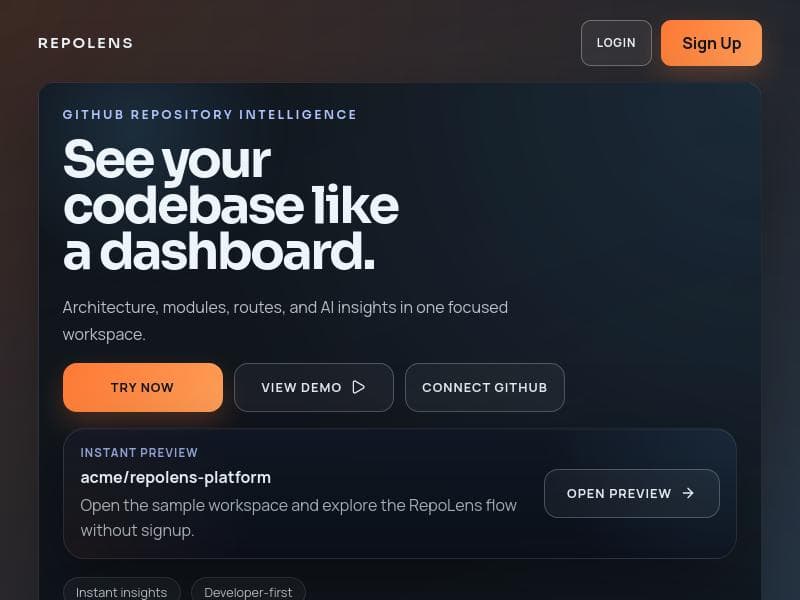
RepoLens Version Two is an AI-driven tool that empowers engineering teams to quickly understand code changes across repositories, branches, and pull requests with detailed module and API insights. Its unique combination of repository analysis, branch-aware chat, and structural comparisons makes it ideal for teams aiming to accelerate reviews and maintain architectural clarity in complex codebases.

Description
RepoLens Version Two helps engineering teams understand what changed and what matters across repositories, branches, and pull requests. It analyzes PRs, detects affected modules and changed endpoints, highlights review hotspots, powers branch-aware chat with grounded code references, compares branches structurally, and sends alerts for important changes so teams can understand evolving codebases faster with more trust.
Detailed Description
RepoLens Version Two is an advanced AI-powered tool designed to help engineering teams gain deep insights into their code repositories, branches, and pull requests. Its core purpose is to streamline the understanding of what has changed in a codebase and to highlight what truly matters, enabling teams to manage evolving software projects with greater confidence and efficiency. By analyzing pull requests (PRs) and detecting affected modules and changed endpoints, RepoLens provides a granular view of code modifications that can otherwise be difficult to track, especially in large and complex repositories. This capability allows developers and reviewers to focus their attention on critical areas, improving code quality and accelerating review cycles. One of the standout features of RepoLens is its comprehensive repository analysis, which includes the generation of module maps and dependency graphs. These visualizations help teams explore the structure and interdependencies within their codebase, making it easier to identify potential impact zones of changes. The tool also extracts APIs and generates architecture summaries, offering a high-level overview that aids in understanding the overall design and evolution of the software. Additionally, RepoLens powers a branch-aware chat interface that provides grounded code references, enabling contextual discussions directly tied to specific code segments or branches. This feature fosters better collaboration and reduces misunderstandings during code reviews or development discussions. RepoLens also excels in comparing branches structurally, allowing teams to quickly identify differences beyond simple line-by-line diffs. This structural comparison helps in understanding the architectural impact of changes and supports more informed decision-making. Furthermore, the tool sends alerts for important changes, ensuring that key stakeholders are promptly notified about modifications that could affect the stability or functionality of the system. These alerts help maintain trust in the codebase and reduce the risk of overlooking critical updates. The tool is best suited for engineering teams working on complex, multi-module projects with frequent pull requests and branching strategies. It is particularly valuable for teams aiming to improve code review efficiency, maintain architectural integrity, and foster better collaboration across distributed or cross-functional groups. Use cases include accelerating code reviews by highlighting hotspots, managing dependencies and module interactions, tracking API changes, and facilitating architectural discussions with up-to-date summaries. RepoLens is offered as a free tool, making it accessible to teams of all sizes without upfront costs. This pricing model encourages adoption and experimentation, especially for startups and open-source projects seeking to enhance their development workflows without financial barriers. Compared to alternatives, RepoLens stands out by combining multiple advanced features—such as module map exploration, dependency graph inspection, and grounded repository chat—into a single cohesive platform. While other tools may focus on static code analysis or simple diff visualization, RepoLens provides a richer, more interactive experience that integrates architectural insights and communication capabilities. However, users should consider that, as a specialized tool, it may require some onboarding to fully leverage its features, and its effectiveness depends on the quality and structure of the underlying repositories. In summary, RepoLens Version Two is a powerful AI assistant for engineering teams seeking to understand code changes deeply and collaborate more effectively. Its rich feature set, free pricing, and focus on meaningful insights make it a compelling choice for modern software development environments. Teams looking to reduce review bottlenecks, maintain architectural clarity, and stay informed about critical changes will find RepoLens an invaluable addition to their toolkit.
Tool Features
- Repository analysis
- Module maps exploration
- Dependency graphs inspection
- API extraction
- Architecture summaries generation
- Grounded repository chat
Description
RepoLens Version Two is an AI-driven tool that empowers engineering teams to quickly understand code changes across repositories, branches, and pull requests with detailed module and API insights. Its unique combination of repository analysis, branch-aware chat, and structural comparisons makes it ideal for teams aiming to accelerate reviews and maintain architectural clarity in complex codebases.
RepoLens Version Two helps engineering teams understand what changed and what matters across repositories, branches, and pull requests. It analyzes PRs, detects affected modules and changed endpoints, highlights review hotspots, powers branch-aware chat with grounded code references, compares branches structurally, and sends alerts for important changes so teams can understand evolving codebases faster with more trust.
Detailed Description
RepoLens Version Two is an advanced AI-powered tool designed to help engineering teams gain deep insights into their code repositories, branches, and pull requests. Its core purpose is to streamline the understanding of what has changed in a codebase and to highlight what truly matters, enabling teams to manage evolving software projects with greater confidence and efficiency. By analyzing pull requests (PRs) and detecting affected modules and changed endpoints, RepoLens provides a granular view of code modifications that can otherwise be difficult to track, especially in large and complex repositories. This capability allows developers and reviewers to focus their attention on critical areas, improving code quality and accelerating review cycles. One of the standout features of RepoLens is its comprehensive repository analysis, which includes the generation of module maps and dependency graphs. These visualizations help teams explore the structure and interdependencies within their codebase, making it easier to identify potential impact zones of changes. The tool also extracts APIs and generates architecture summaries, offering a high-level overview that aids in understanding the overall design and evolution of the software. Additionally, RepoLens powers a branch-aware chat interface that provides grounded code references, enabling contextual discussions directly tied to specific code segments or branches. This feature fosters better collaboration and reduces misunderstandings during code reviews or development discussions. RepoLens also excels in comparing branches structurally, allowing teams to quickly identify differences beyond simple line-by-line diffs. This structural comparison helps in understanding the architectural impact of changes and supports more informed decision-making. Furthermore, the tool sends alerts for important changes, ensuring that key stakeholders are promptly notified about modifications that could affect the stability or functionality of the system. These alerts help maintain trust in the codebase and reduce the risk of overlooking critical updates. The tool is best suited for engineering teams working on complex, multi-module projects with frequent pull requests and branching strategies. It is particularly valuable for teams aiming to improve code review efficiency, maintain architectural integrity, and foster better collaboration across distributed or cross-functional groups. Use cases include accelerating code reviews by highlighting hotspots, managing dependencies and module interactions, tracking API changes, and facilitating architectural discussions with up-to-date summaries. RepoLens is offered as a free tool, making it accessible to teams of all sizes without upfront costs. This pricing model encourages adoption and experimentation, especially for startups and open-source projects seeking to enhance their development workflows without financial barriers. Compared to alternatives, RepoLens stands out by combining multiple advanced features—such as module map exploration, dependency graph inspection, and grounded repository chat—into a single cohesive platform. While other tools may focus on static code analysis or simple diff visualization, RepoLens provides a richer, more interactive experience that integrates architectural insights and communication capabilities. However, users should consider that, as a specialized tool, it may require some onboarding to fully leverage its features, and its effectiveness depends on the quality and structure of the underlying repositories. In summary, RepoLens Version Two is a powerful AI assistant for engineering teams seeking to understand code changes deeply and collaborate more effectively. Its rich feature set, free pricing, and focus on meaningful insights make it a compelling choice for modern software development environments. Teams looking to reduce review bottlenecks, maintain architectural clarity, and stay informed about critical changes will find RepoLens an invaluable addition to their toolkit.
Frequently Asked Questions
What is RepoLens?
RepoLens is an AI-powered tool designed to help engineering teams understand changes across code repositories, branches, and pull requests by analyzing affected modules, endpoints, and architectural impacts.
How much does RepoLens cost?
RepoLens is available for free, allowing teams to access its full range of features without any subscription fees.
Who is RepoLens best for?
RepoLens is best suited for engineering teams working on complex, multi-module projects who want to improve code review efficiency, maintain architectural integrity, and enhance collaboration.
What are the main features of RepoLens?
Key features include repository analysis, module maps exploration, dependency graphs inspection, API extraction, architecture summaries generation, branch-aware grounded chat, structural branch comparisons, and alerts for important changes.
Does RepoLens offer a free trial?
RepoLens is offered for free, so there is no need for a separate trial period.
What integrations does RepoLens support?
While specific integrations are not detailed, RepoLens works across repositories, branches, and pull requests, implying compatibility with common version control systems and workflows.
How does RepoLens work?
RepoLens analyzes pull requests and code changes to detect affected modules and endpoints, generates visual maps and summaries of the codebase architecture, enables branch-aware chat with code references, compares branches structurally, and sends alerts to keep teams informed.
Socials
Use ToolReviews
No reviews yet. Be the first to share your experience.
Sponsored Tools





























Recommended Tools
Stay updated on latest Ai tools
Get the latest insights, Join our newsletter
Read and trusted by 50,000+ readers
Join the biggest AI Community
Our community and staff are here to help!
Your feedback will help Alice AI improve in future versions.








Submit your Tool

PoweredByAI.app is an AI Tools Directory helping individuals, businesses, and creators discover the best AI tools for writing, coding, design, productivity, and more.
© 2026 , Product of011BQ. All rights reserved.