ReasoningBank by Google


Is this your AI tool? Claim it today.
Verify ownership, manage your profile, and unlock growth features.
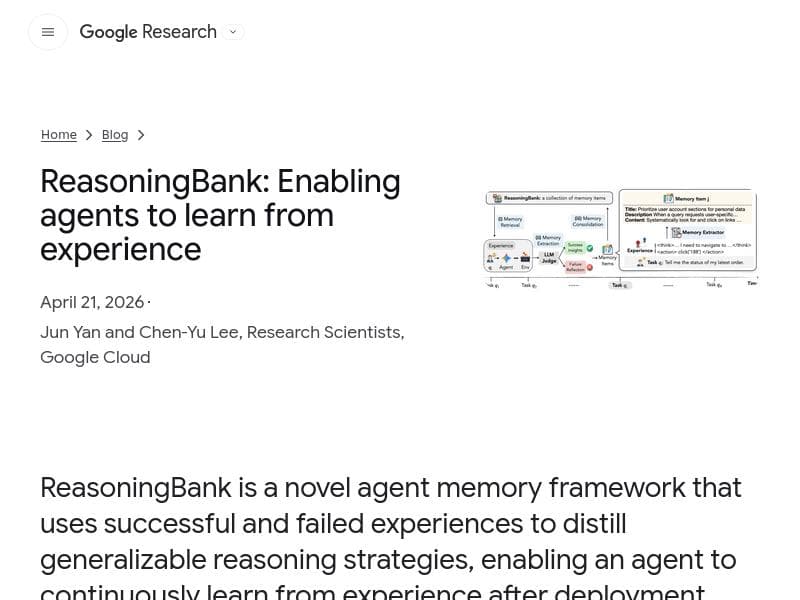
ReasoningBank revolutionizes AI by enabling agents to learn from their own experiences, significantly boosting their reasoning and decision-making abilities. Ideal for researchers and developers focused on adaptive, intelligent systems, it transforms static AI models into dynamic learners capable of complex problem-solving.

Description
ReasoningBank is an open-source agent memory framework that distills reasoning patterns from both successful and failed runs, helping agents improve continuously after deployment. For AI researchers and agent builders.
Detailed Description
ReasoningBank is an innovative research initiative designed to enhance the cognitive capabilities of AI agents by enabling them to learn from experience. Its core purpose is to improve the reasoning and decision-making processes of artificial intelligence systems by leveraging accumulated knowledge and past experiences. Unlike traditional AI models that rely heavily on static datasets or predefined rules, ReasoningBank focuses on creating a dynamic knowledge repository where AI agents can store, retrieve, and apply experiential insights to solve complex problems more effectively. This approach aims to bridge the gap between raw data processing and higher-level reasoning, making AI systems more adaptable and capable of nuanced understanding. At the heart of ReasoningBank are several key features that distinguish it from conventional AI frameworks. First, it enables agents to learn continuously from their interactions and outcomes, effectively building a knowledge base that grows richer over time. This experiential learning mechanism allows AI agents to refine their reasoning strategies based on what has worked or failed in previous scenarios. Second, ReasoningBank enhances the reasoning capabilities of AI by integrating accumulated knowledge into the decision-making pipeline, allowing agents to make more informed and context-aware choices. This is particularly valuable in environments where conditions change or where agents face novel challenges. Third, the system leverages a structured knowledge representation that supports complex inference, enabling agents to draw logical conclusions and solve problems that require multi-step reasoning. ReasoningBank is best suited for AI researchers, developers, and organizations focused on advancing autonomous systems, robotics, natural language understanding, and complex problem-solving applications. Use cases include intelligent virtual assistants that improve their responses over time, robotics systems that adapt to new tasks by learning from prior experiences, and decision support tools that require deep contextual reasoning. By incorporating ReasoningBank, these applications can achieve higher levels of autonomy, flexibility, and accuracy, making them more effective in real-world scenarios. As a research initiative, ReasoningBank does not currently operate on a commercial pricing model or offer subscription plans. It is primarily accessible through academic publications, research collaborations, and possibly open-source implementations or APIs made available by the developers. Interested users should monitor official channels and research blogs for updates on availability and potential integration options. Compared to alternative AI reasoning frameworks, ReasoningBank stands out by emphasizing experiential learning and knowledge accumulation as central components of reasoning. While many AI tools focus on static knowledge graphs or purely data-driven models, ReasoningBank's approach allows agents to evolve their reasoning capabilities dynamically. This makes it particularly powerful for applications requiring continual learning and adaptation. However, as a research project, it may lack the polished user interfaces, extensive documentation, and commercial support found in mature AI platforms. Notable limitations include its current status as a research initiative, which means it may not yet be production-ready or widely accessible for commercial use. Additionally, the complexity of implementing experiential learning and reasoning mechanisms can pose challenges for developers unfamiliar with advanced AI concepts. Users should also consider the computational resources required to maintain and query large experiential knowledge bases, which may impact scalability. Despite these considerations, ReasoningBank represents a significant step forward in enabling AI agents to reason more like humans by learning from their experiences.
Tool Features
- Enables agents to learn from experience
- Improves reasoning capabilities of AI agents
- Leverages accumulated knowledge for better decision-making
Description
ReasoningBank revolutionizes AI by enabling agents to learn from their own experiences, significantly boosting their reasoning and decision-making abilities. Ideal for researchers and developers focused on adaptive, intelligent systems, it transforms static AI models into dynamic learners capable of complex problem-solving.
ReasoningBank is an open-source agent memory framework that distills reasoning patterns from both successful and failed runs, helping agents improve continuously after deployment. For AI researchers and agent builders.
Detailed Description
ReasoningBank is an innovative research initiative designed to enhance the cognitive capabilities of AI agents by enabling them to learn from experience. Its core purpose is to improve the reasoning and decision-making processes of artificial intelligence systems by leveraging accumulated knowledge and past experiences. Unlike traditional AI models that rely heavily on static datasets or predefined rules, ReasoningBank focuses on creating a dynamic knowledge repository where AI agents can store, retrieve, and apply experiential insights to solve complex problems more effectively. This approach aims to bridge the gap between raw data processing and higher-level reasoning, making AI systems more adaptable and capable of nuanced understanding. At the heart of ReasoningBank are several key features that distinguish it from conventional AI frameworks. First, it enables agents to learn continuously from their interactions and outcomes, effectively building a knowledge base that grows richer over time. This experiential learning mechanism allows AI agents to refine their reasoning strategies based on what has worked or failed in previous scenarios. Second, ReasoningBank enhances the reasoning capabilities of AI by integrating accumulated knowledge into the decision-making pipeline, allowing agents to make more informed and context-aware choices. This is particularly valuable in environments where conditions change or where agents face novel challenges. Third, the system leverages a structured knowledge representation that supports complex inference, enabling agents to draw logical conclusions and solve problems that require multi-step reasoning. ReasoningBank is best suited for AI researchers, developers, and organizations focused on advancing autonomous systems, robotics, natural language understanding, and complex problem-solving applications. Use cases include intelligent virtual assistants that improve their responses over time, robotics systems that adapt to new tasks by learning from prior experiences, and decision support tools that require deep contextual reasoning. By incorporating ReasoningBank, these applications can achieve higher levels of autonomy, flexibility, and accuracy, making them more effective in real-world scenarios. As a research initiative, ReasoningBank does not currently operate on a commercial pricing model or offer subscription plans. It is primarily accessible through academic publications, research collaborations, and possibly open-source implementations or APIs made available by the developers. Interested users should monitor official channels and research blogs for updates on availability and potential integration options. Compared to alternative AI reasoning frameworks, ReasoningBank stands out by emphasizing experiential learning and knowledge accumulation as central components of reasoning. While many AI tools focus on static knowledge graphs or purely data-driven models, ReasoningBank's approach allows agents to evolve their reasoning capabilities dynamically. This makes it particularly powerful for applications requiring continual learning and adaptation. However, as a research project, it may lack the polished user interfaces, extensive documentation, and commercial support found in mature AI platforms. Notable limitations include its current status as a research initiative, which means it may not yet be production-ready or widely accessible for commercial use. Additionally, the complexity of implementing experiential learning and reasoning mechanisms can pose challenges for developers unfamiliar with advanced AI concepts. Users should also consider the computational resources required to maintain and query large experiential knowledge bases, which may impact scalability. Despite these considerations, ReasoningBank represents a significant step forward in enabling AI agents to reason more like humans by learning from their experiences.
Frequently Asked Questions
What is ReasoningBank?
ReasoningBank is a research initiative focused on enabling AI agents to learn from experience, enhancing their reasoning and decision-making capabilities by leveraging accumulated knowledge.
How much does ReasoningBank cost?
As a research initiative, ReasoningBank does not currently have a commercial pricing model or subscription plans. Access is primarily through research collaborations and publications.
Who is ReasoningBank best for?
ReasoningBank is best suited for AI researchers, developers, and organizations working on autonomous systems, robotics, natural language understanding, and complex problem-solving applications.
What are the main features of ReasoningBank?
Its main features include enabling AI agents to learn continuously from experience, improving reasoning capabilities through accumulated knowledge, and supporting complex inference for better decision-making.
Does ReasoningBank offer a free trial?
ReasoningBank is a research project and does not offer a free trial. Access is generally through research publications or collaborations rather than commercial products.
What integrations does ReasoningBank support?
As a research initiative, ReasoningBank does not currently provide specific integrations but may be incorporated into AI systems via research implementations or APIs developed by the research team.
How does ReasoningBank work?
ReasoningBank works by allowing AI agents to accumulate and leverage knowledge gained from past experiences, enhancing their reasoning and decision-making processes through continuous learning and complex inference.
Socials
Use ToolReviews
No reviews yet. Be the first to share your experience.