🚀 Zaprep: Your Socials on Steroids. Start free — automate 1,000 DMs/month & turn engagement into leads. with 1,000 automated DMs/month.


Is this your AI tool? Claim it today.
Verify ownership, manage your profile, and unlock growth features.
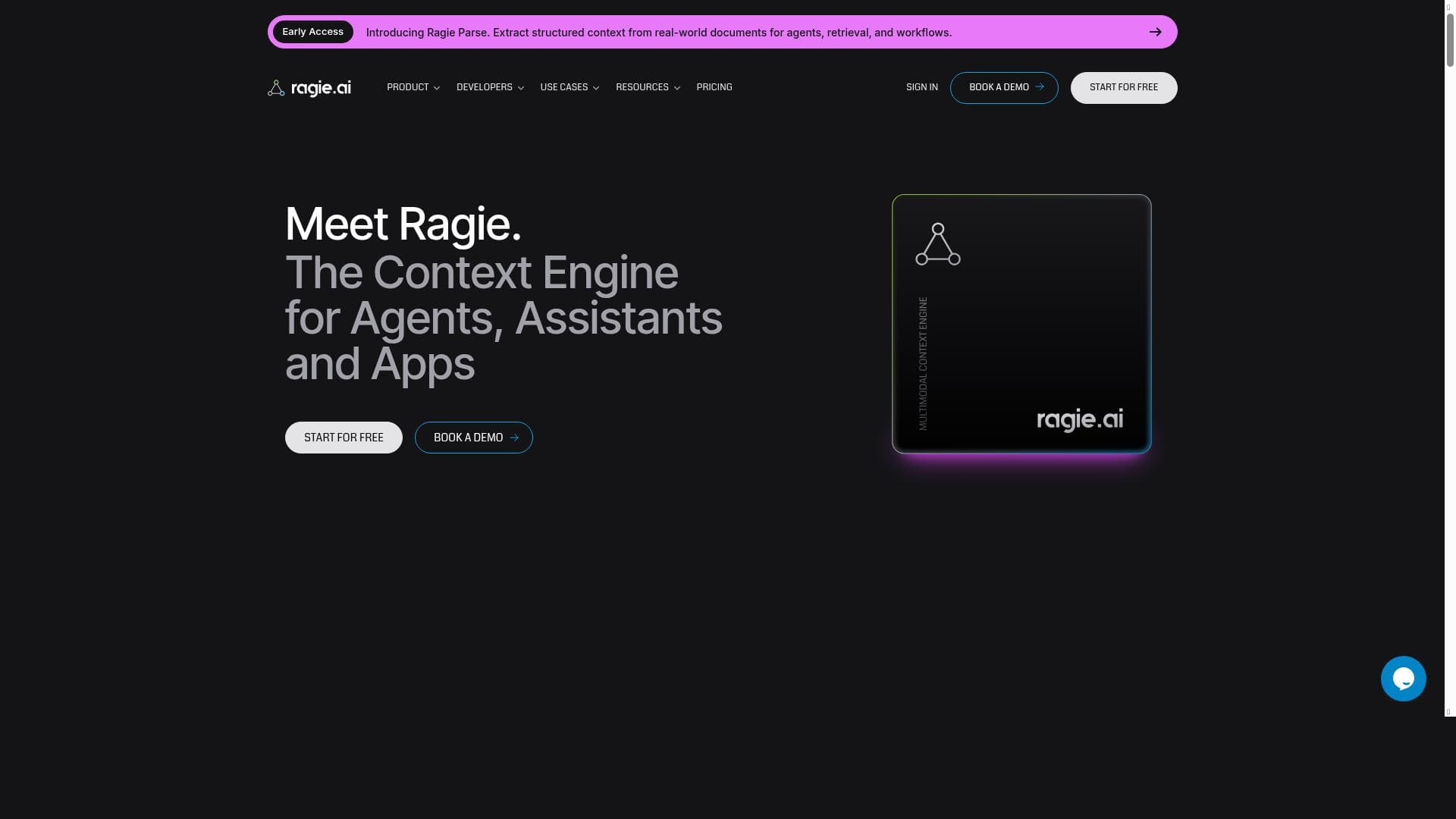
Ragie is a fully managed RAG-as-a-Service platform that empowers developers to build advanced generative AI applications with real-time indexing, retrieval with citations, and seamless integrations to popular data sources like Google Drive and Notion. Ideal for developers seeking a scalable, easy-to-use solution to deliver trustworthy, context-aware AI experiences, Ragie combines powerful features with a free developer tier to accelerate innovation.

Description
Ragie is a fully managed RAG-as-a-Service built for developers, offering easy-to-use APIs/SDKs, instant connectivity to Google Drive/Notion/and more, and advanced features like summary index and hybrid search to help your app deliver state-of-the art GenAI.
Detailed Description
Ragie is a fully managed Retrieval-Augmented Generation (RAG) as a Service platform designed specifically for developers who want to integrate advanced generative AI capabilities into their applications with minimal overhead. At its core, Ragie enables applications to perform intelligent information retrieval combined with generative AI, allowing for more accurate, context-aware, and citation-backed responses. By providing easy-to-use APIs and SDKs, Ragie abstracts the complexity of building and maintaining RAG pipelines, making it accessible even for teams without deep expertise in AI infrastructure. The platform supports instant connectivity to popular data sources such as Google Drive and Notion, enabling seamless ingestion and indexing of documents and notes, which can then be queried in real time. One of Ragie's standout features is its fully managed nature, which means developers do not need to worry about infrastructure, scaling, or model updates. The platform offers real-time indexing, ensuring that any changes or additions to connected data sources are immediately reflected in search results and generative outputs. This is particularly valuable for applications requiring up-to-date information retrieval. Additionally, Ragie supports retrieval with citations, a critical feature for applications where source transparency and trustworthiness are paramount. This allows generated responses to be accompanied by references to the original documents, enhancing credibility and user confidence. Ragie also supports multimodal data, enabling developers to incorporate not just text but other data types into their retrieval and generation workflows. Advanced features such as summary indexing and hybrid search combine the strengths of vector-based semantic search with traditional keyword search, improving both precision and recall. This hybrid approach ensures that users receive the most relevant and contextually appropriate information, even from large and diverse data sets. The platform is ideal for developers building AI assistants, knowledge management tools, customer support bots, educational applications, and any software requiring sophisticated document understanding and conversational AI. Its easy integration with widely used productivity platforms like Google Drive and Notion makes it particularly attractive for teams looking to leverage existing organizational knowledge bases without complex data migration. Startups, SMBs, and enterprises alike can benefit from Ragie's scalable and developer-friendly environment. Regarding pricing, Ragie offers a freemium model which includes a free developer tier. This allows developers to experiment with the platform, build prototypes, and deploy small-scale applications without upfront costs. For larger-scale or production deployments, paid plans provide expanded quotas, enhanced performance, and additional enterprise features. This flexible pricing structure lowers the barrier to entry while supporting growth as application demands increase. Compared to alternatives, Ragie stands out due to its fully managed service approach combined with advanced features like real-time indexing and retrieval with citations. While some competitors require manual setup of RAG pipelines or lack seamless integrations with popular data sources, Ragie streamlines these processes, saving development time and operational effort. Its hybrid search capability also offers a more robust retrieval experience than platforms relying solely on vector similarity. However, potential users should consider that as a managed service, Ragie may have limitations in terms of customization compared to self-hosted RAG solutions. Organizations with highly specialized or proprietary AI models might find the platform less flexible. Additionally, while the free tier is generous, high-volume applications will require paid plans, which should be evaluated for cost-effectiveness based on usage patterns. In summary, Ragie provides a powerful, developer-centric platform for integrating state-of-the-art generative AI augmented by real-time, citation-backed retrieval. Its ease of use, robust feature set, and seamless integrations make it an excellent choice for teams seeking to build intelligent, trustworthy AI applications quickly and efficiently.
Tool Features
- Fully managed RAG-as-a-Service platform
- Real-time indexing
- Retrieval with citations
- Multimodal support
- Free developer tier
Description
Ragie is a fully managed RAG-as-a-Service platform that empowers developers to build advanced generative AI applications with real-time indexing, retrieval with citations, and seamless integrations to popular data sources like Google Drive and Notion. Ideal for developers seeking a scalable, easy-to-use solution to deliver trustworthy, context-aware AI experiences, Ragie combines powerful features with a free developer tier to accelerate innovation.
Ragie is a fully managed RAG-as-a-Service built for developers, offering easy-to-use APIs/SDKs, instant connectivity to Google Drive/Notion/and more, and advanced features like summary index and hybrid search to help your app deliver state-of-the art GenAI.
Detailed Description
Ragie is a fully managed Retrieval-Augmented Generation (RAG) as a Service platform designed specifically for developers who want to integrate advanced generative AI capabilities into their applications with minimal overhead. At its core, Ragie enables applications to perform intelligent information retrieval combined with generative AI, allowing for more accurate, context-aware, and citation-backed responses. By providing easy-to-use APIs and SDKs, Ragie abstracts the complexity of building and maintaining RAG pipelines, making it accessible even for teams without deep expertise in AI infrastructure. The platform supports instant connectivity to popular data sources such as Google Drive and Notion, enabling seamless ingestion and indexing of documents and notes, which can then be queried in real time. One of Ragie's standout features is its fully managed nature, which means developers do not need to worry about infrastructure, scaling, or model updates. The platform offers real-time indexing, ensuring that any changes or additions to connected data sources are immediately reflected in search results and generative outputs. This is particularly valuable for applications requiring up-to-date information retrieval. Additionally, Ragie supports retrieval with citations, a critical feature for applications where source transparency and trustworthiness are paramount. This allows generated responses to be accompanied by references to the original documents, enhancing credibility and user confidence. Ragie also supports multimodal data, enabling developers to incorporate not just text but other data types into their retrieval and generation workflows. Advanced features such as summary indexing and hybrid search combine the strengths of vector-based semantic search with traditional keyword search, improving both precision and recall. This hybrid approach ensures that users receive the most relevant and contextually appropriate information, even from large and diverse data sets. The platform is ideal for developers building AI assistants, knowledge management tools, customer support bots, educational applications, and any software requiring sophisticated document understanding and conversational AI. Its easy integration with widely used productivity platforms like Google Drive and Notion makes it particularly attractive for teams looking to leverage existing organizational knowledge bases without complex data migration. Startups, SMBs, and enterprises alike can benefit from Ragie's scalable and developer-friendly environment. Regarding pricing, Ragie offers a freemium model which includes a free developer tier. This allows developers to experiment with the platform, build prototypes, and deploy small-scale applications without upfront costs. For larger-scale or production deployments, paid plans provide expanded quotas, enhanced performance, and additional enterprise features. This flexible pricing structure lowers the barrier to entry while supporting growth as application demands increase. Compared to alternatives, Ragie stands out due to its fully managed service approach combined with advanced features like real-time indexing and retrieval with citations. While some competitors require manual setup of RAG pipelines or lack seamless integrations with popular data sources, Ragie streamlines these processes, saving development time and operational effort. Its hybrid search capability also offers a more robust retrieval experience than platforms relying solely on vector similarity. However, potential users should consider that as a managed service, Ragie may have limitations in terms of customization compared to self-hosted RAG solutions. Organizations with highly specialized or proprietary AI models might find the platform less flexible. Additionally, while the free tier is generous, high-volume applications will require paid plans, which should be evaluated for cost-effectiveness based on usage patterns. In summary, Ragie provides a powerful, developer-centric platform for integrating state-of-the-art generative AI augmented by real-time, citation-backed retrieval. Its ease of use, robust feature set, and seamless integrations make it an excellent choice for teams seeking to build intelligent, trustworthy AI applications quickly and efficiently.
Frequently Asked Questions
What is Ragie?
Ragie is a fully managed Retrieval-Augmented Generation (RAG) as a Service platform designed to help developers easily integrate advanced generative AI capabilities with real-time document retrieval and citation support.
How much does Ragie cost?
Ragie offers a freemium pricing model with a free developer tier for experimentation and small projects, while paid plans provide higher usage limits and additional features for larger-scale or production applications.
Who is Ragie best for?
Ragie is best suited for developers and teams building AI assistants, knowledge management systems, customer support bots, and other applications that require real-time, citation-backed generative AI integrated with popular data sources.
What are the main features of Ragie?
Key features include a fully managed RAG platform, real-time indexing of connected data sources, retrieval with citations for trustworthy responses, multimodal data support, hybrid search combining vector and keyword methods, and easy integration with platforms like Google Drive and Notion.
Does Ragie offer a free trial?
Yes, Ragie provides a free developer tier that allows users to try out the platform and build applications without upfront costs.
What integrations does Ragie support?
Ragie supports instant connectivity to popular productivity and knowledge platforms such as Google Drive and Notion, enabling seamless ingestion and indexing of documents and notes.
How does Ragie work?
Ragie works by connecting to your data sources, indexing documents in real time, and enabling your applications to query this indexed data using APIs or SDKs. It combines retrieval techniques with generative AI to produce contextually relevant, citation-backed responses.
Socials
Use ToolReviews
No reviews yet. Be the first to share your experience.
Sponsored Tools























Recommended Tools
Stay updated on latest Ai tools
Get the latest insights, Join our newsletter
Read and trusted by 50,000+ readers
Join the biggest AI Community
Our community and staff are here to help!
Your feedback will help Alice AI improve in future versions.








Submit your Tool


PoweredByAI.app is an AI Tools Directory helping individuals, businesses, and creators discover the best AI tools for writing, coding, design, productivity, and more.
© 2026 , Product of011BQ. All rights reserved.