🚀 Zaprep: Your Socials on Steroids. Start free — automate 1,000 DMs/month & turn engagement into leads. with 1,000 automated DMs/month.





Is this your AI tool? Claim it today.
Verify ownership, manage your profile, and unlock growth features.
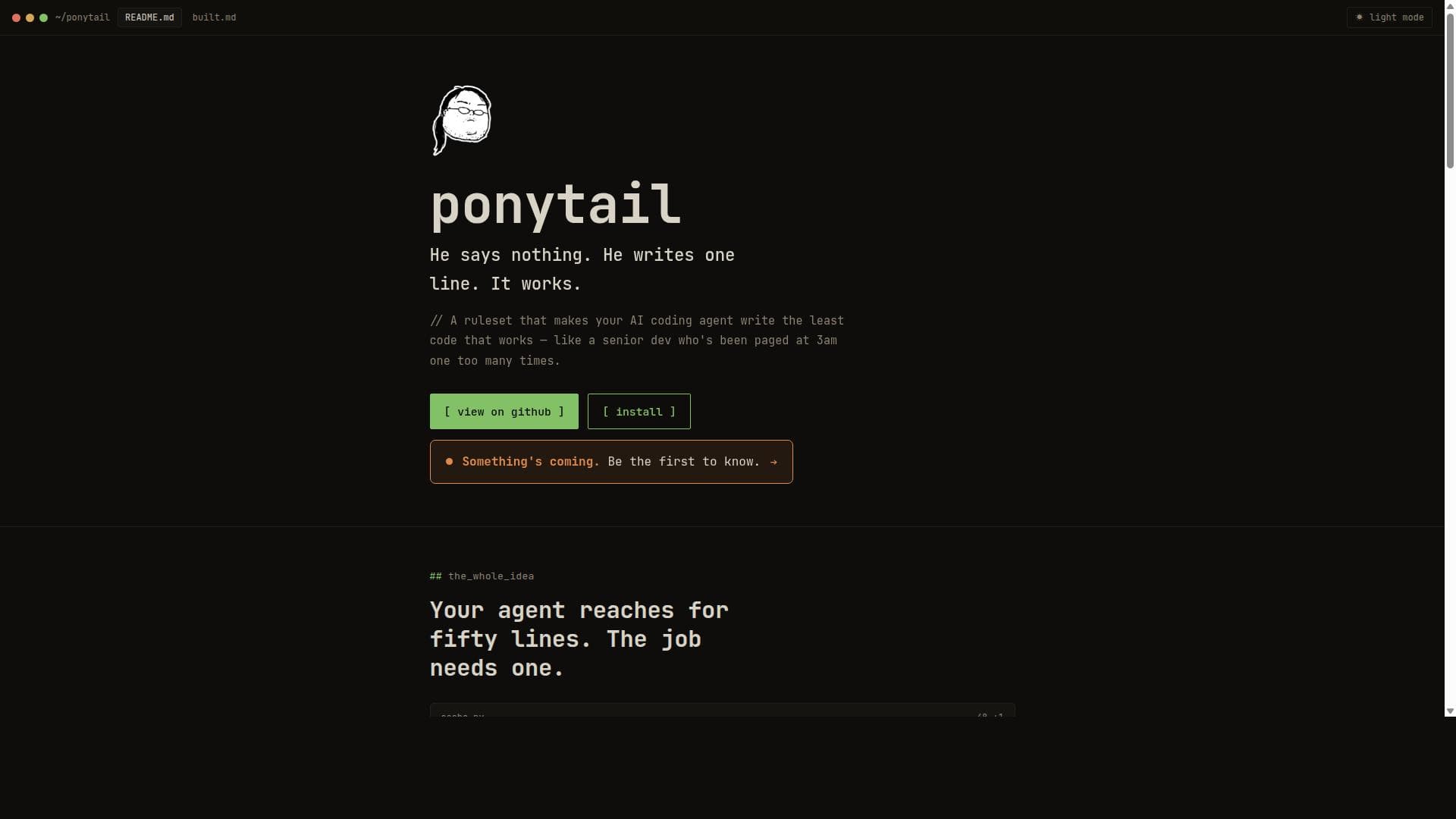
Ponytail is a ruleset that empowers AI coding agents to write the minimal amount of code needed to work effectively, cutting code length by 54% while maintaining safety. Ideal for developers leveraging AI for code generation, it emphasizes standard libraries and native solutions over dependencies, producing clean, efficient, and maintainable code.

Description
Ponytail is a plugin that makes coding agents write the least code that works. Before adding anything, it checks whether the change is needed, already exists, or can use the stdlib or a native API. Same behavior, fewer lines to own.
Detailed Description
Ponytail is an innovative ruleset designed to optimize the way AI coding agents generate code by encouraging them to write the minimal amount of code necessary to achieve effective functionality. Its core purpose is to reduce code bloat and complexity by emphasizing the use of standard libraries and native solutions over custom implementations and external dependencies. This approach not only streamlines codebases but also enhances maintainability and safety. By guiding AI agents to prefer one line of code that works over verbose multi-line solutions, Ponytail achieves a remarkable reduction in code length—up to 54% less code—without compromising on safety or reliability. The key features of Ponytail revolve around its strict coding philosophy. First, it prioritizes the use of standard libraries (stdlib) rather than reinventing the wheel with custom code. This ensures that the code leverages well-tested, widely supported functions that are efficient and secure. Second, it favors native solutions over third-party dependencies, reducing the risk of introducing vulnerabilities or compatibility issues that often come with external packages. Third, Ponytail encourages AI agents to write concise code, often condensing what might traditionally be many lines into a single, elegant line that accomplishes the same task. This minimalistic approach not only makes the code easier to read and maintain but also improves performance by reducing overhead. Ponytail is particularly well-suited for developers and organizations that rely heavily on AI coding agents for software development, especially those focused on automation, rapid prototyping, or AI-assisted coding workflows. It benefits senior developers who want their AI tools to produce clean, efficient code that aligns with best practices and reduces technical debt. Use cases include AI-powered code generation in integrated development environments (IDEs), automated refactoring tools, and AI agents embedded in continuous integration pipelines to optimize code quality and size. By integrating Ponytail, teams can ensure that the AI-generated code is not only functional but also minimal and safe, facilitating easier debugging and faster deployment. Regarding pricing and plans, the publicly available information does not specify any direct costs or subscription models for Ponytail, as it is primarily a ruleset or guideline for AI coding agents rather than a standalone commercial software product. Users interested in implementing Ponytail’s principles would typically integrate it into their AI coding workflows or tools. For precise pricing details or enterprise offerings, visiting the official website or contacting the developers directly would be advisable. When compared to alternative approaches, Ponytail stands out by focusing on code minimalism and safety simultaneously. Many AI code generation tools prioritize functionality or creativity but may produce verbose or dependency-heavy code. Ponytail’s strict preference for standard libraries and native solutions reduces complexity and external risks, which is a significant advantage over tools that encourage extensive use of third-party packages. Its emphasis on writing the least code that works effectively is unique and aligns well with best practices in software engineering, making it a valuable complement to existing AI coding agents. However, some limitations or considerations include the potential trade-off between minimal code and readability in certain complex scenarios. While one-liners are elegant, they can sometimes be harder to understand or maintain for human developers unfamiliar with the style. Additionally, Ponytail’s strict avoidance of dependencies might limit the use of specialized libraries that could offer optimized or domain-specific functionality. Users need to balance the benefits of minimalism with the practical needs of their projects. Furthermore, as a ruleset rather than a full-fledged software product, Ponytail requires integration and adaptation within existing AI coding frameworks, which may involve some setup effort. In summary, Ponytail offers a compelling approach to AI-assisted coding by enforcing a minimalist, safe, and dependency-light coding style. It is ideal for teams and developers seeking to harness AI coding agents to produce clean, efficient, and maintainable code. While it may require thoughtful application to balance minimalism with clarity, its benefits in reducing code size and complexity make it a valuable tool in the evolving landscape of AI-driven software development.
Tool Features
- Reduces code length by 54% while maintaining safety
- Prefers standard libraries over custom implementations
- Uses native solutions instead of dependencies
- Encourages writing one line of code instead of many
- Helps AI coding agents produce minimal and effective code
Description
Ponytail is a ruleset that empowers AI coding agents to write the minimal amount of code needed to work effectively, cutting code length by 54% while maintaining safety. Ideal for developers leveraging AI for code generation, it emphasizes standard libraries and native solutions over dependencies, producing clean, efficient, and maintainable code.
Ponytail is a plugin that makes coding agents write the least code that works. Before adding anything, it checks whether the change is needed, already exists, or can use the stdlib or a native API. Same behavior, fewer lines to own.
Detailed Description
Ponytail is an innovative ruleset designed to optimize the way AI coding agents generate code by encouraging them to write the minimal amount of code necessary to achieve effective functionality. Its core purpose is to reduce code bloat and complexity by emphasizing the use of standard libraries and native solutions over custom implementations and external dependencies. This approach not only streamlines codebases but also enhances maintainability and safety. By guiding AI agents to prefer one line of code that works over verbose multi-line solutions, Ponytail achieves a remarkable reduction in code length—up to 54% less code—without compromising on safety or reliability. The key features of Ponytail revolve around its strict coding philosophy. First, it prioritizes the use of standard libraries (stdlib) rather than reinventing the wheel with custom code. This ensures that the code leverages well-tested, widely supported functions that are efficient and secure. Second, it favors native solutions over third-party dependencies, reducing the risk of introducing vulnerabilities or compatibility issues that often come with external packages. Third, Ponytail encourages AI agents to write concise code, often condensing what might traditionally be many lines into a single, elegant line that accomplishes the same task. This minimalistic approach not only makes the code easier to read and maintain but also improves performance by reducing overhead. Ponytail is particularly well-suited for developers and organizations that rely heavily on AI coding agents for software development, especially those focused on automation, rapid prototyping, or AI-assisted coding workflows. It benefits senior developers who want their AI tools to produce clean, efficient code that aligns with best practices and reduces technical debt. Use cases include AI-powered code generation in integrated development environments (IDEs), automated refactoring tools, and AI agents embedded in continuous integration pipelines to optimize code quality and size. By integrating Ponytail, teams can ensure that the AI-generated code is not only functional but also minimal and safe, facilitating easier debugging and faster deployment. Regarding pricing and plans, the publicly available information does not specify any direct costs or subscription models for Ponytail, as it is primarily a ruleset or guideline for AI coding agents rather than a standalone commercial software product. Users interested in implementing Ponytail’s principles would typically integrate it into their AI coding workflows or tools. For precise pricing details or enterprise offerings, visiting the official website or contacting the developers directly would be advisable. When compared to alternative approaches, Ponytail stands out by focusing on code minimalism and safety simultaneously. Many AI code generation tools prioritize functionality or creativity but may produce verbose or dependency-heavy code. Ponytail’s strict preference for standard libraries and native solutions reduces complexity and external risks, which is a significant advantage over tools that encourage extensive use of third-party packages. Its emphasis on writing the least code that works effectively is unique and aligns well with best practices in software engineering, making it a valuable complement to existing AI coding agents. However, some limitations or considerations include the potential trade-off between minimal code and readability in certain complex scenarios. While one-liners are elegant, they can sometimes be harder to understand or maintain for human developers unfamiliar with the style. Additionally, Ponytail’s strict avoidance of dependencies might limit the use of specialized libraries that could offer optimized or domain-specific functionality. Users need to balance the benefits of minimalism with the practical needs of their projects. Furthermore, as a ruleset rather than a full-fledged software product, Ponytail requires integration and adaptation within existing AI coding frameworks, which may involve some setup effort. In summary, Ponytail offers a compelling approach to AI-assisted coding by enforcing a minimalist, safe, and dependency-light coding style. It is ideal for teams and developers seeking to harness AI coding agents to produce clean, efficient, and maintainable code. While it may require thoughtful application to balance minimalism with clarity, its benefits in reducing code size and complexity make it a valuable tool in the evolving landscape of AI-driven software development.
Frequently Asked Questions
What is ponytail?
Ponytail is a ruleset designed to guide AI coding agents to write the least amount of code necessary to achieve effective functionality. It emphasizes using standard libraries over custom code, native solutions over dependencies, and encourages minimal lines of code to maintain safety and efficiency.
How much does ponytail cost?
Ponytail is primarily a coding philosophy or ruleset rather than a standalone commercial product, so there is no publicly available pricing information. Implementation typically involves integrating its principles into existing AI coding workflows.
Who is ponytail best for?
Ponytail is best suited for developers, senior engineers, and organizations that use AI coding agents for software development and want to ensure the generated code is minimal, safe, and maintainable. It is particularly useful for teams focused on clean code, reducing dependencies, and optimizing AI-assisted coding.
What are the main features of ponytail?
The main features include reducing code length by 54% while maintaining safety, prioritizing standard libraries over custom implementations, favoring native solutions instead of dependencies, encouraging writing concise one-liners over verbose code, and helping AI coding agents produce minimal and effective code.
Does ponytail offer a free trial?
Since Ponytail is a ruleset rather than a software product, it does not offer a traditional free trial. Users can explore its principles and integrate them into their AI coding agents without cost.
What integrations does ponytail support?
Ponytail is a set of coding guidelines for AI agents and does not have direct integrations. It can be applied within AI coding frameworks or tools that support customizable coding rules or prompts.
How does ponytail work?
Ponytail works by instructing AI coding agents to prefer minimal, effective code solutions that rely on standard libraries and native functions rather than custom code or external dependencies. This approach reduces code size and complexity while ensuring safety and functionality.
Socials
Use ToolReviews
No reviews yet. Be the first to share your experience.
Sponsored Tools




























Recommended Tools
Stay updated on latest Ai tools
Get the latest insights, Join our newsletter
Read and trusted by 50,000+ readers
Join the biggest AI Community
Our community and staff are here to help!
Your feedback will help Alice AI improve in future versions.








Submit your Tool


PoweredByAI.app is an AI Tools Directory helping individuals, businesses, and creators discover the best AI tools for writing, coding, design, productivity, and more.
© 2026 , Product of011BQ. All rights reserved.