🚀 Zaprep: Your Socials on Steroids. Start free — automate 1,000 DMs/month & turn engagement into leads. with 1,000 automated DMs/month.
PMB | Local-first memory for AI


Is this your AI tool? Claim it today.
Verify ownership, manage your profile, and unlock growth features.
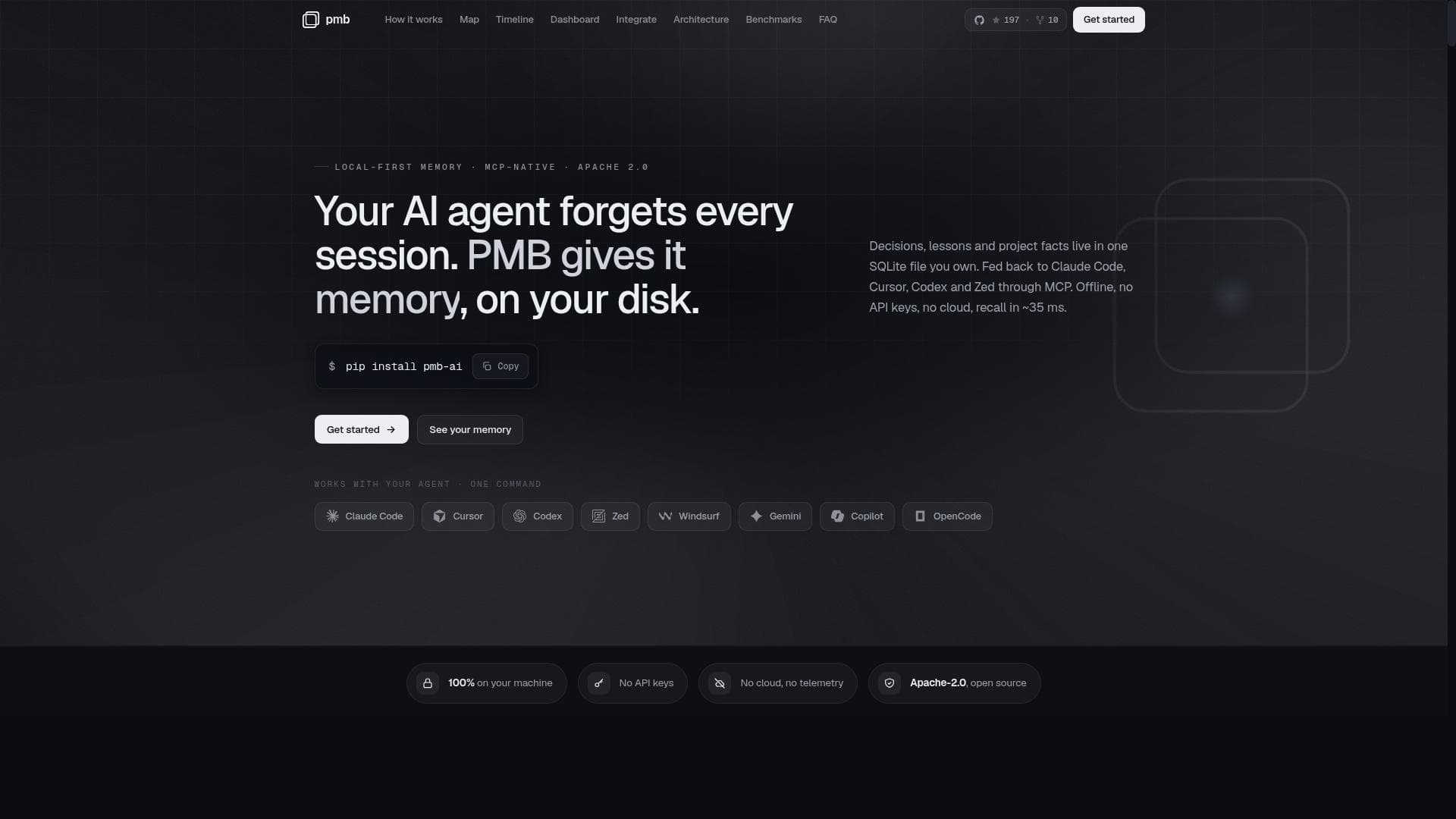
PMB delivers a unique local-first memory solution that empowers AI coding agents like Claude Code and Codex to remember decisions and project facts offline, stored securely in a single SQLite file on your disk. Ideal for developers valuing privacy and speed, PMB enhances AI continuity without any cloud dependency or API keys.

Description
PMB gives Claude Code, Cursor, Codex and Zed persistent project memory through MCP. It stores decisions, lessons, goals, recent work, project facts and docs in one SQLite workspace on your disk. No cloud, no API keys, no LLM call on the read path. It is open source, offline-first, inspectable/exportable, with a local dashboard and honest impact tracking so you can see which memories actually help.
Detailed Description
PMB is a specialized local-first memory solution designed to enhance the capabilities of AI coding agents such as Claude Code, Cursor, Codex, and Zed. Its core purpose is to provide these AI agents with persistent memory by storing decisions, lessons, and project facts in a single SQLite file located on the user's disk. This approach allows AI agents to recall important information quickly and efficiently across sessions without relying on cloud services or API keys, thereby ensuring privacy, security, and offline accessibility. One of the standout features of PMB is its local-first architecture. Unlike many AI memory solutions that depend on cloud storage or external APIs, PMB keeps all data on the user's device in a lightweight SQLite database. This design eliminates the need for internet connectivity and third-party service dependencies, making it ideal for developers working in secure or restricted environments. The memory recall speed is impressively fast, with retrieval times averaging around 35 milliseconds, which ensures minimal latency during AI interactions. PMB is compatible with several popular AI coding agents, including Claude Code, Cursor, Codex, and Zed. This compatibility is facilitated through the Memory-Centric Protocol (MCP), which allows seamless integration and communication between the AI agents and the local memory store. By feeding back stored knowledge such as past decisions, lessons learned, and project-specific facts, PMB significantly improves the continuity and contextual understanding of AI agents, enabling them to perform better and more consistently over time. Installation and setup are straightforward, with PMB available as an open-source package under the Apache 2.0 license. Users can easily install it via pip, making it accessible to a wide range of developers and organizations. The open-source nature encourages community contributions, transparency, and customization, which can be particularly valuable for teams looking to tailor the memory solution to their specific workflows. PMB is best suited for developers, AI researchers, and organizations that utilize AI coding assistants and require persistent, fast, and private memory capabilities. It is especially beneficial for those who need offline functionality or operate in environments where cloud services are not viable due to security or compliance reasons. Use cases include software development projects where AI agents assist with coding tasks, decision tracking, and knowledge retention across multiple sessions, thereby reducing repetitive queries and improving productivity. Regarding pricing, PMB is open-source and free to use, which makes it an attractive option for individuals and organizations looking to integrate AI memory without incurring additional costs. There are no subscription plans or usage fees, but users should consider the cost of local storage and maintenance as part of their infrastructure. Compared to alternative AI memory solutions that rely heavily on cloud infrastructure, PMB stands out by offering a truly local-first approach. This reduces latency, enhances privacy, and removes dependencies on external services. While some cloud-based solutions may offer more extensive scalability or integrated analytics, PMB’s simplicity, speed, and offline capabilities make it a compelling choice for many developers. However, there are some considerations to keep in mind. Since PMB stores data locally, users must manage backups and data security themselves. Additionally, the memory capacity is limited by local storage constraints and the performance characteristics of SQLite. For extremely large datasets or distributed teams requiring shared memory, cloud-based solutions might still be preferable. Lastly, while PMB supports several AI coding agents, integration with other AI platforms may require additional development effort. In summary, PMB is a powerful, efficient, and privacy-conscious memory solution that empowers AI coding agents with persistent knowledge stored locally. Its fast recall times, offline functionality, and open-source availability make it an excellent tool for developers seeking to enhance AI-assisted coding workflows without relying on cloud services.
Tool Features
- Local-first memory stored in one SQLite file on your disk
- Works offline with no API keys or cloud required
- Compatible with AI coding agents like Claude Code, Cursor, Codex, and Zed
- Enables AI agents to recall decisions, lessons, and project facts
- Fast recall time of approximately 35 milliseconds
- Open source under Apache 2.0 license
- Easy installation via pip
Description
PMB delivers a unique local-first memory solution that empowers AI coding agents like Claude Code and Codex to remember decisions and project facts offline, stored securely in a single SQLite file on your disk. Ideal for developers valuing privacy and speed, PMB enhances AI continuity without any cloud dependency or API keys.
PMB gives Claude Code, Cursor, Codex and Zed persistent project memory through MCP. It stores decisions, lessons, goals, recent work, project facts and docs in one SQLite workspace on your disk. No cloud, no API keys, no LLM call on the read path. It is open source, offline-first, inspectable/exportable, with a local dashboard and honest impact tracking so you can see which memories actually help.
Detailed Description
PMB is a specialized local-first memory solution designed to enhance the capabilities of AI coding agents such as Claude Code, Cursor, Codex, and Zed. Its core purpose is to provide these AI agents with persistent memory by storing decisions, lessons, and project facts in a single SQLite file located on the user's disk. This approach allows AI agents to recall important information quickly and efficiently across sessions without relying on cloud services or API keys, thereby ensuring privacy, security, and offline accessibility. One of the standout features of PMB is its local-first architecture. Unlike many AI memory solutions that depend on cloud storage or external APIs, PMB keeps all data on the user's device in a lightweight SQLite database. This design eliminates the need for internet connectivity and third-party service dependencies, making it ideal for developers working in secure or restricted environments. The memory recall speed is impressively fast, with retrieval times averaging around 35 milliseconds, which ensures minimal latency during AI interactions. PMB is compatible with several popular AI coding agents, including Claude Code, Cursor, Codex, and Zed. This compatibility is facilitated through the Memory-Centric Protocol (MCP), which allows seamless integration and communication between the AI agents and the local memory store. By feeding back stored knowledge such as past decisions, lessons learned, and project-specific facts, PMB significantly improves the continuity and contextual understanding of AI agents, enabling them to perform better and more consistently over time. Installation and setup are straightforward, with PMB available as an open-source package under the Apache 2.0 license. Users can easily install it via pip, making it accessible to a wide range of developers and organizations. The open-source nature encourages community contributions, transparency, and customization, which can be particularly valuable for teams looking to tailor the memory solution to their specific workflows. PMB is best suited for developers, AI researchers, and organizations that utilize AI coding assistants and require persistent, fast, and private memory capabilities. It is especially beneficial for those who need offline functionality or operate in environments where cloud services are not viable due to security or compliance reasons. Use cases include software development projects where AI agents assist with coding tasks, decision tracking, and knowledge retention across multiple sessions, thereby reducing repetitive queries and improving productivity. Regarding pricing, PMB is open-source and free to use, which makes it an attractive option for individuals and organizations looking to integrate AI memory without incurring additional costs. There are no subscription plans or usage fees, but users should consider the cost of local storage and maintenance as part of their infrastructure. Compared to alternative AI memory solutions that rely heavily on cloud infrastructure, PMB stands out by offering a truly local-first approach. This reduces latency, enhances privacy, and removes dependencies on external services. While some cloud-based solutions may offer more extensive scalability or integrated analytics, PMB’s simplicity, speed, and offline capabilities make it a compelling choice for many developers. However, there are some considerations to keep in mind. Since PMB stores data locally, users must manage backups and data security themselves. Additionally, the memory capacity is limited by local storage constraints and the performance characteristics of SQLite. For extremely large datasets or distributed teams requiring shared memory, cloud-based solutions might still be preferable. Lastly, while PMB supports several AI coding agents, integration with other AI platforms may require additional development effort. In summary, PMB is a powerful, efficient, and privacy-conscious memory solution that empowers AI coding agents with persistent knowledge stored locally. Its fast recall times, offline functionality, and open-source availability make it an excellent tool for developers seeking to enhance AI-assisted coding workflows without relying on cloud services.
Frequently Asked Questions
What is PMB?
PMB is a local-first memory solution designed for AI coding agents such as Claude Code, Cursor, Codex, and Zed. It stores decisions, lessons, and project facts in a single SQLite file on your local disk, enabling AI agents to recall information quickly and efficiently across sessions without relying on cloud services or API keys.
How much does PMB cost?
PMB is an open-source tool licensed under Apache 2.0 and is free to use. There are no subscription fees or pricing plans associated with it.
Who is PMB best for?
PMB is best suited for developers, AI researchers, and organizations that use AI coding assistants and require persistent, fast, and private memory capabilities. It is particularly beneficial for those needing offline functionality or working in secure environments where cloud services are restricted.
What are the main features of PMB?
Key features of PMB include local-first memory stored in a single SQLite file, offline operation with no need for API keys or cloud services, compatibility with AI coding agents like Claude Code, Cursor, Codex, and Zed, fast recall times of approximately 35 milliseconds, and open-source availability under the Apache 2.0 license.
Does PMB offer a free trial?
Since PMB is an open-source and free-to-use tool, there is no need for a free trial. Users can install and use it immediately without any cost.
What integrations does PMB support?
PMB supports integration with AI coding agents such as Claude Code, Cursor, Codex, and Zed through the Memory-Centric Protocol (MCP), enabling these agents to access and update the local memory store seamlessly.
How does PMB work?
PMB works by storing an AI agent's memory—decisions, lessons, and project facts—in a single SQLite file on the user's local disk. AI agents access this memory via the Memory-Centric Protocol (MCP), allowing them to recall information quickly and maintain continuity across sessions without relying on cloud services or API keys.
Socials
Use ToolReviews
No reviews yet. Be the first to share your experience.
Sponsored Tools
























Recommended Tools
Stay updated on latest Ai tools
Get the latest insights, Join our newsletter
Read and trusted by 50,000+ readers
Join the biggest AI Community
Our community and staff are here to help!
Your feedback will help Alice AI improve in future versions.








Submit your Tool

PoweredByAI.app is an AI Tools Directory helping individuals, businesses, and creators discover the best AI tools for writing, coding, design, productivity, and more.
© 2026 , Product of011BQ. All rights reserved.