

Is this your AI tool? Claim it today.
Verify ownership, manage your profile, and unlock growth features.
OpenTag revolutionizes task tagging by routing requests across eighty AI models, delivering up to 70% cost savings without token-based pricing. Ideal for teams using Slack or Microsoft Teams, it offers a seamless, flexible, and affordable tagging solution that adapts to diverse needs.

Description
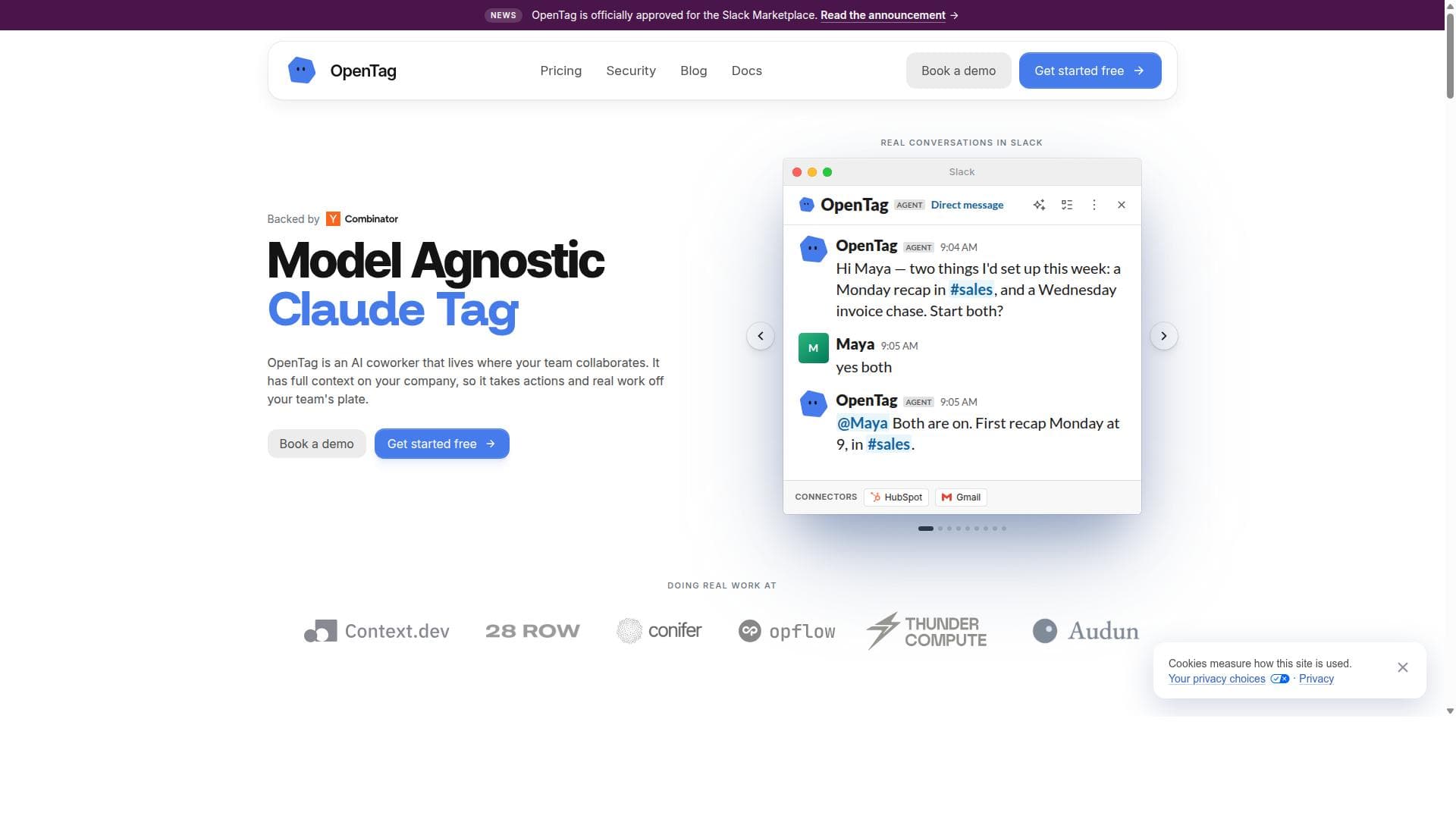
OpenTag is an AI coworker that lives where your team collaborates. It has full context on your company, so it takes actions and real work off your team's plate.
Detailed Description
OpenTag is an innovative AI tool designed to optimize and streamline the process of task tagging by leveraging a model-agnostic Claude Tag platform. Its core purpose is to route tagging tasks intelligently across a diverse ecosystem of eighty different AI models, enabling users to achieve significant cost savings—up to 70%—compared to traditional tagging solutions. By abstracting the complexity of model selection and management, OpenTag empowers organizations to efficiently handle tagging workflows without being locked into a single AI provider or incurring excessive expenses. This flexibility is especially valuable in environments where tagging accuracy, speed, and cost-efficiency are critical. One of OpenTag's standout features is its model-agnostic routing capability. Instead of relying on a single AI model, it dynamically directs tagging tasks to the most appropriate model among its extensive pool of eighty options. This approach not only optimizes performance but also ensures cost-effectiveness by selecting models that balance quality and price. Furthermore, OpenTag integrates seamlessly with popular collaboration platforms such as Slack and Microsoft Teams, allowing users to tag content directly within their existing communication workflows. This integration reduces friction and enhances productivity by eliminating the need to switch between multiple tools. Another key aspect of OpenTag is its transparent and user-friendly business model. Unlike many AI platforms that operate on token selling or usage-based pricing, OpenTag does not engage in selling tokens. This means users can focus on their tagging tasks without worrying about complex token economies or hidden fees. The platform's pricing structure is designed to provide clear cost savings and predictable expenses, making it accessible for teams of various sizes and industries. OpenTag is particularly well-suited for enterprises, data annotation teams, and AI developers who require scalable, cost-efficient tagging solutions. Use cases include content moderation, dataset labeling for machine learning training, customer support ticket categorization, and any scenario where accurate tagging is essential for downstream AI or analytics applications. Its ability to integrate with Slack and Microsoft Teams also makes it ideal for organizations that prioritize collaboration and want to embed AI capabilities directly into their communication channels. While OpenTag offers compelling advantages, potential users should consider that its effectiveness depends on the quality and suitability of the underlying models it routes tasks to. Organizations with highly specialized or niche tagging requirements may need to evaluate whether the available models meet their specific standards. Additionally, as the platform routes tasks across many models, there may be variability in response times or output consistency depending on the model selected. In comparison to alternatives, OpenTag's model-agnostic approach and deep integration with collaboration tools set it apart. Many competitors offer single-model tagging or require users to manage multiple AI subscriptions independently. OpenTag simplifies this by centralizing model access and automating routing decisions, delivering both operational simplicity and cost benefits. Its no-token-selling policy also contrasts with platforms that complicate billing through token-based pricing, providing a more straightforward user experience. Overall, OpenTag is a powerful solution for organizations seeking to enhance their tagging workflows with AI while controlling costs and maintaining flexibility. Its extensive model network, seamless integrations, and transparent pricing make it a valuable tool for a wide range of industries and use cases, from data annotation to customer service and beyond.
Tool Features
- Model-agnostic routing to eighty models
- Up to 70% cost savings on tagged tasks
- Integration with Slack and Microsoft Teams
- No token selling business model
Description
OpenTag revolutionizes task tagging by routing requests across eighty AI models, delivering up to 70% cost savings without token-based pricing. Ideal for teams using Slack or Microsoft Teams, it offers a seamless, flexible, and affordable tagging solution that adapts to diverse needs.
OpenTag is an AI coworker that lives where your team collaborates. It has full context on your company, so it takes actions and real work off your team's plate.
Detailed Description
OpenTag is an innovative AI tool designed to optimize and streamline the process of task tagging by leveraging a model-agnostic Claude Tag platform. Its core purpose is to route tagging tasks intelligently across a diverse ecosystem of eighty different AI models, enabling users to achieve significant cost savings—up to 70%—compared to traditional tagging solutions. By abstracting the complexity of model selection and management, OpenTag empowers organizations to efficiently handle tagging workflows without being locked into a single AI provider or incurring excessive expenses. This flexibility is especially valuable in environments where tagging accuracy, speed, and cost-efficiency are critical. One of OpenTag's standout features is its model-agnostic routing capability. Instead of relying on a single AI model, it dynamically directs tagging tasks to the most appropriate model among its extensive pool of eighty options. This approach not only optimizes performance but also ensures cost-effectiveness by selecting models that balance quality and price. Furthermore, OpenTag integrates seamlessly with popular collaboration platforms such as Slack and Microsoft Teams, allowing users to tag content directly within their existing communication workflows. This integration reduces friction and enhances productivity by eliminating the need to switch between multiple tools. Another key aspect of OpenTag is its transparent and user-friendly business model. Unlike many AI platforms that operate on token selling or usage-based pricing, OpenTag does not engage in selling tokens. This means users can focus on their tagging tasks without worrying about complex token economies or hidden fees. The platform's pricing structure is designed to provide clear cost savings and predictable expenses, making it accessible for teams of various sizes and industries. OpenTag is particularly well-suited for enterprises, data annotation teams, and AI developers who require scalable, cost-efficient tagging solutions. Use cases include content moderation, dataset labeling for machine learning training, customer support ticket categorization, and any scenario where accurate tagging is essential for downstream AI or analytics applications. Its ability to integrate with Slack and Microsoft Teams also makes it ideal for organizations that prioritize collaboration and want to embed AI capabilities directly into their communication channels. While OpenTag offers compelling advantages, potential users should consider that its effectiveness depends on the quality and suitability of the underlying models it routes tasks to. Organizations with highly specialized or niche tagging requirements may need to evaluate whether the available models meet their specific standards. Additionally, as the platform routes tasks across many models, there may be variability in response times or output consistency depending on the model selected. In comparison to alternatives, OpenTag's model-agnostic approach and deep integration with collaboration tools set it apart. Many competitors offer single-model tagging or require users to manage multiple AI subscriptions independently. OpenTag simplifies this by centralizing model access and automating routing decisions, delivering both operational simplicity and cost benefits. Its no-token-selling policy also contrasts with platforms that complicate billing through token-based pricing, providing a more straightforward user experience. Overall, OpenTag is a powerful solution for organizations seeking to enhance their tagging workflows with AI while controlling costs and maintaining flexibility. Its extensive model network, seamless integrations, and transparent pricing make it a valuable tool for a wide range of industries and use cases, from data annotation to customer service and beyond.
Frequently Asked Questions
What is OpenTag?
OpenTag is a model-agnostic Claude Tag platform that routes tagging tasks to eighty different AI models, optimizing for cost and performance. It integrates with Slack and Microsoft Teams to provide a seamless tagging experience without relying on token selling.
How much does OpenTag cost?
OpenTag offers up to 70% cost savings on tagged tasks compared to traditional solutions. While specific pricing details are not publicly listed, the platform emphasizes transparent, predictable costs without token-based billing.
Who is OpenTag best for?
OpenTag is best suited for enterprises, data annotation teams, AI developers, and organizations that require scalable, cost-efficient tagging workflows integrated within collaboration platforms like Slack and Microsoft Teams.
What are the main features of OpenTag?
Key features include model-agnostic routing to eighty AI models, integration with Slack and Microsoft Teams, up to 70% cost savings on tagging tasks, and a business model that avoids token selling.
Does OpenTag offer a free trial?
The available information does not specify whether OpenTag offers a free trial. Interested users should visit the official website or contact the OpenTag team for details on trial availability.
What integrations does OpenTag support?
OpenTag integrates directly with Slack and Microsoft Teams, enabling users to tag content within these collaboration platforms without switching tools.
How does OpenTag work?
OpenTag routes tagging tasks across a network of eighty different AI models, selecting the most suitable model for each task to optimize cost and performance. Users interact with the platform primarily through Slack or Microsoft Teams, where tagging is embedded into their existing workflows.
Socials
Use ToolReviews
No reviews yet. Be the first to share your experience.