

Is this your AI tool? Claim it today.
Verify ownership, manage your profile, and unlock growth features.
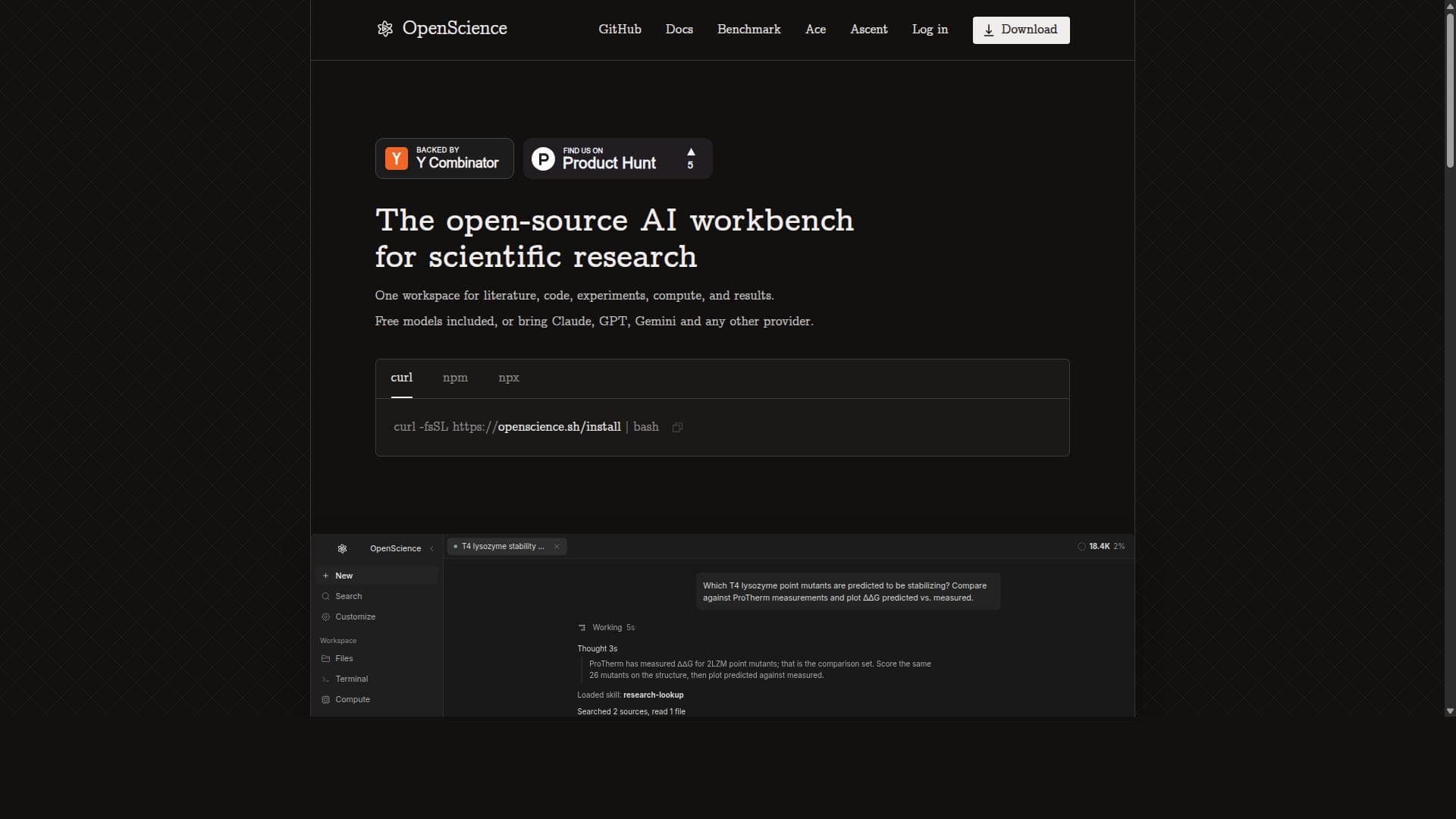
OpenScience is a unique open-source AI workbench that unifies literature, code, experiments, compute, and results into a single local workspace, designed specifically for scientific research. It offers free AI models and seamless integration with leading providers like Claude, GPT, and Gemini, making it ideal for researchers aiming to streamline and accelerate their workflows.

Description
OpenScience is an open-source AI agent for scientific research. It reads papers, writes and runs code, works in notebooks and a terminal, and sends long jobs to Modal, your own servers, or a Slurm/PBS cluster. Give it a metric and Autoresearch runs experiments, logs every one, and keeps hill-climbing. Use 30+ models through one wallet, sign in with ChatGPT, or run a local model. It ranks #1 on agentic scientific research benchmarks. Free and open source.
Detailed Description
OpenScience is an innovative open-source AI workbench specifically designed to streamline and enhance scientific research workflows. Its core purpose is to provide researchers with a unified, local workspace that integrates all essential components of scientific investigation — including literature review, coding, experiment management, computational resources, and results documentation. By consolidating these elements into a single platform, OpenScience enables scientists to work more efficiently and collaboratively, reducing the friction typically encountered when juggling multiple disconnected tools. The platform’s open-source nature also encourages transparency, customization, and community-driven development, making it a flexible solution adaptable to diverse research needs. One of the standout features of OpenScience is its comprehensive unified workspace. This workspace allows users to seamlessly access and manage scientific literature alongside their codebases and experimental data, fostering a more holistic approach to research. Users can run experiments, execute computations, and document findings all within the same environment. OpenScience includes a selection of free AI models out of the box, empowering researchers to leverage artificial intelligence for tasks such as data analysis, hypothesis generation, and writing assistance. Moreover, it supports integration with any AI model from any provider, including leading models like Claude, GPT, and Gemini. This extensibility ensures that researchers can incorporate the latest AI advancements and tailor the platform to their specific scientific domains. OpenScience is designed to be cross-platform, supporting macOS, Linux, and Windows, which broadens its accessibility to researchers regardless of their operating system preferences. Installation is straightforward, with command line options available via curl, npm, and npx, catering to both novice users and those comfortable with terminal-based setups. The local workspace environment ensures that sensitive research data remains secure and under the user’s control, an important consideration for many scientific projects. This tool is ideal for academic researchers, data scientists, and R&D professionals who require an integrated environment to manage complex scientific workflows. Use cases include literature synthesis, experimental design and tracking, computational modeling, AI-assisted data interpretation, and collaborative project management. OpenScience’s ability to unify these disparate tasks into one platform can significantly reduce the time spent switching contexts and managing files, thereby accelerating the pace of discovery. OpenScience is freely accessible under an open-source license, with no cost to users. This makes it an attractive alternative to proprietary research platforms that often come with expensive subscription fees or restrictive usage terms. Compared to other research tools that may focus narrowly on literature management or coding environments alone, OpenScience’s holistic approach sets it apart by addressing the full research lifecycle. Its open-source foundation also contrasts with closed-source AI solutions, offering greater transparency and the potential for community-driven enhancements. However, as an open-source project, OpenScience may require some technical proficiency to fully leverage its capabilities, especially when integrating external AI models or customizing the environment. While it supports a broad range of AI providers, the quality and performance of integrated models depend on the user’s configuration and access to those services. Additionally, since it operates as a local workspace, users must ensure their own hardware and computational resources meet the demands of their research tasks. In summary, OpenScience is a powerful, flexible, and cost-effective AI workbench tailored for scientific research. Its unified workspace, extensive AI model support, and cross-platform availability make it a compelling choice for researchers seeking to modernize and streamline their workflows. By combining literature, code, experiments, compute, and results in one open-source platform, OpenScience empowers scientists to focus on innovation and discovery with enhanced efficiency and collaboration.
Tool Features
- Unified workspace for literature, code, experiments, compute, and results
- Includes free AI models and supports any model from any provider
- Open-source with local workspace environment
- Cross-platform support for macOS, Linux, and Windows
- Integration with Claude, GPT, Gemini, and more
- Command line installation options via curl, npm, and npx
Description
OpenScience is a unique open-source AI workbench that unifies literature, code, experiments, compute, and results into a single local workspace, designed specifically for scientific research. It offers free AI models and seamless integration with leading providers like Claude, GPT, and Gemini, making it ideal for researchers aiming to streamline and accelerate their workflows.
OpenScience is an open-source AI agent for scientific research. It reads papers, writes and runs code, works in notebooks and a terminal, and sends long jobs to Modal, your own servers, or a Slurm/PBS cluster. Give it a metric and Autoresearch runs experiments, logs every one, and keeps hill-climbing. Use 30+ models through one wallet, sign in with ChatGPT, or run a local model. It ranks #1 on agentic scientific research benchmarks. Free and open source.
Detailed Description
OpenScience is an innovative open-source AI workbench specifically designed to streamline and enhance scientific research workflows. Its core purpose is to provide researchers with a unified, local workspace that integrates all essential components of scientific investigation — including literature review, coding, experiment management, computational resources, and results documentation. By consolidating these elements into a single platform, OpenScience enables scientists to work more efficiently and collaboratively, reducing the friction typically encountered when juggling multiple disconnected tools. The platform’s open-source nature also encourages transparency, customization, and community-driven development, making it a flexible solution adaptable to diverse research needs. One of the standout features of OpenScience is its comprehensive unified workspace. This workspace allows users to seamlessly access and manage scientific literature alongside their codebases and experimental data, fostering a more holistic approach to research. Users can run experiments, execute computations, and document findings all within the same environment. OpenScience includes a selection of free AI models out of the box, empowering researchers to leverage artificial intelligence for tasks such as data analysis, hypothesis generation, and writing assistance. Moreover, it supports integration with any AI model from any provider, including leading models like Claude, GPT, and Gemini. This extensibility ensures that researchers can incorporate the latest AI advancements and tailor the platform to their specific scientific domains. OpenScience is designed to be cross-platform, supporting macOS, Linux, and Windows, which broadens its accessibility to researchers regardless of their operating system preferences. Installation is straightforward, with command line options available via curl, npm, and npx, catering to both novice users and those comfortable with terminal-based setups. The local workspace environment ensures that sensitive research data remains secure and under the user’s control, an important consideration for many scientific projects. This tool is ideal for academic researchers, data scientists, and R&D professionals who require an integrated environment to manage complex scientific workflows. Use cases include literature synthesis, experimental design and tracking, computational modeling, AI-assisted data interpretation, and collaborative project management. OpenScience’s ability to unify these disparate tasks into one platform can significantly reduce the time spent switching contexts and managing files, thereby accelerating the pace of discovery. OpenScience is freely accessible under an open-source license, with no cost to users. This makes it an attractive alternative to proprietary research platforms that often come with expensive subscription fees or restrictive usage terms. Compared to other research tools that may focus narrowly on literature management or coding environments alone, OpenScience’s holistic approach sets it apart by addressing the full research lifecycle. Its open-source foundation also contrasts with closed-source AI solutions, offering greater transparency and the potential for community-driven enhancements. However, as an open-source project, OpenScience may require some technical proficiency to fully leverage its capabilities, especially when integrating external AI models or customizing the environment. While it supports a broad range of AI providers, the quality and performance of integrated models depend on the user’s configuration and access to those services. Additionally, since it operates as a local workspace, users must ensure their own hardware and computational resources meet the demands of their research tasks. In summary, OpenScience is a powerful, flexible, and cost-effective AI workbench tailored for scientific research. Its unified workspace, extensive AI model support, and cross-platform availability make it a compelling choice for researchers seeking to modernize and streamline their workflows. By combining literature, code, experiments, compute, and results in one open-source platform, OpenScience empowers scientists to focus on innovation and discovery with enhanced efficiency and collaboration.
Frequently Asked Questions
What is OpenScience?
OpenScience is an open-source AI workbench designed to provide a unified workspace for scientific research, integrating literature, code, experiments, computational resources, and results into one local environment.
How much does OpenScience cost?
OpenScience is completely free to use under an open-source license, with no subscription fees or hidden costs.
Who is OpenScience best for?
OpenScience is best suited for academic researchers, data scientists, and R&D professionals who need an integrated platform to manage complex scientific workflows efficiently.
What are the main features of OpenScience?
Key features include a unified workspace for literature, code, experiments, compute, and results; free built-in AI models; support for any AI model from any provider such as Claude, GPT, and Gemini; cross-platform compatibility (macOS, Linux, Windows); and command line installation options via curl, npm, and npx.
Does OpenScience offer a free trial?
Since OpenScience is open-source and free to use, there is no need for a trial period; users can download and use the full platform at no cost.
What integrations does OpenScience support?
OpenScience supports integration with AI models from any provider, including popular models like Claude, GPT, and Gemini, allowing users to connect and utilize a wide range of AI capabilities.
How does OpenScience work?
OpenScience operates as a local workspace where researchers can manage literature, write and run code, conduct experiments, perform computations, and document results all in one place. It includes free AI models and allows users to connect external AI services to enhance their scientific workflows.
Socials
Use ToolReviews
No reviews yet. Be the first to share your experience.