🚀 Zaprep: Your Socials on Steroids. Start free — automate 1,000 DMs/month & turn engagement into leads. with 1,000 automated DMs/month.


Is this your AI tool? Claim it today.
Verify ownership, manage your profile, and unlock growth features.
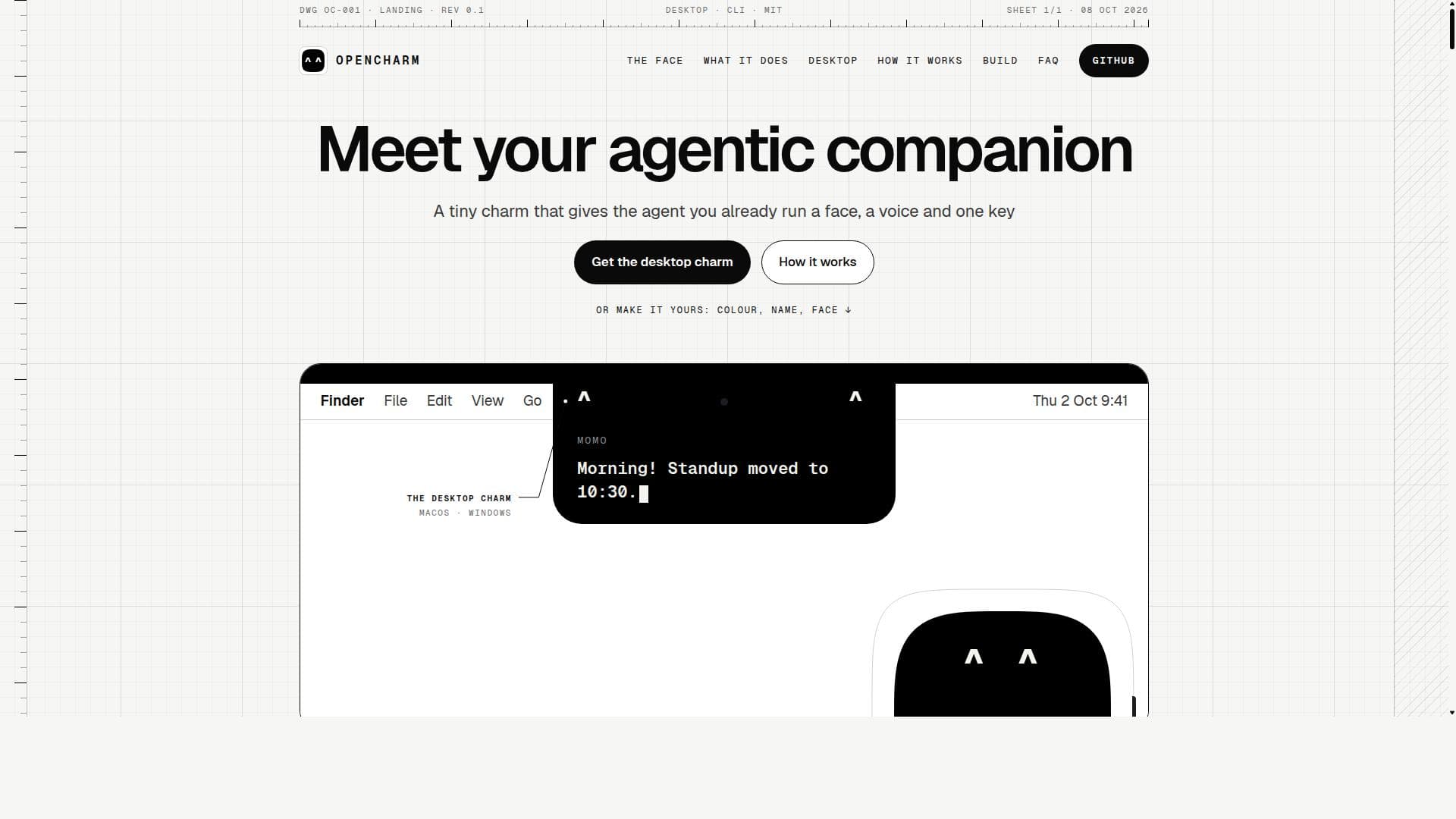
OpenCharm transforms your existing AI agents into personable desktop companions by providing them with a face, voice, and even a physical hardware presence. Ideal for developers and AI enthusiasts, it uniquely blends open-source software with hardware to create a more engaging and interactive AI experience on Mac, Windows, or a custom-built board.

Description
OpenCharm is an open-source body for the AI agent you already run, right by your Mac's notch. Hold one key to talk and Claude Code, Codex or any agent gets to work, answers out loud and asks when it needs you. Next, it hangs from your keychain.
Detailed Description
OpenCharm is an innovative open-source platform designed to provide a tangible, interactive body for AI agents that users already operate, such as Claude Code, Codex, Hermes Agent, OpenClaw, or any agent compliant with the Agent Client Protocol (ACP). Its core purpose is to enhance the AI agent experience by giving it a face, a voice, and a physical presence, either as a small application overlay on the top of Mac or Windows screens or as a hardware device that users can build themselves. This unique approach transforms abstract AI agents into personable desktop companions, making interactions more engaging and natural. At its heart, OpenCharm offers a customizable face and voice interface that acts as the AI agent's visible and audible representation. The software runs seamlessly on both Mac and Windows platforms, appearing unobtrusively at the top of the screen, similar to a notch or a status bar widget. Beyond the software interface, OpenCharm supports integration with open-source hardware, specifically enabling users to build a small companion board based on the ESP32-S3 microcontroller. This hardware option allows the AI agent to have a dedicated physical form factor, complete with a screen and a single key, making it a versatile desktop companion that can respond to voice commands and provide visual feedback. Key features of OpenCharm include its open-source nature, which encourages community contributions and customization, compatibility with a broad range of AI agents, and its dual-mode operation as both a software overlay and a hardware device. The face provided by OpenCharm is minimalist yet expressive, designed to convey the AI's state and personality through simple visual cues. The voice assistant functionality integrates natural language processing capabilities, enabling users to interact with their AI agents through speech, enhancing accessibility and ease of use. The single key on the hardware board acts as a multifunctional control, simplifying user input and interaction. OpenCharm is particularly well-suited for developers, AI enthusiasts, and hobbyists who want to personalize their AI agent interactions beyond traditional text-based interfaces. It serves as an excellent tool for those running Claude Code, Codex, Hermes Agent, OpenClaw, or any ACP-compatible agent, providing a more humanized and approachable interface. Use cases include desktop productivity enhancement, voice-controlled AI assistance, and experimental AI-human interaction projects. The hardware component appeals to makers and hardware developers interested in integrating AI agents with physical devices. Regarding pricing, OpenCharm is fully open-source and available for free, encouraging adoption and experimentation without financial barriers. Users can download the software from the official website and access all features without subscription fees. Building the hardware board requires purchasing the ESP32-S3 microcontroller and related components, which are affordable and widely available, making the hardware option accessible to most users. When compared to alternatives, OpenCharm stands out by combining software and hardware to provide a physical embodiment for AI agents, a feature not commonly found in other AI companion tools. While many AI assistants focus solely on voice or text interfaces, OpenCharm's approach of adding a face, voice, and a physical key creates a more immersive and interactive experience. Its open-source model also contrasts with proprietary AI companions, offering greater flexibility and community-driven innovation. However, there are some considerations to keep in mind. Since OpenCharm is open-source and community-driven, users may encounter varying levels of support and documentation compared to commercial products. The hardware assembly requires some technical skills and familiarity with microcontrollers, which might be a barrier for non-technical users. Additionally, the tool's functionality depends on the AI agents it connects to, so the overall experience can vary based on the capabilities and integration quality of those agents. In summary, OpenCharm offers a unique blend of software and hardware to humanize AI agents, making them more accessible and engaging. Its open-source foundation, compatibility with multiple AI agents, and support for physical embodiment make it an excellent choice for developers and enthusiasts looking to deepen their interaction with AI technology.
Tool Features
- Open-source body for AI agents
- Compatible with Claude Code, Codex, Hermes Agent, OpenClaw, or any ACP agent
- Provides a face and voice for AI agents
- Works on Mac and Windows screens
- Supports building a small hardware board (ESP32-S3)
- Acts as a desktop companion
- Integrates voice assistant functionality
Description
OpenCharm transforms your existing AI agents into personable desktop companions by providing them with a face, voice, and even a physical hardware presence. Ideal for developers and AI enthusiasts, it uniquely blends open-source software with hardware to create a more engaging and interactive AI experience on Mac, Windows, or a custom-built board.
OpenCharm is an open-source body for the AI agent you already run, right by your Mac's notch. Hold one key to talk and Claude Code, Codex or any agent gets to work, answers out loud and asks when it needs you. Next, it hangs from your keychain.
Detailed Description
OpenCharm is an innovative open-source platform designed to provide a tangible, interactive body for AI agents that users already operate, such as Claude Code, Codex, Hermes Agent, OpenClaw, or any agent compliant with the Agent Client Protocol (ACP). Its core purpose is to enhance the AI agent experience by giving it a face, a voice, and a physical presence, either as a small application overlay on the top of Mac or Windows screens or as a hardware device that users can build themselves. This unique approach transforms abstract AI agents into personable desktop companions, making interactions more engaging and natural. At its heart, OpenCharm offers a customizable face and voice interface that acts as the AI agent's visible and audible representation. The software runs seamlessly on both Mac and Windows platforms, appearing unobtrusively at the top of the screen, similar to a notch or a status bar widget. Beyond the software interface, OpenCharm supports integration with open-source hardware, specifically enabling users to build a small companion board based on the ESP32-S3 microcontroller. This hardware option allows the AI agent to have a dedicated physical form factor, complete with a screen and a single key, making it a versatile desktop companion that can respond to voice commands and provide visual feedback. Key features of OpenCharm include its open-source nature, which encourages community contributions and customization, compatibility with a broad range of AI agents, and its dual-mode operation as both a software overlay and a hardware device. The face provided by OpenCharm is minimalist yet expressive, designed to convey the AI's state and personality through simple visual cues. The voice assistant functionality integrates natural language processing capabilities, enabling users to interact with their AI agents through speech, enhancing accessibility and ease of use. The single key on the hardware board acts as a multifunctional control, simplifying user input and interaction. OpenCharm is particularly well-suited for developers, AI enthusiasts, and hobbyists who want to personalize their AI agent interactions beyond traditional text-based interfaces. It serves as an excellent tool for those running Claude Code, Codex, Hermes Agent, OpenClaw, or any ACP-compatible agent, providing a more humanized and approachable interface. Use cases include desktop productivity enhancement, voice-controlled AI assistance, and experimental AI-human interaction projects. The hardware component appeals to makers and hardware developers interested in integrating AI agents with physical devices. Regarding pricing, OpenCharm is fully open-source and available for free, encouraging adoption and experimentation without financial barriers. Users can download the software from the official website and access all features without subscription fees. Building the hardware board requires purchasing the ESP32-S3 microcontroller and related components, which are affordable and widely available, making the hardware option accessible to most users. When compared to alternatives, OpenCharm stands out by combining software and hardware to provide a physical embodiment for AI agents, a feature not commonly found in other AI companion tools. While many AI assistants focus solely on voice or text interfaces, OpenCharm's approach of adding a face, voice, and a physical key creates a more immersive and interactive experience. Its open-source model also contrasts with proprietary AI companions, offering greater flexibility and community-driven innovation. However, there are some considerations to keep in mind. Since OpenCharm is open-source and community-driven, users may encounter varying levels of support and documentation compared to commercial products. The hardware assembly requires some technical skills and familiarity with microcontrollers, which might be a barrier for non-technical users. Additionally, the tool's functionality depends on the AI agents it connects to, so the overall experience can vary based on the capabilities and integration quality of those agents. In summary, OpenCharm offers a unique blend of software and hardware to humanize AI agents, making them more accessible and engaging. Its open-source foundation, compatibility with multiple AI agents, and support for physical embodiment make it an excellent choice for developers and enthusiasts looking to deepen their interaction with AI technology.
Frequently Asked Questions
What is OpenCharm?
OpenCharm is an open-source platform that provides a face, voice, and physical presence for AI agents you already use, such as Claude Code, Codex, Hermes Agent, OpenClaw, or any ACP-compatible agent. It acts as a desktop companion on Mac or Windows and supports building a small hardware board for a tangible AI interface.
How much does OpenCharm cost?
OpenCharm is completely free and open-source. There are no subscription fees or costs to use the software. Building the optional hardware board requires purchasing components like the ESP32-S3 microcontroller, which are affordable and widely available.
Who is OpenCharm best for?
OpenCharm is best suited for developers, AI enthusiasts, and hobbyists who want to enhance their AI agent interactions with a more humanized interface. It is ideal for users running Claude Code, Codex, Hermes Agent, OpenClaw, or any ACP agent, and for makers interested in integrating AI with open-source hardware.
What are the main features of OpenCharm?
Key features include an open-source body for AI agents, compatibility with multiple AI agents, a customizable face and voice interface, operation on Mac and Windows screens, support for building a hardware companion board with ESP32-S3, and integrated voice assistant capabilities.
Does OpenCharm offer a free trial?
Since OpenCharm is open-source and free to use, there is no need for a free trial. Users can download and use the software immediately without any cost.
What integrations does OpenCharm support?
OpenCharm supports integration with AI agents such as Claude Code, Codex, Hermes Agent, OpenClaw, and any agent that follows the Agent Client Protocol (ACP), allowing it to serve as a body and interface for a wide range of AI systems.
How does OpenCharm work?
OpenCharm works by connecting to your existing AI agent and providing it with a visual face and voice interface on your desktop, either as a software overlay on Mac or Windows or through a custom-built hardware board. It enables voice interactions and displays expressive visual cues, acting as a personable desktop companion.
Socials
Use ToolReviews
No reviews yet. Be the first to share your experience.
Sponsored Tools































Recommended Tools
Stay updated on latest Ai tools
Get the latest insights, Join our newsletter
Read and trusted by 50,000+ readers
Join the biggest AI Community
Our community and staff are here to help!
Your feedback will help Alice AI improve in future versions.








Submit your Tool


PoweredByAI.app is an AI Tools Directory helping individuals, businesses, and creators discover the best AI tools for writing, coding, design, productivity, and more.
© 2026 , Product of011BQ. All rights reserved.