









Is this your AI tool? Claim it today.
Verify ownership, manage your profile, and unlock growth features.
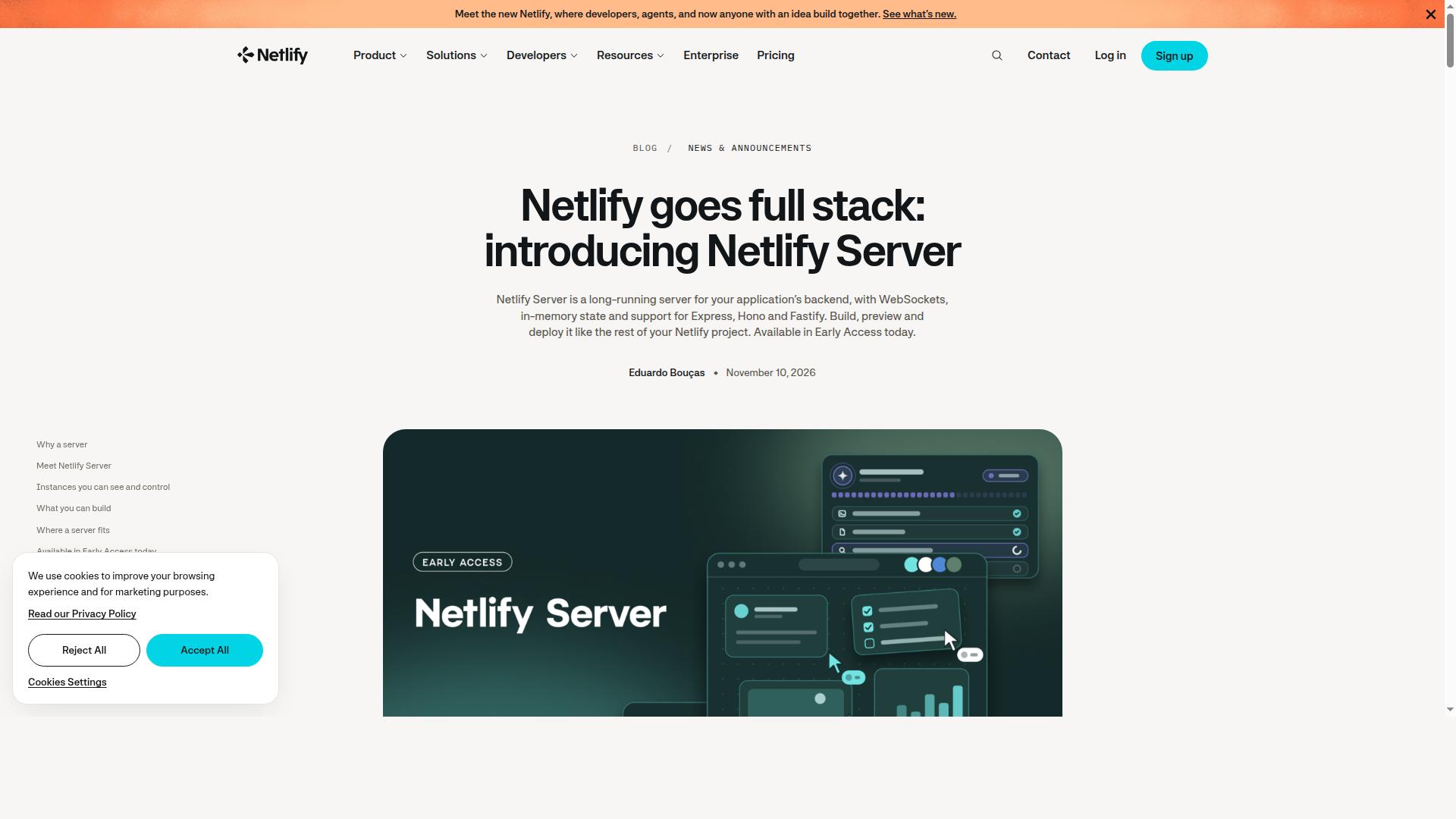
Netlify Server revolutionizes backend development by enabling long-running Node.js servers with WebSocket support and in-memory state, all deployable alongside your Netlify frontend projects. It's perfect for developers building real-time, interactive applications and AI-driven workflows who want seamless integration and scalable backend infrastructure.

Description
Netlify Server gives your app a backend that stays alive while people are using it. Build realtime experiences, multiplayer games, and AI agents that need time to finish. Describe what you want and an agent builds it, or bring your Express, Fastify, Hono, or Koa code. It holds WebSockets open, keeps state in memory, and deploys with the rest of your project, with its own server for every preview. Scales with demand and down to zero when idle. Free during early access.
Detailed Description
Netlify Server is an innovative platform designed to extend the capabilities of Netlify’s cloud infrastructure by enabling developers to run long-lived Node.js backend servers seamlessly alongside their frontend projects. Its core purpose is to provide a robust environment for backend applications that require persistent connections, real-time communication, and complex state management, all integrated within the familiar Netlify ecosystem. This approach bridges the gap between static site hosting and dynamic backend services, empowering developers to build full-stack applications with ease and scalability. At its heart, Netlify Server supports long-running Node.js processes, which is a significant advancement over traditional serverless functions that are typically short-lived and stateless. This capability allows developers to maintain persistent WebSocket connections, crucial for real-time applications such as chat apps, live dashboards, multiplayer games, and collaborative tools. Additionally, Netlify Server supports AI agents and in-memory state management, enabling sophisticated backend logic that can maintain context and state over time without relying exclusively on external databases or caches. This makes it ideal for applications that require quick, stateful interactions or AI-driven workflows. One of the standout features of Netlify Server is its seamless deployment model. Developers can deploy their backend servers alongside their frontend code within the same Netlify project, simplifying the development and deployment workflow. This unified deployment reduces operational overhead and accelerates development cycles by eliminating the need to manage separate backend hosting environments. Furthermore, Netlify Server’s support for WebSockets and real-time communication protocols ensures that applications can deliver low-latency, interactive user experiences. Netlify Server is best suited for developers and teams building modern web applications that demand real-time interactivity and persistent backend processes. This includes startups developing AI-powered chatbots or agents, SaaS companies requiring live data updates, and enterprises looking to integrate backend logic tightly with their frontend deployments. Use cases range from real-time collaboration platforms and IoT dashboards to AI-driven customer support systems and live content feeds. Regarding pricing, Netlify offers a free tier that includes basic hosting and serverless functions, making it accessible for individual developers and small projects to experiment with Netlify Server capabilities. For teams and enterprises, paid plans provide enhanced performance, scalability, and support options. Pricing details are available on the Netlify website, with flexible plans designed to accommodate various project sizes and requirements. Compared to traditional backend hosting solutions or serverless platforms, Netlify Server stands out by combining the benefits of persistent backend processes with the simplicity of Netlify’s deployment model. Unlike typical serverless functions that have execution time limits and lack persistent state, Netlify Server allows long-running processes and in-memory state, enabling more complex and interactive applications. While other platforms may require separate backend infrastructure management, Netlify Server integrates backend and frontend deployment, streamlining the development workflow. However, there are some considerations to keep in mind. As a relatively new offering, Netlify Server may have limitations in terms of ecosystem maturity and third-party integrations compared to more established backend platforms. Additionally, while it supports in-memory state, developers must architect their applications carefully to handle scaling and persistence needs, especially for large-scale or highly available systems. Understanding these trade-offs is important when deciding if Netlify Server fits the specific requirements of a project. In summary, Netlify Server is a powerful tool that redefines backend development within the Netlify platform by enabling long-running Node.js servers with real-time capabilities and AI agent support. It is ideal for developers seeking to build interactive, stateful web applications with minimal infrastructure complexity, offering a compelling alternative to traditional backend hosting and serverless architectures.
Tool Features
- Supports long-running Node.js backend servers
- Enables WebSockets for real-time communication
- Supports AI agents and in-memory state management
- Deploys seamlessly with Netlify projects
- Facilitates real-time applications
Description
Netlify Server revolutionizes backend development by enabling long-running Node.js servers with WebSocket support and in-memory state, all deployable alongside your Netlify frontend projects. It's perfect for developers building real-time, interactive applications and AI-driven workflows who want seamless integration and scalable backend infrastructure.
Netlify Server gives your app a backend that stays alive while people are using it. Build realtime experiences, multiplayer games, and AI agents that need time to finish. Describe what you want and an agent builds it, or bring your Express, Fastify, Hono, or Koa code. It holds WebSockets open, keeps state in memory, and deploys with the rest of your project, with its own server for every preview. Scales with demand and down to zero when idle. Free during early access.
Detailed Description
Netlify Server is an innovative platform designed to extend the capabilities of Netlify’s cloud infrastructure by enabling developers to run long-lived Node.js backend servers seamlessly alongside their frontend projects. Its core purpose is to provide a robust environment for backend applications that require persistent connections, real-time communication, and complex state management, all integrated within the familiar Netlify ecosystem. This approach bridges the gap between static site hosting and dynamic backend services, empowering developers to build full-stack applications with ease and scalability. At its heart, Netlify Server supports long-running Node.js processes, which is a significant advancement over traditional serverless functions that are typically short-lived and stateless. This capability allows developers to maintain persistent WebSocket connections, crucial for real-time applications such as chat apps, live dashboards, multiplayer games, and collaborative tools. Additionally, Netlify Server supports AI agents and in-memory state management, enabling sophisticated backend logic that can maintain context and state over time without relying exclusively on external databases or caches. This makes it ideal for applications that require quick, stateful interactions or AI-driven workflows. One of the standout features of Netlify Server is its seamless deployment model. Developers can deploy their backend servers alongside their frontend code within the same Netlify project, simplifying the development and deployment workflow. This unified deployment reduces operational overhead and accelerates development cycles by eliminating the need to manage separate backend hosting environments. Furthermore, Netlify Server’s support for WebSockets and real-time communication protocols ensures that applications can deliver low-latency, interactive user experiences. Netlify Server is best suited for developers and teams building modern web applications that demand real-time interactivity and persistent backend processes. This includes startups developing AI-powered chatbots or agents, SaaS companies requiring live data updates, and enterprises looking to integrate backend logic tightly with their frontend deployments. Use cases range from real-time collaboration platforms and IoT dashboards to AI-driven customer support systems and live content feeds. Regarding pricing, Netlify offers a free tier that includes basic hosting and serverless functions, making it accessible for individual developers and small projects to experiment with Netlify Server capabilities. For teams and enterprises, paid plans provide enhanced performance, scalability, and support options. Pricing details are available on the Netlify website, with flexible plans designed to accommodate various project sizes and requirements. Compared to traditional backend hosting solutions or serverless platforms, Netlify Server stands out by combining the benefits of persistent backend processes with the simplicity of Netlify’s deployment model. Unlike typical serverless functions that have execution time limits and lack persistent state, Netlify Server allows long-running processes and in-memory state, enabling more complex and interactive applications. While other platforms may require separate backend infrastructure management, Netlify Server integrates backend and frontend deployment, streamlining the development workflow. However, there are some considerations to keep in mind. As a relatively new offering, Netlify Server may have limitations in terms of ecosystem maturity and third-party integrations compared to more established backend platforms. Additionally, while it supports in-memory state, developers must architect their applications carefully to handle scaling and persistence needs, especially for large-scale or highly available systems. Understanding these trade-offs is important when deciding if Netlify Server fits the specific requirements of a project. In summary, Netlify Server is a powerful tool that redefines backend development within the Netlify platform by enabling long-running Node.js servers with real-time capabilities and AI agent support. It is ideal for developers seeking to build interactive, stateful web applications with minimal infrastructure complexity, offering a compelling alternative to traditional backend hosting and serverless architectures.
Frequently Asked Questions
What is Netlify Server?
Netlify Server is a platform that allows developers to run long-running Node.js backend servers within the Netlify ecosystem. It supports WebSockets, real-time applications, AI agents, and in-memory state management, enabling seamless deployment alongside frontend projects.
How much does Netlify Server cost?
Netlify Server is available with Netlify’s free tier for basic usage, suitable for individual developers and small projects. Paid plans with additional features, performance, and support are available for teams and enterprises. Detailed pricing can be found on the Netlify website.
Who is Netlify Server best for?
Netlify Server is ideal for developers and teams building modern web applications that require real-time communication, persistent backend processes, and AI-driven workflows. This includes startups, SaaS companies, and enterprises developing interactive apps like chat platforms, live dashboards, and AI agents.
What are the main features of Netlify Server?
Key features include support for long-running Node.js backend servers, WebSocket-enabled real-time communication, AI agent integration, in-memory state management, and seamless deployment alongside Netlify frontend projects.
Does Netlify Server offer a free trial?
Netlify Server capabilities are included within Netlify’s free tier, allowing developers to try out the platform without upfront costs. This enables experimentation with long-running backend servers and real-time features before committing to paid plans.
What integrations does Netlify Server support?
Netlify Server integrates tightly with the Netlify platform, allowing backend servers to be deployed alongside frontend code. It supports WebSockets and AI agents natively. Additional integrations depend on the Node.js ecosystem and can be added through standard Node.js packages.
How does Netlify Server work?
Netlify Server runs long-lived Node.js processes that can maintain persistent connections and state in memory. It supports WebSocket protocols for real-time communication and can host AI agents. These backend servers are deployed and managed within the same Netlify project as the frontend, simplifying development and scaling.
Socials

Reviews
No reviews yet. Be the first to share your experience.
Sponsored Tools

























Recommended Tools
Stay updated on latest Ai tools
Get the latest insights, Join our newsletter
Read and trusted by 50,000+ readers
Join the biggest AI Community
Our community and staff are here to help!
Your feedback will help Alice AI improve in future versions.





 , Product of