🚀 Zaprep: Your Socials on Steroids. Start free — automate 1,000 DMs/month & turn engagement into leads. with 1,000 automated DMs/month.


Is this your AI tool? Claim it today.
Verify ownership, manage your profile, and unlock growth features.
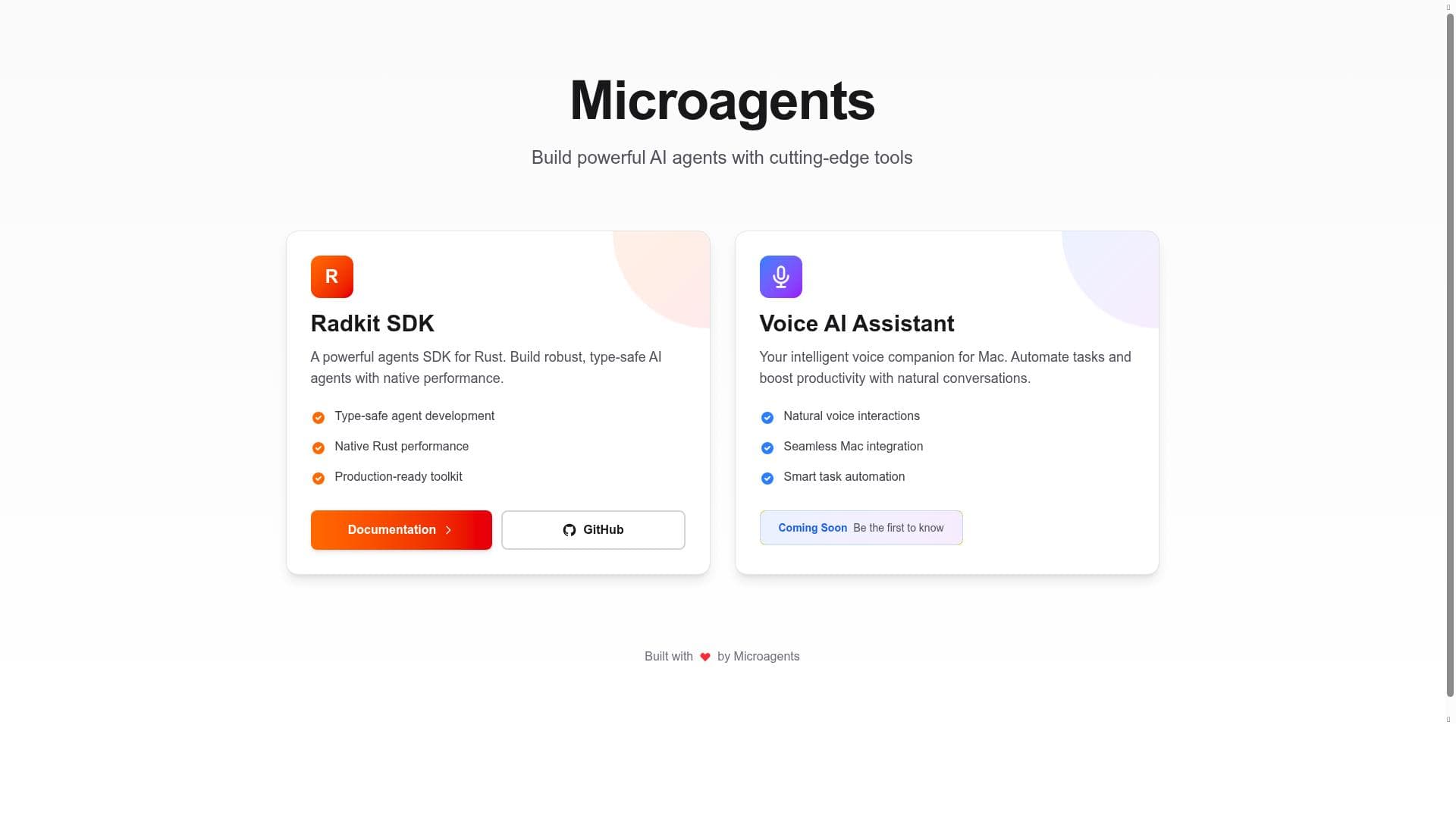
Microagents (Beta) lets you create a collaborative AI team by connecting your favorite tools like Gmail, Notion, and Slack, enabling them to solve problems together in real-time. Ideal for professionals and teams looking to automate complex workflows with type-safe, high-performance AI agents, it combines native Rust speed with natural voice commands and seamless Mac integration.

Description
Create your AI dream team in three simple steps: connect your tools (Gmail, Notion, Slack etc), group them together and tell what you want them to do. Watch them collaborate in real-time, solving problems while you focus on what matters.
Detailed Description
Microagents (Beta) is an innovative AI orchestration platform designed to empower users by creating a collaborative AI 'dream team' that automates complex workflows and problem-solving tasks. Its core purpose is to seamlessly integrate multiple tools and services such as Gmail, Notion, Slack, and more, allowing users to connect these disparate applications, group them logically, and assign tasks that the AI agents collaboratively execute in real-time. This approach frees users from manual coordination and repetitive tasks, enabling them to focus on higher-value activities while the AI agents handle the operational workload. Microagents leverages cutting-edge technology to deliver a robust, efficient, and user-friendly experience that bridges the gap between AI capabilities and practical productivity enhancements. At the heart of Microagents are several key features that distinguish it from other AI automation tools. Firstly, it offers type-safe agent development, ensuring that the AI agents operate with high reliability and minimal runtime errors by enforcing strict data types during development. This feature is particularly valuable for developers and technical users who require precision and robustness in their AI workflows. Secondly, Microagents is built with native Rust performance, which means it benefits from Rust's renowned speed, safety, and concurrency capabilities. This results in a highly responsive and efficient system capable of handling complex tasks without lag or instability. The platform also provides a production-ready toolkit, making it suitable for deployment in real-world environments where reliability and scalability are critical. Users can build, test, and deploy AI agents with confidence that the system can handle enterprise-grade demands. Additionally, Microagents supports natural voice interactions, enabling users to communicate with their AI teams through conversational commands, which enhances accessibility and ease of use. For Mac users, the platform offers seamless integration, ensuring that the AI agents work smoothly within the macOS ecosystem without compatibility issues. Smart task automation is another standout feature, allowing the AI agents to intelligently prioritize, sequence, and execute tasks across connected tools. This capability transforms how users manage workflows by automating multi-step processes that traditionally required manual intervention or complex scripting. Microagents is best suited for professionals, teams, and organizations that rely heavily on multiple digital tools and seek to optimize their workflows through AI-driven automation. Product managers, developers, knowledge workers, and customer support teams can particularly benefit from Microagents by reducing the friction between different platforms and automating routine tasks such as email management, note-taking, messaging, and project tracking. For example, a product manager can connect Gmail for communication, Notion for documentation, and Slack for team collaboration, then instruct the AI agents to monitor incoming requests, update project statuses, and notify relevant stakeholders automatically. Regarding pricing, Microagents operates on a freemium model, allowing users to start with a free tier that provides access to core functionalities and a limited number of AI agents. This approach lowers the barrier to entry and encourages experimentation. Paid plans likely offer expanded capabilities, increased agent limits, priority support, and additional integrations, although specific pricing details should be confirmed on their official website. Compared to alternatives, Microagents stands out due to its unique combination of type-safe development, Rust-powered performance, and real-time collaborative AI agent orchestration. While many AI automation tools focus on single integrations or simple task automation, Microagents emphasizes multi-agent collaboration and developer-friendly features that support complex, production-grade workflows. Its native Mac integration and voice interaction capabilities further enhance its appeal for users within the Apple ecosystem and those who prefer conversational interfaces. However, as a beta product, Microagents may have some limitations. Users might encounter occasional bugs or incomplete features as the platform evolves. The learning curve for type-safe agent development could be steeper for non-technical users compared to no-code automation tools. Additionally, the breadth of supported integrations might be limited initially, requiring users to verify compatibility with their specific tools. Prospective users should consider these factors and monitor updates from the Microagents team as the platform matures. In summary, Microagents (Beta) offers a powerful and flexible AI automation environment that enables users to build collaborative AI teams to streamline workflows across multiple tools. Its focus on performance, reliability, and natural interaction positions it as a compelling choice for professionals seeking advanced AI-driven productivity solutions.
Tool Features
- Type-safe agent development
- Native Rust performance
- Production-ready toolkit
- Natural voice interactions
- Seamless Mac integration
- Smart task automation
Description
Microagents (Beta) lets you create a collaborative AI team by connecting your favorite tools like Gmail, Notion, and Slack, enabling them to solve problems together in real-time. Ideal for professionals and teams looking to automate complex workflows with type-safe, high-performance AI agents, it combines native Rust speed with natural voice commands and seamless Mac integration.
Create your AI dream team in three simple steps: connect your tools (Gmail, Notion, Slack etc), group them together and tell what you want them to do. Watch them collaborate in real-time, solving problems while you focus on what matters.
Detailed Description
Microagents (Beta) is an innovative AI orchestration platform designed to empower users by creating a collaborative AI 'dream team' that automates complex workflows and problem-solving tasks. Its core purpose is to seamlessly integrate multiple tools and services such as Gmail, Notion, Slack, and more, allowing users to connect these disparate applications, group them logically, and assign tasks that the AI agents collaboratively execute in real-time. This approach frees users from manual coordination and repetitive tasks, enabling them to focus on higher-value activities while the AI agents handle the operational workload. Microagents leverages cutting-edge technology to deliver a robust, efficient, and user-friendly experience that bridges the gap between AI capabilities and practical productivity enhancements. At the heart of Microagents are several key features that distinguish it from other AI automation tools. Firstly, it offers type-safe agent development, ensuring that the AI agents operate with high reliability and minimal runtime errors by enforcing strict data types during development. This feature is particularly valuable for developers and technical users who require precision and robustness in their AI workflows. Secondly, Microagents is built with native Rust performance, which means it benefits from Rust's renowned speed, safety, and concurrency capabilities. This results in a highly responsive and efficient system capable of handling complex tasks without lag or instability. The platform also provides a production-ready toolkit, making it suitable for deployment in real-world environments where reliability and scalability are critical. Users can build, test, and deploy AI agents with confidence that the system can handle enterprise-grade demands. Additionally, Microagents supports natural voice interactions, enabling users to communicate with their AI teams through conversational commands, which enhances accessibility and ease of use. For Mac users, the platform offers seamless integration, ensuring that the AI agents work smoothly within the macOS ecosystem without compatibility issues. Smart task automation is another standout feature, allowing the AI agents to intelligently prioritize, sequence, and execute tasks across connected tools. This capability transforms how users manage workflows by automating multi-step processes that traditionally required manual intervention or complex scripting. Microagents is best suited for professionals, teams, and organizations that rely heavily on multiple digital tools and seek to optimize their workflows through AI-driven automation. Product managers, developers, knowledge workers, and customer support teams can particularly benefit from Microagents by reducing the friction between different platforms and automating routine tasks such as email management, note-taking, messaging, and project tracking. For example, a product manager can connect Gmail for communication, Notion for documentation, and Slack for team collaboration, then instruct the AI agents to monitor incoming requests, update project statuses, and notify relevant stakeholders automatically. Regarding pricing, Microagents operates on a freemium model, allowing users to start with a free tier that provides access to core functionalities and a limited number of AI agents. This approach lowers the barrier to entry and encourages experimentation. Paid plans likely offer expanded capabilities, increased agent limits, priority support, and additional integrations, although specific pricing details should be confirmed on their official website. Compared to alternatives, Microagents stands out due to its unique combination of type-safe development, Rust-powered performance, and real-time collaborative AI agent orchestration. While many AI automation tools focus on single integrations or simple task automation, Microagents emphasizes multi-agent collaboration and developer-friendly features that support complex, production-grade workflows. Its native Mac integration and voice interaction capabilities further enhance its appeal for users within the Apple ecosystem and those who prefer conversational interfaces. However, as a beta product, Microagents may have some limitations. Users might encounter occasional bugs or incomplete features as the platform evolves. The learning curve for type-safe agent development could be steeper for non-technical users compared to no-code automation tools. Additionally, the breadth of supported integrations might be limited initially, requiring users to verify compatibility with their specific tools. Prospective users should consider these factors and monitor updates from the Microagents team as the platform matures. In summary, Microagents (Beta) offers a powerful and flexible AI automation environment that enables users to build collaborative AI teams to streamline workflows across multiple tools. Its focus on performance, reliability, and natural interaction positions it as a compelling choice for professionals seeking advanced AI-driven productivity solutions.
Frequently Asked Questions
What is Microagents (Beta)?
Microagents (Beta) is an AI orchestration platform that allows users to connect multiple tools such as Gmail, Notion, and Slack, group them into collaborative AI agents, and automate complex workflows in real-time. It enables users to delegate tasks to an AI 'dream team' that works together to solve problems while users focus on more important activities.
How much does Microagents (Beta) cost?
Microagents (Beta) offers a freemium pricing model, providing free access to core features with limitations on the number of AI agents or integrations. Paid plans likely unlock additional capabilities, higher usage limits, and premium support. For exact pricing details, users should visit the official website.
Who is Microagents (Beta) best for?
Microagents is ideal for professionals, teams, and organizations that use multiple digital tools and want to automate workflows efficiently. It is particularly beneficial for product managers, developers, knowledge workers, and customer support teams who need to coordinate tasks across platforms like Gmail, Notion, and Slack.
What are the main features of Microagents (Beta)?
Key features include type-safe agent development for reliability, native Rust performance for speed and safety, a production-ready toolkit for deployment, natural voice interactions for ease of use, seamless Mac integration, and smart task automation that prioritizes and executes multi-step workflows across connected tools.
Does Microagents (Beta) offer a free trial?
Yes, Microagents operates on a freemium model, which allows users to access the platform for free with limited features and usage. This effectively serves as a free trial to explore the tool before committing to paid plans.
What integrations does Microagents (Beta) support?
Microagents supports integrations with popular productivity and communication tools such as Gmail, Notion, Slack, and potentially others. The platform enables users to connect these tools to create collaborative AI agents that automate workflows across them.
How does Microagents (Beta) work?
Users connect their preferred tools to Microagents, group these tools into AI agents, and then specify the tasks they want the agents to perform. The AI agents collaborate in real-time, automating workflows by communicating and executing tasks across the connected platforms, all while users monitor or focus on other priorities.
Reviews
No reviews yet. Be the first to share your experience.
Sponsored Tools























Recommended Tools
Stay updated on latest Ai tools
Get the latest insights, Join our newsletter
Read and trusted by 50,000+ readers
Join the biggest AI Community
Our community and staff are here to help!
Your feedback will help Alice AI improve in future versions.








Submit your Tool


PoweredByAI.app is an AI Tools Directory helping individuals, businesses, and creators discover the best AI tools for writing, coding, design, productivity, and more.
© 2026 , Product of011BQ. All rights reserved.