

Is this your AI tool? Claim it today.
Verify ownership, manage your profile, and unlock growth features.
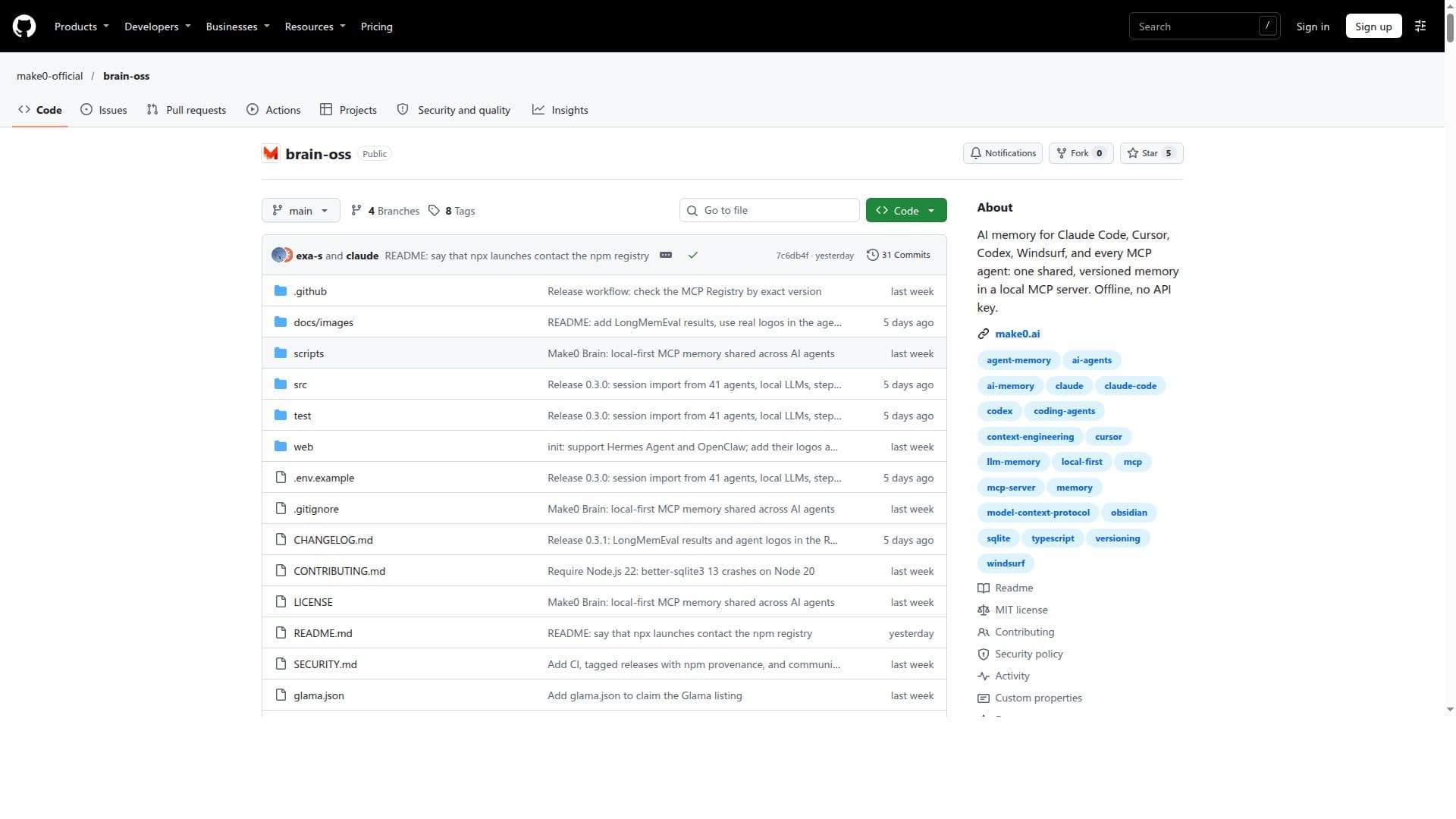
brain-oss is a powerful offline AI memory system that provides shared, versioned memory for multiple MCP agents like Claude Code and Codex, all running locally without API keys. Ideal for developers and organizations seeking secure, efficient multi-agent memory management in private environments.

Description
Your memories belong to you and not your agents. Whenever you are working with multiple agents you all must be encountering a problem that the context between them is not in sync. This leads to the problem of you explaining the same problem again and again. Make0 solves this problem by giving your agents a common memory store to which agents can read and write to. Introducing Make0 Brain OSS - Free, Open sourced, and MIT licensed. 🙌
Detailed Description
brain-oss is an advanced AI memory management system designed to provide a unified, versioned memory solution for multiple AI agents operating within a local environment. Its core purpose is to facilitate efficient and seamless memory sharing among various MCP (Multi-Context Processing) agents such as Claude Code, Cursor, Codex, Windsurf, and others. By running as a local MCP server, brain-oss enables these agents to access and update a shared memory repository without relying on external cloud services or API keys, ensuring privacy, security, and offline functionality. One of the standout features of brain-oss is its shared, versioned memory architecture. This allows multiple AI agents to concurrently read from and write to a single memory store while maintaining version control, which is critical for tracking changes and ensuring consistency across different agents’ interactions. The system operates entirely offline, removing the need for internet connectivity or API authentication, which is particularly valuable for developers and organizations concerned with data sovereignty or operating in restricted network environments. Additionally, brain-oss supports a wide range of MCP agents, making it highly versatile and adaptable to diverse AI workflows. brain-oss runs as a local MCP server, which means it can be deployed on a developer’s machine or within an enterprise’s internal network. This local deployment model enhances data security and reduces latency, as all memory operations are handled internally without external dependencies. The tool’s design focuses on efficient memory management, enabling AI agents to maintain context and state over extended interactions, which improves the quality and relevance of AI responses and outputs. This capability is particularly useful in scenarios where multiple AI agents collaborate or where long-term memory retention is required. This tool is best suited for AI researchers, developers, and organizations that utilize multiple MCP agents and require a robust memory management system that operates offline. Use cases include multi-agent AI systems, local AI development environments, privacy-sensitive AI applications, and scenarios where API key management is impractical or undesirable. By centralizing memory management, brain-oss simplifies the development and deployment of complex AI ecosystems, allowing teams to focus on building intelligent features rather than managing disparate memory stores. brain-oss is an open-source project hosted on GitHub, which means it is available for free and can be customized or extended by the community. There are no subscription fees or licensing costs associated with its use. Users can freely deploy and modify the software to fit their specific needs, benefiting from community contributions and ongoing improvements. This open model contrasts with many commercial AI memory solutions that require paid subscriptions or API usage fees. Compared to alternative AI memory systems, brain-oss stands out due to its offline operation, shared versioned memory, and broad compatibility with multiple MCP agents. Many competing solutions rely on cloud-based memory stores or require API keys, which can introduce latency, security concerns, and additional costs. brain-oss’s local server approach offers greater control, privacy, and reliability, making it ideal for sensitive or resource-constrained environments. However, unlike some commercial platforms, it may require more technical expertise to set up and maintain, as it is primarily targeted at developers comfortable with local server deployment. Notable limitations of brain-oss include the need for users to manage their own local infrastructure, which may pose challenges for those without technical experience or resources to maintain a local MCP server. Additionally, while it supports a range of MCP agents, integration with newer or less common agents may require custom development. Since it operates offline, users cannot leverage cloud scalability or remote access features inherent to cloud-based memory solutions. Despite these considerations, brain-oss offers a powerful and flexible memory management system that empowers AI developers to build sophisticated, multi-agent AI applications with enhanced privacy and control.
Tool Features
- Shared, versioned memory for multiple MCP agents
- Operates offline with no API key required
- Supports Claude Code, Cursor, Codex, Windsurf, and other MCP agents
- Runs as a local MCP server
- Enables efficient AI memory management
Description
brain-oss is a powerful offline AI memory system that provides shared, versioned memory for multiple MCP agents like Claude Code and Codex, all running locally without API keys. Ideal for developers and organizations seeking secure, efficient multi-agent memory management in private environments.
Your memories belong to you and not your agents. Whenever you are working with multiple agents you all must be encountering a problem that the context between them is not in sync. This leads to the problem of you explaining the same problem again and again. Make0 solves this problem by giving your agents a common memory store to which agents can read and write to. Introducing Make0 Brain OSS - Free, Open sourced, and MIT licensed. 🙌
Detailed Description
brain-oss is an advanced AI memory management system designed to provide a unified, versioned memory solution for multiple AI agents operating within a local environment. Its core purpose is to facilitate efficient and seamless memory sharing among various MCP (Multi-Context Processing) agents such as Claude Code, Cursor, Codex, Windsurf, and others. By running as a local MCP server, brain-oss enables these agents to access and update a shared memory repository without relying on external cloud services or API keys, ensuring privacy, security, and offline functionality. One of the standout features of brain-oss is its shared, versioned memory architecture. This allows multiple AI agents to concurrently read from and write to a single memory store while maintaining version control, which is critical for tracking changes and ensuring consistency across different agents’ interactions. The system operates entirely offline, removing the need for internet connectivity or API authentication, which is particularly valuable for developers and organizations concerned with data sovereignty or operating in restricted network environments. Additionally, brain-oss supports a wide range of MCP agents, making it highly versatile and adaptable to diverse AI workflows. brain-oss runs as a local MCP server, which means it can be deployed on a developer’s machine or within an enterprise’s internal network. This local deployment model enhances data security and reduces latency, as all memory operations are handled internally without external dependencies. The tool’s design focuses on efficient memory management, enabling AI agents to maintain context and state over extended interactions, which improves the quality and relevance of AI responses and outputs. This capability is particularly useful in scenarios where multiple AI agents collaborate or where long-term memory retention is required. This tool is best suited for AI researchers, developers, and organizations that utilize multiple MCP agents and require a robust memory management system that operates offline. Use cases include multi-agent AI systems, local AI development environments, privacy-sensitive AI applications, and scenarios where API key management is impractical or undesirable. By centralizing memory management, brain-oss simplifies the development and deployment of complex AI ecosystems, allowing teams to focus on building intelligent features rather than managing disparate memory stores. brain-oss is an open-source project hosted on GitHub, which means it is available for free and can be customized or extended by the community. There are no subscription fees or licensing costs associated with its use. Users can freely deploy and modify the software to fit their specific needs, benefiting from community contributions and ongoing improvements. This open model contrasts with many commercial AI memory solutions that require paid subscriptions or API usage fees. Compared to alternative AI memory systems, brain-oss stands out due to its offline operation, shared versioned memory, and broad compatibility with multiple MCP agents. Many competing solutions rely on cloud-based memory stores or require API keys, which can introduce latency, security concerns, and additional costs. brain-oss’s local server approach offers greater control, privacy, and reliability, making it ideal for sensitive or resource-constrained environments. However, unlike some commercial platforms, it may require more technical expertise to set up and maintain, as it is primarily targeted at developers comfortable with local server deployment. Notable limitations of brain-oss include the need for users to manage their own local infrastructure, which may pose challenges for those without technical experience or resources to maintain a local MCP server. Additionally, while it supports a range of MCP agents, integration with newer or less common agents may require custom development. Since it operates offline, users cannot leverage cloud scalability or remote access features inherent to cloud-based memory solutions. Despite these considerations, brain-oss offers a powerful and flexible memory management system that empowers AI developers to build sophisticated, multi-agent AI applications with enhanced privacy and control.
Frequently Asked Questions
What is brain-oss?
brain-oss is an AI memory system that provides a shared, versioned memory repository for multiple MCP agents, operating as a local server without requiring API keys or internet connectivity.
How much does brain-oss cost?
brain-oss is an open-source tool available for free on GitHub, with no subscription or licensing fees.
Who is brain-oss best for?
It is best suited for AI developers, researchers, and organizations using multiple MCP agents who need efficient, offline memory management with enhanced privacy and control.
What are the main features of brain-oss?
Key features include shared, versioned memory for multiple agents, offline operation without API keys, support for Claude Code, Cursor, Codex, Windsurf, and other MCP agents, and deployment as a local MCP server.
Does brain-oss offer a free trial?
Since brain-oss is open-source and free to use, there is no need for a trial period; users can download and deploy it immediately.
What integrations does brain-oss support?
brain-oss supports integration with various MCP agents including Claude Code, Cursor, Codex, Windsurf, and is designed to be extensible for other compatible agents.
How does brain-oss work?
brain-oss runs as a local MCP server that maintains a shared, versioned memory store accessible by multiple AI agents, enabling them to read and write memory efficiently without external API dependencies.
Socials
Use ToolReviews
No reviews yet. Be the first to share your experience.