Featured in:Best AI Audio Tools
Get featured →🚀 Zaprep: Your Socials on Steroids. Start free — automate 1,000 DMs/month & turn engagement into leads. with 1,000 automated DMs/month.



✦
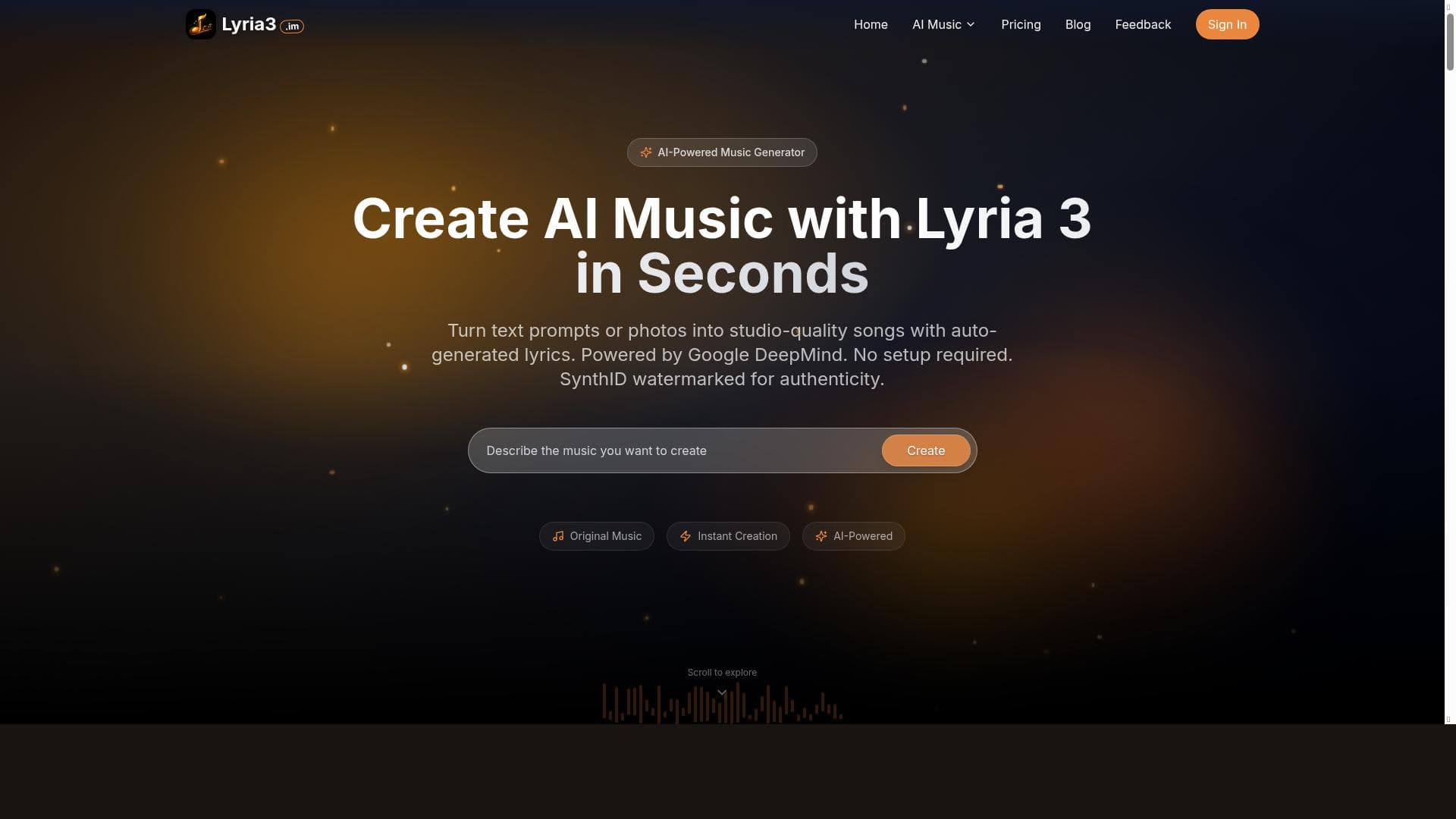
Lyria 3 by Google DeepMind is a powerful AI music generator that instantly creates high-fidelity songs with vocals and beats, requiring no musical training. Ideal for musicians, creators, and hobbyists, it makes professional-quality music accessible to everyone at no cost.

Description
Lyria 3 is an advanced AI music generation model developed by Google DeepMind that allows users to create high-fidelity music instantly. It enables the generation of vocals and beats without requiring any musical training, making music creation accessible to everyone.
Detailed Description
Lyria 3 is a cutting-edge AI music generation model developed by Google DeepMind, designed to revolutionize the way music is created. Its core purpose is to enable users to produce high-fidelity, professional-quality music instantly without the need for any prior musical training or expertise. By leveraging advanced machine learning algorithms and deep neural networks, Lyria 3 can generate complex musical compositions including vocals and beats, making music creation accessible to a broad audience ranging from hobbyists to professional musicians and content creators. One of the standout features of Lyria 3 is its ability to generate high-fidelity music that sounds polished and studio-quality. Unlike many AI music tools that produce synthetic or low-quality audio, Lyria 3 focuses on delivering rich, nuanced soundscapes that can be used directly in projects or further refined. The model supports the generation of both instrumental beats and vocal tracks, which is a significant advancement as many AI music generators typically focus on one or the other. This dual capability allows users to create complete songs or soundtracks from scratch, opening up new creative possibilities. Another key advantage of Lyria 3 is its user-friendly approach. The platform does not require users to have any musical training, knowledge of music theory, or experience with digital audio workstations. This lowers the barrier to entry for music creation, enabling anyone with an idea or inspiration to bring their musical vision to life quickly and easily. The intuitive interface and instant generation capabilities mean users can experiment with different styles, moods, and arrangements in real time, fostering creativity and rapid iteration. Lyria 3 is best suited for a diverse range of users including independent musicians looking to prototype ideas, content creators needing custom soundtracks for videos or podcasts, game developers seeking original music for immersive experiences, and educators exploring music technology. Its ability to generate vocals and beats makes it particularly valuable for artists who want to create demo tracks or explore new genres without hiring session musicians or producers. Additionally, hobbyists and beginners can use Lyria 3 as a learning tool to understand music composition through AI-assisted experimentation. In terms of pricing, Lyria 3 is currently offered for free, making it an attractive option for users who want to explore AI music generation without financial commitment. This free access encourages widespread adoption and experimentation, although users should check the website for any future updates regarding premium features or subscription plans. When compared to alternative AI music generation tools, Lyria 3 stands out due to its combination of high-fidelity output and the ability to generate both vocals and beats seamlessly. Many competitors focus solely on instrumental tracks or require significant user input to produce vocals. Lyria 3’s integration of these capabilities into a single model simplifies the creative process and enhances the quality of the final product. However, as with any AI-generated content, users may find that the music sometimes lacks the emotional depth or originality of human-composed pieces, and further manual refinement may be necessary for professional releases. Notable limitations include the current scope of customization options, which might be limited compared to traditional digital audio workstations or more specialized AI tools. Additionally, while Lyria 3 lowers the barrier to music creation, users seeking highly specific or niche genres might find the model’s outputs less tailored without additional input or editing. Finally, as the tool is free, there may be usage limits or restrictions on commercial use, so users should review the terms of service carefully. Overall, Lyria 3 represents a significant advancement in AI-driven music creation, democratizing access to high-quality music production and enabling a wide range of users to bring their musical ideas to life quickly and effortlessly.
Tool Features
- High-fidelity music generation
- Generate vocals and beats
- No musical training required
Description
✦
Lyria 3 by Google DeepMind is a powerful AI music generator that instantly creates high-fidelity songs with vocals and beats, requiring no musical training. Ideal for musicians, creators, and hobbyists, it makes professional-quality music accessible to everyone at no cost.
Lyria 3 is an advanced AI music generation model developed by Google DeepMind that allows users to create high-fidelity music instantly. It enables the generation of vocals and beats without requiring any musical training, making music creation accessible to everyone.
Detailed Description
Lyria 3 is a cutting-edge AI music generation model developed by Google DeepMind, designed to revolutionize the way music is created. Its core purpose is to enable users to produce high-fidelity, professional-quality music instantly without the need for any prior musical training or expertise. By leveraging advanced machine learning algorithms and deep neural networks, Lyria 3 can generate complex musical compositions including vocals and beats, making music creation accessible to a broad audience ranging from hobbyists to professional musicians and content creators. One of the standout features of Lyria 3 is its ability to generate high-fidelity music that sounds polished and studio-quality. Unlike many AI music tools that produce synthetic or low-quality audio, Lyria 3 focuses on delivering rich, nuanced soundscapes that can be used directly in projects or further refined. The model supports the generation of both instrumental beats and vocal tracks, which is a significant advancement as many AI music generators typically focus on one or the other. This dual capability allows users to create complete songs or soundtracks from scratch, opening up new creative possibilities. Another key advantage of Lyria 3 is its user-friendly approach. The platform does not require users to have any musical training, knowledge of music theory, or experience with digital audio workstations. This lowers the barrier to entry for music creation, enabling anyone with an idea or inspiration to bring their musical vision to life quickly and easily. The intuitive interface and instant generation capabilities mean users can experiment with different styles, moods, and arrangements in real time, fostering creativity and rapid iteration. Lyria 3 is best suited for a diverse range of users including independent musicians looking to prototype ideas, content creators needing custom soundtracks for videos or podcasts, game developers seeking original music for immersive experiences, and educators exploring music technology. Its ability to generate vocals and beats makes it particularly valuable for artists who want to create demo tracks or explore new genres without hiring session musicians or producers. Additionally, hobbyists and beginners can use Lyria 3 as a learning tool to understand music composition through AI-assisted experimentation. In terms of pricing, Lyria 3 is currently offered for free, making it an attractive option for users who want to explore AI music generation without financial commitment. This free access encourages widespread adoption and experimentation, although users should check the website for any future updates regarding premium features or subscription plans. When compared to alternative AI music generation tools, Lyria 3 stands out due to its combination of high-fidelity output and the ability to generate both vocals and beats seamlessly. Many competitors focus solely on instrumental tracks or require significant user input to produce vocals. Lyria 3’s integration of these capabilities into a single model simplifies the creative process and enhances the quality of the final product. However, as with any AI-generated content, users may find that the music sometimes lacks the emotional depth or originality of human-composed pieces, and further manual refinement may be necessary for professional releases. Notable limitations include the current scope of customization options, which might be limited compared to traditional digital audio workstations or more specialized AI tools. Additionally, while Lyria 3 lowers the barrier to music creation, users seeking highly specific or niche genres might find the model’s outputs less tailored without additional input or editing. Finally, as the tool is free, there may be usage limits or restrictions on commercial use, so users should review the terms of service carefully. Overall, Lyria 3 represents a significant advancement in AI-driven music creation, democratizing access to high-quality music production and enabling a wide range of users to bring their musical ideas to life quickly and effortlessly.
Frequently Asked Questions
What is Lyria 3?
Lyria 3 is an advanced AI music generation model developed by Google DeepMind that allows users to create high-fidelity music instantly, including vocals and beats, without needing any musical training.
How much does Lyria 3 cost?
Lyria 3 is currently available for free, enabling users to generate music without any subscription or payment.
Who is Lyria 3 best for?
Lyria 3 is ideal for musicians, content creators, game developers, educators, and hobbyists who want to create professional-quality music quickly and easily without prior musical expertise.
What are the main features of Lyria 3?
The main features include high-fidelity music generation, the ability to create both vocals and beats, and a user-friendly interface that requires no musical training.
Does Lyria 3 offer a free trial?
Lyria 3 is offered for free, so there is no need for a trial period; users can access its full capabilities without payment.
What integrations does Lyria 3 support?
Currently, Lyria 3 is primarily a standalone AI music generation tool accessible via its website. Specific integrations with other platforms or software are not detailed publicly.
How does Lyria 3 work?
Lyria 3 uses advanced deep learning models trained on vast amounts of musical data to generate high-quality music, including vocals and beats, based on user inputs without requiring musical knowledge.
Reviews
0 reviews
No reviews yet. Be the first to share your experience.
Sponsored Tools



























Recommended Tools
Stay updated on latest Ai tools
Get the latest insights, Join our newsletter
Read and trusted by 50,000+ readers
Join the biggest AI Community
Our community and staff are here to help!
Your feedback will help Alice AI improve in future versions.








Submit your Tool


PoweredByAI.app is an AI Tools Directory helping individuals, businesses, and creators discover the best AI tools for writing, coding, design, productivity, and more.
© 2026 , Product of011BQ. All rights reserved.