









Is this your AI tool? Claim it today.
Verify ownership, manage your profile, and unlock growth features.
Liquid AI’s d1.2 is a cutting-edge omnimodal decision model that uniquely supports audio input and five new task types, delivering industry-leading accuracy and efficiency. Ideal for developers and enterprises needing advanced multi-modal AI, d1.2 excels in diverse applications from smart devices to complex analytics.

Description
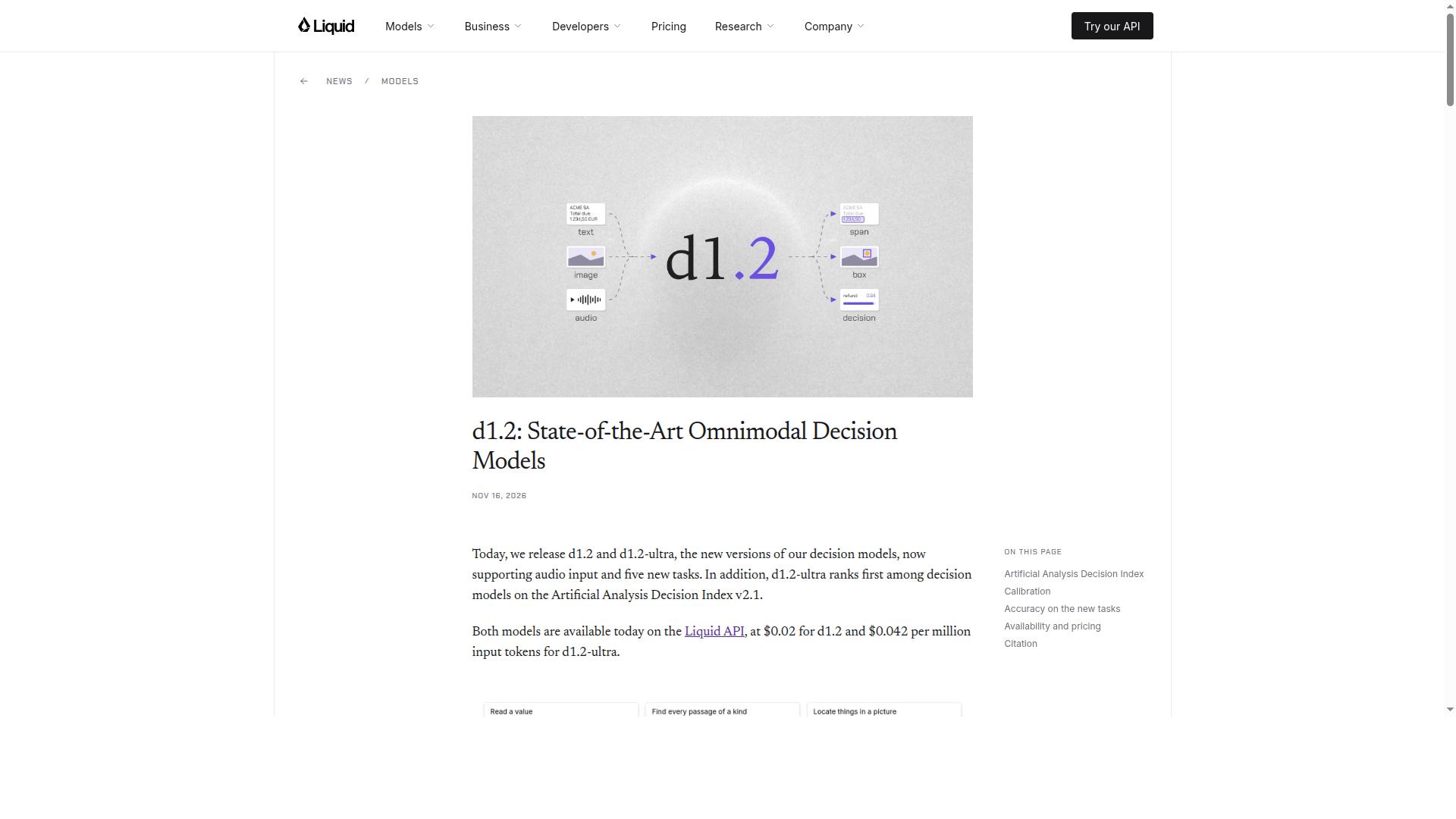
Liquid d1.2 and d1.2-ultra are omnimodal decision models that return calibrated probabilities, so low-confidence answers can go to human review. This version adds audio input and five tasks: reading values, finding text spans, locating objects, estimating numbers with a range, and multi-select. Per Liquid AI, d1.2-ultra scores 75 on the Artificial Analysis Decision Index, two points above the previous best. On the Liquid API now; OpenRouter and Vercel coming soon.
Detailed Description
Liquid AI’s d1.2 and d1.2-ultra represent a significant advancement in the field of artificial intelligence with their state-of-the-art omnimodal decision models. These models are engineered to process and analyze multiple input modalities simultaneously, including audio, which is a notable enhancement over many traditional AI models that focus primarily on text or visual data. The core purpose of d1.2 is to deliver highly accurate, efficient, and versatile decision-making capabilities that can be applied across a wide range of industries and applications, from smart devices to complex enterprise systems. By integrating multiple data types, d1.2 enables more nuanced and context-aware decisions, improving the quality and reliability of AI-driven outcomes. One of the standout features of d1.2 is its support for multiple input types, making it truly omnimodal. This includes audio input, which opens up new possibilities for voice-activated systems, real-time audio analysis, and enhanced human-computer interaction. Additionally, d1.2 introduces the ability to perform five new tasks, expanding its functional scope beyond conventional AI models. These tasks leverage the model’s multi-modal understanding to solve complex problems that require synthesizing information from diverse sources. The model is also optimized for efficiency and compute performance, ensuring that it can operate effectively even on devices with limited processing power. This makes d1.2 suitable for integration across various devices and mediums, from edge computing environments to cloud-based platforms. The d1.2 model is particularly well-suited for developers, AI researchers, and enterprises looking to implement advanced decision-making AI that can handle complex, multi-source data inputs. Use cases include smart home automation systems that respond to voice commands and environmental cues, customer service bots that analyze both spoken and written inputs for better responses, and industrial monitoring systems that combine audio signals with other sensor data for predictive maintenance. Its industry-leading accuracy ensures that decisions made by the model are reliable, which is critical in sectors such as healthcare, finance, and security where precision is paramount. Regarding pricing and plans, detailed information is not explicitly provided on the public-facing blog, but Liquid AI typically offers scalable solutions tailored to enterprise needs. Interested users and organizations are encouraged to contact Liquid AI directly through their website for customized pricing and deployment options. This approach allows for flexibility depending on the scale, integration complexity, and specific use cases. When compared to alternatives, d1.2 stands out due to its omnimodal capabilities and audio support, which many competing models lack or support only partially. Its focus on efficiency and compute optimization also differentiates it from larger, more resource-intensive models that may not be practical for deployment on edge devices or in latency-sensitive environments. However, as with any advanced AI model, users should consider the integration effort required to fully leverage its multi-modal inputs and the potential need for domain-specific fine-tuning to maximize performance in specialized applications. Notable limitations include the current availability of detailed public documentation and pricing transparency, which may require direct engagement with Liquid AI for full access. Additionally, while d1.2 supports multiple modalities, the effectiveness of its decision-making depends on the quality and compatibility of input data streams. Organizations must ensure proper data preprocessing and integration pipelines to fully benefit from the model’s capabilities. Overall, d1.2 represents a cutting-edge solution for organizations seeking to enhance their AI systems with robust, multi-modal decision-making technology that balances accuracy, efficiency, and versatility.
Tool Features
- Omnimodal decision models supporting multiple input types including audio
- Capability to perform five new tasks
- Industry-leading accuracy in decision-making
- Designed for efficiency and compute optimization
- Supports integration across various devices and mediums
Description
Liquid AI’s d1.2 is a cutting-edge omnimodal decision model that uniquely supports audio input and five new task types, delivering industry-leading accuracy and efficiency. Ideal for developers and enterprises needing advanced multi-modal AI, d1.2 excels in diverse applications from smart devices to complex analytics.
Liquid d1.2 and d1.2-ultra are omnimodal decision models that return calibrated probabilities, so low-confidence answers can go to human review. This version adds audio input and five tasks: reading values, finding text spans, locating objects, estimating numbers with a range, and multi-select. Per Liquid AI, d1.2-ultra scores 75 on the Artificial Analysis Decision Index, two points above the previous best. On the Liquid API now; OpenRouter and Vercel coming soon.
Detailed Description
Liquid AI’s d1.2 and d1.2-ultra represent a significant advancement in the field of artificial intelligence with their state-of-the-art omnimodal decision models. These models are engineered to process and analyze multiple input modalities simultaneously, including audio, which is a notable enhancement over many traditional AI models that focus primarily on text or visual data. The core purpose of d1.2 is to deliver highly accurate, efficient, and versatile decision-making capabilities that can be applied across a wide range of industries and applications, from smart devices to complex enterprise systems. By integrating multiple data types, d1.2 enables more nuanced and context-aware decisions, improving the quality and reliability of AI-driven outcomes. One of the standout features of d1.2 is its support for multiple input types, making it truly omnimodal. This includes audio input, which opens up new possibilities for voice-activated systems, real-time audio analysis, and enhanced human-computer interaction. Additionally, d1.2 introduces the ability to perform five new tasks, expanding its functional scope beyond conventional AI models. These tasks leverage the model’s multi-modal understanding to solve complex problems that require synthesizing information from diverse sources. The model is also optimized for efficiency and compute performance, ensuring that it can operate effectively even on devices with limited processing power. This makes d1.2 suitable for integration across various devices and mediums, from edge computing environments to cloud-based platforms. The d1.2 model is particularly well-suited for developers, AI researchers, and enterprises looking to implement advanced decision-making AI that can handle complex, multi-source data inputs. Use cases include smart home automation systems that respond to voice commands and environmental cues, customer service bots that analyze both spoken and written inputs for better responses, and industrial monitoring systems that combine audio signals with other sensor data for predictive maintenance. Its industry-leading accuracy ensures that decisions made by the model are reliable, which is critical in sectors such as healthcare, finance, and security where precision is paramount. Regarding pricing and plans, detailed information is not explicitly provided on the public-facing blog, but Liquid AI typically offers scalable solutions tailored to enterprise needs. Interested users and organizations are encouraged to contact Liquid AI directly through their website for customized pricing and deployment options. This approach allows for flexibility depending on the scale, integration complexity, and specific use cases. When compared to alternatives, d1.2 stands out due to its omnimodal capabilities and audio support, which many competing models lack or support only partially. Its focus on efficiency and compute optimization also differentiates it from larger, more resource-intensive models that may not be practical for deployment on edge devices or in latency-sensitive environments. However, as with any advanced AI model, users should consider the integration effort required to fully leverage its multi-modal inputs and the potential need for domain-specific fine-tuning to maximize performance in specialized applications. Notable limitations include the current availability of detailed public documentation and pricing transparency, which may require direct engagement with Liquid AI for full access. Additionally, while d1.2 supports multiple modalities, the effectiveness of its decision-making depends on the quality and compatibility of input data streams. Organizations must ensure proper data preprocessing and integration pipelines to fully benefit from the model’s capabilities. Overall, d1.2 represents a cutting-edge solution for organizations seeking to enhance their AI systems with robust, multi-modal decision-making technology that balances accuracy, efficiency, and versatility.
Frequently Asked Questions
What is d1.2?
d1.2 is a state-of-the-art omnimodal decision model developed by Liquid AI that supports multiple input types including audio, enabling advanced and accurate decision-making across diverse tasks and applications.
How much does d1.2 cost?
Pricing details for d1.2 are not publicly listed; interested users should contact Liquid AI directly for customized pricing and deployment options tailored to their specific needs.
Who is d1.2 best for?
d1.2 is best suited for developers, AI researchers, and enterprises seeking efficient, multi-modal AI decision models capable of handling complex inputs like audio for applications in smart devices, customer service, industrial monitoring, and more.
What are the main features of d1.2?
Key features include support for multiple input modalities including audio, the ability to perform five new tasks, industry-leading decision accuracy, compute and efficiency optimizations, and seamless integration across various devices and platforms.
Does d1.2 offer a free trial?
There is no publicly available information about a free trial for d1.2; potential users should reach out to Liquid AI to inquire about trial options or demonstrations.
What integrations does d1.2 support?
d1.2 is designed for integration across a wide range of devices and mediums, supporting deployment in edge computing environments, cloud platforms, and various hardware setups to suit different application requirements.
How does d1.2 work?
d1.2 processes multiple types of input data simultaneously, including audio, to perform complex decision-making tasks with high accuracy. It leverages advanced multi-modal AI architecture optimized for efficiency and broad applicability.
Socials


Reviews
No reviews yet. Be the first to share your experience.


































 , Product of