Featured in:Best AI Audio Tools
Get featured →🚀 Zaprep: Your Socials on Steroids. Start free — automate 1,000 DMs/month & turn engagement into leads. with 1,000 automated DMs/month.



✦
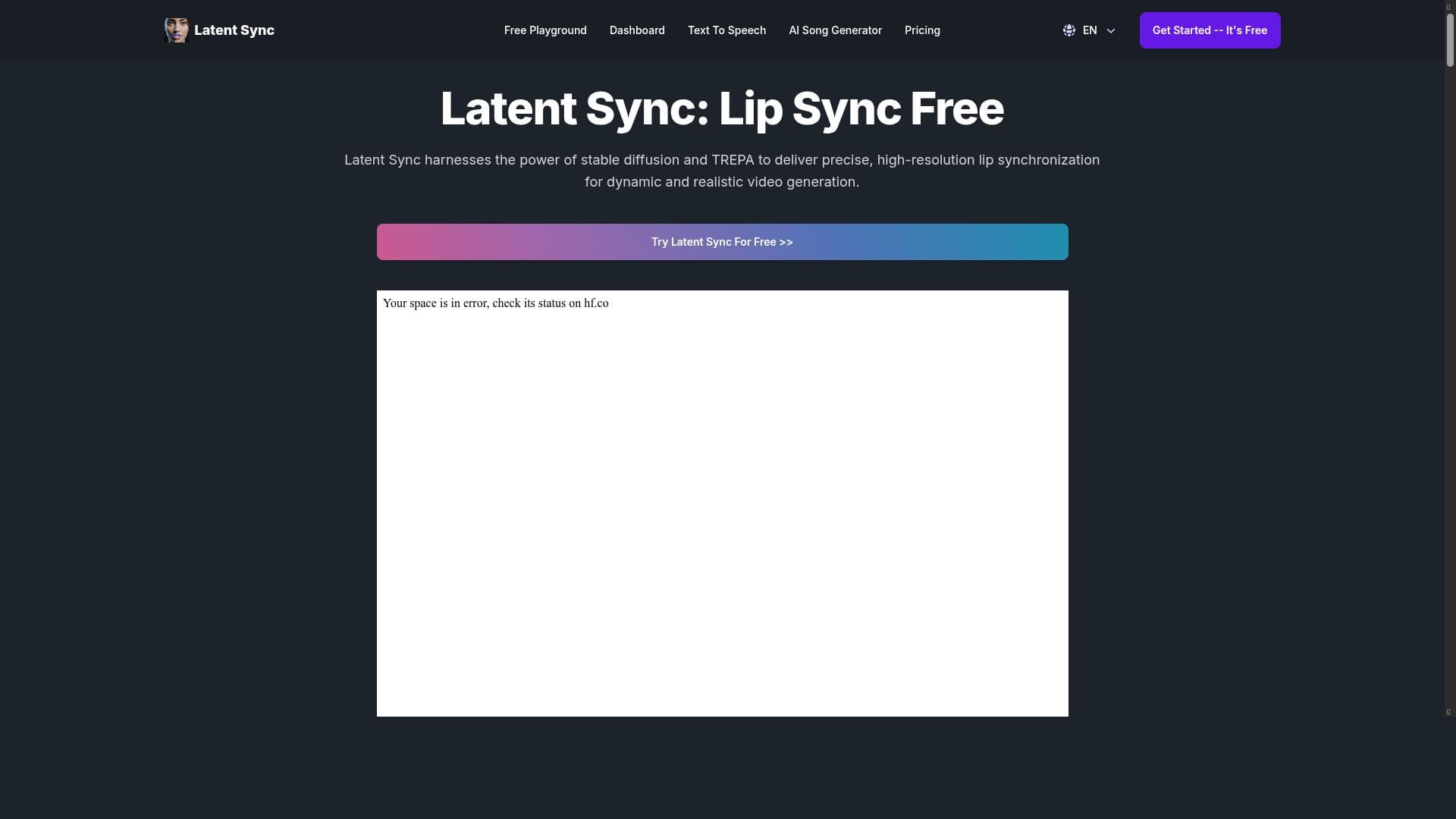
Latent Sync is a cutting-edge AI framework that uses audio-driven latent diffusion models to deliver seamless, high-quality lip synchronization for talking videos. Ideal for dubbing, virtual avatars, and gaming, it offers an end-to-end solution that ensures lifelike, temporally consistent facial animations—all available for free.

Description
Latent Sync is a cutting-edge framework for end-to-end lip synchronization using audio-driven latent diffusion models. It achieves seamless temporal consistency and generates high-quality, lifelike talking videos for applications such as dubbing, virtual avatars, and gaming.
Detailed Description
Latent Sync is an advanced AI-driven framework designed to revolutionize the process of lip synchronization in video content. At its core, the tool leverages audio-driven latent diffusion models to produce end-to-end lip sync solutions that are both temporally consistent and visually lifelike. This technology enables creators and developers to generate talking videos where the lip movements perfectly match the audio input, resulting in seamless and natural-looking speech animations. The framework is particularly valuable in domains such as dubbing foreign language films, creating virtual avatars for interactive experiences, and enhancing gaming environments with realistic character dialogue. One of the standout features of Latent Sync is its use of latent diffusion models that are driven directly by audio signals. Unlike traditional lip sync methods that rely on frame-by-frame adjustments or heuristic approaches, Latent Sync models the underlying latent space of facial movements conditioned on the audio. This approach ensures that the generated lip movements are temporally coherent across frames, eliminating jitter and unnatural transitions. The end-to-end nature of the framework means that users can input raw audio and video data and receive fully synchronized output without needing manual intervention or complex pipeline setups. The generated videos maintain high visual fidelity, producing lifelike talking heads that can convincingly mimic human speech patterns. Latent Sync is ideally suited for a range of professional and creative users. Content creators and filmmakers can use it to automate dubbing processes, ensuring that translated dialogue matches lip movements accurately, thereby improving viewer immersion. Virtual avatar developers benefit from the tool’s ability to produce realistic facial animations driven by voice input, enhancing user engagement in virtual meetings, streaming, or social media applications. In the gaming industry, Latent Sync can be integrated into character animation pipelines to provide dynamic, real-time lip sync that adapts to player interactions or narrative dialogue, significantly elevating the storytelling experience. Its flexibility across these use cases makes it a powerful asset for anyone needing high-quality, synchronized talking videos. Importantly, Latent Sync is offered as a free tool, lowering barriers to access for developers, researchers, and hobbyists alike. This pricing model encourages experimentation and adoption across diverse projects without upfront costs. While the framework is free, users should consider the computational resources required to run latent diffusion models effectively, as high-quality video generation can be resource-intensive. The open accessibility paired with cutting-edge technology positions Latent Sync as a compelling option in the AI video synthesis landscape. Compared to alternative lip sync solutions, Latent Sync stands out due to its integration of latent diffusion techniques, which provide superior temporal consistency and video quality. Many existing tools rely on simpler audio-to-visual mapping or require extensive manual tuning, which can lead to less natural results or increased production time. Latent Sync’s end-to-end approach streamlines workflows and produces outputs that are visually more convincing, making it a preferred choice for high-stakes applications like professional dubbing or interactive avatars. However, users should be aware that, as with any AI-generated video content, there may be occasional artifacts or limitations in handling highly expressive or exaggerated facial movements, which could require additional refinement. In summary, Latent Sync offers a state-of-the-art, free solution for generating high-quality, temporally consistent lip-synced videos using audio-driven latent diffusion models. Its applicability across dubbing, virtual avatars, and gaming, combined with its ease of use and advanced technology, make it a valuable tool for creators and developers seeking to enhance video realism and engagement.
Tool Features
- End-to-end lip synchronization
- Audio-driven latent diffusion models
- Seamless temporal consistency
- High-quality lifelike talking videos
- Applications for dubbing
- Supports virtual avatars
- Suitable for gaming
Description
✦
Latent Sync is a cutting-edge AI framework that uses audio-driven latent diffusion models to deliver seamless, high-quality lip synchronization for talking videos. Ideal for dubbing, virtual avatars, and gaming, it offers an end-to-end solution that ensures lifelike, temporally consistent facial animations—all available for free.
Latent Sync is a cutting-edge framework for end-to-end lip synchronization using audio-driven latent diffusion models. It achieves seamless temporal consistency and generates high-quality, lifelike talking videos for applications such as dubbing, virtual avatars, and gaming.
Detailed Description
Latent Sync is an advanced AI-driven framework designed to revolutionize the process of lip synchronization in video content. At its core, the tool leverages audio-driven latent diffusion models to produce end-to-end lip sync solutions that are both temporally consistent and visually lifelike. This technology enables creators and developers to generate talking videos where the lip movements perfectly match the audio input, resulting in seamless and natural-looking speech animations. The framework is particularly valuable in domains such as dubbing foreign language films, creating virtual avatars for interactive experiences, and enhancing gaming environments with realistic character dialogue. One of the standout features of Latent Sync is its use of latent diffusion models that are driven directly by audio signals. Unlike traditional lip sync methods that rely on frame-by-frame adjustments or heuristic approaches, Latent Sync models the underlying latent space of facial movements conditioned on the audio. This approach ensures that the generated lip movements are temporally coherent across frames, eliminating jitter and unnatural transitions. The end-to-end nature of the framework means that users can input raw audio and video data and receive fully synchronized output without needing manual intervention or complex pipeline setups. The generated videos maintain high visual fidelity, producing lifelike talking heads that can convincingly mimic human speech patterns. Latent Sync is ideally suited for a range of professional and creative users. Content creators and filmmakers can use it to automate dubbing processes, ensuring that translated dialogue matches lip movements accurately, thereby improving viewer immersion. Virtual avatar developers benefit from the tool’s ability to produce realistic facial animations driven by voice input, enhancing user engagement in virtual meetings, streaming, or social media applications. In the gaming industry, Latent Sync can be integrated into character animation pipelines to provide dynamic, real-time lip sync that adapts to player interactions or narrative dialogue, significantly elevating the storytelling experience. Its flexibility across these use cases makes it a powerful asset for anyone needing high-quality, synchronized talking videos. Importantly, Latent Sync is offered as a free tool, lowering barriers to access for developers, researchers, and hobbyists alike. This pricing model encourages experimentation and adoption across diverse projects without upfront costs. While the framework is free, users should consider the computational resources required to run latent diffusion models effectively, as high-quality video generation can be resource-intensive. The open accessibility paired with cutting-edge technology positions Latent Sync as a compelling option in the AI video synthesis landscape. Compared to alternative lip sync solutions, Latent Sync stands out due to its integration of latent diffusion techniques, which provide superior temporal consistency and video quality. Many existing tools rely on simpler audio-to-visual mapping or require extensive manual tuning, which can lead to less natural results or increased production time. Latent Sync’s end-to-end approach streamlines workflows and produces outputs that are visually more convincing, making it a preferred choice for high-stakes applications like professional dubbing or interactive avatars. However, users should be aware that, as with any AI-generated video content, there may be occasional artifacts or limitations in handling highly expressive or exaggerated facial movements, which could require additional refinement. In summary, Latent Sync offers a state-of-the-art, free solution for generating high-quality, temporally consistent lip-synced videos using audio-driven latent diffusion models. Its applicability across dubbing, virtual avatars, and gaming, combined with its ease of use and advanced technology, make it a valuable tool for creators and developers seeking to enhance video realism and engagement.
Frequently Asked Questions
What is Latent Sync?
Latent Sync is an AI-powered framework that generates end-to-end lip synchronization in videos using audio-driven latent diffusion models, producing high-quality, temporally consistent talking videos.
How much does Latent Sync cost?
Latent Sync is available for free, allowing users to access its full lip synchronization capabilities without any subscription or payment.
Who is Latent Sync best for?
Latent Sync is best suited for content creators, filmmakers, virtual avatar developers, and game designers who need realistic, synchronized lip movements in videos or interactive applications.
What are the main features of Latent Sync?
Key features include end-to-end lip synchronization, audio-driven latent diffusion modeling, seamless temporal consistency, high-quality lifelike talking videos, and support for applications like dubbing, virtual avatars, and gaming.
Does Latent Sync offer a free trial?
Latent Sync is offered entirely for free, so there is no need for a trial period; users can access and use the tool without cost.
What integrations does Latent Sync support?
While specific integrations are not detailed, Latent Sync is designed to be flexible for use in dubbing workflows, virtual avatar creation, and gaming environments, and can be integrated into custom pipelines depending on user needs.
How does Latent Sync work?
Latent Sync uses audio-driven latent diffusion models to map audio input to corresponding lip movements in video frames, ensuring temporal consistency and producing natural, high-quality talking videos in an end-to-end process.
Reviews
0 reviews
No reviews yet. Be the first to share your experience.
Sponsored Tools




















Recommended Tools
Stay updated on latest Ai tools
Get the latest insights, Join our newsletter
Read and trusted by 50,000+ readers
Join the biggest AI Community
Our community and staff are here to help!
Your feedback will help Alice AI improve in future versions.






Submit your Tool


PoweredByAI.app is an AI Tools Directory helping individuals, businesses, and creators discover the best AI tools for writing, coding, design, productivity, and more.
© 2026 , Product of011BQ. All rights reserved.