🚀 Zaprep: Your Socials on Steroids. Start free — automate 1,000 DMs/month & turn engagement into leads. with 1,000 automated DMs/month.


Is this your AI tool? Claim it today.
Verify ownership, manage your profile, and unlock growth features.
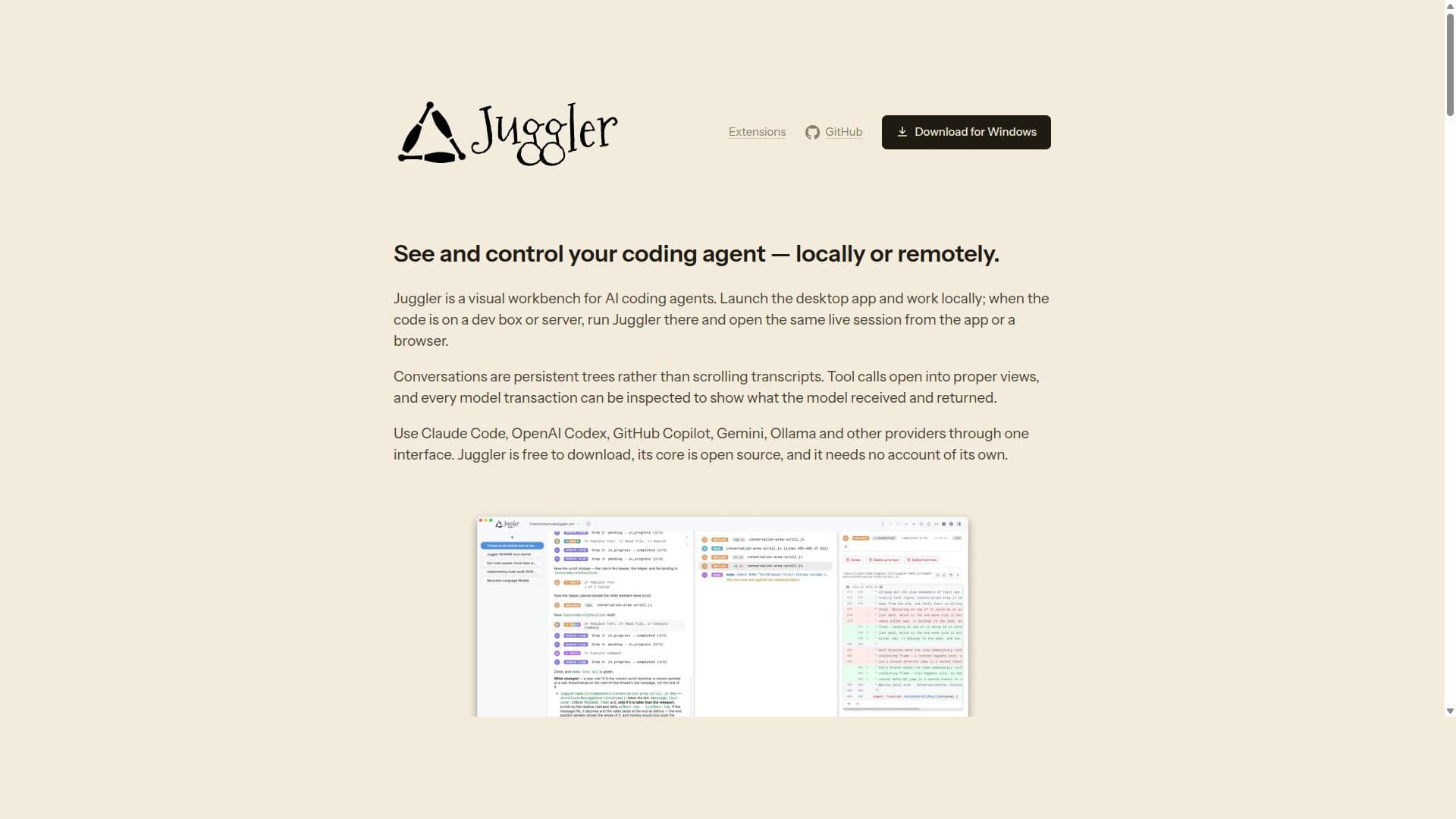
Juggler is a cutting-edge visual workbench that transforms AI coding agent interactions into persistent, branching conversation trees, offering unparalleled control and transparency. Ideal for developers and teams managing complex AI-assisted coding tasks, it supports multiple LLM providers and runs seamlessly across desktop and browser clients.

Description
Juggler is a desktop workbench for AI coding agents. Tool calls, approvals, thread structure and raw context are laid out in Finder-style columns. Conversations branch into sub-threads. Every tool is a JavaScript plugin. Free, open-source, one Go binary.
Detailed Description
Juggler is a sophisticated visual workbench designed specifically for managing AI coding agents, providing developers with a powerful desktop application and browser interface to orchestrate complex coding workflows. At its core, Juggler transforms the traditional linear conversation transcript into persistent, branching conversation trees, enabling users to navigate, manage, and revisit coding sessions with unprecedented clarity and control. This approach allows developers to handle multiple tangents, delegated tasks, or competing coding strategies simultaneously without losing context or cluttering the main workflow. The tool is built to support long coding sessions, offering a robust interface that includes Miller-column navigation, detailed inspection of tool calls, and editable context to facilitate hands-on interaction with AI agents over extended periods. Key features of Juggler include its support for multiple large language model (LLM) providers such as Claude Code, OpenAI Codex, GitHub Copilot, Gemini, and Ollama, among others. This flexibility means users can leverage their preferred AI coding engines through a single unified interface, bringing their existing API keys or subscriptions without needing additional accounts. Juggler runs either locally or remotely, with sessions synchronized across desktop and browser clients, allowing seamless switching between devices and environments. The persistent session data is saved on disk, ensuring that conversations survive application quits, crashes, or network disconnects. Users can inspect every model transaction in detail, including system prompts, messages, tool definitions, token usage, and response timing, which fosters transparency and trust in AI-generated code. The branching thread system enables recursive sub-threads that keep intermediate work isolated from the main context, returning only final results to maintain a clean and efficient coding environment. Juggler is best suited for professional developers, AI researchers, and teams who rely heavily on AI-assisted coding and require a structured, inspectable, and persistent environment to manage complex coding tasks. It is particularly valuable for those working on large codebases or projects that involve multiple AI agents and require rigorous oversight of AI interactions. Use cases include debugging AI-generated code, experimenting with alternative coding approaches, managing delegated coding tasks, and maintaining long-term AI coding sessions without losing context. Its open-source core and extensible SDK also make it ideal for developers who want to customize or extend the platform to fit specialized workflows or integrate additional tools. Regarding pricing, Juggler is free to download and use, with its core being open source. It does not require users to create accounts or pay subscription fees for the application itself. Users only need to provide their own API keys or subscriptions for the LLM providers they wish to use. This model lowers the barrier to entry and encourages adoption by offering a transparent, cost-effective solution for AI coding agent management. Compared to alternatives, Juggler stands out by offering a native desktop application built in Go, avoiding the performance and resource overhead commonly associated with Electron-based apps. Its unique persistent conversation tree model and detailed inspection capabilities provide a level of control and transparency not typically found in other AI coding assistants, which often rely on ephemeral chat transcripts. Additionally, the ability to run sessions remotely and synchronize across multiple clients offers flexibility that many competitors lack. The open-source extension SDK further differentiates Juggler by enabling users to tailor the tool extensively to their needs, unlike many proprietary platforms. However, there are some considerations to keep in mind. Since Juggler requires users to bring their own API keys for LLM providers, it may involve additional costs depending on usage and provider pricing. The complexity of managing branching conversation trees and detailed inspections might present a learning curve for users accustomed to simpler chat-based AI coding tools. Also, while the core is open source, some advanced features or integrations may require technical expertise to implement or customize. Finally, as a relatively new tool, its ecosystem and community support may not be as mature as more established AI coding platforms. Overall, Juggler offers a powerful, flexible, and transparent environment for AI-assisted coding that caters to advanced users seeking control and extensibility in their AI workflows.
Tool Features
- Persistent conversation trees instead of scrolling transcripts
- Inspectable tool calls, approvals, and model transactions
- Supports multiple LLM providers including Claude Code, OpenAI Codex, GitHub Copilot, Gemini, Ollama
- Runs locally or remotely with synchronized sessions across desktop and browser clients
- Branching threads for tangents, delegated tasks, or competing approaches
- Sessions survive quits and reconnects with data saved on disk
- Open-source core with a permissive extension SDK for customization
- Native desktop app built in Go with a type-checked JavaScript interface
Description
Juggler is a cutting-edge visual workbench that transforms AI coding agent interactions into persistent, branching conversation trees, offering unparalleled control and transparency. Ideal for developers and teams managing complex AI-assisted coding tasks, it supports multiple LLM providers and runs seamlessly across desktop and browser clients.
Juggler is a desktop workbench for AI coding agents. Tool calls, approvals, thread structure and raw context are laid out in Finder-style columns. Conversations branch into sub-threads. Every tool is a JavaScript plugin. Free, open-source, one Go binary.
Detailed Description
Juggler is a sophisticated visual workbench designed specifically for managing AI coding agents, providing developers with a powerful desktop application and browser interface to orchestrate complex coding workflows. At its core, Juggler transforms the traditional linear conversation transcript into persistent, branching conversation trees, enabling users to navigate, manage, and revisit coding sessions with unprecedented clarity and control. This approach allows developers to handle multiple tangents, delegated tasks, or competing coding strategies simultaneously without losing context or cluttering the main workflow. The tool is built to support long coding sessions, offering a robust interface that includes Miller-column navigation, detailed inspection of tool calls, and editable context to facilitate hands-on interaction with AI agents over extended periods. Key features of Juggler include its support for multiple large language model (LLM) providers such as Claude Code, OpenAI Codex, GitHub Copilot, Gemini, and Ollama, among others. This flexibility means users can leverage their preferred AI coding engines through a single unified interface, bringing their existing API keys or subscriptions without needing additional accounts. Juggler runs either locally or remotely, with sessions synchronized across desktop and browser clients, allowing seamless switching between devices and environments. The persistent session data is saved on disk, ensuring that conversations survive application quits, crashes, or network disconnects. Users can inspect every model transaction in detail, including system prompts, messages, tool definitions, token usage, and response timing, which fosters transparency and trust in AI-generated code. The branching thread system enables recursive sub-threads that keep intermediate work isolated from the main context, returning only final results to maintain a clean and efficient coding environment. Juggler is best suited for professional developers, AI researchers, and teams who rely heavily on AI-assisted coding and require a structured, inspectable, and persistent environment to manage complex coding tasks. It is particularly valuable for those working on large codebases or projects that involve multiple AI agents and require rigorous oversight of AI interactions. Use cases include debugging AI-generated code, experimenting with alternative coding approaches, managing delegated coding tasks, and maintaining long-term AI coding sessions without losing context. Its open-source core and extensible SDK also make it ideal for developers who want to customize or extend the platform to fit specialized workflows or integrate additional tools. Regarding pricing, Juggler is free to download and use, with its core being open source. It does not require users to create accounts or pay subscription fees for the application itself. Users only need to provide their own API keys or subscriptions for the LLM providers they wish to use. This model lowers the barrier to entry and encourages adoption by offering a transparent, cost-effective solution for AI coding agent management. Compared to alternatives, Juggler stands out by offering a native desktop application built in Go, avoiding the performance and resource overhead commonly associated with Electron-based apps. Its unique persistent conversation tree model and detailed inspection capabilities provide a level of control and transparency not typically found in other AI coding assistants, which often rely on ephemeral chat transcripts. Additionally, the ability to run sessions remotely and synchronize across multiple clients offers flexibility that many competitors lack. The open-source extension SDK further differentiates Juggler by enabling users to tailor the tool extensively to their needs, unlike many proprietary platforms. However, there are some considerations to keep in mind. Since Juggler requires users to bring their own API keys for LLM providers, it may involve additional costs depending on usage and provider pricing. The complexity of managing branching conversation trees and detailed inspections might present a learning curve for users accustomed to simpler chat-based AI coding tools. Also, while the core is open source, some advanced features or integrations may require technical expertise to implement or customize. Finally, as a relatively new tool, its ecosystem and community support may not be as mature as more established AI coding platforms. Overall, Juggler offers a powerful, flexible, and transparent environment for AI-assisted coding that caters to advanced users seeking control and extensibility in their AI workflows.
Frequently Asked Questions
What is Juggler?
Juggler is a visual workbench for AI coding agents that provides a desktop app and browser interface to manage persistent conversation trees, inspect model transactions, and control coding agents locally or remotely. It supports multiple LLM providers and is designed for long coding sessions with branching threads and detailed inspection capabilities.
How much does Juggler cost?
Juggler is free to download and use. It is open source and does not require any subscription or account. Users only need to provide their own API keys or subscriptions for the LLM providers they wish to use.
Who is Juggler best for?
Juggler is best suited for professional developers, AI researchers, and teams who use AI-assisted coding extensively and need a structured, inspectable, and persistent environment to manage complex coding workflows and multiple AI agents.
What are the main features of Juggler?
Key features include persistent conversation trees instead of scrolling transcripts, inspectable tool calls and model transactions, support for multiple LLM providers like Claude Code, OpenAI Codex, GitHub Copilot, and others, local or remote operation with synchronized sessions, branching threads for managing tangents or delegated tasks, session persistence on disk, and an open-source core with a permissive extension SDK.
Does Juggler offer a free trial?
Juggler is completely free to download and use with no trial limitations, as it is open source and does not require a paid subscription.
What integrations does Juggler support?
Juggler supports multiple LLM providers including Claude Code, OpenAI Codex, GitHub Copilot, Gemini, Ollama, Anthropic, Mistral, Z.AI, OpenRouter, DeepSeek, and other OpenAI-compatible providers. Users can bring their own API keys or subscriptions.
How does Juggler work?
Juggler runs as a native desktop app built in Go with a type-checked JavaScript interface, starting a local server automatically. It manages conversation sessions as persistent trees saved on disk, synchronizes live across desktop and browser clients, and allows users to inspect every model transaction and tool call in detail. It supports branching threads for managing complex workflows and runs either locally or remotely on the machine where the code resides.
Socials
Use ToolReviews
No reviews yet. Be the first to share your experience.
Sponsored Tools
























Recommended Tools
Stay updated on latest Ai tools
Get the latest insights, Join our newsletter
Read and trusted by 50,000+ readers
Join the biggest AI Community
Our community and staff are here to help!
Your feedback will help Alice AI improve in future versions.







Submit your Tool


PoweredByAI.app is an AI Tools Directory helping individuals, businesses, and creators discover the best AI tools for writing, coding, design, productivity, and more.
© 2026 , Product of011BQ. All rights reserved.