🚀 Zaprep: Your Socials on Steroids. Start free — automate 1,000 DMs/month & turn engagement into leads. with 1,000 automated DMs/month.


Is this your AI tool? Claim it today.
Verify ownership, manage your profile, and unlock growth features.
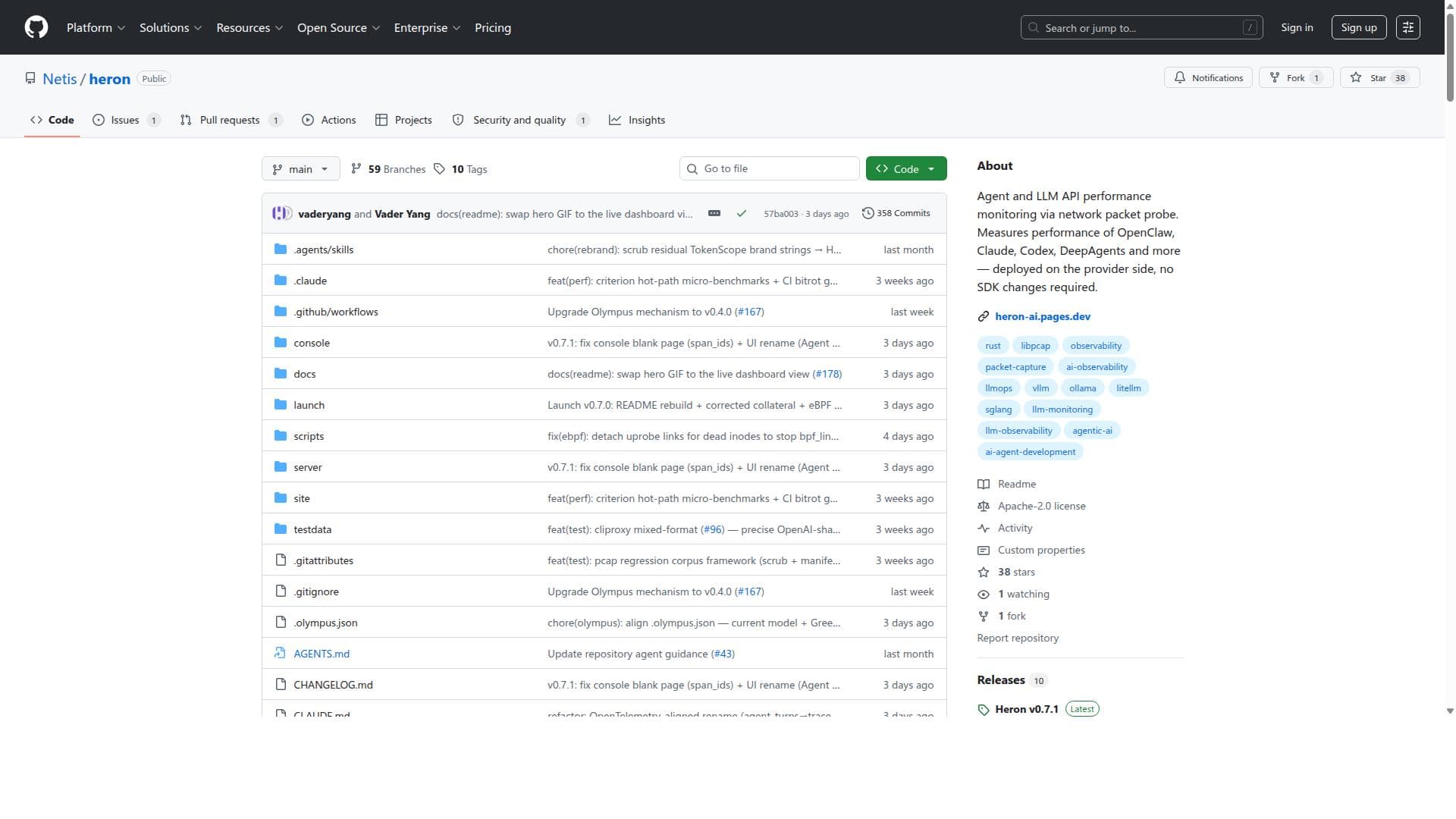
Heron is a unique AI performance monitoring tool that uses network packet probing to measure the responsiveness and efficiency of multiple large language models like OpenClaw, Claude, Codex, and DeepAgents without requiring SDK changes. Ideal for AI service providers and platform operators, it offers seamless, provider-side integration for real-time API performance insights.

Description
Heron is a passive network analyzer that reconstructs what your AI agents are actually doing. Zero SDKs. Zero proxy. Hook eBPF to see TLS-encrypted LLM calls and identify which agent process made them.
Detailed Description
Heron is a specialized monitoring tool designed to track the performance of agent and large language model (LLM) APIs by leveraging network packet probing techniques. Its core purpose is to provide AI service providers with detailed insights into the operational efficiency and responsiveness of various AI models, including OpenClaw, Claude, Codex, DeepAgents, and others. By operating on the provider side and requiring no changes to existing SDKs, Heron enables seamless integration into existing infrastructures without disrupting current workflows or necessitating code modifications. This makes it an invaluable tool for organizations aiming to maintain high-quality AI service delivery and optimize their model deployments. The key features of Heron center around its ability to monitor API performance through network packet analysis. Unlike traditional monitoring solutions that rely on SDK instrumentation or application-level logging, Heron passively probes network traffic to measure latency, throughput, error rates, and other critical performance metrics. This approach allows it to capture real-time data across multiple AI models simultaneously without introducing overhead or requiring cooperation from the client side. Heron supports a broad range of AI models, including popular and emerging ones like OpenClaw, Claude, Codex, and DeepAgents, making it versatile for providers managing heterogeneous AI environments. Its deployment on the provider side ensures data privacy and security, as all monitoring occurs within the service infrastructure. Heron is best suited for AI service providers, platform operators, and enterprises that deploy or manage multiple large language models and AI agents. It is particularly useful for teams responsible for maintaining service-level agreements (SLAs), optimizing API responsiveness, and troubleshooting performance bottlenecks. Use cases include continuous performance monitoring to detect degradation early, benchmarking different AI models under production workloads, and conducting capacity planning based on observed traffic patterns. Additionally, Heron can assist in compliance and auditing scenarios by providing transparent performance records without exposing client-side data. Regarding pricing and plans, Heron is an open-source project hosted on GitHub, which means it is freely available for download and use. There are no licensing fees or subscription costs associated with the tool itself. However, organizations should consider potential infrastructure costs related to deploying and maintaining the monitoring environment, such as server resources and network configuration. Since Heron operates at the network level, it may require specific hardware or software setups to capture and analyze traffic effectively. When compared to alternative monitoring solutions, Heron's network packet probing approach stands out by eliminating the need for SDK integration or client-side instrumentation, which can be complex and error-prone. Many traditional AI monitoring tools rely on application-level hooks or telemetry data that require cooperation from the AI model providers or clients, limiting their applicability. Heron's provider-side deployment and passive monitoring offer a non-intrusive, scalable, and secure method to assess AI API performance. However, unlike some commercial monitoring platforms, Heron may lack advanced analytics dashboards or alerting features out of the box, requiring users to integrate it with other tools for comprehensive observability. Notable limitations of Heron include its dependency on network-level access, which may not be feasible in all deployment environments, especially in highly segmented or encrypted traffic scenarios. Additionally, while Heron supports multiple AI models, its effectiveness depends on the ability to identify and parse relevant network packets, which could be challenged by proprietary or obfuscated protocols. Users should also be aware that as an open-source tool, Heron may require technical expertise to deploy, configure, and maintain effectively. Finally, since it focuses on performance monitoring, it does not provide direct insights into model accuracy, quality, or user experience metrics, which may need to be supplemented by other tools.
Tool Features
- Agent and LLM API performance monitoring via network packet probe
- Measures performance of OpenClaw, Claude, Codex, DeepAgents and more
- Deployed on the provider side with no SDK changes required
Description
Heron is a unique AI performance monitoring tool that uses network packet probing to measure the responsiveness and efficiency of multiple large language models like OpenClaw, Claude, Codex, and DeepAgents without requiring SDK changes. Ideal for AI service providers and platform operators, it offers seamless, provider-side integration for real-time API performance insights.
Heron is a passive network analyzer that reconstructs what your AI agents are actually doing. Zero SDKs. Zero proxy. Hook eBPF to see TLS-encrypted LLM calls and identify which agent process made them.
Detailed Description
Heron is a specialized monitoring tool designed to track the performance of agent and large language model (LLM) APIs by leveraging network packet probing techniques. Its core purpose is to provide AI service providers with detailed insights into the operational efficiency and responsiveness of various AI models, including OpenClaw, Claude, Codex, DeepAgents, and others. By operating on the provider side and requiring no changes to existing SDKs, Heron enables seamless integration into existing infrastructures without disrupting current workflows or necessitating code modifications. This makes it an invaluable tool for organizations aiming to maintain high-quality AI service delivery and optimize their model deployments. The key features of Heron center around its ability to monitor API performance through network packet analysis. Unlike traditional monitoring solutions that rely on SDK instrumentation or application-level logging, Heron passively probes network traffic to measure latency, throughput, error rates, and other critical performance metrics. This approach allows it to capture real-time data across multiple AI models simultaneously without introducing overhead or requiring cooperation from the client side. Heron supports a broad range of AI models, including popular and emerging ones like OpenClaw, Claude, Codex, and DeepAgents, making it versatile for providers managing heterogeneous AI environments. Its deployment on the provider side ensures data privacy and security, as all monitoring occurs within the service infrastructure. Heron is best suited for AI service providers, platform operators, and enterprises that deploy or manage multiple large language models and AI agents. It is particularly useful for teams responsible for maintaining service-level agreements (SLAs), optimizing API responsiveness, and troubleshooting performance bottlenecks. Use cases include continuous performance monitoring to detect degradation early, benchmarking different AI models under production workloads, and conducting capacity planning based on observed traffic patterns. Additionally, Heron can assist in compliance and auditing scenarios by providing transparent performance records without exposing client-side data. Regarding pricing and plans, Heron is an open-source project hosted on GitHub, which means it is freely available for download and use. There are no licensing fees or subscription costs associated with the tool itself. However, organizations should consider potential infrastructure costs related to deploying and maintaining the monitoring environment, such as server resources and network configuration. Since Heron operates at the network level, it may require specific hardware or software setups to capture and analyze traffic effectively. When compared to alternative monitoring solutions, Heron's network packet probing approach stands out by eliminating the need for SDK integration or client-side instrumentation, which can be complex and error-prone. Many traditional AI monitoring tools rely on application-level hooks or telemetry data that require cooperation from the AI model providers or clients, limiting their applicability. Heron's provider-side deployment and passive monitoring offer a non-intrusive, scalable, and secure method to assess AI API performance. However, unlike some commercial monitoring platforms, Heron may lack advanced analytics dashboards or alerting features out of the box, requiring users to integrate it with other tools for comprehensive observability. Notable limitations of Heron include its dependency on network-level access, which may not be feasible in all deployment environments, especially in highly segmented or encrypted traffic scenarios. Additionally, while Heron supports multiple AI models, its effectiveness depends on the ability to identify and parse relevant network packets, which could be challenged by proprietary or obfuscated protocols. Users should also be aware that as an open-source tool, Heron may require technical expertise to deploy, configure, and maintain effectively. Finally, since it focuses on performance monitoring, it does not provide direct insights into model accuracy, quality, or user experience metrics, which may need to be supplemented by other tools.
Frequently Asked Questions
What is heron?
Heron is an agent and large language model (LLM) API performance monitoring tool that uses network packet probing to measure the performance of AI models such as OpenClaw, Claude, Codex, and DeepAgents. It operates on the provider side without requiring any SDK changes, enabling seamless integration and monitoring.
How much does heron cost?
Heron is an open-source tool available for free on GitHub. There are no licensing or subscription fees, but users should consider infrastructure costs for deployment and maintenance.
Who is heron best for?
Heron is best suited for AI service providers, platform operators, and enterprises managing multiple large language models who need to monitor API performance, maintain SLAs, and optimize AI deployments.
What are the main features of heron?
Heron's main features include agent and LLM API performance monitoring via network packet probing, support for multiple AI models like OpenClaw, Claude, Codex, and DeepAgents, and provider-side deployment that requires no SDK changes.
Does heron offer a free trial?
Since Heron is an open-source project, it is freely available to use without a trial period.
What integrations does heron support?
Heron primarily integrates at the network level on the provider side and does not require SDK integrations. For extended analytics or alerting, users may need to connect Heron with external monitoring or observability platforms.
How does heron work?
Heron works by passively probing network packets on the provider side to capture and analyze API traffic related to various AI models. This allows it to measure performance metrics like latency and throughput without modifying client SDKs or application code.
Socials
Use ToolReviews
No reviews yet. Be the first to share your experience.
Sponsored Tools




























Recommended Tools
Stay updated on latest Ai tools
Get the latest insights, Join our newsletter
Read and trusted by 50,000+ readers
Join the biggest AI Community
Our community and staff are here to help!
Your feedback will help Alice AI improve in future versions.








Submit your Tool


PoweredByAI.app is an AI Tools Directory helping individuals, businesses, and creators discover the best AI tools for writing, coding, design, productivity, and more.
© 2026 , Product of011BQ. All rights reserved.