

Is this your AI tool? Claim it today.
Verify ownership, manage your profile, and unlock growth features.
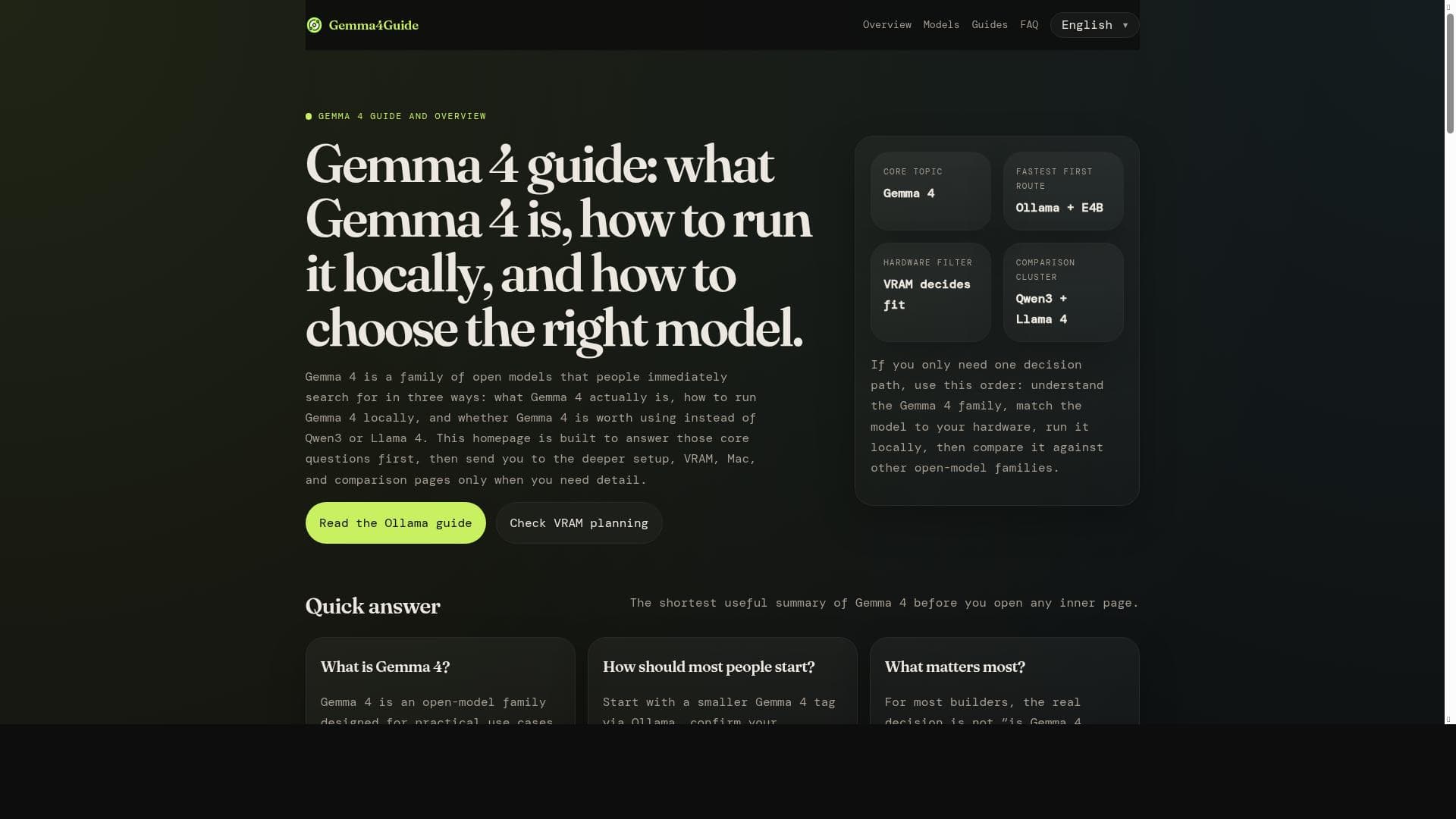
Google Gemma 4 is Google DeepMind’s most advanced open AI model family, delivering powerful reasoning, multimodal processing, and agentic workflows optimized for both mobile and GPU environments. Ideal for developers and enterprises, it enables the creation of sophisticated AI applications with high performance and low compute overhead—all available for free.

Description
Gemma 4 is Google DeepMind’s most capable open model family, delivering advanced reasoning, multimodal processing, and agentic workflows. Optimized for everything from mobile devices to GPUs, it enables developers to build powerful AI apps efficiently with high performance and low compute overhead.
Detailed Description
Google Gemma 4 represents the latest advancement in AI model technology developed by Google DeepMind, designed to empower developers with a highly capable and versatile open model family. At its core, Gemma 4 is engineered to deliver advanced reasoning capabilities, multimodal processing, and support for agentic workflows, making it a powerful tool for building sophisticated AI applications. Its optimization spans a wide range of hardware environments, from resource-constrained mobile devices to high-performance GPUs, ensuring accessibility and efficiency across diverse deployment scenarios. This flexibility allows developers to create AI solutions that are both performant and cost-effective, addressing the growing demand for intelligent applications in various industries. One of the standout features of Gemma 4 is its status as the most capable open model family to date from Google DeepMind. It is purpose-built to handle complex reasoning tasks that require understanding and synthesizing information from multiple sources and modalities, such as text, images, and potentially other data types. This multimodal processing capability enables developers to build AI applications that can interpret and generate content across different formats seamlessly. Additionally, Gemma 4 supports agentic workflows, which means it can manage sequences of tasks autonomously or semi-autonomously, enhancing the ability to create AI agents that perform complex operations with minimal human intervention. The open and accessible nature of Gemma 4 is another critical aspect, as it invites developers from various backgrounds to leverage its capabilities without restrictive barriers. This openness fosters innovation and experimentation, enabling the creation of novel AI-powered applications ranging from advanced AI assistants and content generation tools to intelligent automation systems. Its optimization for both mobile and GPU environments means that developers can target a broad spectrum of use cases, from lightweight on-device AI to large-scale cloud deployments. Google Gemma 4 is particularly well-suited for AI researchers, developers, and enterprises looking to integrate cutting-edge AI models into their products and services. Use cases include building intelligent virtual assistants capable of nuanced reasoning, developing AI-driven content creation platforms that handle multiple data types, and designing autonomous agents that streamline workflows in business processes. Its advanced reasoning capabilities also make it a valuable tool for applications requiring complex decision-making, such as recommendation systems, diagnostics, and strategic planning tools. In terms of pricing, Google Gemma 4 is offered for free, which significantly lowers the barrier to entry for developers and organizations eager to experiment with or deploy advanced AI models. This free access encourages widespread adoption and community-driven development, positioning Gemma 4 as a competitive option against proprietary AI models that often come with high costs or usage restrictions. When compared to alternatives, Gemma 4 stands out due to its combination of advanced reasoning, multimodal support, and agentic workflow capabilities within an open and optimized framework. While other AI models may excel in specific areas such as natural language processing or image recognition, Gemma 4’s integrated approach and performance efficiency across hardware types provide a unique value proposition. However, as with any cutting-edge AI tool, users should consider potential limitations such as the need for technical expertise to fully leverage its capabilities and the evolving nature of open model ecosystems that may require ongoing updates and community support. Overall, Google Gemma 4 offers a robust, flexible, and accessible AI modeling solution that caters to a wide range of development needs. Its advanced features and free availability make it an attractive choice for those seeking to push the boundaries of AI application development while maintaining efficiency and scalability.
Tool Features
- Most capable open models to date
- Purpose-built for advanced reasoning
- Supports agentic workflows
- Open and accessible for developers
Description
Google Gemma 4 is Google DeepMind’s most advanced open AI model family, delivering powerful reasoning, multimodal processing, and agentic workflows optimized for both mobile and GPU environments. Ideal for developers and enterprises, it enables the creation of sophisticated AI applications with high performance and low compute overhead—all available for free.
Gemma 4 is Google DeepMind’s most capable open model family, delivering advanced reasoning, multimodal processing, and agentic workflows. Optimized for everything from mobile devices to GPUs, it enables developers to build powerful AI apps efficiently with high performance and low compute overhead.
Detailed Description
Google Gemma 4 represents the latest advancement in AI model technology developed by Google DeepMind, designed to empower developers with a highly capable and versatile open model family. At its core, Gemma 4 is engineered to deliver advanced reasoning capabilities, multimodal processing, and support for agentic workflows, making it a powerful tool for building sophisticated AI applications. Its optimization spans a wide range of hardware environments, from resource-constrained mobile devices to high-performance GPUs, ensuring accessibility and efficiency across diverse deployment scenarios. This flexibility allows developers to create AI solutions that are both performant and cost-effective, addressing the growing demand for intelligent applications in various industries. One of the standout features of Gemma 4 is its status as the most capable open model family to date from Google DeepMind. It is purpose-built to handle complex reasoning tasks that require understanding and synthesizing information from multiple sources and modalities, such as text, images, and potentially other data types. This multimodal processing capability enables developers to build AI applications that can interpret and generate content across different formats seamlessly. Additionally, Gemma 4 supports agentic workflows, which means it can manage sequences of tasks autonomously or semi-autonomously, enhancing the ability to create AI agents that perform complex operations with minimal human intervention. The open and accessible nature of Gemma 4 is another critical aspect, as it invites developers from various backgrounds to leverage its capabilities without restrictive barriers. This openness fosters innovation and experimentation, enabling the creation of novel AI-powered applications ranging from advanced AI assistants and content generation tools to intelligent automation systems. Its optimization for both mobile and GPU environments means that developers can target a broad spectrum of use cases, from lightweight on-device AI to large-scale cloud deployments. Google Gemma 4 is particularly well-suited for AI researchers, developers, and enterprises looking to integrate cutting-edge AI models into their products and services. Use cases include building intelligent virtual assistants capable of nuanced reasoning, developing AI-driven content creation platforms that handle multiple data types, and designing autonomous agents that streamline workflows in business processes. Its advanced reasoning capabilities also make it a valuable tool for applications requiring complex decision-making, such as recommendation systems, diagnostics, and strategic planning tools. In terms of pricing, Google Gemma 4 is offered for free, which significantly lowers the barrier to entry for developers and organizations eager to experiment with or deploy advanced AI models. This free access encourages widespread adoption and community-driven development, positioning Gemma 4 as a competitive option against proprietary AI models that often come with high costs or usage restrictions. When compared to alternatives, Gemma 4 stands out due to its combination of advanced reasoning, multimodal support, and agentic workflow capabilities within an open and optimized framework. While other AI models may excel in specific areas such as natural language processing or image recognition, Gemma 4’s integrated approach and performance efficiency across hardware types provide a unique value proposition. However, as with any cutting-edge AI tool, users should consider potential limitations such as the need for technical expertise to fully leverage its capabilities and the evolving nature of open model ecosystems that may require ongoing updates and community support. Overall, Google Gemma 4 offers a robust, flexible, and accessible AI modeling solution that caters to a wide range of development needs. Its advanced features and free availability make it an attractive choice for those seeking to push the boundaries of AI application development while maintaining efficiency and scalability.
Frequently Asked Questions
What is Google Gemma 4?
Google Gemma 4 is the latest open model family from Google DeepMind, designed to provide advanced reasoning, multimodal processing, and support for agentic workflows, enabling developers to build powerful and efficient AI applications.
How much does Google Gemma 4 cost?
Google Gemma 4 is available for free, allowing developers and organizations to access its advanced AI capabilities without any cost.
Who is Google Gemma 4 best for?
It is best suited for AI researchers, developers, and enterprises looking to integrate advanced reasoning and multimodal AI models into their applications, particularly those needing efficient performance across mobile and GPU platforms.
What are the main features of Google Gemma 4?
Key features include being the most capable open model family to date, purpose-built advanced reasoning, support for agentic workflows, multimodal processing, and optimization for a broad range of hardware from mobile devices to GPUs.
Does Google Gemma 4 offer a free trial?
Yes, Google Gemma 4 is offered for free, so there is no need for a trial period; developers can access and use it directly without cost.
What integrations does Google Gemma 4 support?
While specific integrations depend on the developer's implementation, Gemma 4’s open nature allows it to be integrated into various AI applications, platforms, and workflows, supporting multimodal data and agentic task management.
How does Google Gemma 4 work?
Google Gemma 4 works by leveraging advanced AI architectures optimized for reasoning and multimodal inputs, enabling it to process and generate responses across different data types and manage complex task sequences autonomously or with minimal supervision.
Socials
Use ToolReviews
No reviews yet. Be the first to share your experience.