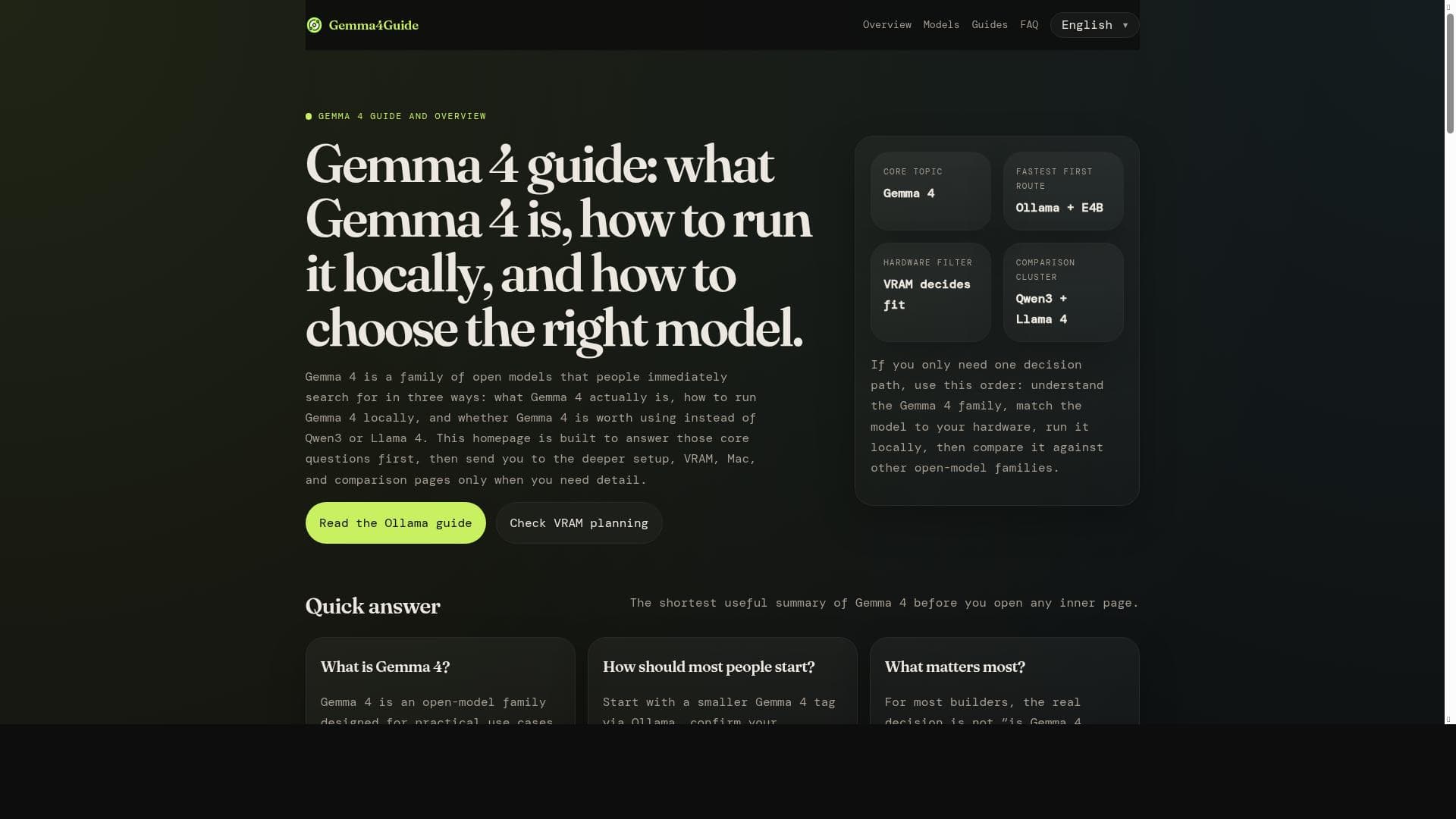


Gemma 4 is a versatile open-model AI family tailored for local deployment and multilingual workflows, offering a clear model ladder that scales with your hardware. Ideal for developers and organizations seeking control and privacy, it enables efficient testing and deployment from lightweight models to high-performance versions on stronger GPUs.

Description
Gemma 4 is an open-model family designed for practical use cases such as local deployment, tool use, and multilingual workflows. It focuses on providing a clear model ladder for users who want control and local testing, rather than just benchmark watching. The family offers different tiers to match hardware capabilities and use cases, enabling users to start small and scale up as needed.
Detailed Description
Gemma 4 is an innovative open-model family designed to address practical AI deployment needs, particularly focusing on local use cases, tool integration, and multilingual workflows. Unlike many AI models that prioritize benchmark performance and cloud-based inference, Gemma 4 emphasizes user control, local testing, and scalability according to hardware capabilities. This approach makes it highly suitable for developers, researchers, and organizations that require flexible, on-premise AI solutions without sacrificing quality or versatility. The core purpose of Gemma 4 is to provide a clear, structured model ladder that allows users to start with smaller, resource-efficient models for initial testing and validation, then scale up to more powerful models as their hardware and use case demands grow. This tiered system ensures that users can optimize their AI workflows based on available VRAM and GPU strength, reducing unnecessary overhead and maximizing efficiency. Key features of Gemma 4 include its open-model architecture, which encourages transparency and adaptability for diverse applications. The family supports local deployment, enabling users to run models directly on their own hardware without relying on cloud services, which is crucial for privacy, latency, and cost considerations. Additionally, Gemma 4 is designed with multilingual workflows in mind, supporting multiple languages to cater to global users and applications. The model tiers range from lightweight versions that fit modest hardware setups to high-quality, resource-intensive models optimized for strong GPUs. This flexibility allows users to validate their workflows using smaller models before committing to more demanding versions, facilitating iterative development and testing. Gemma 4 also provides detailed guidance on VRAM requirements and hardware compatibility, helping users select the appropriate model tier for their specific environment and use case. Gemma 4 is best suited for AI practitioners who prioritize control, privacy, and customization in their AI deployments. This includes developers building AI-powered tools that require local inference, researchers conducting experiments that need reproducibility and hardware-specific tuning, and enterprises seeking to integrate multilingual AI capabilities without depending on external cloud providers. Use cases span from natural language processing tasks, such as translation and summarization, to tool-assisted workflows where AI models interact with external APIs or software. Its open-model nature also appeals to the open-source community and organizations aiming to avoid vendor lock-in. Regarding pricing, Gemma 4 is an open-model family, which typically means the models themselves are freely available for download and use under open licenses. However, users should consider the costs associated with the necessary hardware to run the models efficiently, especially for higher-tier versions requiring stronger GPUs and more VRAM. There may also be optional commercial support or enhanced versions offered by the developers, but the core models emphasize accessibility and practical deployment without mandatory subscription fees. Compared to alternative AI models, Gemma 4 stands out by focusing on a clear model ladder and practical usability rather than solely chasing benchmark scores. Many popular models are cloud-centric or designed for maximum accuracy at the expense of resource demands, whereas Gemma 4 balances quality with hardware adaptability. Its multilingual support and local deployment capabilities provide an edge for users needing privacy and customization. However, it may not match the absolute top-tier performance of some proprietary models hosted on specialized infrastructure. Still, its open nature and scalability make it a compelling choice for those valuing control and incremental growth. Notable limitations include the potential complexity of managing multiple model tiers and ensuring compatibility with specific hardware configurations. Users must carefully assess their VRAM and GPU capabilities to select the appropriate model, which may require technical expertise. Additionally, while the open-model approach promotes flexibility, it may lack some of the polished user interfaces or turnkey solutions offered by commercial AI platforms. Finally, as an open-model family, ongoing community support and updates depend on the developer ecosystem, which may vary in responsiveness compared to commercial vendors. In summary, Gemma 4 is a thoughtfully designed open-model AI family that empowers users to deploy and scale AI models locally with multilingual support and clear hardware guidance. Its tiered approach and focus on practical use cases make it an excellent choice for developers and organizations seeking control, privacy, and adaptability in their AI workflows.
Tool Features
- Open-model family for practical use
- Supports local deployment and multilingual workflows
- Offers multiple model tiers to fit different hardware
- Enables workflow validation with smaller models
- Scales to higher quality models for stronger GPUs
- Focuses on user control and local testing
- Provides guidance on VRAM requirements and hardware fit
Description
Gemma 4 is a versatile open-model AI family tailored for local deployment and multilingual workflows, offering a clear model ladder that scales with your hardware. Ideal for developers and organizations seeking control and privacy, it enables efficient testing and deployment from lightweight models to high-performance versions on stronger GPUs.
Gemma 4 is an open-model family designed for practical use cases such as local deployment, tool use, and multilingual workflows. It focuses on providing a clear model ladder for users who want control and local testing, rather than just benchmark watching. The family offers different tiers to match hardware capabilities and use cases, enabling users to start small and scale up as needed.
Detailed Description
Gemma 4 is an innovative open-model family designed to address practical AI deployment needs, particularly focusing on local use cases, tool integration, and multilingual workflows. Unlike many AI models that prioritize benchmark performance and cloud-based inference, Gemma 4 emphasizes user control, local testing, and scalability according to hardware capabilities. This approach makes it highly suitable for developers, researchers, and organizations that require flexible, on-premise AI solutions without sacrificing quality or versatility. The core purpose of Gemma 4 is to provide a clear, structured model ladder that allows users to start with smaller, resource-efficient models for initial testing and validation, then scale up to more powerful models as their hardware and use case demands grow. This tiered system ensures that users can optimize their AI workflows based on available VRAM and GPU strength, reducing unnecessary overhead and maximizing efficiency. Key features of Gemma 4 include its open-model architecture, which encourages transparency and adaptability for diverse applications. The family supports local deployment, enabling users to run models directly on their own hardware without relying on cloud services, which is crucial for privacy, latency, and cost considerations. Additionally, Gemma 4 is designed with multilingual workflows in mind, supporting multiple languages to cater to global users and applications. The model tiers range from lightweight versions that fit modest hardware setups to high-quality, resource-intensive models optimized for strong GPUs. This flexibility allows users to validate their workflows using smaller models before committing to more demanding versions, facilitating iterative development and testing. Gemma 4 also provides detailed guidance on VRAM requirements and hardware compatibility, helping users select the appropriate model tier for their specific environment and use case. Gemma 4 is best suited for AI practitioners who prioritize control, privacy, and customization in their AI deployments. This includes developers building AI-powered tools that require local inference, researchers conducting experiments that need reproducibility and hardware-specific tuning, and enterprises seeking to integrate multilingual AI capabilities without depending on external cloud providers. Use cases span from natural language processing tasks, such as translation and summarization, to tool-assisted workflows where AI models interact with external APIs or software. Its open-model nature also appeals to the open-source community and organizations aiming to avoid vendor lock-in. Regarding pricing, Gemma 4 is an open-model family, which typically means the models themselves are freely available for download and use under open licenses. However, users should consider the costs associated with the necessary hardware to run the models efficiently, especially for higher-tier versions requiring stronger GPUs and more VRAM. There may also be optional commercial support or enhanced versions offered by the developers, but the core models emphasize accessibility and practical deployment without mandatory subscription fees. Compared to alternative AI models, Gemma 4 stands out by focusing on a clear model ladder and practical usability rather than solely chasing benchmark scores. Many popular models are cloud-centric or designed for maximum accuracy at the expense of resource demands, whereas Gemma 4 balances quality with hardware adaptability. Its multilingual support and local deployment capabilities provide an edge for users needing privacy and customization. However, it may not match the absolute top-tier performance of some proprietary models hosted on specialized infrastructure. Still, its open nature and scalability make it a compelling choice for those valuing control and incremental growth. Notable limitations include the potential complexity of managing multiple model tiers and ensuring compatibility with specific hardware configurations. Users must carefully assess their VRAM and GPU capabilities to select the appropriate model, which may require technical expertise. Additionally, while the open-model approach promotes flexibility, it may lack some of the polished user interfaces or turnkey solutions offered by commercial AI platforms. Finally, as an open-model family, ongoing community support and updates depend on the developer ecosystem, which may vary in responsiveness compared to commercial vendors. In summary, Gemma 4 is a thoughtfully designed open-model AI family that empowers users to deploy and scale AI models locally with multilingual support and clear hardware guidance. Its tiered approach and focus on practical use cases make it an excellent choice for developers and organizations seeking control, privacy, and adaptability in their AI workflows.
Frequently Asked Questions
What is Gemma 4?
Gemma 4 is an open-model family of AI models designed for practical use cases such as local deployment, tool integration, and multilingual workflows. It provides a tiered system of models that scale according to hardware capabilities, allowing users to start with smaller models for testing and scale up to more powerful versions as needed.
How much does Gemma 4 cost?
Gemma 4 models are open and typically available for free download and use under open licenses. However, users need to consider the hardware costs associated with running the models, especially for higher-tier versions that require stronger GPUs and more VRAM.
Who is Gemma 4 best for?
Gemma 4 is best suited for developers, researchers, and organizations that require local AI deployment with control over their models, privacy, and multilingual capabilities. It is ideal for those who want to validate workflows on smaller models before scaling up and for users who prefer open-source solutions over cloud-dependent AI services.
What are the main features of Gemma 4?
The main features of Gemma 4 include an open-model architecture for practical use, support for local deployment, multilingual workflow compatibility, multiple model tiers tailored to different hardware capabilities, workflow validation with smaller models, scalability to higher-quality models for stronger GPUs, user control focus, and detailed guidance on VRAM requirements and hardware fit.
Does Gemma 4 offer a free trial?
Since Gemma 4 is an open-model family, the models themselves are generally freely accessible without a trial period. Users can download and deploy the models locally to evaluate them directly.
What integrations does Gemma 4 support?
Gemma 4 supports integration into local AI workflows and tools, enabling developers to incorporate the models into various applications that require natural language processing and multilingual capabilities. Specific integration options depend on the user's development environment and toolchain.
How does Gemma 4 work?
Gemma 4 works by providing a family of AI models that users can deploy locally on their hardware. Users select a model tier that fits their GPU and VRAM capacity, enabling them to run AI tasks such as language understanding and generation. The tiered approach allows users to validate workflows with smaller models and scale to higher-quality models as their hardware permits.
Reviews
No reviews yet. Be the first to share your experience.