

Is this your AI tool? Claim it today.
Verify ownership, manage your profile, and unlock growth features.
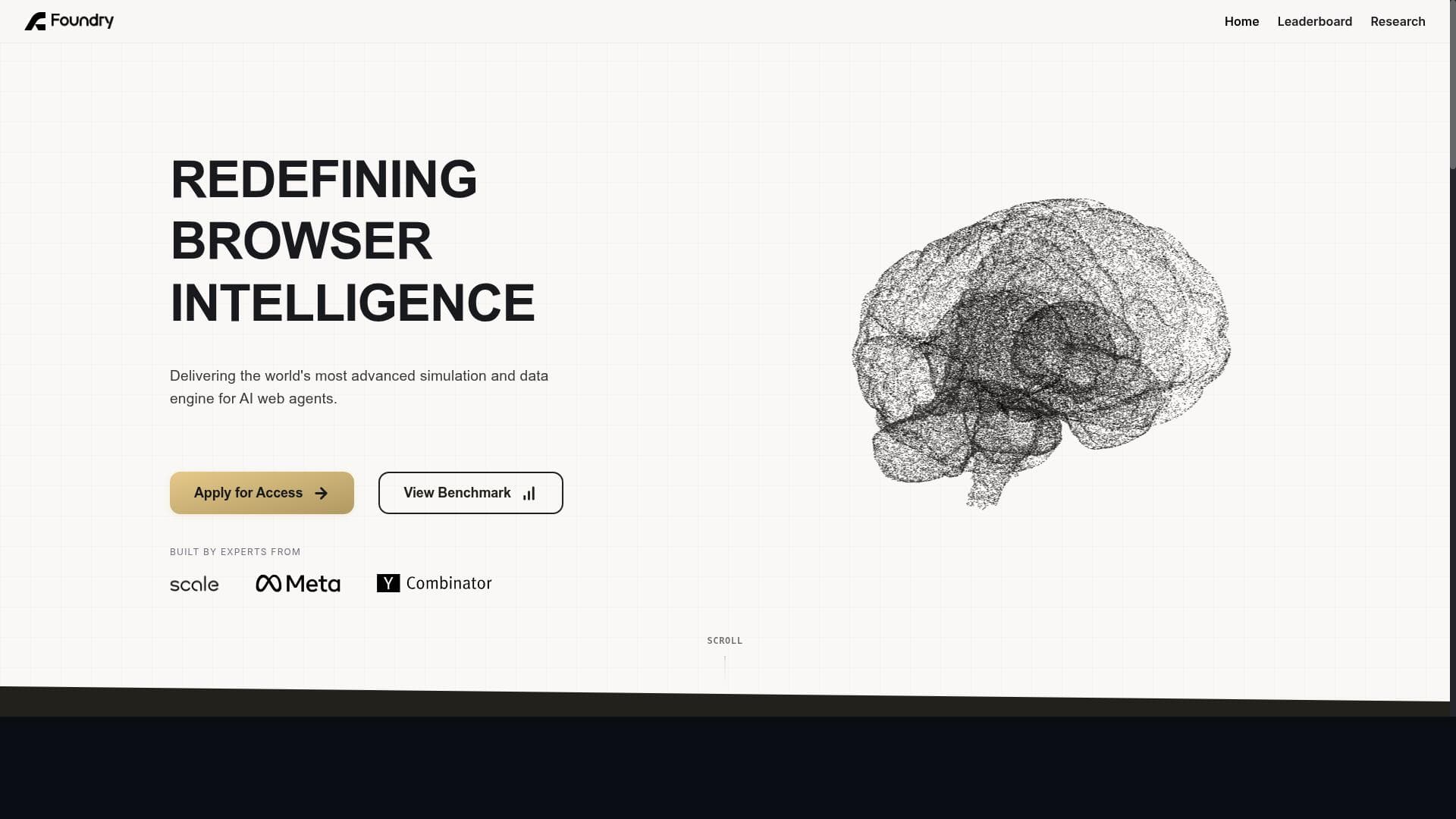
Foundry is an enterprise-focused AI platform that builds, evaluates, and optimizes intelligent agents to automate critical business functions like customer support, hiring, and sales. Its unique blend of high-quality data production, robust evaluation tools, and reinforcement learning makes it ideal for businesses seeking scalable, reliable AI automation without the common pitfalls of web-based agents.

Description
Foundry is a platform to build, evaluate, and improve AI agents that can automate key parts of your business—customer support, hiring, sales, and more.
Detailed Description
Foundry is a comprehensive AI platform designed to help businesses build, evaluate, and continuously improve AI agents that automate critical operational tasks such as customer support, hiring, and sales processes. Its core purpose is to empower enterprises to deploy intelligent agents that not only perform complex workflows but also adapt and optimize over time, ensuring high-quality outcomes and operational efficiency. By focusing on automation of key business functions, Foundry enables organizations to reduce manual workload, improve response times, and enhance overall customer and employee experiences. At the heart of Foundry’s value proposition are its robust features that address common challenges in AI agent deployment and management. The platform excels in producing high-quality enterprise data, which is essential for training and refining AI models with accuracy and relevance. Foundry’s evaluation framework allows businesses to reliably assess agent performance at scale, providing actionable insights to optimize their AI workflows. It also incorporates mechanisms to avoid common pitfalls such as web drift, IP bans, or rate limits, which can disrupt data collection and agent functionality. One standout feature is deterministic web snapshots, which capture consistent and reproducible web states to ensure reliable agent training and testing. Additionally, Foundry offers structured error classification, enabling teams to systematically identify and address issues in agent behavior. Its support for unlimited reinforcement learning specifically for browser agents allows continuous improvement through real-time feedback and learning cycles. The platform also facilitates agent benchmarking and supervised fine-tuning, giving organizations the tools to compare different AI agents and iteratively enhance their capabilities based on performance metrics. Foundry is best suited for medium to large enterprises that rely heavily on automated workflows in customer service, recruitment, sales, and other operational areas. Companies looking to scale their AI initiatives with reliable data pipelines and advanced evaluation tools will find Foundry particularly beneficial. Use cases include automating customer support ticket resolution, streamlining candidate screening processes in hiring, and optimizing sales outreach through intelligent agent interactions. Its ability to handle complex web interactions and maintain compliance with web usage policies makes it ideal for businesses that depend on web-based data and automation. Regarding pricing, Foundry operates on a paid model, though specific pricing tiers or plans are not publicly detailed on their website. Prospective users typically need to contact the Foundry team for customized pricing based on their scale and feature requirements. This approach suggests a tailored enterprise focus rather than a one-size-fits-all pricing structure. Compared to alternatives, Foundry stands out for its comprehensive approach to AI agent lifecycle management, combining data production, evaluation, error classification, and reinforcement learning in a single platform. Many competing tools focus on isolated aspects such as model training or deployment, whereas Foundry integrates these stages to provide end-to-end control and optimization. Its deterministic web snapshots and mechanisms to avoid web drift and IP bans also differentiate it by addressing real-world challenges in web automation that many platforms overlook. However, potential limitations include the lack of publicly available pricing information, which may pose a barrier for smaller businesses or startups with limited budgets. Additionally, the platform’s advanced features and enterprise orientation might require a steep learning curve or dedicated technical resources to fully leverage its capabilities. Foundry’s focus on browser-based agents may also limit applicability for organizations seeking AI automation beyond web environments. In summary, Foundry is a powerful, enterprise-grade AI platform designed to automate and optimize key business processes through intelligent agents. Its rich feature set, emphasis on reliable data and evaluation, and reinforcement learning capabilities make it a compelling choice for organizations aiming to scale AI-driven automation with precision and control.
Tool Features
- Produce high-quality enterprise data
- Evaluate reliably and optimize performance at scale
- Avoid web drift, IP bans, or rate limits
- Deterministic web snapshots
- Structured error classification
- Unlimited reinforcement learning for browser agents
- Agent benchmarking and supervised fine-tuning
Description
Foundry is an enterprise-focused AI platform that builds, evaluates, and optimizes intelligent agents to automate critical business functions like customer support, hiring, and sales. Its unique blend of high-quality data production, robust evaluation tools, and reinforcement learning makes it ideal for businesses seeking scalable, reliable AI automation without the common pitfalls of web-based agents.
Foundry is a platform to build, evaluate, and improve AI agents that can automate key parts of your business—customer support, hiring, sales, and more.
Detailed Description
Foundry is a comprehensive AI platform designed to help businesses build, evaluate, and continuously improve AI agents that automate critical operational tasks such as customer support, hiring, and sales processes. Its core purpose is to empower enterprises to deploy intelligent agents that not only perform complex workflows but also adapt and optimize over time, ensuring high-quality outcomes and operational efficiency. By focusing on automation of key business functions, Foundry enables organizations to reduce manual workload, improve response times, and enhance overall customer and employee experiences. At the heart of Foundry’s value proposition are its robust features that address common challenges in AI agent deployment and management. The platform excels in producing high-quality enterprise data, which is essential for training and refining AI models with accuracy and relevance. Foundry’s evaluation framework allows businesses to reliably assess agent performance at scale, providing actionable insights to optimize their AI workflows. It also incorporates mechanisms to avoid common pitfalls such as web drift, IP bans, or rate limits, which can disrupt data collection and agent functionality. One standout feature is deterministic web snapshots, which capture consistent and reproducible web states to ensure reliable agent training and testing. Additionally, Foundry offers structured error classification, enabling teams to systematically identify and address issues in agent behavior. Its support for unlimited reinforcement learning specifically for browser agents allows continuous improvement through real-time feedback and learning cycles. The platform also facilitates agent benchmarking and supervised fine-tuning, giving organizations the tools to compare different AI agents and iteratively enhance their capabilities based on performance metrics. Foundry is best suited for medium to large enterprises that rely heavily on automated workflows in customer service, recruitment, sales, and other operational areas. Companies looking to scale their AI initiatives with reliable data pipelines and advanced evaluation tools will find Foundry particularly beneficial. Use cases include automating customer support ticket resolution, streamlining candidate screening processes in hiring, and optimizing sales outreach through intelligent agent interactions. Its ability to handle complex web interactions and maintain compliance with web usage policies makes it ideal for businesses that depend on web-based data and automation. Regarding pricing, Foundry operates on a paid model, though specific pricing tiers or plans are not publicly detailed on their website. Prospective users typically need to contact the Foundry team for customized pricing based on their scale and feature requirements. This approach suggests a tailored enterprise focus rather than a one-size-fits-all pricing structure. Compared to alternatives, Foundry stands out for its comprehensive approach to AI agent lifecycle management, combining data production, evaluation, error classification, and reinforcement learning in a single platform. Many competing tools focus on isolated aspects such as model training or deployment, whereas Foundry integrates these stages to provide end-to-end control and optimization. Its deterministic web snapshots and mechanisms to avoid web drift and IP bans also differentiate it by addressing real-world challenges in web automation that many platforms overlook. However, potential limitations include the lack of publicly available pricing information, which may pose a barrier for smaller businesses or startups with limited budgets. Additionally, the platform’s advanced features and enterprise orientation might require a steep learning curve or dedicated technical resources to fully leverage its capabilities. Foundry’s focus on browser-based agents may also limit applicability for organizations seeking AI automation beyond web environments. In summary, Foundry is a powerful, enterprise-grade AI platform designed to automate and optimize key business processes through intelligent agents. Its rich feature set, emphasis on reliable data and evaluation, and reinforcement learning capabilities make it a compelling choice for organizations aiming to scale AI-driven automation with precision and control.
Frequently Asked Questions
What is Foundry?
Foundry is a platform designed to build, evaluate, and improve AI agents that automate key business processes such as customer support, hiring, and sales. It provides tools to produce high-quality data, optimize agent performance, and continuously enhance AI workflows.
How much does Foundry cost?
Foundry operates on a paid pricing model, but specific pricing details are not publicly listed. Interested users need to contact the Foundry team directly to receive customized pricing based on their business needs and scale.
Who is Foundry best for?
Foundry is best suited for medium to large enterprises that require scalable AI automation for customer support, recruitment, sales, and other operational workflows. It is ideal for organizations looking to deploy and optimize intelligent agents with robust data and evaluation capabilities.
What are the main features of Foundry?
Key features include producing high-quality enterprise data, reliable evaluation and performance optimization at scale, avoidance of web drift and IP bans, deterministic web snapshots, structured error classification, unlimited reinforcement learning for browser agents, and agent benchmarking with supervised fine-tuning.
Does Foundry offer a free trial?
There is no publicly available information indicating that Foundry offers a free trial. Prospective users should contact the company directly to inquire about trial options or demos.
What integrations does Foundry support?
Specific integrations are not detailed publicly. However, Foundry’s focus on browser-based AI agents suggests it integrates with web environments and enterprise data systems to facilitate automation and data collection.
How does Foundry work?
Foundry works by enabling businesses to build AI agents that interact with web environments and enterprise systems. It produces high-quality data for training, evaluates agent performance at scale, and uses reinforcement learning and fine-tuning to continuously improve agent effectiveness while avoiding common web automation issues.
Reviews
No reviews yet. Be the first to share your experience.