

Is this your AI tool? Claim it today.
Verify ownership, manage your profile, and unlock growth features.
Cognee is an open-source semantic memory layer that empowers AI agents to deliver precise, context-aware responses by constructing knowledge graphs from data. Ideal for developers and enterprises, it uncovers hidden data connections and enhances AI infrastructure through its innovative vector and graph database integration.

Description
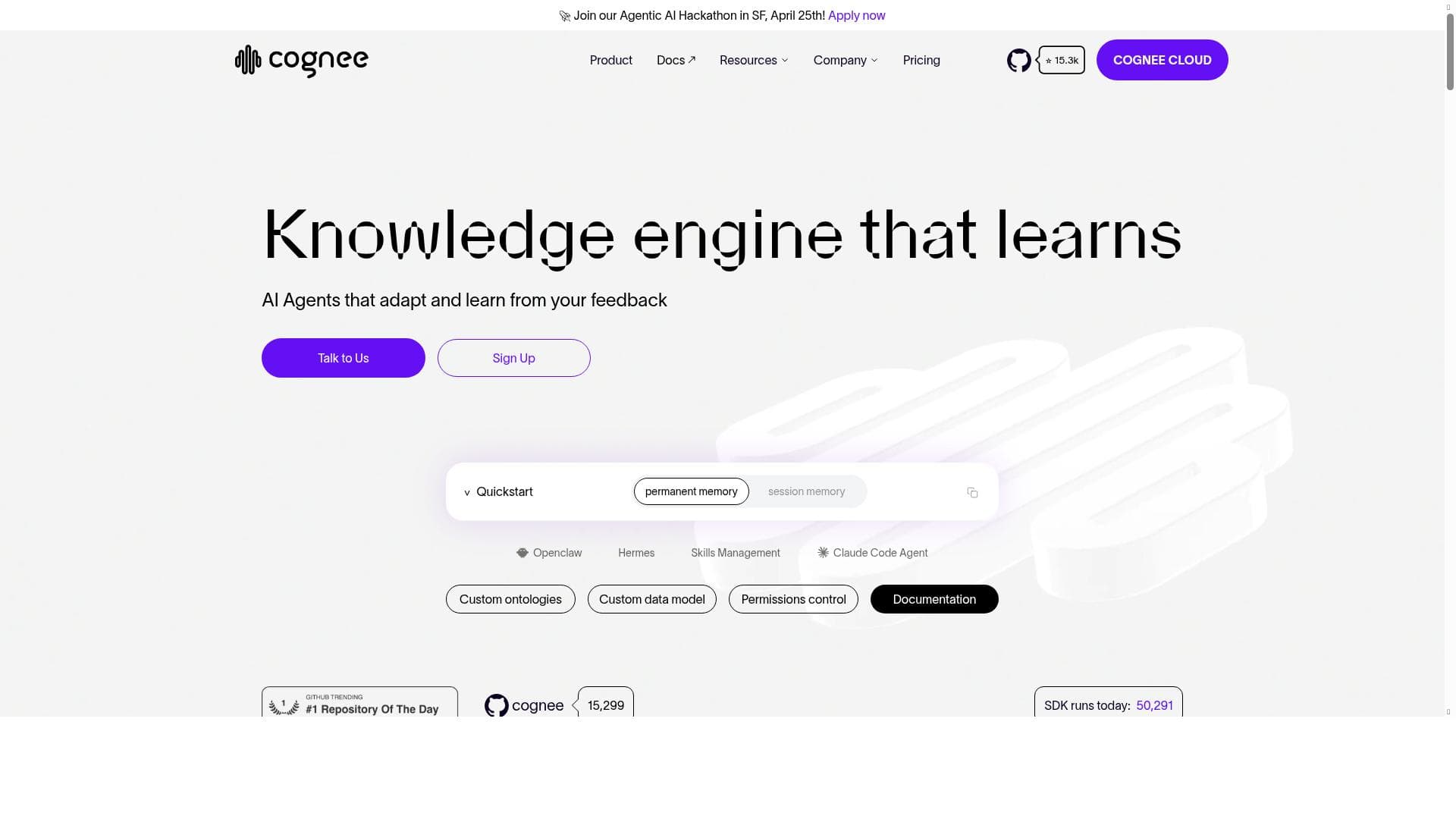
cognee is an open-source semantic memory layer for AI agents, built on vector and graph databases. It constructs knowledge graphs from retrieved data, enabling AI apps and agents to deliver accurate, context-aware responses.
Detailed Description
Cognee is an innovative open-source semantic memory layer designed specifically for AI agents and applications that require deep contextual understanding and knowledge management. At its core, cognee leverages advanced vector and graph database technologies to construct dynamic knowledge graphs from retrieved data. This unique approach allows AI systems to store, organize, and retrieve information in a way that mimics human-like memory, enabling them to deliver highly accurate and context-aware responses. By integrating semantic memory capabilities, cognee enhances the intelligence and responsiveness of AI agents, making them more effective in complex decision-making and problem-solving scenarios. One of the standout features of cognee is its open-source AI memory engine, which provides developers and organizations with full transparency and flexibility to customize and extend the platform according to their specific needs. This engine is designed to identify and uncover hidden connections within disparate data sources by mapping relationships in a graph structure. This capability is crucial for applications that require nuanced understanding of data interdependencies, such as recommendation systems, knowledge management platforms, and conversational AI. Additionally, cognee’s architecture improves AI infrastructure by enabling seamless integration with existing AI models and data pipelines, thus enhancing overall system performance and scalability. Cognee is particularly well-suited for AI developers, data scientists, and enterprises aiming to build sophisticated AI applications that demand contextual awareness and semantic reasoning. Use cases include intelligent virtual assistants that can recall and relate past interactions, research tools that synthesize information from multiple documents, and enterprise knowledge bases that dynamically update and link organizational data. Its open-source nature also makes it an excellent choice for academic research and experimental AI projects where customization and transparency are paramount. Regarding pricing, cognee operates on a freemium model, offering a free tier that allows users to explore its core functionalities and build initial projects without cost. This approach lowers the barrier to entry for startups and individual developers. For more advanced features, higher usage limits, or enterprise-grade support, paid plans are available, although specific pricing details are typically provided upon inquiry or through the official website. Compared to alternative AI memory solutions, cognee stands out due to its combination of vector and graph database technologies, which provides a richer semantic representation than systems relying solely on vector embeddings or traditional databases. Its open-source license also contrasts with many proprietary memory layers, granting users greater control and the ability to contribute to the platform’s evolution. However, users should consider that as an open-source project, cognee may require more hands-on setup and maintenance compared to fully managed commercial services. Potential limitations include the need for technical expertise to deploy and optimize the system effectively, especially when integrating with complex AI infrastructures. Additionally, while the freemium model is attractive, scaling to large enterprise deployments may involve additional costs and resource commitments. Users should also evaluate how cognee’s memory layer fits within their broader AI ecosystem to ensure compatibility and performance alignment. In summary, cognee offers a powerful and flexible semantic memory solution that enhances AI agents’ ability to understand and utilize knowledge contextually. Its open-source foundation, combined with advanced graph and vector database integration, makes it a compelling choice for developers and organizations seeking to build next-generation AI applications with enriched memory capabilities.
Tool Features
- Open source AI memory engine
- Find hidden connections in data
- Improve AI infrastructure
Description
Cognee is an open-source semantic memory layer that empowers AI agents to deliver precise, context-aware responses by constructing knowledge graphs from data. Ideal for developers and enterprises, it uncovers hidden data connections and enhances AI infrastructure through its innovative vector and graph database integration.
cognee is an open-source semantic memory layer for AI agents, built on vector and graph databases. It constructs knowledge graphs from retrieved data, enabling AI apps and agents to deliver accurate, context-aware responses.
Detailed Description
Cognee is an innovative open-source semantic memory layer designed specifically for AI agents and applications that require deep contextual understanding and knowledge management. At its core, cognee leverages advanced vector and graph database technologies to construct dynamic knowledge graphs from retrieved data. This unique approach allows AI systems to store, organize, and retrieve information in a way that mimics human-like memory, enabling them to deliver highly accurate and context-aware responses. By integrating semantic memory capabilities, cognee enhances the intelligence and responsiveness of AI agents, making them more effective in complex decision-making and problem-solving scenarios. One of the standout features of cognee is its open-source AI memory engine, which provides developers and organizations with full transparency and flexibility to customize and extend the platform according to their specific needs. This engine is designed to identify and uncover hidden connections within disparate data sources by mapping relationships in a graph structure. This capability is crucial for applications that require nuanced understanding of data interdependencies, such as recommendation systems, knowledge management platforms, and conversational AI. Additionally, cognee’s architecture improves AI infrastructure by enabling seamless integration with existing AI models and data pipelines, thus enhancing overall system performance and scalability. Cognee is particularly well-suited for AI developers, data scientists, and enterprises aiming to build sophisticated AI applications that demand contextual awareness and semantic reasoning. Use cases include intelligent virtual assistants that can recall and relate past interactions, research tools that synthesize information from multiple documents, and enterprise knowledge bases that dynamically update and link organizational data. Its open-source nature also makes it an excellent choice for academic research and experimental AI projects where customization and transparency are paramount. Regarding pricing, cognee operates on a freemium model, offering a free tier that allows users to explore its core functionalities and build initial projects without cost. This approach lowers the barrier to entry for startups and individual developers. For more advanced features, higher usage limits, or enterprise-grade support, paid plans are available, although specific pricing details are typically provided upon inquiry or through the official website. Compared to alternative AI memory solutions, cognee stands out due to its combination of vector and graph database technologies, which provides a richer semantic representation than systems relying solely on vector embeddings or traditional databases. Its open-source license also contrasts with many proprietary memory layers, granting users greater control and the ability to contribute to the platform’s evolution. However, users should consider that as an open-source project, cognee may require more hands-on setup and maintenance compared to fully managed commercial services. Potential limitations include the need for technical expertise to deploy and optimize the system effectively, especially when integrating with complex AI infrastructures. Additionally, while the freemium model is attractive, scaling to large enterprise deployments may involve additional costs and resource commitments. Users should also evaluate how cognee’s memory layer fits within their broader AI ecosystem to ensure compatibility and performance alignment. In summary, cognee offers a powerful and flexible semantic memory solution that enhances AI agents’ ability to understand and utilize knowledge contextually. Its open-source foundation, combined with advanced graph and vector database integration, makes it a compelling choice for developers and organizations seeking to build next-generation AI applications with enriched memory capabilities.
Frequently Asked Questions
What is cognee?
Cognee is an open-source semantic memory layer designed for AI agents. It uses vector and graph databases to build knowledge graphs from retrieved data, enabling AI applications to provide accurate and context-aware responses.
How much does cognee cost?
Cognee offers a freemium pricing model. Users can access core features for free, with paid plans available for advanced functionalities, higher usage limits, and enterprise support. Detailed pricing information is available on their website.
Who is cognee best for?
Cognee is ideal for AI developers, data scientists, and enterprises looking to build AI applications that require semantic memory and contextual understanding, such as virtual assistants, knowledge management systems, and research tools.
What are the main features of cognee?
Key features include an open-source AI memory engine, the ability to find hidden connections in data through knowledge graph construction, and tools to improve AI infrastructure by integrating semantic memory capabilities.
Does cognee offer a free trial?
Yes, cognee’s freemium model allows users to try core features for free, enabling them to explore and build projects without initial cost.
What integrations does cognee support?
Cognee integrates with vector and graph databases and can be incorporated into existing AI models and data pipelines to enhance semantic memory capabilities. Specific integrations depend on user implementation and customization.
How does cognee work?
Cognee works by retrieving data and constructing knowledge graphs using vector and graph databases. This semantic memory layer helps AI agents understand context and relationships within data, enabling more accurate and context-aware responses.
Socials
Use ToolReviews
No reviews yet. Be the first to share your experience.