AI Styling Studio — Infinite avatar looks from just 1 photo. Try it now.
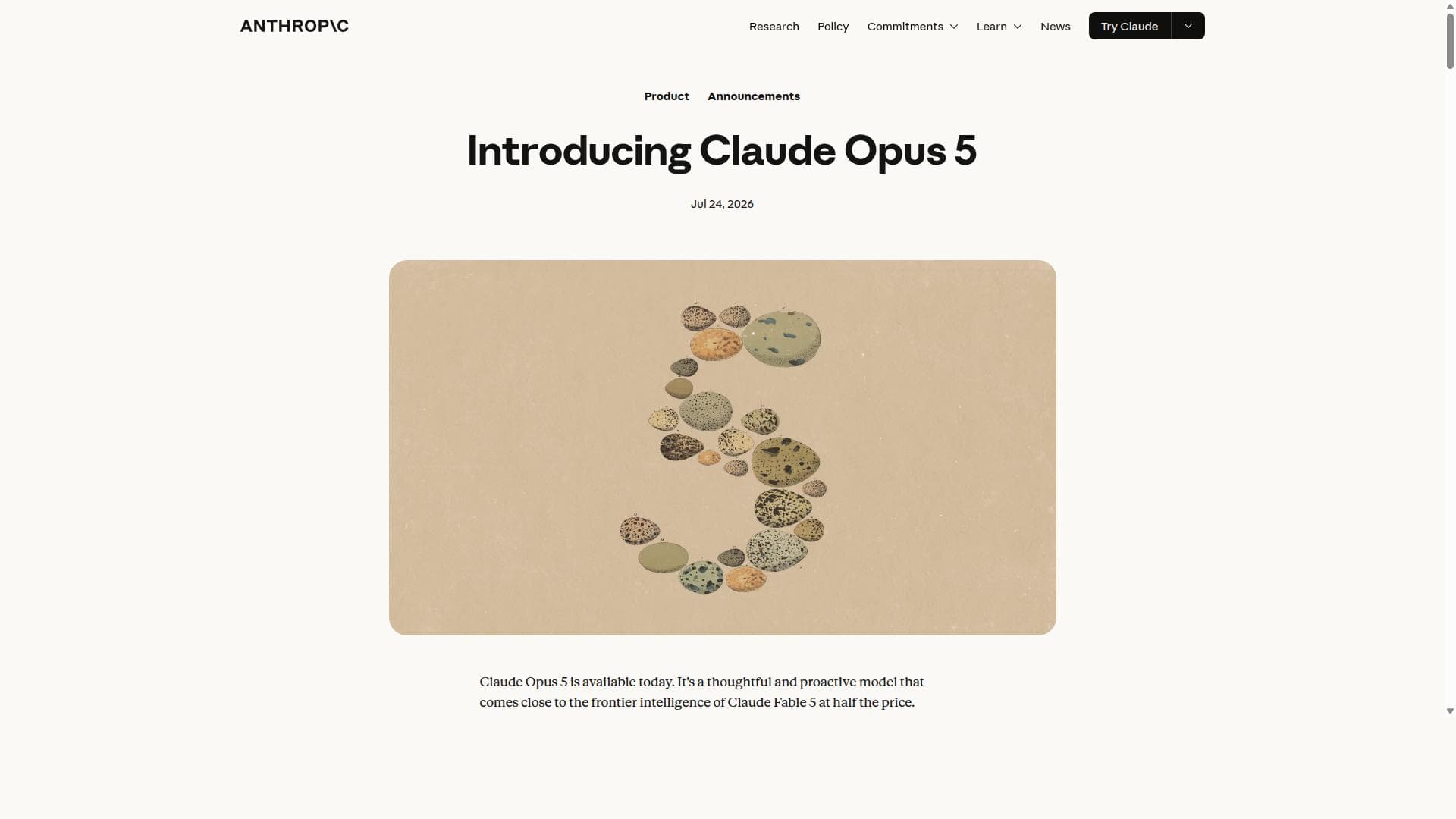


Claude Opus 5 is a cutting-edge AI model designed to power long-running agents with enhanced coding and professional work capabilities. Ideal for developers and professionals needing sustained, context-aware AI assistance, it significantly boosts productivity by maintaining coherence over extended interactions and delivering smarter code generation.

Description
Opus 5 is a step change improvement for the Opus tier powering long-running agents while delivering improvements in coding and professional work.
Detailed Description
Claude Opus 5 is an advanced AI language model developed by Anthropic, representing a significant evolution within the Opus tier of AI tools. Its core purpose is to power long-running agents that require sustained context and complex task management over extended interactions. This makes Claude Opus 5 particularly suited for professional environments where continuous, coherent, and context-aware AI assistance is essential. The model excels in delivering improvements in coding capabilities and professional work tasks, enabling users to boost productivity and efficiency in various domains. At its heart, Claude Opus 5 introduces a step change improvement over previous iterations in the Opus tier. This means it can maintain longer conversations or workflows without losing track of context, which is crucial for applications such as software development, project management, and complex problem-solving. The tool has been optimized to enhance coding tasks, providing users with more accurate, contextually relevant code generation, debugging assistance, and code review capabilities. Beyond coding, Claude Opus 5 supports a broad range of professional work activities, including drafting documents, analyzing data, generating reports, and automating routine tasks, all with improved reliability and depth. The key features of Claude Opus 5 include its ability to power long-running agents, which means it can handle ongoing tasks that require memory of previous interactions and evolving contexts. This is a major advancement for AI tools that traditionally struggle with maintaining coherence over extended sessions. Additionally, the model delivers notable improvements in coding, such as better understanding of programming languages, enhanced syntax generation, and more intelligent suggestions. Its professional work capabilities are also enhanced, allowing it to assist in complex workflows, multi-step reasoning, and nuanced communication tasks. Claude Opus 5 is best suited for developers, software engineers, data analysts, project managers, and other professionals who rely on AI to augment their work. Use cases include automated coding assistants that help write and debug code, virtual agents that manage ongoing projects or customer interactions, and AI collaborators that support document creation and data analysis. Organizations looking to integrate AI into their workflows for sustained, high-quality assistance will find Claude Opus 5 particularly valuable. Regarding pricing and plans, Anthropic typically offers tiered access to its AI models, with the Opus tier representing a premium level of service. While specific pricing details for Claude Opus 5 are not publicly disclosed on the announcement page, it is expected to be available through Anthropic's API with usage-based pricing or subscription plans tailored to enterprise needs. Interested users should contact Anthropic directly or visit their website for the most current pricing information and access options. When compared to alternatives, Claude Opus 5 stands out due to its focus on long-running agent capabilities and enhanced coding proficiency. Many AI language models excel at short interactions but lose context over time; Claude Opus 5 addresses this limitation by maintaining coherence in extended sessions. Its improvements in professional work tasks also position it above general-purpose models that may lack domain-specific optimizations. However, as with any AI tool, users should evaluate it against competitors like OpenAI's GPT models or other specialized coding assistants based on their specific requirements. Notable limitations or considerations include the typical challenges of AI language models, such as occasional inaccuracies, potential biases, and the need for human oversight in critical applications. Additionally, the advanced capabilities of Claude Opus 5 may require higher computational resources and costs compared to simpler models. Users should also consider data privacy and security policies when integrating the tool into sensitive workflows. Overall, Claude Opus 5 represents a powerful and versatile AI solution for professionals seeking to leverage AI for complex, ongoing tasks with improved coding and work-related functionalities.
Tool Features
- Step change improvement for the Opus tier
- Powers long-running agents
- Delivers improvements in coding
- Enhances professional work capabilities
Description
Claude Opus 5 is a cutting-edge AI model designed to power long-running agents with enhanced coding and professional work capabilities. Ideal for developers and professionals needing sustained, context-aware AI assistance, it significantly boosts productivity by maintaining coherence over extended interactions and delivering smarter code generation.
Opus 5 is a step change improvement for the Opus tier powering long-running agents while delivering improvements in coding and professional work.
Detailed Description
Claude Opus 5 is an advanced AI language model developed by Anthropic, representing a significant evolution within the Opus tier of AI tools. Its core purpose is to power long-running agents that require sustained context and complex task management over extended interactions. This makes Claude Opus 5 particularly suited for professional environments where continuous, coherent, and context-aware AI assistance is essential. The model excels in delivering improvements in coding capabilities and professional work tasks, enabling users to boost productivity and efficiency in various domains. At its heart, Claude Opus 5 introduces a step change improvement over previous iterations in the Opus tier. This means it can maintain longer conversations or workflows without losing track of context, which is crucial for applications such as software development, project management, and complex problem-solving. The tool has been optimized to enhance coding tasks, providing users with more accurate, contextually relevant code generation, debugging assistance, and code review capabilities. Beyond coding, Claude Opus 5 supports a broad range of professional work activities, including drafting documents, analyzing data, generating reports, and automating routine tasks, all with improved reliability and depth. The key features of Claude Opus 5 include its ability to power long-running agents, which means it can handle ongoing tasks that require memory of previous interactions and evolving contexts. This is a major advancement for AI tools that traditionally struggle with maintaining coherence over extended sessions. Additionally, the model delivers notable improvements in coding, such as better understanding of programming languages, enhanced syntax generation, and more intelligent suggestions. Its professional work capabilities are also enhanced, allowing it to assist in complex workflows, multi-step reasoning, and nuanced communication tasks. Claude Opus 5 is best suited for developers, software engineers, data analysts, project managers, and other professionals who rely on AI to augment their work. Use cases include automated coding assistants that help write and debug code, virtual agents that manage ongoing projects or customer interactions, and AI collaborators that support document creation and data analysis. Organizations looking to integrate AI into their workflows for sustained, high-quality assistance will find Claude Opus 5 particularly valuable. Regarding pricing and plans, Anthropic typically offers tiered access to its AI models, with the Opus tier representing a premium level of service. While specific pricing details for Claude Opus 5 are not publicly disclosed on the announcement page, it is expected to be available through Anthropic's API with usage-based pricing or subscription plans tailored to enterprise needs. Interested users should contact Anthropic directly or visit their website for the most current pricing information and access options. When compared to alternatives, Claude Opus 5 stands out due to its focus on long-running agent capabilities and enhanced coding proficiency. Many AI language models excel at short interactions but lose context over time; Claude Opus 5 addresses this limitation by maintaining coherence in extended sessions. Its improvements in professional work tasks also position it above general-purpose models that may lack domain-specific optimizations. However, as with any AI tool, users should evaluate it against competitors like OpenAI's GPT models or other specialized coding assistants based on their specific requirements. Notable limitations or considerations include the typical challenges of AI language models, such as occasional inaccuracies, potential biases, and the need for human oversight in critical applications. Additionally, the advanced capabilities of Claude Opus 5 may require higher computational resources and costs compared to simpler models. Users should also consider data privacy and security policies when integrating the tool into sensitive workflows. Overall, Claude Opus 5 represents a powerful and versatile AI solution for professionals seeking to leverage AI for complex, ongoing tasks with improved coding and work-related functionalities.
Frequently Asked Questions
What is Claude Opus 5?
Claude Opus 5 is an advanced AI language model from Anthropic that powers long-running agents, offering significant improvements in coding and professional work tasks to enhance productivity and efficiency.
How much does Claude Opus 5 cost?
Pricing details for Claude Opus 5 are not publicly disclosed; it is typically available through Anthropic's API with usage-based or subscription pricing. Interested users should contact Anthropic or visit their website for current pricing information.
Who is Claude Opus 5 best for?
Claude Opus 5 is best suited for developers, software engineers, data analysts, project managers, and professionals who require AI assistance for long-running tasks, coding, and complex professional workflows.
What are the main features of Claude Opus 5?
Key features include powering long-running agents with sustained context, improved coding capabilities such as code generation and debugging, and enhanced support for professional work tasks like document drafting and data analysis.
Does Claude Opus 5 offer a free trial?
There is no public information confirming a free trial for Claude Opus 5; users should check Anthropic's official channels for any trial or demo offerings.
What integrations does Claude Opus 5 support?
Claude Opus 5 is accessible via Anthropic's API, allowing integration into various applications and workflows. Specific third-party integrations depend on the implementation by users and developers.
How does Claude Opus 5 work?
Claude Opus 5 operates as a large language model optimized for maintaining context over long-running interactions, enabling it to assist with coding and professional tasks by understanding and generating relevant, coherent responses throughout extended sessions.
Socials
Use ToolReviews
No reviews yet. Be the first to share your experience.
Sponsored Tools
























Recommended Tools
Stay updated on latest Ai tools
Get the latest insights, Join our newsletter
Read and trusted by 50,000+ readers
Join the biggest AI Community
Our community and staff are here to help!
Your feedback will help Alice AI improve in future versions.







Submit your Tool

PoweredByAI.app is an AI Tools Directory helping individuals, businesses, and creators discover the best AI tools for writing, coding, design, productivity, and more.
© 2026 , Product of011BQ. All rights reserved.