🚀 Zaprep: Your Socials on Steroids. Start free — automate 1,000 DMs/month & turn engagement into leads. with 1,000 automated DMs/month.


Is this your AI tool? Claim it today.
Verify ownership, manage your profile, and unlock growth features.
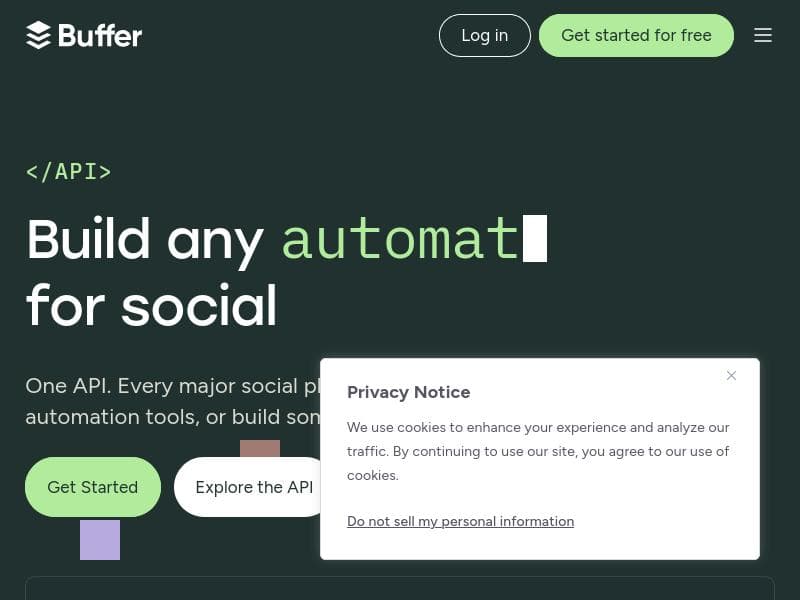
Buffer API is a versatile GraphQL interface that enables developers to automate and customize social media publishing and planning directly within their Buffer accounts. Ideal for businesses and developers seeking to integrate Buffer’s powerful scheduling features into their own tools, it offers flexible API key management, tiered rate limits, and comprehensive developer support.

Description
Buffer's API lets you publish and manage content across 11 social platforms through a single endpoint. Connect it to AI assistants, no-code automation tools, or build full custom integrations. Ships with an MCP server, pre-built automation templates, a CLI, and an interactive API explorer. Available on every Buffer plan, including Free.
Detailed Description
Buffer API is a powerful GraphQL interface designed to seamlessly connect developers' tools and workflows with their Buffer accounts, enabling automation and customization of social media management tasks. At its core, Buffer API empowers users to programmatically manage their social media publishing and planning by allowing them to create, fetch, and delete posts within queues, manage ideas in the Ideas library, and retrieve detailed information about accounts, organizations, and connected channels. This API is built to facilitate smooth integration with internal systems, dashboards, and content management systems, making social media scheduling and reporting more efficient and tailored to specific business needs. One of the standout features of Buffer API is its comprehensive support for common social media management operations. Developers can automate the creation of posts directly from their CMS or internal tools, fetch scheduled content to display within custom dashboards, and synchronize channel and organizational data into internal reporting platforms. It supports both personal API keys for individual users and app clients for broader application integrations. Rate limits are thoughtfully structured to accommodate different user plans, including Free, Essentials, and Team tiers, each offering varying numbers of API keys, app clients, and request limits over 15-minute, daily, and monthly windows. Moreover, Buffer provides extensive developer support through detailed documentation, example queries, and responsive chat and email support channels. Buffer API is best suited for social media managers, developers, and businesses looking to automate and customize their social media workflows beyond the native Buffer interface. Small businesses, marketing teams, and agencies can leverage the API to integrate Buffer’s publishing capabilities into their existing tools, streamline content scheduling, and enhance reporting accuracy. For example, a company can auto-generate social media posts from their product database or blog CMS, ensuring timely and consistent content distribution without manual intervention. Similarly, teams can pull analytics and channel data into bespoke dashboards, providing a unified view of social media performance alongside other business metrics. Regarding pricing, Buffer API access is included across all Buffer plans, including the Free tier, making it accessible to a wide range of users. The Free plan allows for one API key and one app client with a 15-minute limit of 100 requests and a monthly cap of 3,000 requests. Paid plans such as Essentials and Team increase these limits significantly, offering more API keys, app clients, and higher request thresholds to support larger teams and more intensive usage. For partners or users requiring higher limits, Buffer offers the possibility to request increased quotas by contacting their developer support team. Compared to alternative social media APIs, Buffer API stands out for its ease of use, GraphQL interface, and integration with Buffer’s well-regarded publishing and planning features. While other platforms may offer RESTful APIs with broader social network coverage, Buffer’s API focuses on delivering a streamlined, developer-friendly experience tailored to content scheduling and management. Its GraphQL approach allows for more efficient data queries and flexibility, reducing the amount of data transferred and simplifying integration complexity. However, there are some considerations to keep in mind. Currently, Buffer API’s analytics and community features are in development, so users seeking in-depth social media analytics or community engagement tools may need to supplement Buffer with additional services. Also, API key creation and management require organization owner permissions, which may limit accessibility for some team members. Rate limits, while reasonable, may require monitoring for high-volume applications, and exceeding these limits results in temporary access blocks until usage resets. Despite these minor limitations, Buffer API offers a robust, scalable solution for automating and customizing social media workflows with strong developer support and ongoing feature expansion plans.
Tool Features
- Create, fetch, and delete posts in queues
- Create ideas in the Ideas library
- Retrieve accounts, organization, and connected channels
- Automate social media publishing and planning
- Supports personal API keys and app clients
- Rate limits vary by plan with Free and paid tiers
- Developer support and documentation available
- Plans to add analytics and community features
Description
Buffer API is a versatile GraphQL interface that enables developers to automate and customize social media publishing and planning directly within their Buffer accounts. Ideal for businesses and developers seeking to integrate Buffer’s powerful scheduling features into their own tools, it offers flexible API key management, tiered rate limits, and comprehensive developer support.
Buffer's API lets you publish and manage content across 11 social platforms through a single endpoint. Connect it to AI assistants, no-code automation tools, or build full custom integrations. Ships with an MCP server, pre-built automation templates, a CLI, and an interactive API explorer. Available on every Buffer plan, including Free.
Detailed Description
Buffer API is a powerful GraphQL interface designed to seamlessly connect developers' tools and workflows with their Buffer accounts, enabling automation and customization of social media management tasks. At its core, Buffer API empowers users to programmatically manage their social media publishing and planning by allowing them to create, fetch, and delete posts within queues, manage ideas in the Ideas library, and retrieve detailed information about accounts, organizations, and connected channels. This API is built to facilitate smooth integration with internal systems, dashboards, and content management systems, making social media scheduling and reporting more efficient and tailored to specific business needs. One of the standout features of Buffer API is its comprehensive support for common social media management operations. Developers can automate the creation of posts directly from their CMS or internal tools, fetch scheduled content to display within custom dashboards, and synchronize channel and organizational data into internal reporting platforms. It supports both personal API keys for individual users and app clients for broader application integrations. Rate limits are thoughtfully structured to accommodate different user plans, including Free, Essentials, and Team tiers, each offering varying numbers of API keys, app clients, and request limits over 15-minute, daily, and monthly windows. Moreover, Buffer provides extensive developer support through detailed documentation, example queries, and responsive chat and email support channels. Buffer API is best suited for social media managers, developers, and businesses looking to automate and customize their social media workflows beyond the native Buffer interface. Small businesses, marketing teams, and agencies can leverage the API to integrate Buffer’s publishing capabilities into their existing tools, streamline content scheduling, and enhance reporting accuracy. For example, a company can auto-generate social media posts from their product database or blog CMS, ensuring timely and consistent content distribution without manual intervention. Similarly, teams can pull analytics and channel data into bespoke dashboards, providing a unified view of social media performance alongside other business metrics. Regarding pricing, Buffer API access is included across all Buffer plans, including the Free tier, making it accessible to a wide range of users. The Free plan allows for one API key and one app client with a 15-minute limit of 100 requests and a monthly cap of 3,000 requests. Paid plans such as Essentials and Team increase these limits significantly, offering more API keys, app clients, and higher request thresholds to support larger teams and more intensive usage. For partners or users requiring higher limits, Buffer offers the possibility to request increased quotas by contacting their developer support team. Compared to alternative social media APIs, Buffer API stands out for its ease of use, GraphQL interface, and integration with Buffer’s well-regarded publishing and planning features. While other platforms may offer RESTful APIs with broader social network coverage, Buffer’s API focuses on delivering a streamlined, developer-friendly experience tailored to content scheduling and management. Its GraphQL approach allows for more efficient data queries and flexibility, reducing the amount of data transferred and simplifying integration complexity. However, there are some considerations to keep in mind. Currently, Buffer API’s analytics and community features are in development, so users seeking in-depth social media analytics or community engagement tools may need to supplement Buffer with additional services. Also, API key creation and management require organization owner permissions, which may limit accessibility for some team members. Rate limits, while reasonable, may require monitoring for high-volume applications, and exceeding these limits results in temporary access blocks until usage resets. Despite these minor limitations, Buffer API offers a robust, scalable solution for automating and customizing social media workflows with strong developer support and ongoing feature expansion plans.
Frequently Asked Questions
What is Buffer API?
Buffer API is a GraphQL interface that allows developers to connect their own tools and workflows to their Buffer account. It enables automation of social media management tasks such as creating, fetching, and deleting posts, managing ideas, and retrieving account and channel information programmatically.
How much does Buffer API cost?
Access to Buffer API is included with all Buffer plans, including the Free tier. The Free plan offers 1 API key and 1 app client with specific rate limits, while paid plans like Essentials and Team provide more API keys, app clients, and higher request limits. Pricing details and upgrade options are available within Buffer’s billing settings.
Who is Buffer API best for?
Buffer API is ideal for social media managers, developers, small businesses, marketing teams, and agencies who want to automate and customize their social media workflows by integrating Buffer’s publishing and planning features into their own tools and systems.
What are the main features of Buffer API?
Key features include creating, fetching, and deleting posts in queues; managing ideas in the Ideas library; retrieving accounts, organizations, and connected channels; automating social media publishing and planning; support for personal API keys and app clients; tiered rate limits based on plans; and developer support with documentation and example queries.
Does Buffer API offer a free trial?
Yes, Buffer API access is available on the Free plan, which allows users to create one API key and one app client with limited request quotas, effectively serving as a free trial for developers to explore the API’s capabilities.
What integrations does Buffer API support?
Buffer API supports integration with custom tools, content management systems, internal dashboards, and reporting platforms by enabling programmatic access to Buffer’s publishing, planning, and account data. It supports personal API keys and app clients for flexible integration setups.
How does Buffer API work?
Buffer API works by providing a GraphQL interface through which developers can send queries and mutations to manage social media posts, ideas, accounts, and channels within their Buffer account. Users authenticate via API keys or app clients, and the API enforces rate limits based on the user’s plan.
Socials
Use ToolReviews
No reviews yet. Be the first to share your experience.
Sponsored Tools


























Recommended Tools
Stay updated on latest Ai tools
Get the latest insights, Join our newsletter
Read and trusted by 50,000+ readers
Join the biggest AI Community
Our community and staff are here to help!
Your feedback will help Alice AI improve in future versions.








Submit your Tool


PoweredByAI.app is an AI Tools Directory helping individuals, businesses, and creators discover the best AI tools for writing, coding, design, productivity, and more.
© 2026 , Product of011BQ. All rights reserved.