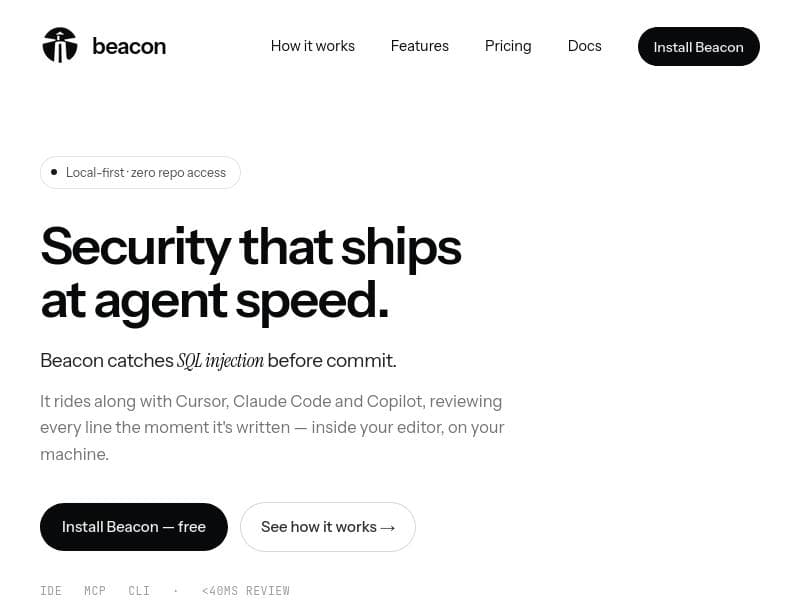


Beacon is a cutting-edge local-first security tool that integrates directly into your code editor, providing instant, inline scanning of every line of code as it’s written. Ideal for developers and security-conscious teams, it catches secrets, SQL injection, and broken authentication vulnerabilities before code commits, all without accessing your repositories.

Description
Beacon predicts open source package abandonment before it becomes your incident. Get SPS scores, tier alerts, and daily digests — so your team acts before the dependency breaks, not after.
Detailed Description
Beacon is an innovative security tool designed to integrate seamlessly with your code editor, providing real-time security reviews for every line of code as it is written. Its core purpose is to enhance developer productivity and code security by catching critical vulnerabilities and secrets before the code is committed to any repository. Unlike traditional security scanners that operate post-commit or require cloud access, Beacon runs locally on your machine, ensuring zero access to your repositories and maintaining privacy and security at the developer level. This local-first approach allows developers to receive immediate feedback on potential security issues without interrupting their workflow or exposing sensitive code externally. One of Beacon's standout features is its ability to ride alongside popular AI coding assistants such as Cursor, Claude Code, and GitHub Copilot directly inside your editor. This means that as you write code with the help of these tools, Beacon simultaneously scans each line for security flaws, including secrets like API keys, SQL injection vulnerabilities, and broken authentication mechanisms. The inline code security scanning capability ensures that developers can identify and remediate risks instantly, reducing the likelihood of introducing exploitable bugs into the codebase. Beacon’s operation is entirely local, which is a significant advantage for teams and individuals concerned about code privacy and compliance. Since it does not require access to remote repositories, it mitigates risks associated with cloud-based scanning tools and aligns well with strict organizational security policies. This makes Beacon particularly suitable for enterprises, security-conscious startups, and individual developers who want to maintain full control over their source code while still benefiting from automated security checks. The tool is ideal for software developers, DevOps engineers, and security teams who want to embed security into the development lifecycle without slowing down the coding process. Use cases include early detection of hardcoded secrets, prevention of common injection attacks, and ensuring authentication logic is robust before code reaches version control systems. By catching these issues early, Beacon helps reduce costly security incidents and compliance violations. While specific pricing details are not publicly listed on the Product Hunt page, tools like Beacon typically offer tiered plans based on usage, team size, or feature access. Interested users should visit the official website or contact the vendor directly for detailed pricing and potential free trial options. The local-first nature of Beacon may also imply a one-time purchase or subscription model that supports continuous updates and integrations. Compared to alternative security tools that scan code after commits or rely on cloud services, Beacon’s real-time, inline scanning inside the editor is a unique differentiator. Many traditional static application security testing (SAST) tools require lengthy scans and can disrupt developer flow, whereas Beacon provides immediate, contextual feedback. However, because it operates locally, it may depend on the computing resources of the developer’s machine and might not cover the full scope of enterprise-wide security policies that centralized tools enforce. Notable limitations include the potential for false positives or missed vulnerabilities if Beacon’s scanning rules are not comprehensive or updated regularly. Additionally, since it integrates with specific editors and AI coding assistants, compatibility with all development environments may be limited. Users should evaluate Beacon alongside their existing security toolchain to ensure it complements rather than duplicates efforts. Overall, Beacon represents a forward-thinking approach to embedding security directly into the coding process, empowering developers to write safer code from the outset.
Tool Features
- Rides along with Cursor, Claude Code, and Copilot inside your editor
- Reviews every line of code the moment it’s written
- Operates locally on your machine with zero repo access
- Catches secrets, SQL injection, and broken authentication before commit
- Inline code security scanning
Description
Beacon is a cutting-edge local-first security tool that integrates directly into your code editor, providing instant, inline scanning of every line of code as it’s written. Ideal for developers and security-conscious teams, it catches secrets, SQL injection, and broken authentication vulnerabilities before code commits, all without accessing your repositories.
Beacon predicts open source package abandonment before it becomes your incident. Get SPS scores, tier alerts, and daily digests — so your team acts before the dependency breaks, not after.
Detailed Description
Beacon is an innovative security tool designed to integrate seamlessly with your code editor, providing real-time security reviews for every line of code as it is written. Its core purpose is to enhance developer productivity and code security by catching critical vulnerabilities and secrets before the code is committed to any repository. Unlike traditional security scanners that operate post-commit or require cloud access, Beacon runs locally on your machine, ensuring zero access to your repositories and maintaining privacy and security at the developer level. This local-first approach allows developers to receive immediate feedback on potential security issues without interrupting their workflow or exposing sensitive code externally. One of Beacon's standout features is its ability to ride alongside popular AI coding assistants such as Cursor, Claude Code, and GitHub Copilot directly inside your editor. This means that as you write code with the help of these tools, Beacon simultaneously scans each line for security flaws, including secrets like API keys, SQL injection vulnerabilities, and broken authentication mechanisms. The inline code security scanning capability ensures that developers can identify and remediate risks instantly, reducing the likelihood of introducing exploitable bugs into the codebase. Beacon’s operation is entirely local, which is a significant advantage for teams and individuals concerned about code privacy and compliance. Since it does not require access to remote repositories, it mitigates risks associated with cloud-based scanning tools and aligns well with strict organizational security policies. This makes Beacon particularly suitable for enterprises, security-conscious startups, and individual developers who want to maintain full control over their source code while still benefiting from automated security checks. The tool is ideal for software developers, DevOps engineers, and security teams who want to embed security into the development lifecycle without slowing down the coding process. Use cases include early detection of hardcoded secrets, prevention of common injection attacks, and ensuring authentication logic is robust before code reaches version control systems. By catching these issues early, Beacon helps reduce costly security incidents and compliance violations. While specific pricing details are not publicly listed on the Product Hunt page, tools like Beacon typically offer tiered plans based on usage, team size, or feature access. Interested users should visit the official website or contact the vendor directly for detailed pricing and potential free trial options. The local-first nature of Beacon may also imply a one-time purchase or subscription model that supports continuous updates and integrations. Compared to alternative security tools that scan code after commits or rely on cloud services, Beacon’s real-time, inline scanning inside the editor is a unique differentiator. Many traditional static application security testing (SAST) tools require lengthy scans and can disrupt developer flow, whereas Beacon provides immediate, contextual feedback. However, because it operates locally, it may depend on the computing resources of the developer’s machine and might not cover the full scope of enterprise-wide security policies that centralized tools enforce. Notable limitations include the potential for false positives or missed vulnerabilities if Beacon’s scanning rules are not comprehensive or updated regularly. Additionally, since it integrates with specific editors and AI coding assistants, compatibility with all development environments may be limited. Users should evaluate Beacon alongside their existing security toolchain to ensure it complements rather than duplicates efforts. Overall, Beacon represents a forward-thinking approach to embedding security directly into the coding process, empowering developers to write safer code from the outset.
Frequently Asked Questions
What is Beacon?
Beacon is a security tool that integrates with your code editor to review and scan every line of code in real-time as you write it. It operates locally on your machine without accessing your repositories, helping to catch security issues like secrets, SQL injection, and broken authentication before code commits.
How much does Beacon cost?
Pricing details for Beacon are not explicitly listed on the Product Hunt page. Interested users should visit the official website or contact the vendor directly for information on pricing plans, subscriptions, or any available free trials.
Who is Beacon best for?
Beacon is best suited for software developers, DevOps engineers, and security teams who want to embed security checks directly into their development workflow. It is particularly valuable for those who prioritize code privacy and want to catch vulnerabilities early without exposing code to external services.
What are the main features of Beacon?
Beacon’s main features include real-time inline code security scanning, local operation with zero repository access, integration with AI coding assistants like Cursor, Claude Code, and Copilot, and the ability to detect secrets, SQL injection vulnerabilities, and broken authentication issues before code commits.
Does Beacon offer a free trial?
The availability of a free trial for Beacon is not specified in the provided information. Prospective users should check the official website or contact the Beacon team to inquire about trial options.
What integrations does Beacon support?
Beacon integrates directly with popular AI coding assistants such as Cursor, Claude Code, and GitHub Copilot inside your code editor, enabling seamless security scanning alongside these tools.
How does Beacon work?
Beacon works by running locally on your machine and monitoring every line of code as you write it within your editor. It performs inline security scanning to detect secrets, SQL injection, and broken authentication vulnerabilities immediately, providing feedback before code is committed to any repository.
Socials
Use ToolReviews
No reviews yet. Be the first to share your experience.