🚀 Zaprep: Your Socials on Steroids. Start free — automate 1,000 DMs/month & turn engagement into leads. with 1,000 automated DMs/month.


Is this your AI tool? Claim it today.
Verify ownership, manage your profile, and unlock growth features.
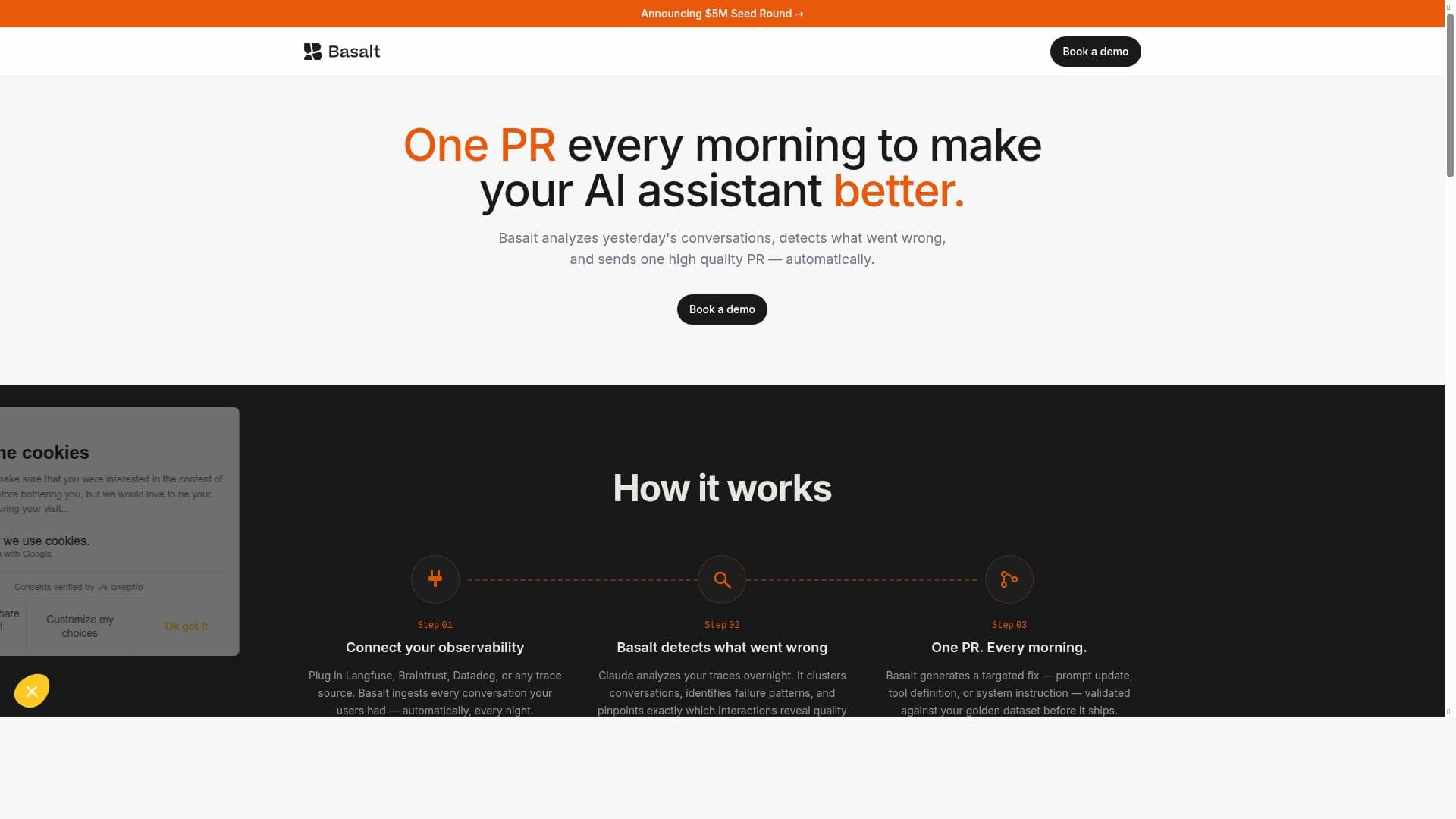
Basalt is a unified platform that streamlines the creation, deployment, and continuous improvement of AI features, powered by an AI-assisted prompt engineer and real-time monitoring tools. Ideal for teams building customer support chatbots and self-improving agents, Basalt enables seamless collaboration and adaptive AI performance in production environments.

Description
Basalt is the platform to build and operate AI features : Craft high-quality prompts with our AI-powered Copilot, test and evaluate LLM outputs, deploy seamlessly with our SDK, monitor and refine performance in real conditions—all in a collaborative workflow.
Detailed Description
Basalt is a comprehensive platform designed to empower developers and businesses in building, deploying, and managing AI-driven features with ease and efficiency. At its core, Basalt focuses on streamlining the entire lifecycle of AI feature development—from crafting high-quality prompts to monitoring and refining AI performance in real-world scenarios. This platform is particularly tailored for teams working with large language models (LLMs), offering an AI-powered Copilot that assists in prompt engineering, ensuring that the AI outputs are precise, relevant, and aligned with user needs. By integrating testing and evaluation tools, Basalt enables users to rigorously assess LLM responses before deployment, reducing errors and improving overall quality. The seamless deployment process is facilitated through Basalt's SDK, which simplifies integration into existing applications and workflows. Additionally, Basalt supports continuous monitoring and performance refinement, allowing teams to adapt their AI features based on real-time data and user interactions within a collaborative environment that promotes transparency and teamwork. Key features of Basalt include the ability to capture customer behavior effectively, which provides valuable insights into user interactions and preferences. This data is crucial for tailoring AI responses and improving user satisfaction. Another standout capability is enabling agents to learn and improve from their interactions, fostering self-improving AI systems that evolve over time without requiring constant manual intervention. Basalt also offers infrastructure support for creating self-improving agents, making it an ideal choice for organizations aiming to deploy intelligent, adaptive AI solutions that can autonomously enhance their performance. The collaborative workflow embedded in Basalt ensures that multiple stakeholders, including developers, data scientists, and product managers, can work together seamlessly to iterate and optimize AI features. Basalt is best suited for companies and development teams focused on customer support automation, chatbot development, and AI assistant creation. Its robust features cater to those who require not just deployment capabilities but also ongoing evaluation and refinement of AI models in production environments. Use cases include enhancing customer service chatbots with dynamic, context-aware responses, building intelligent agents that improve through user interactions, and deploying AI features that require continuous tuning based on real-world feedback. Startups, mid-sized companies, and enterprises looking to leverage AI to improve customer engagement and operational efficiency will find Basalt particularly valuable. Regarding pricing, Basalt offers a freemium model, allowing users to access essential features at no cost, which is ideal for small teams or those just beginning to experiment with AI features. For more advanced capabilities, higher usage limits, and premium support, Basalt likely provides paid plans, although specific pricing tiers and details would be available on their website. This flexible pricing approach makes Basalt accessible to a wide range of users, from individual developers to large organizations. Compared to alternatives, Basalt stands out due to its end-to-end platform approach that combines prompt engineering, testing, deployment, and monitoring within a single collaborative environment. Many competing tools focus on isolated aspects such as prompt crafting or deployment but lack integrated workflows that facilitate continuous improvement. Basalt's emphasis on self-improving agents and capturing customer behavior also provides a competitive edge for teams looking to build adaptive AI systems rather than static models. However, potential users should consider that as a relatively specialized platform, Basalt may require some initial learning curve to fully leverage its collaborative and monitoring features. Additionally, while the freemium model is attractive, organizations with complex AI needs might find the need to upgrade to paid plans to unlock the full potential of the platform. Integration capabilities and support for various LLM providers should also be verified to ensure compatibility with existing tech stacks. In summary, Basalt is a powerful, all-in-one platform for building, operating, and continuously improving AI features, making it an excellent choice for teams aiming to deploy intelligent, adaptive AI solutions in customer-facing applications.
Tool Features
- Capture customer behavior
- Enable agents to improve from interactions
- Create infrastructure for self-improving agents
Description
Basalt is a unified platform that streamlines the creation, deployment, and continuous improvement of AI features, powered by an AI-assisted prompt engineer and real-time monitoring tools. Ideal for teams building customer support chatbots and self-improving agents, Basalt enables seamless collaboration and adaptive AI performance in production environments.
Basalt is the platform to build and operate AI features : Craft high-quality prompts with our AI-powered Copilot, test and evaluate LLM outputs, deploy seamlessly with our SDK, monitor and refine performance in real conditions—all in a collaborative workflow.
Detailed Description
Basalt is a comprehensive platform designed to empower developers and businesses in building, deploying, and managing AI-driven features with ease and efficiency. At its core, Basalt focuses on streamlining the entire lifecycle of AI feature development—from crafting high-quality prompts to monitoring and refining AI performance in real-world scenarios. This platform is particularly tailored for teams working with large language models (LLMs), offering an AI-powered Copilot that assists in prompt engineering, ensuring that the AI outputs are precise, relevant, and aligned with user needs. By integrating testing and evaluation tools, Basalt enables users to rigorously assess LLM responses before deployment, reducing errors and improving overall quality. The seamless deployment process is facilitated through Basalt's SDK, which simplifies integration into existing applications and workflows. Additionally, Basalt supports continuous monitoring and performance refinement, allowing teams to adapt their AI features based on real-time data and user interactions within a collaborative environment that promotes transparency and teamwork. Key features of Basalt include the ability to capture customer behavior effectively, which provides valuable insights into user interactions and preferences. This data is crucial for tailoring AI responses and improving user satisfaction. Another standout capability is enabling agents to learn and improve from their interactions, fostering self-improving AI systems that evolve over time without requiring constant manual intervention. Basalt also offers infrastructure support for creating self-improving agents, making it an ideal choice for organizations aiming to deploy intelligent, adaptive AI solutions that can autonomously enhance their performance. The collaborative workflow embedded in Basalt ensures that multiple stakeholders, including developers, data scientists, and product managers, can work together seamlessly to iterate and optimize AI features. Basalt is best suited for companies and development teams focused on customer support automation, chatbot development, and AI assistant creation. Its robust features cater to those who require not just deployment capabilities but also ongoing evaluation and refinement of AI models in production environments. Use cases include enhancing customer service chatbots with dynamic, context-aware responses, building intelligent agents that improve through user interactions, and deploying AI features that require continuous tuning based on real-world feedback. Startups, mid-sized companies, and enterprises looking to leverage AI to improve customer engagement and operational efficiency will find Basalt particularly valuable. Regarding pricing, Basalt offers a freemium model, allowing users to access essential features at no cost, which is ideal for small teams or those just beginning to experiment with AI features. For more advanced capabilities, higher usage limits, and premium support, Basalt likely provides paid plans, although specific pricing tiers and details would be available on their website. This flexible pricing approach makes Basalt accessible to a wide range of users, from individual developers to large organizations. Compared to alternatives, Basalt stands out due to its end-to-end platform approach that combines prompt engineering, testing, deployment, and monitoring within a single collaborative environment. Many competing tools focus on isolated aspects such as prompt crafting or deployment but lack integrated workflows that facilitate continuous improvement. Basalt's emphasis on self-improving agents and capturing customer behavior also provides a competitive edge for teams looking to build adaptive AI systems rather than static models. However, potential users should consider that as a relatively specialized platform, Basalt may require some initial learning curve to fully leverage its collaborative and monitoring features. Additionally, while the freemium model is attractive, organizations with complex AI needs might find the need to upgrade to paid plans to unlock the full potential of the platform. Integration capabilities and support for various LLM providers should also be verified to ensure compatibility with existing tech stacks. In summary, Basalt is a powerful, all-in-one platform for building, operating, and continuously improving AI features, making it an excellent choice for teams aiming to deploy intelligent, adaptive AI solutions in customer-facing applications.
Frequently Asked Questions
What is Basalt?
Basalt is a platform designed to help developers and businesses build, deploy, and manage AI features efficiently. It offers tools for crafting high-quality prompts, testing large language model outputs, seamless deployment via SDK, and monitoring AI performance in real-world conditions, all within a collaborative workflow.
How much does Basalt cost?
Basalt operates on a freemium pricing model, providing free access to essential features suitable for small teams or experimentation. For advanced features, higher usage limits, and premium support, paid plans are available. Detailed pricing information can be found on Basalt's official website.
Who is Basalt best for?
Basalt is ideal for development teams and companies focused on building AI-powered customer support solutions, chatbots, and AI assistants. It suits organizations that need not only deployment tools but also capabilities for ongoing evaluation, refinement, and creation of self-improving AI agents.
What are the main features of Basalt?
Key features include an AI-powered Copilot for prompt engineering, tools to test and evaluate large language model outputs, seamless deployment with an SDK, real-time monitoring and performance refinement, capturing customer behavior insights, enabling agents to learn from interactions, and infrastructure support for self-improving agents.
Does Basalt offer a free trial?
Basalt offers a freemium plan that allows users to access core features at no cost, effectively serving as a free trial for individuals and small teams to explore the platform before committing to paid plans.
What integrations does Basalt support?
While specific integrations are not detailed here, Basalt provides an SDK for seamless deployment, suggesting compatibility with various development environments and AI models. Users should consult Basalt's documentation or website for a comprehensive list of supported integrations.
How does Basalt work?
Basalt works by guiding users through the AI feature lifecycle: it helps craft effective prompts using an AI-powered Copilot, tests and evaluates outputs from large language models, deploys AI features through its SDK, and continuously monitors performance in production. It also captures customer behavior data and enables AI agents to improve autonomously within a collaborative workflow.
Reviews
No reviews yet. Be the first to share your experience.
Sponsored Tools

























Recommended Tools
Stay updated on latest Ai tools
Get the latest insights, Join our newsletter
Read and trusted by 50,000+ readers
Join the biggest AI Community
Our community and staff are here to help!
Your feedback will help Alice AI improve in future versions.








Submit your Tool

PoweredByAI.app is an AI Tools Directory helping individuals, businesses, and creators discover the best AI tools for writing, coding, design, productivity, and more.
© 2026 , Product of011BQ. All rights reserved.