Autonomous Product Delivery


Is this your AI tool? Claim it today.
Verify ownership, manage your profile, and unlock growth features.
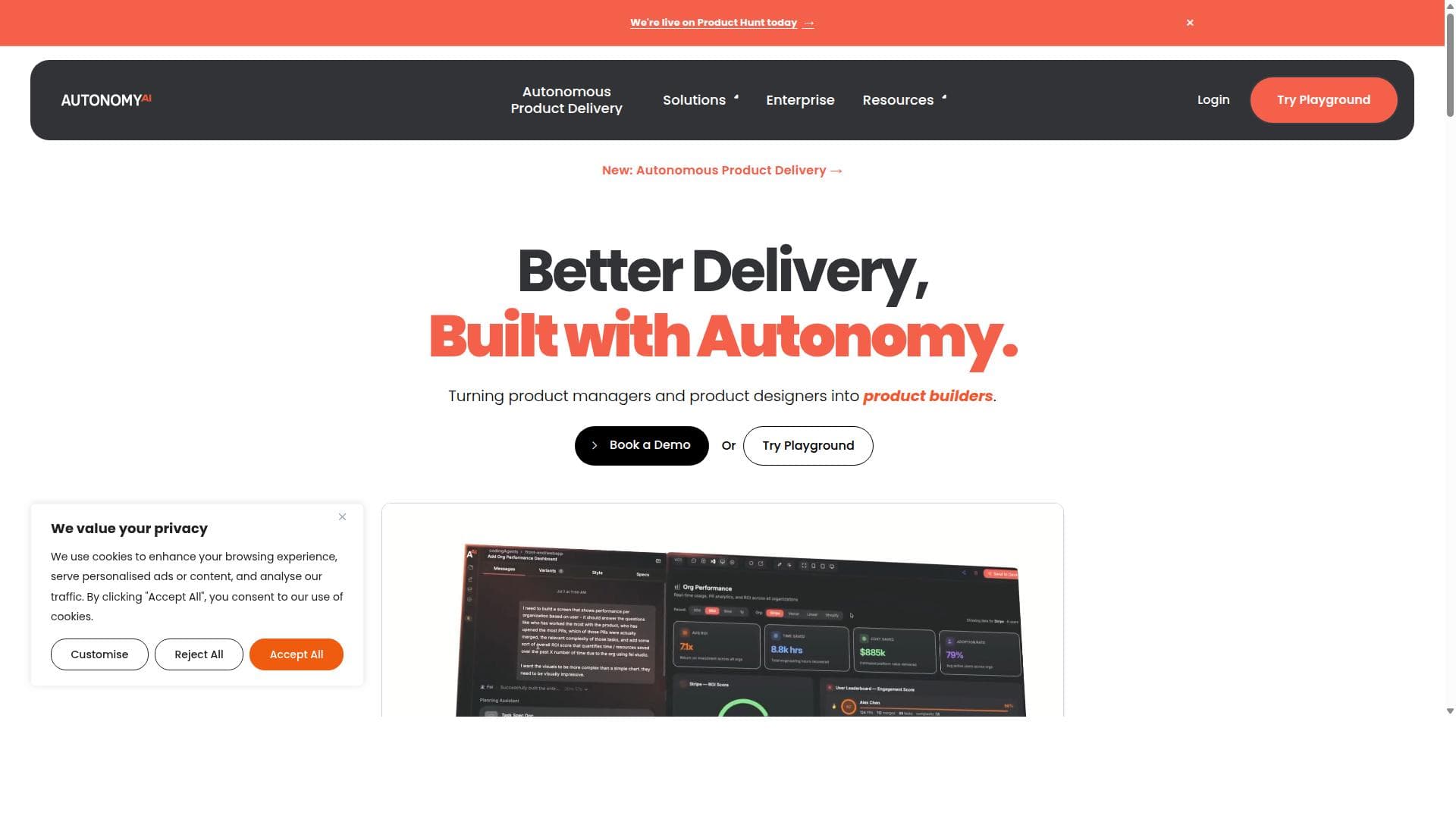
AutonomyAI revolutionizes product development by giving product managers and designers direct access to production environments, eliminating traditional handoffs and enabling faster feature delivery. It’s ideal for teams seeking to enhance collaboration and accelerate shipping while allowing engineers to focus on complex development tasks.

Description
AI coding agents made code fast; delivery still crawls, because coding is one seat in the product cycle. Autonomous Product Delivery runs the whole loop as one system on your real codebase. Ask a question, or let it suggest the next improvement on its own: The final piece in the loop, the new Discover Mode, researches your analytics, tickets, calls, and code, then the system plans, builds, verifies, and hands your engineers a review-ready PR. Every merge makes it smarter.
Detailed Description
AutonomyAI is an innovative operating system designed specifically to streamline the product development lifecycle by enabling product managers (PMs) and designers to ship features directly into the production codebase without the traditional handoff process. Its core purpose is to bridge the gap between design, product, and engineering teams, allowing them to collaborate more effectively in a shared, production-safe environment. By doing so, AutonomyAI empowers non-engineering teams to have direct access to production environments, accelerating feature delivery and reducing bottlenecks typically caused by sequential workflows. At its heart, AutonomyAI eliminates the conventional handoff between teams, which often leads to delays, miscommunication, and duplicated efforts. Instead, it creates a unified platform where PMs and designers can contribute directly to production-ready features, while engineers can focus on complex development tasks that require their specialized skills. This division of labor not only improves efficiency but also enhances product quality by enabling faster iterations and more immediate feedback loops. Key features of AutonomyAI include granting PMs and designers direct access to production environments, which is traditionally restricted to engineering teams. This access is carefully managed to ensure production safety, allowing teams to ship features with confidence. The platform supports shipping features directly into the production codebase, bypassing the need for multiple handoffs and reducing the risk of errors or misaligned implementations. Additionally, AutonomyAI fosters a shared environment where engineering, design, and product teams can collaborate seamlessly, ensuring that everyone is aligned and working towards the same goals. AutonomyAI is best suited for organizations that prioritize rapid product development and cross-functional collaboration. Product teams in startups, scale-ups, and enterprises that want to accelerate their release cycles without compromising on quality will find this tool particularly valuable. It is ideal for companies where PMs and designers have the technical proficiency to engage with production environments or where such empowerment is a strategic goal. Use cases include shipping new features faster, reducing engineering workload on routine tasks, and improving transparency and communication across teams. Regarding pricing, AutonomyAI’s website does not publicly disclose detailed pricing plans, which suggests that pricing may be customized based on the size of the organization, number of users, or specific feature requirements. Interested users should contact AutonomyAI directly through their website for tailored pricing information and potential enterprise agreements. When compared to traditional product development workflows and alternative tools, AutonomyAI stands out by fundamentally changing the way teams interact with production codebases. Unlike conventional project management or design handoff tools that merely facilitate communication, AutonomyAI provides direct production access to non-engineering teams in a controlled manner. This reduces delays and improves agility. However, compared to some low-code or no-code platforms, AutonomyAI is more focused on integrating with existing engineering workflows rather than replacing coding entirely. Notable limitations or considerations include the need for organizations to have a certain level of maturity and trust in their teams, as granting production access to PMs and designers requires robust safeguards and governance. Additionally, teams must be comfortable adopting a new workflow that blends roles traditionally kept separate. Organizations with strict compliance or security requirements may need to evaluate how AutonomyAI’s shared production environment aligns with their policies. Finally, the lack of publicly available pricing and integration details means prospective users should engage directly with the vendor to assess fit. In summary, AutonomyAI offers a transformative approach to product development by enabling direct production access for PMs and designers, reducing handoffs, and allowing engineers to focus on complex tasks. Its shared, production-safe environment fosters collaboration and accelerates feature delivery, making it a compelling choice for forward-thinking product teams aiming to innovate faster and more efficiently.
Tool Features
- Gives PMs and designers direct access to production
- Eliminates the handoff between teams
- Allows engineers to focus on complex development
- Supports shipping features directly into production codebase
- Creates a shared, production-safe environment for engineering, design, and product teams
Description
AutonomyAI revolutionizes product development by giving product managers and designers direct access to production environments, eliminating traditional handoffs and enabling faster feature delivery. It’s ideal for teams seeking to enhance collaboration and accelerate shipping while allowing engineers to focus on complex development tasks.
AI coding agents made code fast; delivery still crawls, because coding is one seat in the product cycle. Autonomous Product Delivery runs the whole loop as one system on your real codebase. Ask a question, or let it suggest the next improvement on its own: The final piece in the loop, the new Discover Mode, researches your analytics, tickets, calls, and code, then the system plans, builds, verifies, and hands your engineers a review-ready PR. Every merge makes it smarter.
Detailed Description
AutonomyAI is an innovative operating system designed specifically to streamline the product development lifecycle by enabling product managers (PMs) and designers to ship features directly into the production codebase without the traditional handoff process. Its core purpose is to bridge the gap between design, product, and engineering teams, allowing them to collaborate more effectively in a shared, production-safe environment. By doing so, AutonomyAI empowers non-engineering teams to have direct access to production environments, accelerating feature delivery and reducing bottlenecks typically caused by sequential workflows. At its heart, AutonomyAI eliminates the conventional handoff between teams, which often leads to delays, miscommunication, and duplicated efforts. Instead, it creates a unified platform where PMs and designers can contribute directly to production-ready features, while engineers can focus on complex development tasks that require their specialized skills. This division of labor not only improves efficiency but also enhances product quality by enabling faster iterations and more immediate feedback loops. Key features of AutonomyAI include granting PMs and designers direct access to production environments, which is traditionally restricted to engineering teams. This access is carefully managed to ensure production safety, allowing teams to ship features with confidence. The platform supports shipping features directly into the production codebase, bypassing the need for multiple handoffs and reducing the risk of errors or misaligned implementations. Additionally, AutonomyAI fosters a shared environment where engineering, design, and product teams can collaborate seamlessly, ensuring that everyone is aligned and working towards the same goals. AutonomyAI is best suited for organizations that prioritize rapid product development and cross-functional collaboration. Product teams in startups, scale-ups, and enterprises that want to accelerate their release cycles without compromising on quality will find this tool particularly valuable. It is ideal for companies where PMs and designers have the technical proficiency to engage with production environments or where such empowerment is a strategic goal. Use cases include shipping new features faster, reducing engineering workload on routine tasks, and improving transparency and communication across teams. Regarding pricing, AutonomyAI’s website does not publicly disclose detailed pricing plans, which suggests that pricing may be customized based on the size of the organization, number of users, or specific feature requirements. Interested users should contact AutonomyAI directly through their website for tailored pricing information and potential enterprise agreements. When compared to traditional product development workflows and alternative tools, AutonomyAI stands out by fundamentally changing the way teams interact with production codebases. Unlike conventional project management or design handoff tools that merely facilitate communication, AutonomyAI provides direct production access to non-engineering teams in a controlled manner. This reduces delays and improves agility. However, compared to some low-code or no-code platforms, AutonomyAI is more focused on integrating with existing engineering workflows rather than replacing coding entirely. Notable limitations or considerations include the need for organizations to have a certain level of maturity and trust in their teams, as granting production access to PMs and designers requires robust safeguards and governance. Additionally, teams must be comfortable adopting a new workflow that blends roles traditionally kept separate. Organizations with strict compliance or security requirements may need to evaluate how AutonomyAI’s shared production environment aligns with their policies. Finally, the lack of publicly available pricing and integration details means prospective users should engage directly with the vendor to assess fit. In summary, AutonomyAI offers a transformative approach to product development by enabling direct production access for PMs and designers, reducing handoffs, and allowing engineers to focus on complex tasks. Its shared, production-safe environment fosters collaboration and accelerates feature delivery, making it a compelling choice for forward-thinking product teams aiming to innovate faster and more efficiently.
Frequently Asked Questions
What is AutonomyAI?
AutonomyAI is an operating system designed to enable product managers and designers to ship features directly into production codebases without the traditional handoff process, fostering seamless collaboration between product, design, and engineering teams.
How much does AutonomyAI cost?
AutonomyAI does not publicly disclose detailed pricing plans on its website. Pricing is likely customized based on organizational needs, so interested users should contact AutonomyAI directly for a tailored quote.
Who is AutonomyAI best for?
AutonomyAI is best suited for product teams in startups, scale-ups, and enterprises that want to accelerate feature delivery by empowering PMs and designers with direct production access, while allowing engineers to focus on complex development tasks.
What are the main features of AutonomyAI?
Key features include granting PMs and designers direct access to production environments, eliminating handoffs between teams, enabling shipping features directly into the production codebase, and creating a shared, production-safe environment for engineering, design, and product teams.
Does AutonomyAI offer a free trial?
There is no publicly available information about a free trial on AutonomyAI’s website. Prospective users should contact the company directly to inquire about trial options or demos.
What integrations does AutonomyAI support?
Specific integrations are not detailed publicly. Given its focus on production codebases, AutonomyAI likely integrates with common development and deployment tools, but users should consult the vendor for precise integration capabilities.
How does AutonomyAI work?
AutonomyAI works by providing product managers and designers with controlled, direct access to production environments, allowing them to ship features directly into the production codebase. This eliminates traditional handoffs and enables engineers to concentrate on complex development, all within a shared, production-safe platform.
Socials
Use ToolReviews
No reviews yet. Be the first to share your experience.